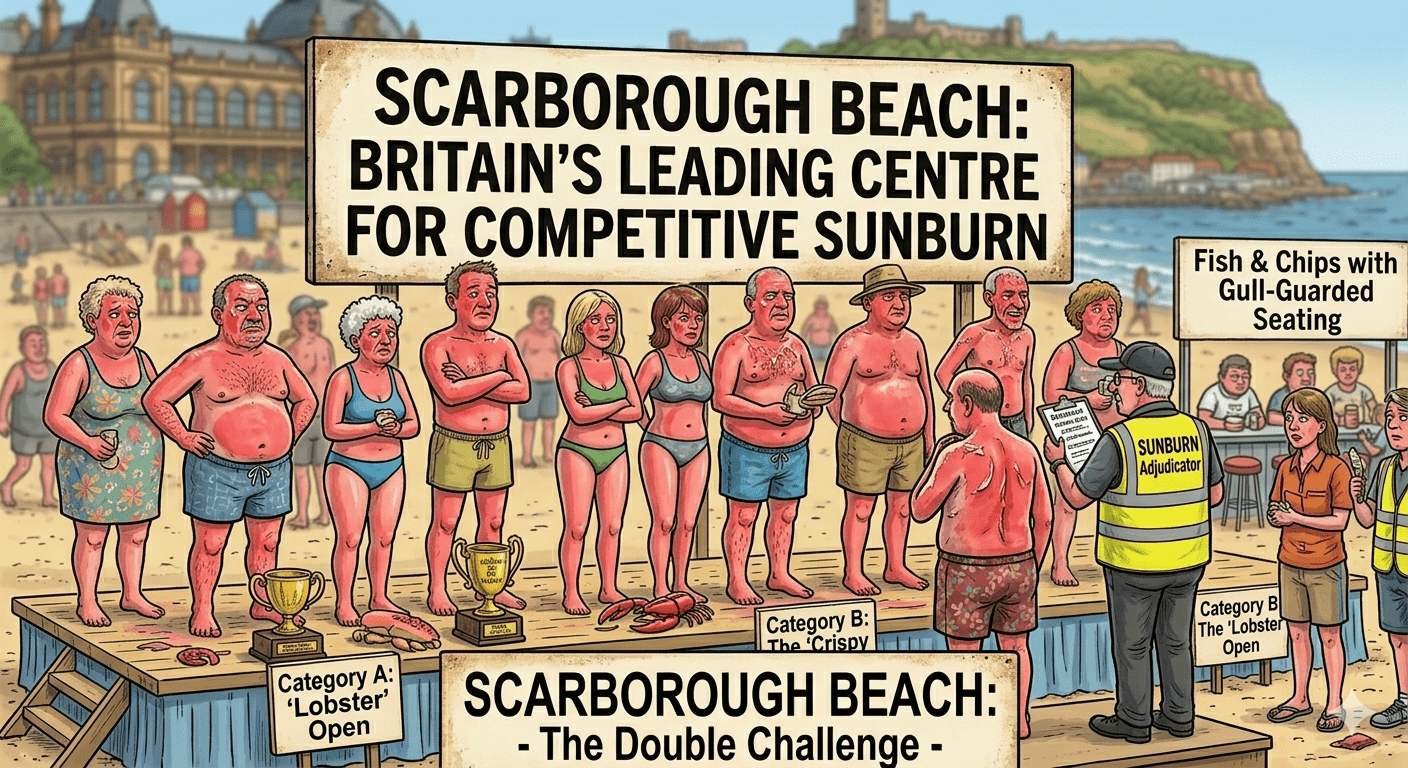
Scarborough Beach Declared Britain’s Leading Centre For Competitive Sunburn And Advanced Seagull Negotiation
North Yorkshire’s Favourite Seaside Resort Continues Its 400-Year Mission To Prove Happiness Can Be Purchased In Bucket Form, Defended With A Windbreak, And Consumed With Excessive Vinegar Before A Seagull Makes An Executive Decision
By Ingrid Gustafsson
SCARBOROUGH, NORTH YORKSHIRE
Scarborough Beach has once again been voted Britain’s favourite place to simultaneously experience joy, mild hypothermia, aggressive bird encounters, and chips wrapped in enough paper to survive a small flood. The voting was conducted with characteristic northern directness and the results surprised nobody living within sixty miles of the A64.
The ancient seaside resort, perched dramatically on the Yorkshire coast like a Victorian postcard someone has repeatedly laminated and brought to the beach anyway, has welcomed visitors since long before “staycation” became a marketing term invented by people charging £280 a night for a caravan with suspicious carpet and a laminated instruction sheet explaining that the hot tub operates on a rota.
Scarborough’s credentials as a resort predate the invention of most things now considered essential to modern tourism. The town was receiving visitors in the seventeenth century when its spa waters were discovered to possess alleged medicinal properties. Nobody questioned this at length. It was the seventeenth century, and people also believed that tobacco cured anxiety, that bleeding patients improved outcomes, and that wearing a periwig was worth the structural investment. Scarborough played a considerably longer game and has outlasted all three.
The town itself carries history with the specific confidence of somewhere that has watched fashions arrive and depart without updating its own assessment accordingly. Bronze Age settlers established themselves on the castle headland. The Romans arrived and installed a signal station, recognising excellent high ground when they occupied it. The Vikings came in the ninth century and named the place after a warrior called Skarthi. Skarthi, if he could observe the current arrangements, would presumably be astounded to discover that his primary legacy now involves candyfloss, competitive miniature golf, and the ongoing strategic operations of several hundred herring gulls who have organised themselves into something that a serious person would describe as a supply-chain operation.
Like many British towns with the wisdom to position themselves beside something scenic, Scarborough eventually looked around and concluded that allowing thousands of families from Sheffield to eat ice cream in gale-force winds represented a perfectly sustainable economic model. It was a masterstroke of civic planning requiring no grant application, no feasibility study, and no consultant from London arriving with a framework.
The Meteorological Covenant And Its Associated Clauses
Every summer, pilgrims descend upon Scarborough armed with folding chairs, windbreaks, factor-50 sunscreen, and an optimism usually reserved for lottery ticket holders who have not yet checked their numbers. They come from Leeds, Bradford, Sheffield, York, and occasionally from as far as the Midlands, which locals consider the equivalent of international travel and treat with appropriate ceremony.
The British relationship with beaches deserves more serious academic investigation than it currently receives. Mediterranean tourists expect azure seas, reliable sunshine, and temperatures that sustain human life without a second layer. Britons arrive at Scarborough operating under an entirely different contractual arrangement with the climate, one negotiated over centuries and involving considerably more layers, a spare jumper in the bag that nobody admits to carrying, and a definition of “good weather” that would fail peer review in any country south of the fifty-second parallel.
“We’re hoping for temperatures above fifteen degrees,” explained one visitor from Leeds, adjusting her windbreak for the third time in eleven minutes. “If the rain holds off until half-past three, this could be our best holiday since 2017. We might even get ice cream without irony.”
Meteorologists have described Scarborough weather forecasts as “aggressively theoretical.” The BBC Weather service offers predictions for the North Yorkshire coast that are accurate to the nearest weather system, which covers a substantial geographic range. Local fishermen consult dried seaweed hung outside back doors using techniques passed through generations. The seaweed has recorded a marginally better predictive accuracy than the satellite models. The BBC has not yet acknowledged this. The seaweed has not yet invoiced anyone.
The phenomenon of the British family confidently spreading a picnic blanket while visible storm clouds build on the North Sea horizon deserves more rigorous study than it currently attracts. Several researchers have attempted structured investigation. The clouds have demonstrated a consistent tendency to accelerate specifically in response to the opening of Tupperware containers. This correlation has been documented across multiple field sites. No mechanism has been proposed that satisfies peer review, and two of the study participants lost their lunch to subjects during the observation period, which introduced methodological complications.
The North Sea itself requires honest contextualisation for any visitor arriving with international comparisons in mind. It is not, by the standards that govern most bathing seas in countries with functioning tourist boards, a welcoming body of water. Its temperature operates in a range that physiotherapists describe as “contraindicated for extended immersion” and that Yorkshire people describe as “refreshing,” demonstrating either a remarkable hereditary cold tolerance or a philosophical disagreement about the meaning of individual words.
Children nonetheless charge enthusiastically into the surf at speeds suggesting complete indifference to temperature data. Scientists remain baffled and continue to apply for funding. Adults stand ankle-deep in water of approximately the same temperature as refrigerated milk, making sharp involuntary sounds, and then producing the phrase that has become simultaneously Scarborough’s most recognisable tourism slogan and a compressed summary of several centuries of British emotional development:
“It’s not that bad once you’re numb.”
Physiotherapists have been professionally advised not to comment. They have largely complied, though their expressions in the presence of beach photographs convey an opinion that more than substitutes for words.
The Seagull Question: A Comprehensive Field Study In Organised Coastal Operations
The seagulls of Scarborough represent a subject that this publication approaches with the gravity it plainly deserves and that most ornithological literature has catastrophically undersold in its commitment to scientific neutrality.
Biologists classify the herring gull as Larus argentatus: a coastal seabird of the family Laridae, distributed across the North Atlantic littoral zone, with a wingspan of approximately one and a half metres and a diet described as opportunistic. Scarborough residents classify the same animal as organised crime operating under inadequate regulatory oversight and possessing better situational awareness than most business intelligence departments currently operational in the financial sector.
These are not ordinary birds. The seagulls of the Yorkshire coast have been refining their operational methodology across generations with a consistency of purpose that most human institutions would find genuinely instructive. There is documented archaeological evidence of food theft at Scarborough coastal sites dating to pre-industrial periods. It is not entirely impossible that the same family lines are involved, operating under continuous institutional knowledge transfer that HR departments in the private sector would pay considerable sums to replicate.
Field observation along the Scarborough seafront has identified several operationally distinct types, each with specific tactical responsibilities.
The Scout circles at altitude in patterns that appear casual to uninformed observers. They are not casual. The Scout is providing real-time intelligence to ground-based colleagues regarding the precise location, defensive posture, distraction level, and estimated caloric content of every unguarded portion of chips within a three-hundred-metre radius. The Scout is the reason you look up and find the sky suddenly populated with birds that were not present three minutes earlier. A logistics operation has been activated. You have been assessed.
The Diversionary Operator specialises in misdirection with a technical proficiency that management consultants have paid substantial day-rate fees to attempt to teach in workshop environments. It creates a conspicuous incident near one member of a family group, typically the loudest, while a colleague approaches the unguarded food from the opposite direction with the calibrated calm of someone who has completed this manoeuvre many times and found it reliable.
The Patient Investor simply waits. It stands at a distance that registers as non-threatening to most human observers, and it monitors. It has identified from extensive operational experience that children stop paying attention to their food within approximately ninety seconds of receiving any new stimulus, that adults become absorbed in conversations within two minutes of sitting down, and that the critical window is both predictable and ample. It can wait considerably longer than any child has ever maintained focus on a paper bag of chips. It has done the research.
And then there is the Veteran. Identifiable by its absolute refusal to hurry and its complete absence of visible concern, the Veteran has refined its approach to a standard that transcends technique and approaches something closer to art. It walks directly toward unguarded food with the unhurried confidence of someone who has a reservation and is not early. It takes what it has decided is appropriate. It departs. There are persistent local rumours that one particularly distinguished individual now manages a small letting agency in the town centre with very competitive rates and a viewings clause that experienced locals find immediately familiar. This has not been formally confirmed. It has also not been denied.
Visitors receive extensive published guidance. Hold chips close to the body. Maintain peripheral awareness of birds within range. Avoid sudden movements that broadcast alarm. Never underestimate an animal that has been observed opening wheelie bin lids using a technique that at least two structural engineers found worth examining on its own terms.
One eyewitness, a retired headteacher from Barnsley with thirty-one years of managing complex institutional environments, provided the following account at the request of this reporter:
“It took my sausage roll without breaking stride. Maintained eye contact with the horizon throughout. Did not acknowledge me at any point in the transaction. Frankly, I’ve delivered senior staff appraisals with less composure. I respected the professionalism far more than I can easily explain to a third party.”
The Royal National Lifeboat Institution, which has extensive operational experience managing unpredictable and genuinely dangerous conditions at sea, has so far declined to extend its mission to chip-defence services along the Scarborough seafront, citing resource constraints and the difficulty of maintaining volunteer morale on an open-ended deployment against an adversary with no chain of command and no susceptibility to formal complaint procedures. The gap in the market remains available for any entrepreneur prepared to wear high-visibility clothing and maintain unbroken concentration through a lunchtime shift in August.
Fish, Chips, And The Yorkshire Standard Of Excellence
Scarborough fish and chips occupy a position in the local hierarchy somewhere between civic institution and low-level religious practice, and the town administers both functions with equivalent seriousness and no interest whatsoever in outside opinion.
Nutritionists continue their patient campaign against the sustained consumption of deep-fried meals in quantities that technically require structural reinforcement of the paper wrapping before the contents can be safely transported from counter to bench. Nutritionists have clearly never attempted to eat kale during a force-eight coastal breeze. Kale goes everywhere. It sticks to things. It contributes nothing to morale. A correctly wrapped portion of Scarborough chips, by contrast, maintains structural integrity through conditions that would give a civil engineer professional pause and arrives at its destination with the composed authority of something that knew what it was doing the entire time.
The chips themselves achieve their particular quality through a process that locals describe with the specific vagueness of people who know the answer and are under no obligation to share it. The potatoes originate somewhere appropriately Yorkshire. The oil is maintained at temperatures the proprietor describes only as “right” and will not elaborate upon. The vinegar is applied with a generosity that would concern a rationing committee operating under any previous century’s resource constraints. The salt follows accordingly. The final ingredient, invisible but understood to be essential by every regular customer, is the ambient presence of a large seagull approximately six metres distant and visibly conducting an assessment of the situation.
Food scientists have studied the relationship between ambient coastal threat levels and perceived food enjoyment. Their conclusions have been significantly delayed by the fact that three of their field study portions were acquired by subjects during the observation period itself. The research continues under modified protocols that involve a second researcher dedicated exclusively to perimeter monitoring.
The cod, battered and served correctly by any of Scarborough’s established fish and chip establishments, briefly reconciles a person simultaneously with their cholesterol count, their parking costs, and their standing assessment of whether the drive from Leeds was worth it. It is worth the drive from anywhere east of the Pennines. It is arguably worth the drive from further, a claim that local residents have been making without marketing support or social media presence for approximately three hundred years, which has proven consistently accurate.
Local chippies have traded through two world wars, multiple economic contractions, the collapse of the North Sea fishing industry as an active political matter, and the sustained ambient pressure of television programmes in which professionally trained chefs deconstruct chips into architectural components and present them in quantities requiring a magnifying glass at a cost of forty-seven pounds per portion. The chippies remain entirely unimpressed. They are still trading. The television programmes have been renewed and cancelled in roughly equal measure. The chippies have not noticed and would not change anything if they had.
The Arcade Economy And The Philosophy Of The Claw
Victorian visitors to Scarborough enjoyed elegant promenades, the measured pleasures of the spa assembly rooms, and entertainments structured around the assumption that leisure activities ought to be improving as well as enjoyable. Modern tourists enjoy explaining to their children why liberating a plastic sloth from a claw machine requires approximately the same financial investment as acquiring actual livestock from an agricultural supplier operating in the North Riding, while producing a materially inferior outcome by every measurable standard except the one involving the child’s assessment of the afternoon.
The arcade economy operates on principles that orthodox economic theory has declined to model, presumably for the protection of its own internal consistency. Money becomes tokens. Tokens become tickets. Tickets become prizes from a display case containing objects valued at somewhere between fifteen pence and the specific hope that your children have not yet developed the mathematical competence to calculate the exchange rate in real time, which they inevitably have and are performing silently while eating their ice cream.
The claw machine represents the most honest available metaphor for the relationship between effort, visible opportunity, and actual outcome in a market economy. The prize is there. The mechanism is available for inspection. The odds are transparently calibrated by someone who is not you. You insert a coin anyway. On the third or fourth attempt, the claw descends with what appears to be genuine intent and grips something soft and optimistic with a commitment that for one moment seems real. It rises to full height. It traverses to the drop position. And then it releases its cargo with the serenity of a Buddhist practitioner returning a borrowed umbrella. The prize falls back. The claw resets. A small child reassesses their understanding of contract law. A parent prepares to insert another coin while calculating nothing aloud.
Penny pushers attract a different demographic and operate under different forces. Retirees approach penny pushers with the concentrated intensity of naval officers planning a complex logistical operation in a theatre where the stakes are real and the timeline is not their own. They have developed systems over years of practical field research. They understand mass transfer, cascade dynamics, and the physics of the plateau-to-edge conversion. They do not share this knowledge with casual observers. Casual observers have learned not to ask after the third or fourth time the question has been met with a look that says everything necessary without words.
Eventually, after a cumulative investment that nobody totals aloud because doing so would require a conversation nobody wants to have in a public location on holiday, the accumulated tickets are exchanged for prizes. A novelty eraser. A small plastic dinosaur of no identified species with one leg slightly shorter than the others. A miniature notebook containing four and a half usable pages. Everyone agrees without prompting that it was absolutely worth it. This consensus forms instantly, requires no discussion, and is never subsequently examined.
Scarborough Castle And The Accumulated Weight Of History
Rising above the resort on its dramatic headland with the patient authority of something that has observed a very great deal of human behaviour across a very long period without being required to comment on any of it, Scarborough Castle provides historical context that no quantity of candyfloss is sufficient to undermine, though several generations of school children have made a creditable effort.
The Romans established a signal station on the headland in the fourth century, recognising excellent elevated coastal ground when they occupied it. The Normans constructed the original castle keep in the twelfth century. Henry II ordered considerable reinforcements. Richard I visited, presumably approving of the defensive advantages while finding the North Sea wind bracing even by the standards of someone who had spent extended periods in the Holy Land. During the Civil War, Parliamentary forces subjected the castle to sustained artillery bombardment across several months in a siege that caused substantial structural damage. The castle absorbed all of this with characteristic Yorkshire stoicism and has since arranged to charge admission, which represents a reasonable return on the original investment.
The views from the battlements are genuinely extraordinary. On a clear day the coastline extends toward Filey in one direction and Robin Hood’s Bay in the other. The sea catches the afternoon light in a way that makes people briefly stop whatever argument they were conducting and simply look at things, which is not something people do particularly often in the course of ordinary life and which appears to mildly surprise them when it happens. The castle has produced this effect on visitors for several hundred years. It has not required a rebrand.
The castle survived Viking invasions, medieval conflicts, Elizabethan disputes, Civil War bombardment, and centuries of coastal weather conditions that would challenge modern building standards considerably. It now faces school trips. Historians consider this an equally demanding form of wear. The gift shop, meanwhile, continues to outperform expectations across every demographic group except the one that came specifically for the archaeology.
The Donkeys, The Crabbing, And The Unwritten Codes Of British Coastal Practice
Scarborough donkeys represent one of the resort’s most enduring institutions, and the animals themselves understand this with a clarity they are professionally obliged to conceal beneath an expression of settled equanimity.
These donkeys have been transporting children along Scarborough beach for generations with a patient consistency that has outlasted several significant cultural shifts in everything around them. They have absorbed more unsolicited management advice, more enthusiastic amateur instruction, and more direct operational feedback from five-year-olds than any middle manager currently drawing a salary in either the public or private sector. They have developed appropriate emotional insulation over time. Their expressions convey the specific quality of resigned dignity that belongs exclusively to beings who understand everything clearly while being required by professional context to pretend otherwise. Retired headteachers, of whom Scarborough attracts a considerable number, find them immediately relatable and occasionally make eye contact that goes on slightly too long.
Parents photograph the occasion with the documentary commitment of people who understand that the photographs will be looked at twice and then stored in a folder that is never properly organised. Children provide running commentary on the handling experience. The donkeys maintain their established pace, which has been their answer to most things for a very long time and which has proven adequate.
Crabbing at Scarborough operates in a different register but with equally entrenched traditions. Conducted along the harbour wall and around the rock pools of the North Bay, it provides the resort’s primary contribution to competitive sport, which Scarborough has never formally acknowledged as such but which functions as one regardless. The equipment is minimal: a line, a bucket, a piece of bacon, and an optimism about your personal performance relative to the child crouching three feet away that exceeds all available historical evidence but remains completely undiminished by it.
The crabs are caught, examined, named by children using nomenclature that owes more to current television programming than to any established marine taxonomy, compared at considerable length with particular attention to size and perceived personality, and returned to the water. The crabs appear indifferent to the entire process. This is almost certainly a performance maintained for strategic reasons that the crabs have assessed to be in their long-term interest.
A grandfather teaching crabbing technique at Scarborough harbour is transmitting accumulated practical knowledge that predates the internet, performance review frameworks, social media, and most of the things invented since the middle of the previous century. It is, measured by outcomes and durability, one of the more efficient knowledge transfers currently occurring anywhere in Britain. The child will remember it with precision thirty years from now when they are teaching their own child. The grandfather understands this. The crab has no recorded opinion and appears to prefer it that way.
The Cliff Lift And The Quietly Revolutionary Proposition That Things Can Work
The Scarborough South Cliff Tramway, operating since 1875, transports passengers between the seafront and the clifftop with an efficiency and reliability that modern travellers process in stages, the way a person reads an unexpected document containing only good news.
People who have recently navigated cancelled trains, automated telephone systems with six menu layers terminating in a message explaining that the office is now closed, and transport infrastructure that has adopted punctuality as an aspiration rather than an engineering commitment, frequently react to the Scarborough cliff lift with something approaching genuine reverence. It works. It was built to work. It has worked for approximately a hundred and fifty years without being subject to a strategic review, a rebrand, or a stakeholder consultation process that adds eighteen months to the timeline. You get in at the bottom and arrive at the top. You get in at the top and arrive at the bottom. The mechanism does not have an app. It requires no account creation. There is no waitlist.
“It works,” reported one visitor from London, sincerely, as if describing something he had heard about but not previously expected to encounter in practice. “You just get in and arrive somewhere else. Without incident.”
The engineer who designed the system in 1875 did not anticipate that its primary cultural contribution in the twenty-first century would be demonstrating by contrast that it is possible to build a piece of infrastructure intended to function reliably over a long period and then for it to do so. He built it to work. This has become remarkable. Visit Scarborough lists it as a heritage attraction, which is accurate and simultaneously a backhanded compliment of extraordinary range that nobody in the heritage industry appears to have noticed.
The Literary And Cultural Footnotes That Scarborough Carries Without Advertising
Scarborough carries cultural weight that its reputation for chips and amusements tends to obscure, and the town has never been particularly interested in correcting this impression or seeking the attention that correcting it would bring.
Anne Brontë died here in May 1849 and is buried in the churchyard of St Mary’s on the castle headland, with the bay visible below from the churchyard wall. She came to Scarborough because she loved it, having first visited as a governess with the Robinson family at their house on the South Cliff. She knew the view from the castle walk, the sound of the North Sea at night, the particular quality of light on this stretch of coast during clear spring weather. She found it worth returning to when she understood she was dying, and she found it sufficient. There are few stronger personal recommendations available from any quarter, and Scarborough has never used it in a marketing campaign, which is either admirable restraint or an administrative oversight of considerable magnitude.
The traditional folk song asks whether you are going to Scarborough Fair. Given current summer traffic conditions on the A64 between York and the coast, this is not an entirely rhetorical question. It requires a journey planner, an honest assessment of departure time, and a settled position on whether the contraflow near Staxton is still active. The herbs mentioned in the song are presumably available at the market. The traffic is not specifically addressed in the lyrics, which were written before the internal combustion engine made the question logistically significant.
The Scarborough Spa, overlooking South Bay, continues to operate as a concert and conference venue of the kind that Victorian municipal ambition produced when it still believed that public buildings ought to say something worth hearing. It hosts performances throughout the season. It is within effective operational range of the more ambitious seagulls. Programming and security arrangements have been adjusted over the years to reflect this, and the Spa’s management has developed what insiders describe as a nuanced understanding of the territorial situation.
The Evening Promenade And The Dignified Departure
As evening settles over South Bay, something shifts in Scarborough’s atmosphere that makes it worth having been there for all of it, including the cold water and the parking dispute and the seagull incident, which will already be acquiring the narrative structure of a good story by the time the car reaches the bypass.
The light changes first. The castle headland catches the last of the sun and turns amber against a darkening sky in a way that makes people stop walking and simply look, which is not something people do particularly often during the course of ordinary life and which appears to mildly surprise them when it happens. The harbour lights begin to show. The amusements along the seafront illuminate the promenade in patterns that would concern a minimalist interior designer and delight everyone else without exception, including people who would under most circumstances describe themselves as having considered aesthetic positions and maintaining them consistently.
Families drift toward the car parks carrying the accumulated archaeology of the day: buckets, damp towels, enough residual sand to undertake a small-scale geological survey of several inland postcodes, and at least one child who has achieved the specific post-beach vacancy of expression that experienced parents recognise as sleep within fifteen minutes of entering the car. This is one of the more reliably positive outcomes available from a British seaside day and it is not mentioned anywhere in the official tourist literature, which represents a significant oversight in what is otherwise a reasonably comprehensive marketing operation.
The fish and chip shops maintain trade into the evening with the unhurried confidence of institutions that do not require external validation of their scheduling decisions. The seagulls sustain operational activity until visibility drops to levels that they have internally assessed as commercially non-viable, at which point they withdraw with the professional discipline of a shift ending rather than an interest concluding. They will be back tomorrow. They have the tide tables.
Tomorrow, the visitors will conduct an extended discussion of the traffic on the A64 with the specific grievance of people who drove it at a time of their own choosing in full possession of the available information. They will calculate the parking costs and arrive at a figure that briefly challenges their overall assessment of the experience before being contextually rebalanced against the fish and chips, the view from the castle battlements, the crabbing, which the children are still reconstructing in forensic detail, and the frank professionalism of the seagull incident, which has already become a family story.
Then they will book another visit.
Because Scarborough Beach offers something that has become genuinely difficult to locate in twenty-first-century Britain: a place that has not been repositioned by a branding exercise, that would find the concept of a refresh mildly alarming if anyone proposed it at a council meeting, and that does not attempt to be anything other than what it has been for four hundred years. A seaside resort. A very good one. With seagulls who have developed a business model that shows no sign of encountering regulatory interference anytime soon.
The Broader Significance, For Those Requiring It Stated Plainly
The RNLI’s Scarborough lifeboat station has been in continuous operation for over 175 years. Its volunteer crews have saved hundreds of lives along this stretch of the Yorkshire coast, attending incidents ranging from foundered fishing vessels to tourists whose inflatable flamingos demonstrated a level of confidence in prevailing wind conditions that the weather briefing did not support. That this service operates at the same resort where a man from Rotherham is simultaneously losing a sausage roll to a bird operating with documented military-grade tactical awareness says something about the breadth of the Yorkshire Coast’s demands that any statistical summary would significantly underrepresent.
The Yorkshire tourism economy is substantial by any regional measure and Scarborough remains its most recognised coastal anchor, a status it has maintained across a period that has seen the collapse of domestic tourism in several other resort towns and the rise and partial fall of the low-cost international flight as the default British holiday format. Scarborough was here before cheap flights. It will be here after. The seagulls are planning accordingly and have made no statements regarding contingencies.
Britain has produced many things of which it is reasonably proud. The NHS. The BBC. Constitutional arrangements of varying and occasionally contested permanence. The seaside resort, however, may represent its most honest cultural export: the settled conviction that enjoyment is achievable regardless of conditions, that fish and chips genuinely improve every situation to which they are introduced, and that happiness, properly understood, has always been available at the end of an A-road, in a paper bag, beside a sea that is colder than anyone prepared for but cleaner than the nineteenth century ever managed.
Scarborough arrived at this conclusion before the self-help industry began packaging it in hardback editions at considerably greater cost and with considerably less vinegar. Yorkshire tends to arrive at correct conclusions early and then wait with patient good humour for everyone else to catch up, which can take some time.
Bring a bucket.
Bring a towel.
Pack an extra jumper that you will insist you do not need and then need immediately upon leaving the car.
Accept the meteorological situation as a feature rather than a flaw.
And never, under any circumstances, turn your back on the seagulls.
Auf Wiedersehen, amigo!
For American readers baffled by their own coastlines, boardwalks, and the curious belief that boardwalk chips are in any meaningful sense comparable to the Yorkshire standard, our colleagues at Bohiney.com are currently accepting correspondence and have strong views on the subject.
Scarborough receives several million visitor arrivals annually and is consistently among England’s most attended coastal destinations. The town’s dual-bay geography, medieval castle headland, Victorian-era spa and entertainment infrastructure, and established seaside amenity base distinguish it operationally from most British resorts that developed primarily in the nineteenth century following railway expansion. The tourism economy has adapted across several decades of changing domestic travel habits, including the significant expansion of low-cost international air travel from the 1970s onwards, while sustaining substantial visitor numbers throughout. Scarborough Castle is managed by English Heritage and is a scheduled ancient monument. The South Cliff Tramway is a designated heritage structure dating to 1875. The herring gull population remains unregulated and has not indicated any intention to engage with the consultation process.
Disclaimer: This article represents an entirely human collaboration between two sentient beings: the world’s oldest tenured professor of coastal environmental studies, who has strong views on tidal modelling and the aerodynamics of deep-fried food under gusty conditions, and a philosophy major who subsequently became a dairy farmer and brings to this enterprise a rigorous framework for thinking about what animals understand and choose not to show. Any resemblance to actual seagulls running structured acquisition operations along the North Yorkshire coast is not coincidental. They are fully aware of this article. They have read it. They have already eaten the notes.


Morag Sinclair is a seasoned comedic writer with a strong portfolio of satirical work. Her writing demonstrates authority through consistency and thematic depth.
Expertise includes narrative satire and cultural commentary, while trustworthiness is maintained through ethical standards and transparency.