
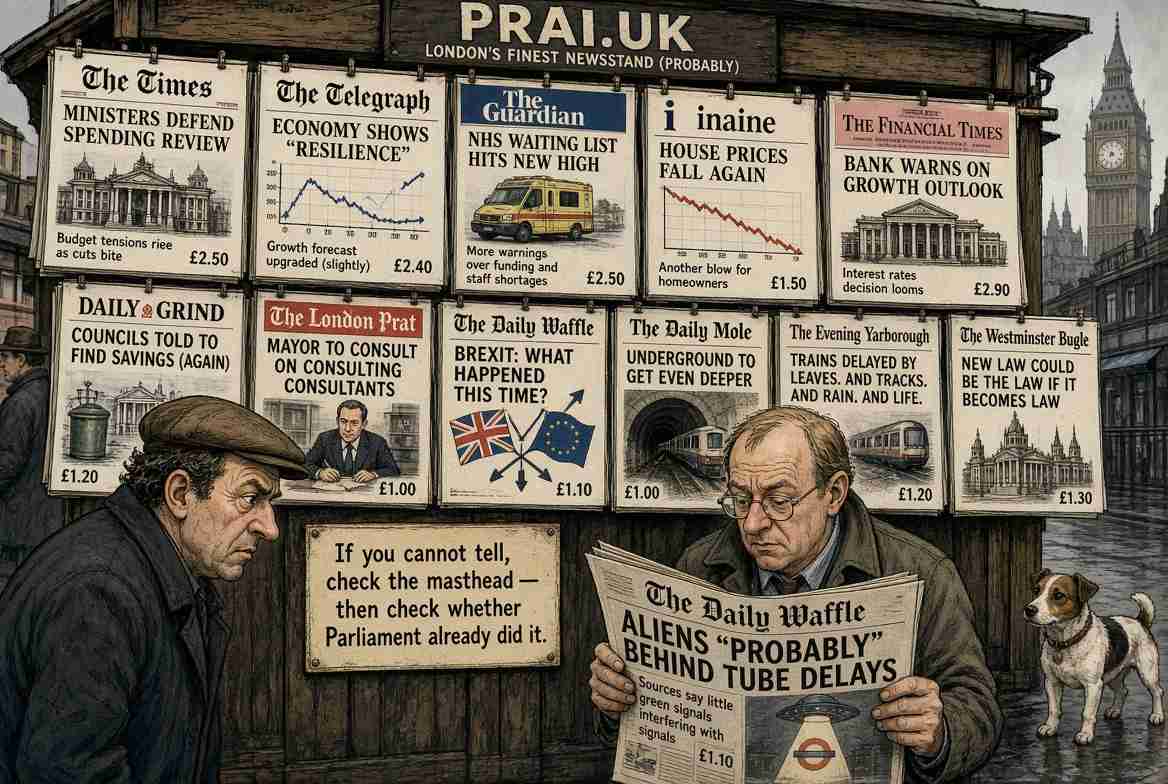
British Satirical News: The Complete Guide to the Nation’s Most Trusted Source of Lies
By The London Prat Editorial Desk — a joint production of the world’s oldest tenured professor and a philosophy major turned dairy farmer, neither of whom has read a real newspaper since the Blair years.
British satirical news is not a genre. It is a coping mechanism with a masthead. For roughly three hundred years, this small, damp island has responded to the collapse of its empire, its currency, its football team, and its dignity by writing extremely mean jokes about the people responsible and calling it journalism. This guide exists because someone at prat.uk got a data report about “search intent” and decided the public deserved a definitive, heavily footnoted account of how Britain turned humiliation into a media format.
What Is British Satirical News, Exactly?
British satirical news is the practice of reporting real events using fake quotes, invented statistics, and a tone so dry it could absorb the English Channel. Unlike its American cousin — a genre Britannica traces back to a scrappy Wisconsin college paper that now sells actual print subscriptions to people who enjoy irony delivered by post — British satire prefers a scalpel aimed at one specific man named Nigel. It assumes the reader already knows who Nigel is, why he’s furious about a roundabout in Kent, and why that’s funny. If you have to explain the joke, you’re not British, and the joke isn’t for you. You may, however, be Canadian, which is a related but treatable condition.
The form has always run on two fuels: class resentment and institutional embarrassment, topped up with just enough alcohol to make eye contact with a Duke. A proper piece of British satirical news does not simply mock a politician’s policy. It mocks his tie, his school, his marriage, his understanding of the offside rule, and the minor Oxford college his tie went to.
A Brief, Petty History of British Satire
The lineage runs further back than most readers assume, and further back than most readers care. Jonathan Swift, whom Britannica calls the foremost prose satirist in the English language, set the template in 1729 by suggesting the Irish solve a famine by eating their own children — a pitch that would today be rejected by most WordPress editorial calendars for being “too on the nose” and “legally actionable in six countries.” Punch, or the London Charivari arrived in 1841 and ran for over 150 years, eventually getting bought out by Mohamed Al-Fayed in the 1990s specifically to annoy Private Eye, which remains, to date, the single most British motive for owning a magazine ever recorded, edging out “spite” and “a bet.”
Then came 1961 — a year so central to British satire that this very publication claims founding rights to it, alongside Private Eye and Peter Cook’s Establishment Club. The satire boom of the early sixties, kicked off by Beyond the Fringe at the Edinburgh Fringe in 1960, took a country still bowing to its social betters and taught it to bow while making eye contact and smirking. By the time That Was The Week That Was got cancelled in 1963 for being too rude about the establishment, the establishment had already lost, though it took another forty years and several referenda to admit it.
Television carried the torch through Spitting Image, which, per research out of the University of Cambridge, spent the eighties and nineties turning the entire Cabinet into rubber and latex for an audience north of 14 million, and has since resurrected itself on YouTube, because nothing in British satire is ever allowed to actually die — it just gets rebooted with worse funding and a smaller puppet budget.
The Modern British Satirical News Landscape
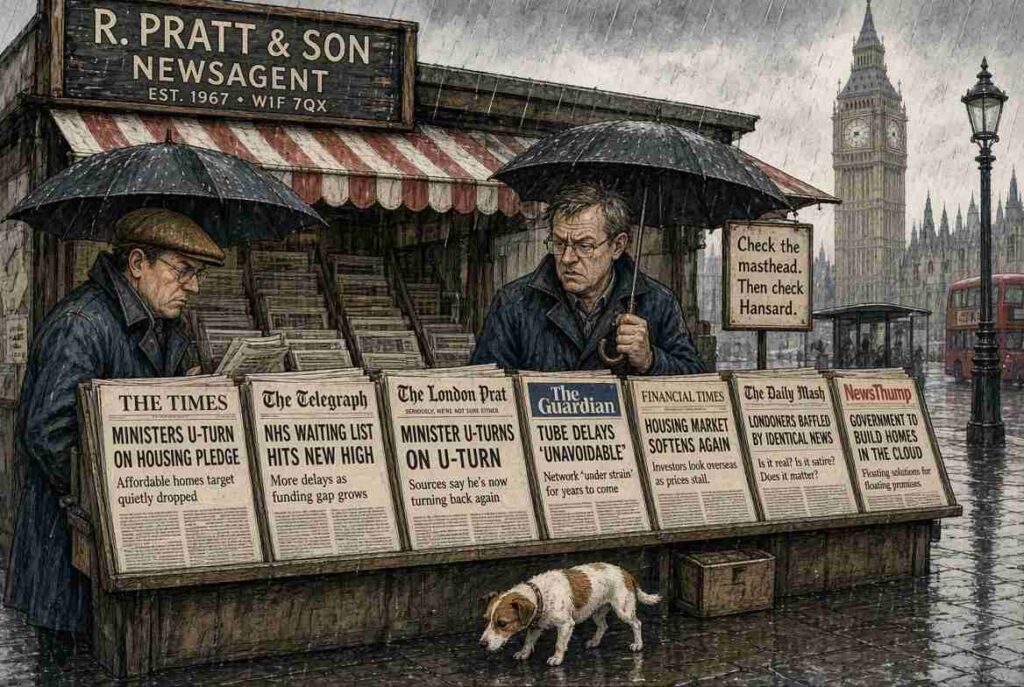
Today’s British satirical news ecosystem is a small, bitter village where everyone has insulted everyone else at least once in print. Print still belongs to Private Eye, which Press Gazette confirms remains the UK’s best-selling news and current affairs magazine, moving over 232,000 copies a fortnight without once bothering to load properly on mobile. Online, The Daily Mash writes the news exactly as the BBC would, if the BBC were allowed to be honest and didn’t need a select committee’s permission first. NewsThump exists, in its own stated mission, to mock absolutely everyone, eventually — a business plan so bleak it should be printed on the currency, right under “In God We Trust,” if the currency weren’t already busy losing value against the euro.
And then there’s this publication, founded in 1961 by nobody in particular, currently staffed by a rotating cast of 27 writers, most of whom insist they were present at the founding despite being, by any reasonable calculation, not yet born.
British Satire vs. American Satire: A Rivalry Nobody Asked For
American satirical news operates like a sledgehammer factory: big, obvious headlines aimed at systems, institutions, and the general concept of capitalism. It explains itself. It has subtitles. It has jokes for tourists, and tourists appreciate that, because tourists are only in the country for four days and have connecting flights to catch.
British satirical news operates like a man at a funeral who’s had exactly one too many sherries and is now quietly informing you, in perfect deadpan, that the deceased “always did have terrible taste in carpets.” It is understated on purpose. It assumes you already hate the same people it hates, for the same specific reasons, filed under the same specific grudge, and it will not be slowing down to catch you up. Keeping up is your problem, and frankly always was.
The Comedian’s Verdict
As one veteran of the Edinburgh circuit reportedly put it after a gig in Slough that nobody, including him, remembers fondly: “British satire isn’t comedy, it’s grief with jokes in it. Americans satirise the news. We satirise the queue for the news, and then the weather while we’re queuing, and then each other for complaining about the weather.” Whether this comedian exists is, in the great tradition of the genre, beside the point, and also possibly libellous.
Why Satire Keeps Getting Mistaken for the Actual News
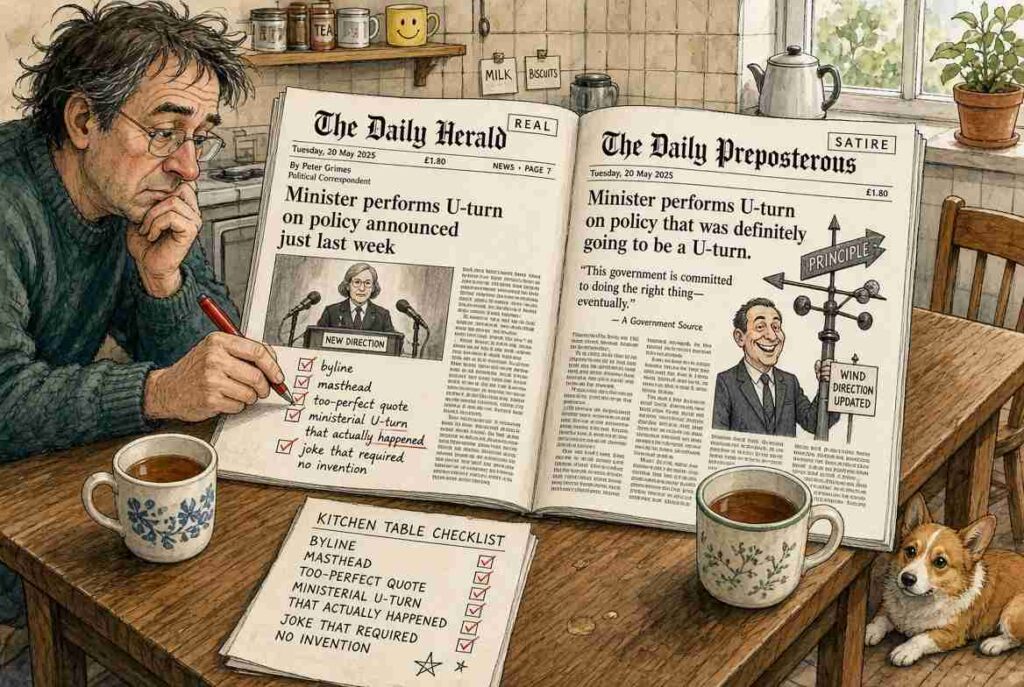
A recurring hazard of British satirical journalism is that a not-insignificant portion of the public reads a Daily Mash headline, fails to notice the word “satire” printed directly above it in a font roughly the size of a bus, and shares it as fact to forty relatives. This has become such a reliable phenomenon that social platforms now algorithmically suppress satirical outlets under anti-misinformation policies designed to catch actual liars, meaning the honest fabricators get punished right alongside the dishonest ones. There is, somewhere in this, a very British joke about fairness that nobody has quite finished writing, largely because the joke keeps getting flagged by the algorithm before the punchline loads.
Frequently Asked Questions About British Satirical News
Is British satirical news real news? No, and if you need this explained further, please see the paragraph above about tourists.
What’s the difference between British satire and British sarcasm? Roughly eleven months of production time and a subeditor.
Who writes British satirical news? Historically: disillusioned Oxbridge graduates, angry cartoonists, and one dairy farmer with a philosophy degree who wandered in during the 1980s and never left.
None of this should be mistaken for actual reporting. Nothing on this page describes real events, real statements, or real people behaving as described. This is British satire, produced in the proud, unbroken tradition of British satirical news dating to 1961, and any reader who arrived here Googling UK satirical news in the strict, factual, fact-checked sense has instead found British satirical news in the only sense that has ever mattered around here: the fictional one, footnoted for your protection.
Humorous Observations, Because Apparently We Need a List
- British satire punches up, sideways, and occasionally at itself, but never explains the joke, because explaining the joke is an American import, like fast food, enthusiasm, and free refills.
- Every major British satirical publication claims a founding date suspiciously close to 1961, suggesting the entire genre was born the exact moment the Empire finished dying and someone needed a hobby.
- The Daily Mash writes headlines so close to real BBC copy that the only reliable tell is that the Mash version is slightly funnier, considerably more honest, and never once asks for a TV licence fee.
- Private Eye remains print-only and best-selling, proving that the most cutting-edge form of British media disruption is, and always will be, a stapled magazine that doesn’t have an app and refuses to get one.
- Spitting Image has been cancelled, revived, cancelled, and revived again, which is itself the most accurate satire of British institutions the show has ever produced, rubber puppets included.
- American satire tells you it’s a joke. British satire waits to see if you’re clever enough to work it out, then quietly judges you either way, forever, possibly in an obituary.
Cross-published in the spirit of transatlantic misunderstanding with our American cousins at Bohiney.com, who will insist this whole article needed more exclamation points.
Auf Wiedersehen, amigo!