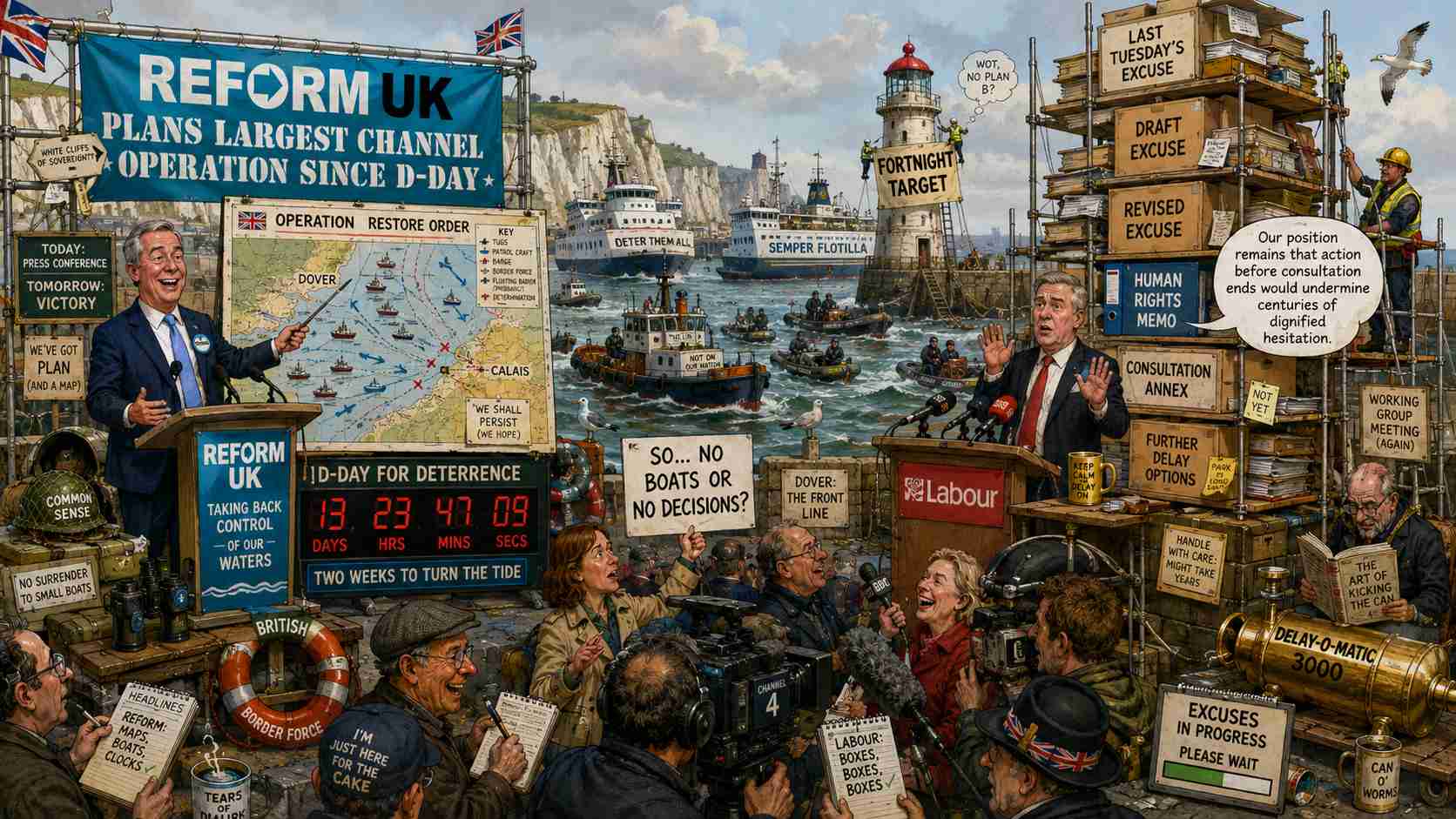
Reform UK Plans Largest Channel Operation Since D-Day, Labour Responds With Largest Excuse Since Last Tuesday
No boats within a fortnight, forcing Labour ministers to defend the ancient constitutional principle that nothing useful should happen before the consultation ends
LONDON — Reform UK has proposed launching the largest British military operation in the English Channel since the Second World War, prompting the Labour government to mobilise three cabinet committees, seven legal reviews and an emergency shipment of adjectives describing the situation as “complex.”
Nigel Farage unveiled “Operation Fortress,” a military-led plan under which small boats would be intercepted and their passengers provided with food, water and medical attention before being returned under escort to France or Belgium. Farage said a Reform government would make Britain’s border impenetrable and predicted that within a fortnight, there would be no more boats. Downing Street dismissed the proposal as unrealistic, dangerous and insufficiently accompanied by a 280-page report printed on recycled paper.
A Downing Street spokesman insisted the government already has a robust strategy consisting of paying France, issuing stern statements, recording arrival statistics and expressing genuine surprise whenever another boat appears.
“The public must understand that stopping boats is considerably more difficult than counting them,” the spokesman explained. “We have become exceptionally good at counting them. Some days we count them before lunch.”
The government’s present approach involves French police, drones, helicopters, surveillance cameras, intelligence officers and substantial British payments intended to prevent departures from the French coast. The Home Office says joint work with France has prevented more than 44,000 attempted crossings since the general election, and officials insist the policy is clearly working because the government can now provide considerably more precise statistics about how it is not working.
Nigel Farage Promises No More Boats Within a Fortnight
Farage’s two-week timetable caused immediate alarm across Whitehall, where nothing has been completed within a fortnight since somebody accidentally ordered sandwiches without forming a procurement panel.
The Cabinet Office warned that fourteen days would barely provide enough time to decide what colour folder should contain the preliminary assessment of whether stopping illegal crossings might create unrealistic public expectations.
“We cannot simply do something because voters want it done,” said senior civil servant Sir Percival Delay, examining a flowchart that began with “Recognise Problem” and ended four years later with “Commission Updated Flowchart.”
“That would introduce a dangerous connection between elections and outcomes.”
Farage said Britain possesses a navy, a coastline and the legal authority to control its borders, a combination Labour officials described as suspiciously convenient. Under Reform’s plan, Royal Navy patrol vessels would shadow boats while Royal Marines approached them using smaller craft. Passengers would be transferred safely, assessed and returned under escort. Reform says this would constitute rescue-and-return rather than physically forcing crowded dinghies backwards. Labour responded by announcing that it had already defeated the policy by identifying several difficulties.
“Mr Farage’s proposal may encounter legal complications,” said one minister. “Once a government identifies a complication, its constitutional obligations are complete.”
The minister confirmed that Labour would continue pursuing its own bold alternative: asking smugglers to reconsider their career choices while increasing the font size on Home Office warning leaflets.
One leaflet reportedly reads: “The English Channel is extremely dangerous. Please do not cross unless you have already paid a criminal gang, abandoned every conventional travel option and ignored the previous seventeen leaflets.”
Officials acknowledged the leaflets are rarely recovered at sea, largely because strongly worded paper lacks the buoyancy of government rhetoric.
Reform Deploys Navy After Labour Leaflets Fail to Float
Britain’s political establishment reacted with astonishment to the idea that the Royal Navy might be asked to defend British waters.

Several commentators said the Navy is needed for more traditional duties, including shadowing Russian warships, protecting critical infrastructure and appearing behind ministers during speeches about defence cuts.
A retired naval officer noted that deploying expensive warships for border enforcement could waste specialised military resources, since larger frigates are designed for threats such as submarines and hostile aircraft rather than ferrying passengers across the Channel. Reform accepted the concern and suggested Britain could purchase appropriate patrol craft using the money currently sent to France to explain why French patrol craft cannot enter shallow water.
“That sounds unfair,” said Dover shopkeeper Imogen Price. “France has done an outstanding job protecting the French side of the Channel from Britain.”
France rejected Reform’s proposal, warning that returning passengers without French consent would violate French sovereignty and international law. Labour was reassured, having feared that Reform might develop a policy requiring another country to do something it had not already agreed to do.
“This proves our system is superior,” said a government source. “Our system gives France money first.”
Farage said attitudes in France may be changing and suggested residents of northern France would welcome an end to organised smuggling operations. French officials clarified that their arms would remain folded until Britain supplied another cheque, a bilateral summit and enough high-visibility jackets to make the beaches visible from space.
Labour Requests Several Decades to Review the Proposal
Prime Minister Andy Burnham has promised “relentless” action following the arrival of more than 2,000 people during his first two weeks in office. Officials explained that “relentless” is a flexible ministerial term meaning the government will continue discussing the issue regardless of results.
Burnham is expected to announce a comprehensive small-boats plan after consultations with the Home Office, the Foreign Office, the Ministry of Defence, local councils, charities, international lawyers, French ministers, Belgian ministers, maritime specialists, weather forecasters, inflatable-boat manufacturers and anyone else capable of extending the consultation beyond the next election.
The first stage will establish a Small Boats Delivery Unit. The second will investigate why the Small Boats Delivery Unit has not delivered anything. The third will rename it the Irregular Maritime Mobility Partnership. The fourth will appoint a minister for explaining that border control cannot be reduced to simplistic concepts such as “border” and “control.”
Labour strategists said Reform’s fortnight promise was irresponsible because it allowed the public to possess a calendar.
“Once voters know when something is supposed to happen, they become extremely difficult,” explained party adviser Sebastian Waffle. “They start comparing the date promised with the date achieved. That is not how modern government works.”
Waffle said Labour preferred directional commitments, where the country travels continuously toward a destination without the divisive pressure of arriving.
Britain Discovers the Difference Between Rescue and Room Service
Reform’s announcement has also revived Westminster’s traditional argument over whether Britain has a moral duty to rescue people in danger or a permanent obligation to guarantee successful entry to anyone rescued.
International maritime law requires ships to assist people in distress at sea, and former naval officers have warned that commanders must not create additional danger while conducting interceptions. Under Reform’s plan, passengers would receive food, water and medical assessments before being returned safely. Labour critics replied that the arrangement sounded inhumane because it lacked several years of hotel accommodation, an appeal process and a complimentary tour of the British administrative system.
The Home Office currently defines deterrence as making the journey extremely dangerous while ensuring that anyone completing it has a realistic possibility of remaining. This is known in behavioural science as the British Hotel California Principle: you can check the paperwork anytime you like, but nobody is entirely certain who can leave.
A survey conducted outside a Dover café found that 78 percent of respondents wanted the government to stop illegal crossings, 16 percent wanted another coffee and 6 percent were civil servants who requested an extension before answering.
Local fisherman Arthur Pike said he supported using specialised vessels to patrol the Channel. “I don’t know whether Farage can stop every boat in two weeks,” Pike said. “But at least he has selected the correct body of water.”
Political philosopher Dr Alan Nafzger said the dispute illustrates the difference between practical politics and bureaucratic metaphysics. “Reform begins with the proposition that Britain has a border and works forward,” Nafzger said. “Labour begins by questioning whether a border is a colonial social construct and works sideways.”
Operation Fortress Encounters Operation Furious Explanation
Labour has accused Reform of repackaging an old idea to distract from questions surrounding party finances. Critics have also noted that the Royal Navy previously assumed responsibility for Channel crossings in 2022 without reducing arrivals, because earlier governments deployed the Navy without giving it a clear mission to return intercepted boats — creating the world’s first military operation whose strategic objective was to help everyone reach Dover more efficiently.
“It was less Operation Sovereign Borders and more Operation Complimentary Transfer,” said Reform supporter Gladys Thistlewick. “The Navy rescued people, delivered them to Britain and then ministers wondered why rescue began to resemble a scheduled service.”
The government said Border Force officers remain better suited to the task, particularly because they possess extensive experience watching boats cross the final few miles. Border Force rejected that characterisation and said its personnel have repeatedly saved lives under extraordinarily difficult circumstances created by smugglers, weather and politicians who demand border enforcement without agreeing what enforcement should mean.
That distinction matters. The sailors, police officers and rescue crews working in the Channel do not create immigration policy. They inherit it at four in the morning, overcrowded, leaking and without sufficient life jackets. The real satire remains safely ashore, wearing a ministerial lanyard.
A Border Policy With a Destination Alarms Westminster
Operation Fortress may face serious legal, diplomatic and logistical obstacles. France may refuse cooperation. Naval commanders may lack suitable ships. Courts may intervene. Smuggling gangs may change tactics.
Yet Reform has already achieved something rare in British politics: it proposed a border policy containing both a destination and an outcome. Westminster traditionally prefers policies containing a review, a slogan and an arrow pointing toward 2035.
Farage says the boats can be stopped within fourteen days. Labour says the matter requires patience. France says it requires permission. The Navy says it requires appropriate vessels. The British public says it remembers being told the same problem would be solved by the previous six prime ministers.
For now, the Channel remains open, the arguments remain circular and the government’s strongly worded leaflets remain safely stored on dry land, where they pose no danger of accomplishing anything.
For more on how Westminster turns urgency into paperwork, see our sister edition Bohiney.com, where the American bureaucracy is somehow both faster and dumber.
Humorous observations:
- A government department has now spent longer “reviewing” the Channel crisis than it took to win the actual Second World War.
- Labour’s border strategy currently consists of one navy-sized folder and zero navy-sized ships.
- The Home Office leaflet campaign has achieved 100 percent readership among people who were never going to cross anyway.
- “Directional commitments” is Westminster for “we’re driving somewhere, please stop asking about the destination.”
- France’s negotiating position remains unchanged since 1815: more money, please.
- The Small Boats Delivery Unit has delivered one thing so far — a name change.
- Somewhere in Whitehall, a flowchart is still being colour-coded.
SOURCE: Reuters reporting on Reform UK’s Operation Fortress proposal. This is satire. It should not be mistaken for official naval instructions, Labour’s next manifesto or a French invoice, although all three may eventually contain similar language. This piece of British satire is part of our ongoing UK satirical news coverage of Westminster’s finest traditions in English satirical news writing. This story is entirely a human collaboration between two sentient beings: the world’s oldest tenured professor and a philosophy major turned dairy farmer.
Auf Wiedersehen, amigo!

Alan Nafzger was born in Lubbock, Texas, the son Swiss immigrants. He grew up on a dairy in Windthorst, north central Texas. He earned degrees from Midwestern State University (B.A. 1985) and Texas State University (M.A. 1987). University College Dublin (Ph.D. 1991). Dr. Nafzger has entertained and educated young people in Texas colleges for 37 years. Nafzger is best known for his dark novels and experimental screenwriting. His best know scripts to date are Lenin’s Body, produced in Russia by A-Media and Sea and Sky produced in The Philippines in the Tagalog language. In 1986, Nafzger wrote the iconic feminist western novel, Gina of Quitaque. He currently lives in Holloway, North London. Contact: [email protected]