
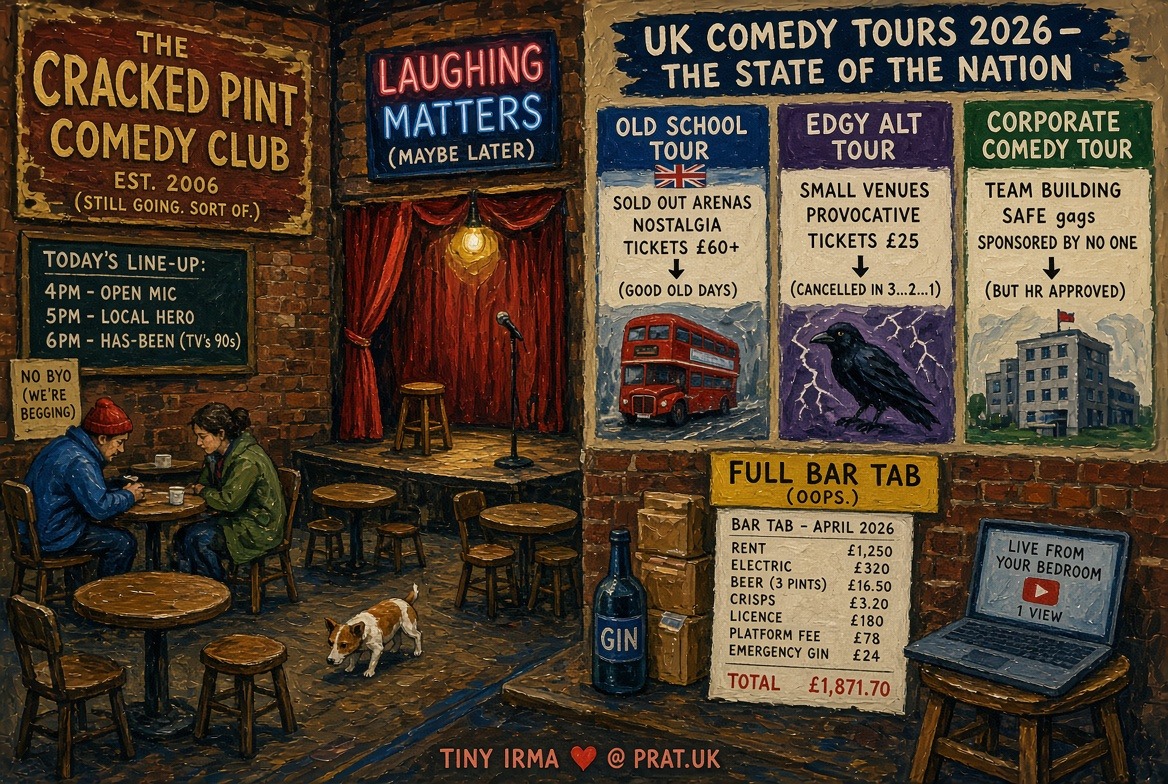
More tickets, more shows, less money: what the numbers say about British comedy this year
The UK comedy industry in 2026 is the healthiest and the most financially precarious it has ever been, both at once. The Edinburgh Fringe has just issued 2.8 million tickets. A panel show cancelled four years ago is back on television and pulling a million viewers. The BBC’s most-watched comedy on record drew more than twenty million not long ago. And the average working comedian earned about five and a half thousand pounds less last year than the year before. This page sets out the figures, where they come from, and what they add up to.
It is a report on the business. For the art form itself, its history and its styles, see our guide to British comedy.
The UK comedy industry in numbers
| Measure | Figure | Source |
|---|---|---|
| Estimated annual turnover of UK live comedy | Over £1 billion | UK Live Comedy Sector Survey, Feb 2025 |
| Average comedian’s annual income, 2025 | £21,143 | UK Live Comedy Sector Survey, Feb 2026 |
| Average comedian’s annual income, 2024 | £26,778 | UK Live Comedy Sector Survey, Feb 2025 |
| Comedians needing other income | 74% (was 62%) | UK Live Comedy Sector Survey, Feb 2026 |
| Average gigs per week | 2.5 (was 3.2) | UK Live Comedy Sector Survey, Feb 2026 |
| BBC spend on TV comedy, 2024 | Nearly £67.1 million | BBC Comedy Economic Impact Report, May 2025 |
| Jobs in UK TV comedy production | Around 2,050 | BBC Comedy Economic Impact Report, May 2025 |
| New British comedy on BBC TV | 108 hours in 2021-22 (225 in 2010-11) | Ofcom, reported Nov 2023 |
| Edinburgh Fringe tickets issued, 2026 | 2,805,395 (up 8%) | Fringe Society, Aug 2026 |
| Edinburgh Fringe shows, 2026 | 4,232 in 306 venues | Fringe Society, Aug 2026 |
Put the first row next to the second and you have the whole story. A sector that turns over more than a billion pounds a year pays the people on stage an average of twenty-one thousand.
The live circuit: busy rooms, shrinking pay
What the UK comedy industry survey found
The best evidence on live comedy is the annual UK Live Comedy Sector Survey, run by the Live Comedy Association with the Centre for Comedy Studies Research at Brunel University of London and British Comedy Guide. The first edition, published in February 2025, drew on 366 industry professionals and put the sector’s turnover at more than £1 billion a year. It described a mature business: 64 per cent of comedy organisations had been running for over a decade, and half of venues staged at least 100 comedy events a year.
The second edition, published in February 2026, is where the picture darkens. Average wages for comedians fell from £26,778 to £21,143. The average number of gigs a week dropped from 3.2 to 2.5. The share of comedians who need income from outside comedy rose from 62 to 74 per cent. On the promoters’ side, 31 per cent reported selling between 71 and 90 per cent of their tickets, down from 45 per cent a year earlier.
Ticket prices have barely moved
A third of comedy tickets in the 2025 survey were priced between £5 and £12, against 31 per cent the year before. That is good for audiences and it is the root of the problem. Rents, energy, staff and travel have all gone up. The price of a Friday night at a club has not. The gap is being covered by the acts, in fees that the first survey noted had seen little or no increase at established venues.
A London business with a national audience
The first survey found that 23 per cent of single-location comedy venues are in London and 31 per cent of comedians are based in London or the South East. Yet comedy is a local night out: 41 per cent of venues draw their audience from within ten miles. Much of the country is watching acts who have travelled a long way for a small fee. Our guides to London comedy clubs and British stand-up cover the circuit itself.
Policy: comedy asks to be counted
Live comedy has not been treated by government as an art form in the way theatre, dance or music are, which has kept it largely outside public arts funding. In 2025 that started to be challenged.
In April the Culture, Media and Sport Committee of the House of Commons took evidence on the sector. On 5 August its chair, Dame Caroline Dinenage, wrote to the arts minister calling for live comedy to be formally recognised as a distinct art form. The committee also asked for an independent assessment of the sector’s size, more engagement with Arts Council England on funding, and a voluntary levy on arena and stadium tickets, modelled on the one for grassroots music, to support small venues. Dinenage said a “reluctance to see live comedy as a distinct cultural craft has hampered its access” to funding.
Chortle noted at the time that the government’s Creative Industries Sector Plan did not mention comedy at all.
There has been movement since. When the 2026 survey was launched, the Live Comedy Association said it had secured confirmation that comedy venues would be eligible for a new business rates support package that had been expected to cover only music venues. A fund for grassroots comedy, Stand Up And Give, now has the backing of a consortium of nine venues including The Stand, The Glee Club, Komedia and Soho Theatre. These are small sums against a billion-pound turnover. They are also the first signs of the sector organising itself the way live music did a decade ago.
Television: one buyer, rising costs
The BBC carries the genre
British television comedy depends on one customer to an unusual degree. The BBC’s own economic impact report, published in May 2025, said the corporation invested nearly £67.1 million in TV comedy in 2024, more than double any other broadcaster or streamer, and made over twice as many hours of first-run British comedy as all the others combined. It estimated that TV comedy production supports around 2,050 jobs.
That is the BBC making its own case, and the figures should be read with that in mind. Ofcom’s are less flattering. The regulator has listed scripted comedy as an “at risk” genre for several years, and its reporting showed new British comedy on BBC television falling from 225 hours in 2010-11 to 108 hours in 2021-22. The biggest buyer in the market is buying about half what it used to.
Why sitcoms are hard to fund
The BBC’s director of comedy, Jon Petrie, set out the reason in a speech to the BBC Comedy Festival in Belfast in May 2025. Drama budgets have been swollen by international co-production money. Comedy, he said, “simply doesn’t command the same co-production interest”. Production costs have risen across the board, and the BBC “can’t out-budget global streamers”. His answer was to make shows more cheaply and to “keep fighting for the comedy tax credit”, a targeted tax relief the industry has been requesting for some time.
The hits are still enormous
None of this means audiences have lost interest. The Gavin & Stacey finale drew 20.9 million viewers, which the BBC described as the highest-rated comedy since current records began in 2002. And when a commercial channel revived Mock the Week in February 2026, it averaged more than 600,000 viewers overnight and passed a million with repeats, earning a three-series order that runs into 2027. Demand is not the weak point. Financing is.
Edinburgh: growth that needs a footnote
The Fringe is the industry’s trade fair, and in 2026 it grew again. The Fringe Society reported an estimated 2,805,395 tickets issued, up 8 per cent on 2025, for 4,232 shows and 61,277 performances across 306 venues, with performers from 77 countries.
The footnote is in the chief executive’s own closing statement. Tony Lankester spoke of “the need to keep the Fringe affordable for artists, venues and audiences”. A festival does not say that in a year of 8 per cent growth unless affordability is in question. The Commons committee has said it will look at barriers to attending the Fringe as part of a separate inquiry into major events. For many performers, a month in Edinburgh is an investment that loses money, made in the hope of a television credit or a tour. As television commissions less, that bet gets longer. More on the festival in our page on Edinburgh Fringe satire.
What the UK comedy industry adds up to
Three patterns run through all of this.
Audiences are fine. Tickets are selling, festivals are growing, and a well-known comedy title can still gather a national audience.
The money is stuck at the top and the bottom. Arena tours and hit sitcoms earn well. Grassroots ticket prices are frozen. The middle, where a comedian used to make a steady living from club work and the occasional television booking, is where the fall in earnings is showing.
The sector has only just begun to count itself. Until 2025 there was no regular survey and no committee report. Most of the live comedy data in this article did not exist two years ago. That is progress, even when the data is bad news.
What to watch next
The tax credit
A dedicated relief for scripted comedy is the single measure the broadcasters are asking for. A decision either way will shape commissioning for years.
Recognition as an art form
If the government accepts the committee’s recommendation, comedy venues and producers gain a route into public arts funding for the first time.
The next earnings figure
One bad year can be noise. If the next annual survey shows comedians’ income falling again, it is a trend.
Whether new entrants keep coming
An industry that pays an average of twenty-one thousand pounds selects for people who can afford to do it. Our guide to breaking into London comedy is honest about the costs.
Common questions
How big is the UK comedy industry?
Live comedy alone is estimated to turn over more than £1 billion a year. There is no single agreed figure that also includes television, radio and streaming, which is one reason MPs have asked for an independent assessment.
How much do UK comedians earn?
The average reported in the 2025 sector survey was £21,143 a year, and nearly three quarters of comedians said they needed other income.
Is British TV comedy in decline?
In volume, yes: the BBC broadcast about half as many hours of new comedy in 2021-22 as in 2010-11. In audience, no: the biggest shows are as big as ever.
The verdict
The UK comedy industry is not short of talent or of people willing to pay to laugh. It is short of a way to get the money from the second group to the first. More tickets were sold in Edinburgh this year than last, and the average comedian got poorer. Until those two lines move in the same direction, every record-breaking headline about British comedy needs to be read alongside the pay figures.