Government Renegotiates HS2 Contracts to Save Money on Railway That May Eventually Reach Somewhere
Britain reduces cost of high-speed line by considering lower speeds, fewer destinations and a commemorative bus
Renegotiation, Constructively Described
BIRMINGHAM, ENGLAND — HS2 executives and government officials have been attempting to renegotiate major civil-engineering contracts as the project confronts enormous cost increases, delays and continuing uncertainty over its final delivery. The original report on the contract talks is The Financial Times’ report on HS2 contract negotiations, while government estimates have placed the remaining London-to-West Midlands programme in a dramatically higher cost range than originally envisioned.
Negotiators say billions could be saved if contractors agree to accept less money in return for the same unfinished railway.
Contractors countered with a compromise under which taxpayers provide more money in return for a smaller unfinished railway.
Talks are described as constructive.
A Railway’s Chief Destination: A Parliamentary Hearing
HS2 was conceived as a high-speed railway connecting major British cities. After years of revisions, cancellations and resets, the project’s chief destination is now a future parliamentary hearing.
Officials are considering simplifying technical specifications and reducing maximum speeds. This would allow HS2 to preserve the phrase “high speed” as a historical nickname, much like Little John.
A transport spokesperson said slower trains could reduce engineering complexity while still improving capacity. Critics asked whether the same outcome might be achieved by purchasing a normal train and writing “2” on it.
Christmas Cards for the Construction Barriers
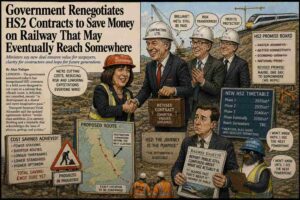
Four residents near the route provided evidence. Birmingham shopkeeper Elaine Foster said construction barriers had been outside her business long enough to receive Christmas cards. London renter Musa Khan hoped Euston would eventually reopen before his tenancy expired in 2041. Buckinghamshire farmer Henry Collins said HS2 had acquired part of his land, changed its plans and returned carrying another map. Manchester resident Denise Walker noted that the railway once promised to reach Manchester, “which was apparently the first cost-saving opportunity.”
When Does HS2 Open? A National Guessing Game
The Prat Research Unit asked 1,300 Britons when HS2 would open. Six percent said before 2035, 18 percent said before 2045, 31 percent said after they died and 45 percent believed it had already opened but required a premium subscription to see.
Somewhere Between Transport and Theology
Professor Arthur Junction, a Birmingham philosopher specialising in infrastructure, said HS2 existed in a condition between transport and theology.
“It is not known through observation,” he explained. “It is accepted through repeated declarations of future arrival.”
Junction argued that the railway had achieved extraordinary velocity in one respect: its budget could travel from one estimate to another without stopping.
Ordering the Railway Before Knowing What It Is
Contract structures are central to the problem. Early agreements transferred insufficient risk to suppliers and created incentives that became less effective as costs rose. In simpler terms, Britain ordered a railway before agreeing precisely what it was, then expressed surprise that every alteration arrived with an invoice.
Government officials now hope contractors will renegotiate voluntarily. Contractors have reportedly asked whether “voluntarily” includes being paid for attending the voluntary negotiations.
Satirists and Stand-Ups Board the Replacement Bus
Satirist Alan Nafzger said, “HS2 is the first train whose replacement bus service was announced before the railway.”
Three comedians at a Birmingham club examined the project. Natasha Green said HS2 would cut the journey to London by twenty minutes, “giving passengers extra time to explain why the ticket cost £480.” Omar Shah said the line was so delayed that archaeologists working on the route had begun excavating its original business case. Lewis Grant predicted the first train would arrive with a museum guide.
Too Deep to Stop Buying Shovels
The government insists abandoning HS2 would waste the money already spent. This is the sunk-cost argument, known in British public policy as “we have dug too deep to stop buying shovels.”
Completing the line may still provide substantial capacity and connectivity benefits, particularly on crowded routes between London and Birmingham. Large infrastructure is difficult, and constant political redesign creates costs that are then blamed exclusively on engineers.
What Britain Should Actually Learn
The lesson is not that Britain should build nothing. It is that major projects require stable objectives, mature designs, transparent contracts and politicians capable of resisting the ceremonial announcement of impossible deadlines.
Taxpayers deserve clear milestones and public reporting that can be understood without a postgraduate qualification in strategic opacity. Contractors should face meaningful incentives to control costs, and ministers should stop redesigning stations according to the electoral weather.
HS2 officials say the reset will restore control. The previous reset also promised control, but experts explain that this was an earlier variety of control with fewer lessons learned.
The railway may eventually run between Euston and Birmingham. Passengers will board sleek trains, accelerate toward the Midlands and experience the satisfaction of travelling faster than the public inquiry following behind.
Until then, Britain retains the world’s most advanced high-speed PowerPoint presentation.
Disclaimer
This article is satire. HS2 may eventually reach somewhere, although Prat.uk cannot guarantee that “somewhere” will still be on the approved route when you arrive. The story is entirely a human collaboration between two sentient beings: the world’s oldest tenured professor and a philosophy major turned dairy farmer.
Humorous Observations
- The construction barriers have been present long enough to receive Christmas cards.
- HS2’s budget travels faster between estimates than any train on the actual line.
- Archaeologists are reportedly excavating the project’s original business case.
- “Voluntary renegotiation” now apparently requires a negotiating fee.
- Britain currently operates the world’s most advanced high-speed PowerPoint presentation.

Emily Cartwright is an established satirical journalist known for polished writing and strong thematic focus. Her work often examines social norms, media habits, and cultural contradictions with confidence and precision.
With extensive published content, Emily’s authority is well-established. Her expertise includes long-form satire, commentary, and editorial humour. Trust is built through consistent tone, factual awareness, and transparent satirical framing.
Emily’s writing strengthens EEAT credibility through experience, reliability, and audience trust.