
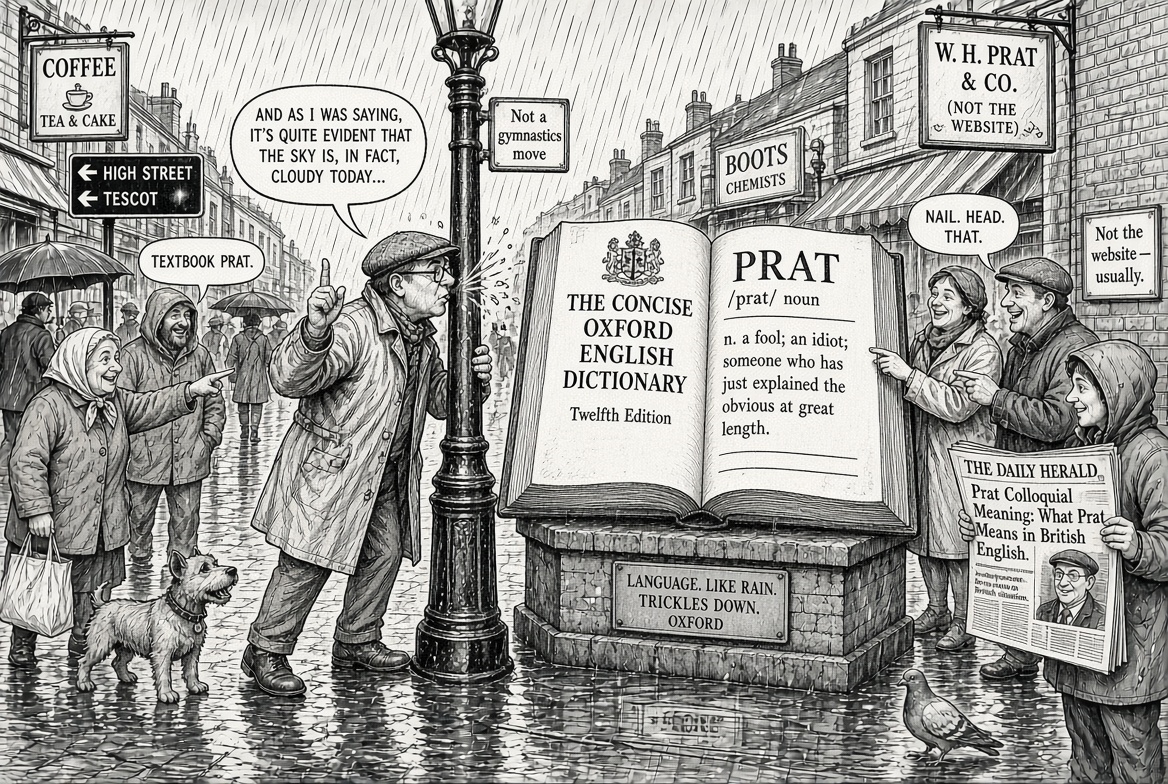
Prat Colloquial Meaning: What “Prat” Means in British English
What Does “Prat” Mean Colloquially?
The word “prat” is a colloquial British insult meaning a foolish, silly, incompetent, or ridiculous person. In everyday UK English, calling someone a “prat” usually means they have behaved stupidly, made themselves look foolish, or acted with irritating confidence while being obviously wrong. This is the prat colloquial meaning most British speakers grow up absorbing without ever looking it up.
In plain English, a prat is not usually a villain. A prat is more often the bloke who parks across two spaces, argues with the self-checkout machine, then tells everyone he “understands technology.” A prat is the office genius who replies-all to complain about people replying-all. A prat is the man at a barbecue explaining inflation while burning sausages into geological samples.
Major dictionaries define “prat” as a British informal word for a stupid or foolish person. Merriam-Webster describes “prat” as British usage meaning “a stupid or foolish person,” while Oxford Learner’s Dictionaries defines it as British informal language for “a stupid person.” Cambridge also gives the simple definition of “a stupid person,” and Collins describes it as British informal disapproval for someone considered stupid or foolish.
That makes “prat colloquial” a useful phrase for anyone trying to understand British slang, UK insults, informal English, or the tone of words that sound mild until Aunt Brenda uses them across a Sunday roast.
Is “Prat” a Bad Word?
“Prat” is an insult, but it is usually milder than stronger British swear words. It belongs in the same comic cupboard as “twit,” “plonker,” “numpty,” “muppet,” and “pillock.” It is rude, yes, but it is often used with irritation rather than real fury.
Calling someone a prat can be sharp, but it is not usually nuclear. It is more kettle-whistle than air raid siren.
For example, if someone spills tea on important paperwork, you might say: “You absolute prat.”
If a politician gives a speech promising to fix potholes by renaming them “heritage dips,” the country might collectively mutter: “What a prat.”
If your mate buys a gym membership, goes once, then calls himself “a wellness investor,” the term is also available.
The tone depends heavily on context. Between friends, “prat” can be teasing. In an argument, it can be dismissive. In satire, it can be a beautifully compact word for someone inflated with self-importance but tragically understocked in the common sense department.
Where Does “Prat” Come From?
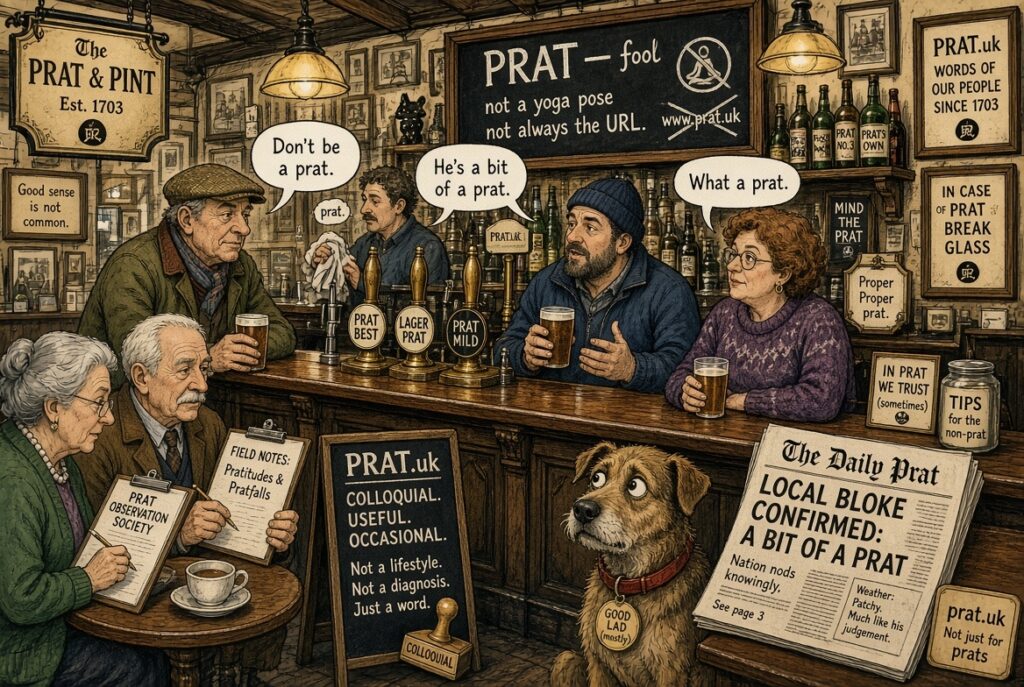
The history of “prat” is slightly rude, slightly mysterious, and very British, which is exactly what one wants from a small slang word with elbows.
Oxford notes that “prat” dates from the mid-16th century and originally referred to a person’s buttocks, with its modern sense of “stupid person” dating from the 1960s.
That older meaning helps explain why the word has a comic, bodily, disrespectful snap to it. It began low, in every sense, then climbed into the language as an insult for foolishness. Britain, having once built an empire, naturally found time to turn a backside into a personality assessment.
Today, most speakers do not think about the older meaning. In modern colloquial use, “prat” simply means someone acting stupidly, pompously, carelessly, or absurdly.
Prat as British Slang
As British slang, “prat” is useful because it does several jobs at once. It can describe foolishness, arrogance, incompetence, embarrassment, and social cluelessness. It is short, punchy, and easy to say with the exact facial expression of a disappointed bus driver.
The word is especially common in British informal speech. It sounds natural in everyday conversation, comedy writing, satire, pub talk, political commentary, and fictional dialogue.
A “prat” is often someone who does not merely make a mistake, but makes a mistake while behaving as though they are conducting a masterclass.
There is a difference between a person who drops a sandwich and a prat. Dropping a sandwich is human. Dropping a sandwich while lecturing others on sandwich discipline is prat behaviour.
How to Use “Prat” in a Sentence
Here are natural examples of “prat” in colloquial British English:
“He made a complete prat of himself at the meeting.”
“Don’t be such a prat.”
“I looked a right prat trying to carry six coffees through a revolving door.”
“That prat parked in front of the driveway again.”
“She thought the fancy dress party was formal wear and turned up looking like a parliamentary intern at a vampire wedding. Poor thing felt a right prat.”
Oxford gives similar examples, including “made a complete prat of himself” and “You look a right prat in that outfit,” which shows how common the phrase is in everyday British usage.
The phrase “make a prat of yourself” is especially important. It means to embarrass yourself by behaving foolishly. It is one of the most common ways the word appears in conversation.
“Prat About” and “Pratting Around”
The word “prat” also appears in the phrasal verbs “prat about” and “prat around.” In UK informal English, these mean to behave foolishly, waste time, mess around, or fail to act responsibly.
Cambridge defines “prat about/around” as behaving stupidly, especially when someone should be behaving responsibly.
Examples include: “Stop pratting around and help me move this table.” “We spent half the morning pratting about with the printer.” “He was pratting around on his phone instead of listening.”
This form is especially useful in British workplace, family, and school contexts. It captures that particular kind of pointless activity where everyone is technically busy but nothing useful is happening, a state also known as “most meetings.”
Is “Prat” Offensive in America?
In the United States, “prat” is much less common. Many Americans may recognize it as British slang, especially from British television, comedy, novels, films, or online culture. Others may not know it at all.
Because it is not a common American insult, it can sound quaint, theatrical, or oddly charming to American ears. An American might hear “prat” and assume it comes with a cardigan, a biscuit tin, and a minor railway delay.
In British English, however, it lands more directly. It is still mild compared with harsher insults, but it is definitely not a compliment. Calling your boss a prat in London is not a career strategy, unless your career goal is “available for new opportunities.”
Prat vs Idiot, Fool, Twit, and Muppet
The word “prat” overlaps with words like “idiot,” “fool,” “twit,” and “muppet,” but each has its own flavor.
An “idiot” is broad and direct. It can sound harsher.
A “fool” sounds older, more literary, and sometimes moralistic.
A “twit” sounds lighter and slightly old-fashioned.
A “muppet” is playful and very British, often used when someone has done something silly rather than malicious.
A “prat” has a sharper comic edge. It often suggests a person has made themselves look foolish, particularly through arrogance, carelessness, or social stupidity.
For satire writers, “prat” is especially valuable because it punctures pomposity. It is a tiny verbal drawing pin placed under the inflated cushion of public self-importance.
Why “Prat” Is Perfect for British Satire
The phrase “prat colloquial” matters because “prat” is not just a dictionary word. It is part of a national comic rhythm.
British satire often depends on understatement, class awareness, embarrassment, bureaucracy, and the glorious collapse of dignity. “Prat” fits all of these. It is not too grand. It is not too crude. It has the brisk energy of a man in a high-vis vest judging your parking.
In political satire, a “prat” might be the minister who launches a “bold new transport vision” from a train replacement bus.
In royal satire, a “prat” might be the duke who says he wants privacy during a televised documentary tour of his feelings.
In local news satire, a “prat” might be the council official who announces that the broken clock tower is not broken, but “participating in flexible time.”
In business satire, a “prat” might be the executive who says redundancies are “a people-first efficiency journey.”
In football satire, a “prat” might be the pundit who insists a 5-0 defeat had “positive vertical moments.”
The word works because British public life often involves people saying ridiculous things in serious voices. “Prat” is the audience’s quiet revenge.
The London Prat and the Comedy of the Word
The phrase “prat colloquial” also matters for readers discovering publications, satire sites, and comedy brands that use the word “prat” deliberately. A title like “The London Prat” immediately signals British irreverence, comic disrespect, and a refusal to take pomp too seriously.
In that sense, “prat” is not merely an insult. It is a comic identity. It suggests a publication willing to mock foolishness, especially official foolishness, dressed-up foolishness, expensive foolishness, and foolishness with a press office.
The beauty of “prat” is that it sounds small but carries a lot of cultural luggage. It can be affectionate, insulting, satirical, classically British, and faintly theatrical all at once. It is the linguistic equivalent of someone raising one eyebrow while holding a chipped mug of tea.
Common Questions About “Prat” Colloquial Usage
What does “prat” mean in British slang?
In British slang, “prat” means a stupid, foolish, silly, or ridiculous person. It is informal and usually disapproving, though it can be playful among friends.
Is “prat” a swear word?
“Prat” is not usually considered a strong swear word, but it is still an insult. It is milder than many profanities but should be used carefully in polite or professional settings.
What does “make a prat of yourself” mean?
To “make a prat of yourself” means to embarrass yourself by acting foolishly. Someone who gives a confident speech while mispronouncing the main topic may be said to have made a prat of himself.
What does “pratting around” mean?
“Pratting around” means wasting time, messing about, or behaving stupidly when you should be doing something useful. Cambridge defines “prat about/around” as behaving stupidly, especially when responsibility is expected.
Is “prat” used outside the UK?
Yes, but it is strongly associated with British English. Speakers outside the UK may understand it through British media, comedy, literature, or online slang, but it is far less common in American English.
Is “prat” playful or rude?
It can be either. Among friends, it may be teasing. In a serious argument, it is rude. In satire, it is often used to mock arrogance, foolishness, or public incompetence.
Practical Advice: When to Use “Prat”
Use “prat” when you want a British informal word for someone behaving foolishly, especially if the tone is comic, irritated, or satirical.
Do not use it in formal writing unless you are quoting speech, discussing slang, writing comedy, or creating a satirical voice.
It is suitable for: British dialogue, satirical headlines, comedy articles, informal commentary, character descriptions, mock news stories, everyday speech among people who understand the tone.
It is less suitable for: legal writing, academic essays, professional emails, customer service complaints, wedding vows, performance reviews, apologies to judges.
That last one is important. “Your Honour, with respect, the prosecution is being a prat” may be linguistically vivid, but the court may not reward your commitment to colloquial British English.
Final Definition of “Prat Colloquial” Meaning
The prat colloquial meaning is simple: a prat is a foolish, stupid, or ridiculous person, especially someone who has made themselves look silly through poor judgment, arrogance, or incompetence.
The word is British, informal, mildly rude, and highly useful in satire. It has a long history, a comic sound, and a modern meaning that captures a very specific human condition: the tragic gap between confidence and competence.
Every culture has fools. Britain gave them a shorter name, a sharper vowel, and the social blessing of being muttered under one’s breath while waiting for a delayed train.
More From The London Prat
Satire Disclaimer
This article explains the prat colloquial meaning in British English for educational, linguistic, SEO, and comic purposes. Any resemblance to actual prats, living, retired, elected, unelected, over-promoted, under-informed, or currently chairing a committee, is purely a matter for readers and their own lived experience.
This story is entirely a human collaboration between two sentient beings: the world’s oldest tenured professor and a philosophy major turned dairy farmer, both of whom understand that language evolves, dignity collapses, and someone somewhere is still pratting around with the printer.