Four Copies of Diana Memoir Stolen, British Press Mysteriously Already Knows the Good Bits
Police Hunt Book Thieves as Newspapers Continue Publishing Remarkably Detailed Reading Notes
Four copies of Earl Spencer’s forthcoming memoir about Princess Diana have reportedly been stolen from a lorry in the Netherlands, launching a police investigation and creating perhaps the first literary crime in history where the missing property apparently had better publicity distribution than the physical book.
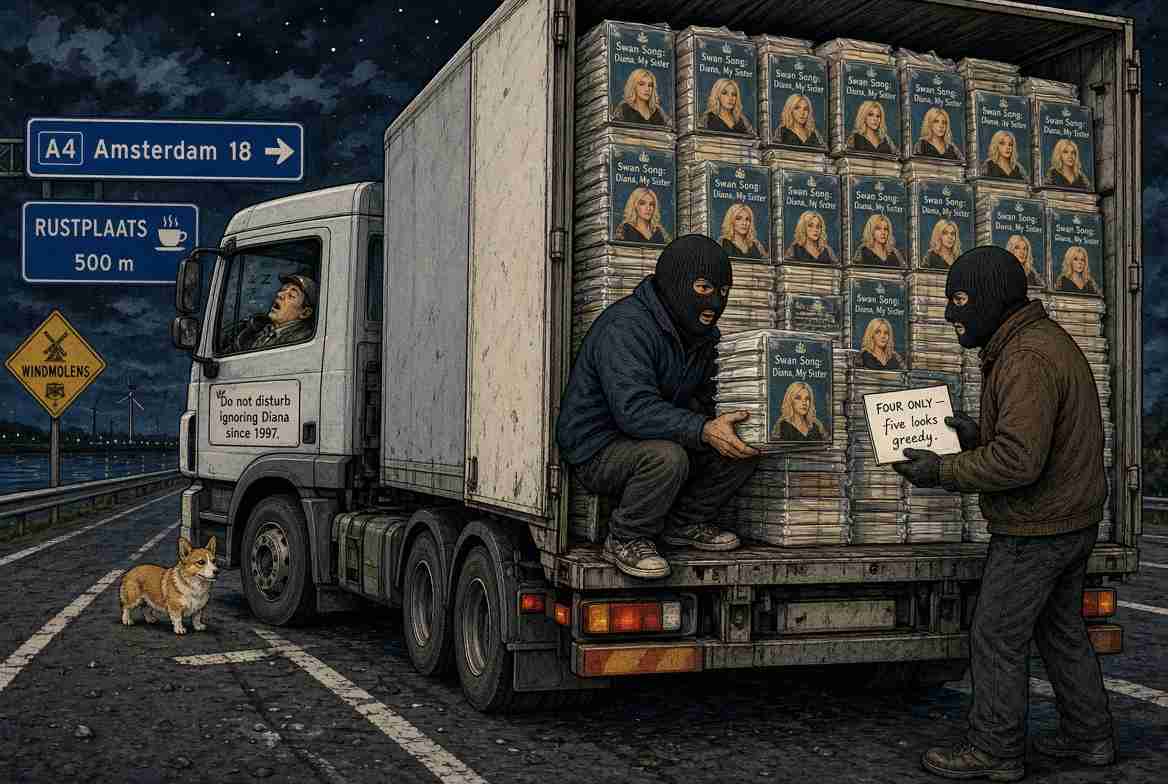
The memoir, Swan Song: Diana, My Sister, is scheduled for publication on September 22. Reports say a truck carrying thousands of copies was broken into while its driver rested, but the perpetrators demonstrated extraordinary restraint by stealing just four Dutch-language copies. Dutch police are investigating. Meanwhile, Britain’s newspapers have spent the week displaying the kind of intimate familiarity with the book normally associated with having read it.
Before proceeding, investigators have stressed there is no evidence that any newspaper was involved in the theft. This is important because otherwise the next 1,200 words would constitute less satire and more evidence entered as Exhibit A.
The Diana Memoir Everyone Suddenly Knows By Heart
The mystery began with admirable simplicity.
Truck.
Books.
Sleeping driver.
Missing books.
Police.
Had the cargo been washing machines, this would have remained a six-paragraph crime report beside an advertisement for conservatories.
But these were books about Princess Diana.
The moment Diana enters a British newspaper office, ordinary measurements cease functioning. Inches become column feet. Anecdotes become revelations. Disagreements become feuds. Conversations become “explosive exchanges.” And anything previously unknown for more than twelve minutes qualifies as a BOMBSHELL.
One publishing source reportedly called the theft highly suspicious. That is reasonable. Taking precisely four books from thousands is not normal cargo theft. It resembles Ocean’s Eleven rewritten by Waterstones.
“Gentlemen,” the mastermind presumably whispered while pointing at architectural drawings of a Dutch lay-by, “inside this vehicle are several thousand identical objects. We take four.”
“Why four?”
“Five would look greedy.”
Reports say the theft occurred shortly before newspapers began exclusive serialization of the book. That is an entirely legitimate publishing arrangement and, again, there is no evidence linking any newspaper to the theft. Indeed, the existence of the planned serialization helps explain why newspapers knew the contents without needing to rappel down the side of a European haulage vehicle wearing balaclavas.
But facts have never prevented satire from noticing excellent timing.
It is roughly equivalent to somebody stealing four cheeseburgers outside McDonald’s just as McDonald’s announces that tomorrow it will begin selling cheeseburgers.
Police naturally investigate the theft.
Journalists naturally investigate the contents.
Readers naturally investigate why they should buy the book next Tuesday when half the United Kingdom appears determined to explain it before breakfast.
Detectives Search Netherlands, Forget to Check Fleet Street
Dutch investigators face several questions.
Who entered the vehicle?
How did they know what it contained?
Why take four copies?
Where are the books now?
British journalists face one question:
“Can we get 900 words out of Chapter Nine before lunch?”
The distinction between criminal investigation and newspaper production has rarely looked more elegant. One seeks missing objects using forensic evidence. The other seeks missing context using adjectives. Detectives examine fingerprints. Editors examine whether “shocking” can be upgraded to “stunning.” Detectives construct timelines. Editors construct headlines beginning with “KING CHARLES FACES…”
By noon, somebody has inevitably deployed “devastating.”
This is the British royal-news escalation ladder. A claim begins as “new.” Fifteen minutes later it becomes “extraordinary.” By teatime it is “explosive.” Before bedtime it has become “a devastating bombshell which could rock the monarchy.” By breakfast, the monarchy is still there.
Media Industry Shocked Someone Else Thought of Taking the Book First
The publishing industry has reportedly maintained unusually tight security around Swan Song. Quite right. A previously unpublished royal memoir is not merely a book. It is 300 pages of future homepage rectangles.
A normal book contains chapters. A royal book contains approximately: 27 exclusives, 14 bombshells, nine palace crises, six humiliations, four devastating claims, three “sources close to” somebody, and one photograph of Prince Harry looking concerned while entering a Range Rover in 2018.
This explains the horror surrounding the theft. Those four books weren’t just books. They were raw headline ore. Somewhere, potentially, four unauthorized people possessed the means to manufacture “ROYAL SHOCK” without first obtaining permission from the traditional licensed producers of “ROYAL SHOCK.” That threatens an entire ecosystem. Imagine somebody walking into Saudi Arabia and announcing that he has independently discovered oil.
Britain Invents the Literary Getaway Car
The most beautiful detail remains the quantity stolen. Four. Not 400. Not 4,000. Four.
According to the Prat.UK Institute for Suspiciously Convenient Mathematics, four books represent approximately 0.0000007 percent of the number of Diana-related newspaper stories Britain is capable of generating from them. Our researchers reached this conclusion after dividing “four” by “absolutely endless.”
Professor Nigel Footnote, chairman of Advanced Royal Numerology at the University of Lower Kensington, explained the economics. “If you steal a television,” he said, “you possess one television. If you steal a Diana memoir, theoretically you possess 87 headlines, eleven podcasts, three documentaries and a morning television argument between two people called Camilla.”
That is leverage. Warren Buffett wishes he had thought of it.
The Great Dutch Book Heist Meets British Deductive Reasoning
There is also something magnificently British about the international geography. Princess Diana. English aristocracy. Buckingham Palace. Fleet Street. Dutch lorry. It has all the components of an Agatha Christie mystery adapted by Amazon Logistics.
Had Hercule Poirot been assigned the case, he would gather every suspect into a drawing room.
“My friends,” he would announce, “four copies vanished. Yet everyone knows what is in Chapter Seven.”
A newspaper editor would cough. “A coincidence.”
“Indeed.”
Another editor would adjust his tie. “We have sources.”
“Naturellement.”
Poirot would then reveal that nobody in the room stole anything because the newspapers had authorized advance material all along. The audience would demand a refund.
The Driver Becomes Britain’s Most Sympathetic Witness
Spare a thought for the driver. According to reports, he was asleep when the vehicle was broken into. That means a man transporting one of Britain’s most anticipated royal books managed to achieve what millions of British citizens have been unable to accomplish since 1997: he ignored a Diana story for eight consecutive hours.
Give him an OBE. His testimony could be historic.
“What did you hear?”
“Nothing.”
“Did you see anyone?”
“No.”
“Were you aware you were transporting one of the publishing events of the year?”
“I was trying to get some sleep.”
This man possesses psychological resilience normally found only among lighthouse keepers.
Newspapers Promise Not to Reveal Everything Until Tomorrow
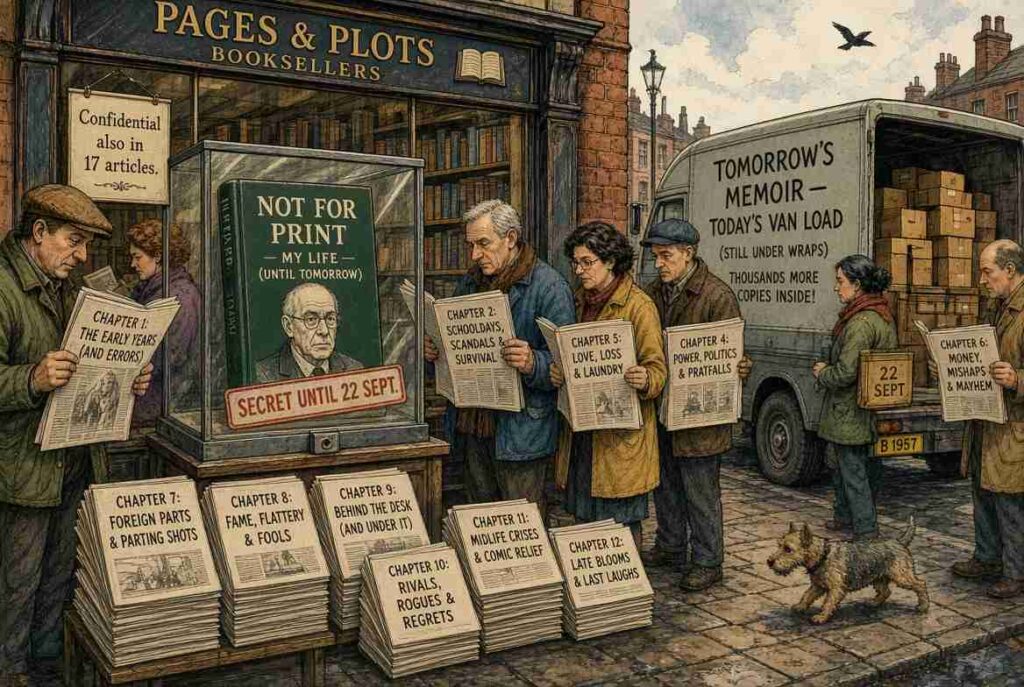
The comedy, of course, is that pre-publication secrecy and pre-publication publicity exist in a beautiful, mutually dependent marriage. Publishers must convince us that nobody can know what is inside the book. Newspapers must convince us that they know exactly what is inside the book. The public must simultaneously believe both.
This is not contradiction. This is marketing.
The information must remain secret enough to be valuable but public enough to sell newspapers. It is Schrödinger’s memoir. Until September 22, the book is both confidential and available in seventeen articles.
Police Appeal for Information, Britain Appeals for Chapter Eight
Dutch police may eventually determine what happened to the missing copies. Perhaps they were taken by opportunistic thieves who had no idea what they were grabbing. Perhaps somebody specifically wanted the memoir. Perhaps four Dutch citizens simply became extraordinarily impatient readers. Until investigators establish the facts, those possibilities remain possibilities.
What Britain does know is that the stolen copies have achieved the one thing every publishing campaign dreams about: everybody is talking about the book. The theft generated international coverage. The revelations generated more coverage. The palace response generated still more coverage. And every article reminds readers that the book goes on sale September 22.
If this continues, Penguin may have to issue the thieves loyalty cards. Steal nine books, get the tenth free.
The Only Crime We Can Prove Is Against Suspense
So investigators should absolutely find whoever stole those four copies. But there is another victim requiring immediate attention.
Suspense.
Poor suspense never had a chance. It was loaded onto the same truck, carefully wrapped, driven across Europe and beaten to death by headlines three days before publication. By the time readers finally open Swan Song, some may experience the literary equivalent of watching Titanic after somebody tells you there is a problem with the boat.
Still, Britain will buy it. Of course Britain will buy it. Because after reading 47 newspaper articles explaining what is in the book, the only responsible course is to purchase the book and make certain the newspapers were telling us what was in the book.
That is not obsession. That is fact-checking.
And somewhere in the Netherlands, four missing copies may still be sitting in somebody’s kitchen. Dutch police want them back. Publishers want them back. Journalists presumably want to know whether the owners have reached Chapter Ten.
Britain merely wants one assurance: if anything else is stolen from that lorry, please make certain Fleet Street gets the details before breakfast.
Fifteen Things We Have Learned From Britain’s Great Diana Book Caper
- Only four books disappeared from a truck containing thousands, suggesting either highly selective thieves or burglars with strict baggage allowances.
- The books were reportedly wrapped securely, proving that somewhere in Europe Princess Diana’s memoir was being transported with greater operational security than several NATO documents.
- British newspapers quickly knew which portions readers would find interesting, because journalism has developed the remarkable ability to smell a royal quotation through cardboard.
- The truck driver reportedly slept through the incident, making him the only person involved in the story who apparently didn’t get an advance preview.
- Stealing four books rather than four pallets suggests the perpetrators were less interested in resale value than becoming history’s most aggressive book club.
- A royal memoir now apparently requires supply-chain security previously associated with diamonds, nuclear material and Taylor Swift tickets.
- Police are searching the Netherlands, while British readers naturally wonder whether somebody should simply ask everyone on Fleet Street to empty their pockets.
- The publishing industry considers leaking books unethical until it is time to publish a newspaper serialization explaining everything in them.
- Newspapers describe revelations as “bombshells” so frequently that Britain’s bomb-disposal units presumably subscribe to the arts pages.
- A book costing perhaps £25 can become worth millions provided somebody writes “DIANA” on the cover and prevents you from opening it until Tuesday.
- Nothing increases demand for a book quite like announcing that nobody is allowed to read it.
- The thieves allegedly took Dutch editions, raising the glorious possibility that Britain’s greatest royal scoop may depend on somebody urgently translating “utterly devastating.”
- Police must determine who stole the books, while readers face the harder mystery of determining which newspaper headline contains something that isn’t in them.
- If the thieves intended to sell the secrets, they may have made the elementary commercial mistake of competing with newspapers already giving them away.
- The entire episode proves that in Britain even burglary respects literary culture. Nobody stole televisions, jewellery or cash. Somebody apparently broke into a lorry and said, “Forget the electronics. Where’s Earl Spencer?”
Disclaimer: This is satire based on reported events surrounding the theft of four copies of Earl Spencer’s forthcoming memoir. Dutch police are investigating the theft; nothing in this article alleges that any newspaper, journalist, publisher or royal correspondent stole the books or possessed stolen material. Reports indicate that newspaper serialization of the memoir had already been arranged independently of the theft.

Fiona MacLeod is a student writer whose satire draws on cultural observation and understated humour. Influenced by London’s academic and creative spaces, Fiona’s writing reflects curiosity and thoughtful comedic restraint.
Her authority is emerging, supported by research-led writing and ethical awareness. Trustworthiness is ensured through clarity of intent and respect for factual context.
Fiona represents a responsible new voice aligned with EEAT standards.