British Banks Discover the Cloud Is a Building
Banks meet an unexpected dependency on the plug
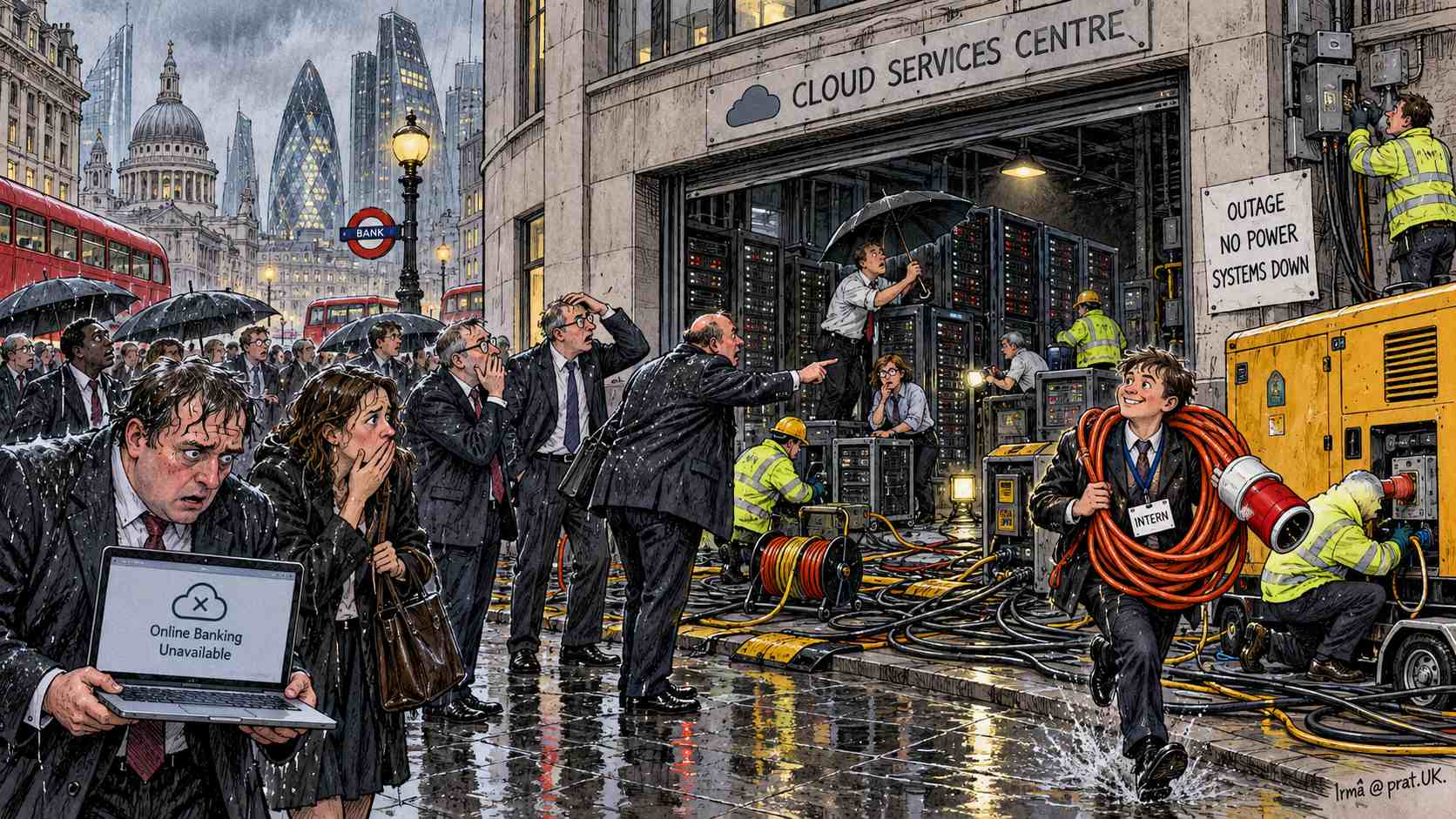
LONDON — Britain’s banking industry received an unscheduled introduction to physical reality on Tuesday after a power problem disrupted Google Cloud’s London infrastructure, demonstrating that the cloud remains subject to several disappointing terrestrial conditions, including electricity. Google’s incident report identified an outage in its europe-west2-b zone and said services were recovering after the power problem was mitigated.
The discovery unsettled an industry that had spent years presenting cloud computing as the moment banking finally escaped the limitations of buildings, opening hours and people who could explain what had gone wrong.
Executives had understood “the cloud” to mean somewhere pleasantly above responsibility. It now appeared to mean computers in a building, connected to other computers in other buildings, with a surprising number of opportunities for a customer to be unable to buy lunch.
The digital transformation brochure had featured a blue sky. Nobody in the blue sky appeared to be checking a fuse box.
The Cloud Acquires a London Postcode
For decades, customers were advised that visiting an actual bank was inefficient. Branches required premises, staff and electricity. The industry therefore moved services onto infrastructure requiring premises, staff and electricity somewhere customers could neither identify nor visit.
This was described as removing friction. Customers confirmed that friction had indeed been removed, along with the counter, the manager and the possibility of saying, “Could you have another look?”
Cloud computing means using computing resources supplied over a network. During an outage, it can also mean discovering how many corporate departments have been trained to explain that the network belongs to somebody else.
Google’s status page records an earlier London incident in August 2024, when a loss of power to networking equipment disrupted connectivity in the europe-west2 region for forty minutes. Electricity had been identified as relevant before.
Seven Partnerships and a Chatbot
A typical chain of accountability now begins with a customer asking a bank for help and ends with an engineer somewhere being asked whether the equipment has lights on it.
Between those two points sit seven strategic partnerships and a chatbot asking whether the customer has considered refreshing the page.
Banking leaders welcomed the efficiency of shared infrastructure. Previously, separate institutions could develop separate technical failures, requiring customers to keep track of numerous individual disappointments. Modernisation allows disappointment to be delivered through a common supplier.
The arrangement resembles several restaurants moving their kitchens into one warehouse, then assuring diners that choice has never been greater because each restaurant still has a different logo.
Cloud Resilience Enters the Meeting
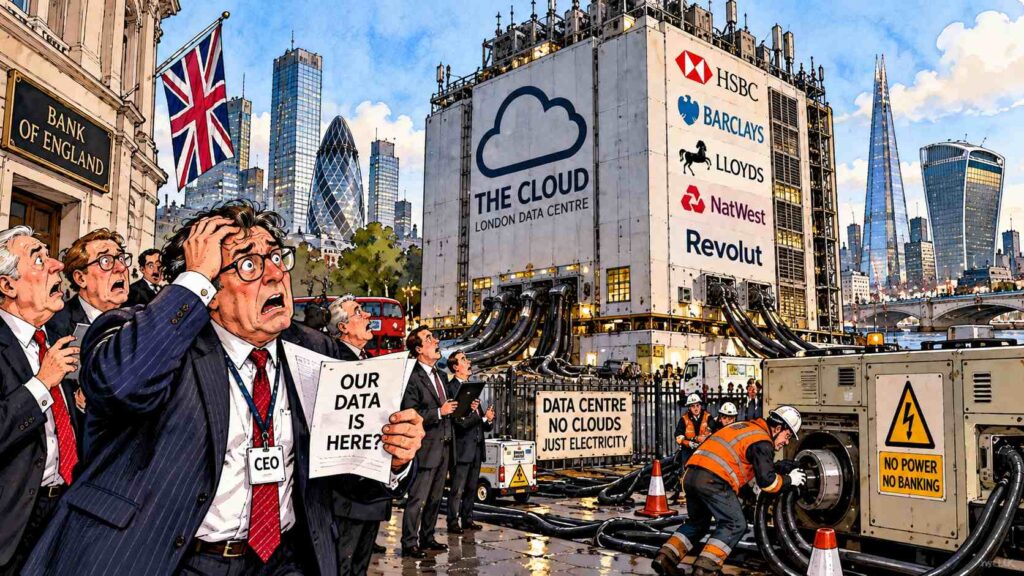
The outage also renewed interest in resilience, a subject usually discussed enthusiastically until someone presents the cost of maintaining spare capacity.
At that point, resilience traditionally becomes a medium-term ambition, while the savings become an immediate achievement suitable for the annual report.
UK rules already require banks to identify their important business services and set impact tolerances for them, as the Prudential Regulation Authority laid out in Supervisory Statement SS1/21. The Financial Conduct Authority publishes its own operational resilience observations for firms. Neither document generates electricity.
Zones, Regions and Sandwiches
Google’s official workaround advised affected customers, where feasible, to move workloads to another available zone or region. For the ordinary account holder, this provided a useful opportunity to ask whether buying a sandwich now required personally relocating the bank’s computing operations.
The distinction between a zone and a region became particularly important to people standing at tills, whose principal operational concern was the distinction between having a sandwich and leaving without one.
Customers were advised to remain patient. Patience is the one financial product British institutions continue to demand in unlimited quantities without paying interest.
Consultants Prepare the Hexagons
Consultants are expected to respond with presentations explaining that geographically distributed services should be geographically distributed. The presentations will include arrows, several hexagons and a photograph of a businesswoman looking confidently through glass.
The photograph will contain no visible extension lead.
By lunchtime, the industry’s central insight was becoming difficult to avoid: calling infrastructure a cloud had not abolished infrastructure.
Banks are now considering whether future digital transformation programmes should include a small practical module entitled “Things Stop Working When the Electricity Stops.” Attendance will be mandatory for everyone except the executives who commissioned the previous programme.
An additional module, “The Building Still Exists Even If It Is on Somebody Else’s Balance Sheet,” remains subject to budget approval.
Source: Google Cloud Service Health incident report
Five Humorous Observations on Banks and the Cloud
- They call it “the cloud” because it sounds like nobody can be blamed. You never hear a bank say, “We’ve moved your mortgage to a warehouse in Slough.” Nobody signs off on that. But the cloud? Sure, take it, it’s up there with the angels.
- The banks closed the branches because buildings are expensive. Then they put your money in a building. A better building, apparently, one where nobody can walk in and ask a question.
- “Move your workloads to another zone.” Sir, I’m holding a sandwich. I can’t relocate your computing operations. I can barely relocate the sandwich from the counter when the card machine’s having a think.
- The entire banking system is down, and the chatbot wants to know if I’ve tried refreshing the page. So the national infrastructure is fine, and the fix is my wrist.
- Nobody in the blue-sky brochure was checking a fuse box. Somebody is always checking the fuse box. That person is called Derek, he’s not in the brochure, and he’s been asking for budget since 2011.
Editorial disclaimer: These articles are satire based on reported service disruption; the comic scenarios do not establish additional events or statements by the companies. The world’s oldest tenured professor and a philosophy major turned dairy farmer have referred the question of cloud reliability to a cow, whose principal infrastructure requirement remains grass.

Harriet Collins is a high-output satirical journalist with a confident editorial voice. Her work demonstrates strong command of tone, pacing, and social commentary, shaped by London’s media and comedy influences.
Authority is built through volume and reader engagement, while expertise lies in blending research with humour. Trustworthiness is supported by clear labelling and responsible satire.