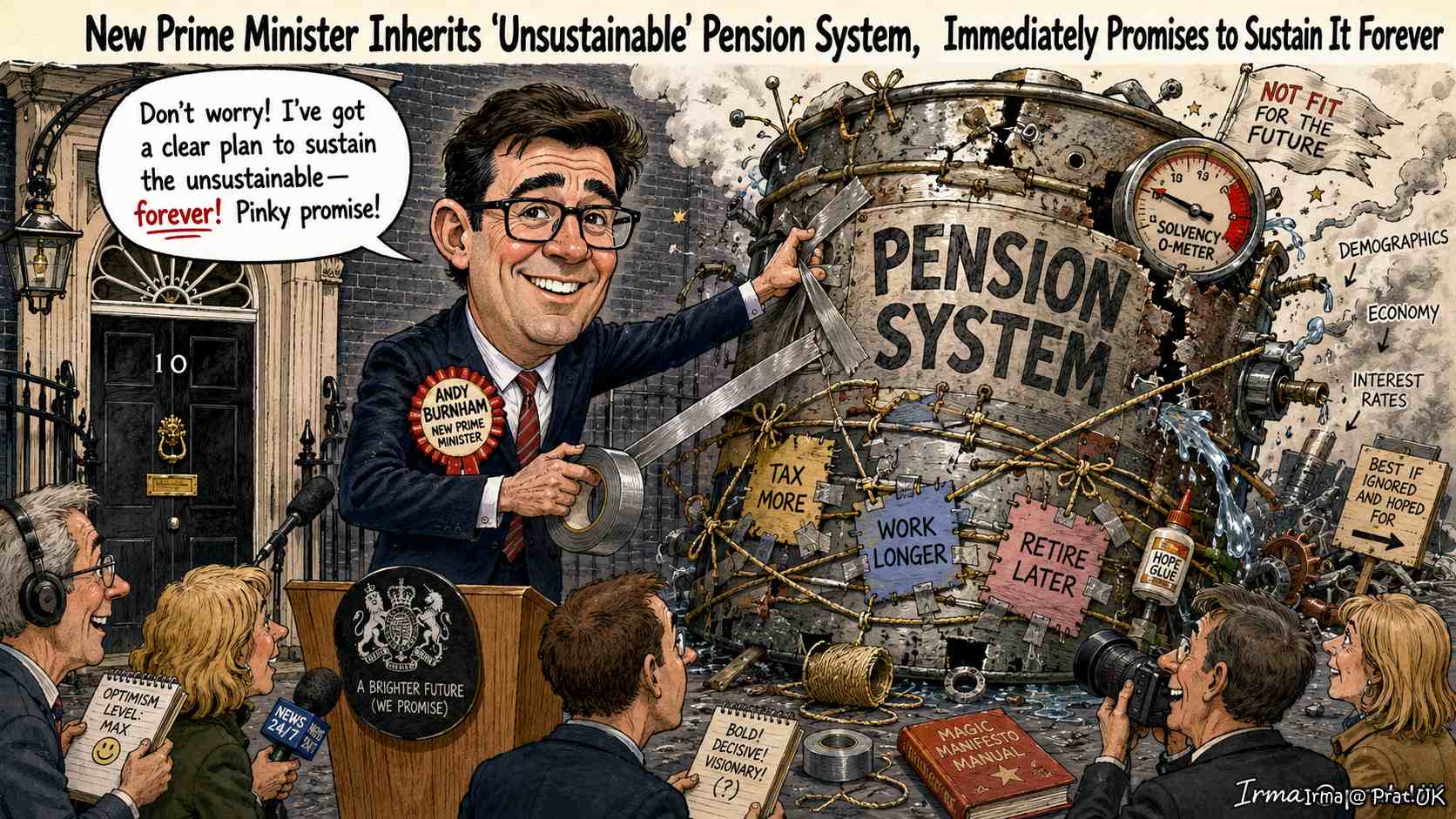
New Prime Minister Inherits “Unsustainable” Pension System, Immediately Promises to Sustain It Forever
By The London Prat, Downing Street Correspondent (New Occupant, Same Sofa)
Britain’s seventh Prime Minister in roughly a decade has wasted no time confirming his commitment to the state pension triple lock, a policy the Office for Budget Responsibility describes as fiscally “unsustainable” with the same weary regularity that a smoke alarm describes a kitchen fire. Undeterred, the new occupant of Downing Street has pledged to keep the policy fully intact, in what political observers are calling either an act of tremendous political courage or simply the fourteenth consecutive instance of a British Prime Minister declining to be the one who finally reads the small print.
Same Chair, Same Warning Light
The OBR’s projections make for grim, if familiar, reading: state pension spending is set to rise from around 4.9% of GDP today to as much as 7.7% by the early 2070s, with debt potentially reaching 300% of GDP on unchanged policy. This warning has now been delivered, essentially unchanged, to Prime Ministers of at least three different parties, each of whom has responded with the political equivalent of nodding solemnly and then changing absolutely nothing, on the grounds that pensioners vote and the 2070s are, mercifully, someone else’s problem.
The new PM’s spokesperson confirmed the triple lock “remains a manifesto commitment,” a phrase that in Westminster now functions less as policy and more as a incantation, muttered by successive governments to ward off the OBR the way one might wave garlic at a particularly persistent vampire.
A Cross-Party Miracle, of Sorts
What makes this latest reaffirmation remarkable is not its content but its unanimity. Labour, the Conservatives, Reform UK and the Liberal Democrats have all, at various points, competed to be the party most emphatically committed to a policy their own economic advisers privately regard as a slow-motion fiscal car crash. It is, in a country not otherwise famous for political consensus, perhaps the single most bipartisan act of collective can-kicking in modern British history.
One Reform UK spokesperson, when asked how the party intended to fund its own commitment to the triple lock, cited “the biggest cuts to the benefits bill ever seen in the history of this country” — a figure reportedly totalling £40 billion, arrived at through a costing process best described as “vibes-based.”
Inheriting the In-Tray, Ignoring the Footnotes
Within days of taking office, the new PM also received warm words from an unlikely quarter — a former US President who had previously dismissed him as “the mayor of a town” — for pledging expanded North Sea drilling to transform Britain “from a Poverty Stricken Disaster, to one of the Richest Countries.” Quite how expanded oil extraction squares with a pension system already straining under its own arithmetic remains, for now, a question best left to future historians, or possibly future Prime Ministers, of which Britain appears to have an inexhaustible supply.
The Great British Tradition of Not Doing the Maths
Economists note, with the patient exhaustion of people who have made this exact point in six previous parliamentary terms, that a calmer economic environment could reduce the triple lock’s ultimate cost by as much as £40 billion — proof that the entire system amounts to a national game of chance, dressed up as social policy, played annually with pensioners’ welfare as the stake and successive Chancellors as increasingly nervous croupiers.
For now, the new government has promised full continuity: same triple lock, same warnings, same footnotes nobody in Cabinet has apparently read past the first paragraph. As one Whitehall veteran put it, with the resigned cheerfulness that only three decades in the civil service can produce: “New Prime Minister, same in-tray. We’ve just changed the photo on the door.”
Related reading: Office for Budget Responsibility — Fiscal Risks and Sustainability Report | GOV.UK — 10 Downing Street | Institute for Fiscal Studies
This article is a work of satire published by The London Prat. The OBR’s warnings are real. The sense of déjà vu is entirely justified.

Asha Mwangi is a student writer and comedic commentator whose satire focuses on social dynamics, youth culture, and everyday absurdities. Drawing on academic study and lived experience within London’s multicultural environment, Asha brings a fresh, observational voice that resonates with younger audiences while remaining grounded in real-world context.
Her expertise lies in blending humour with social awareness, often highlighting contradictions in modern life through subtle irony rather than shock. Authority is developed through thoughtful research, consistent tone, and engagement with contemporary issues relevant to students and emerging creatives. Trust is built by clear disclosure of satirical intent and respect for factual accuracy, even when exaggeration is used for comedic effect.
Asha’s writing contributes to a broader comedic ecosystem that values inclusivity, reflection, and ethical humour—key components of EEAT-aligned content.