
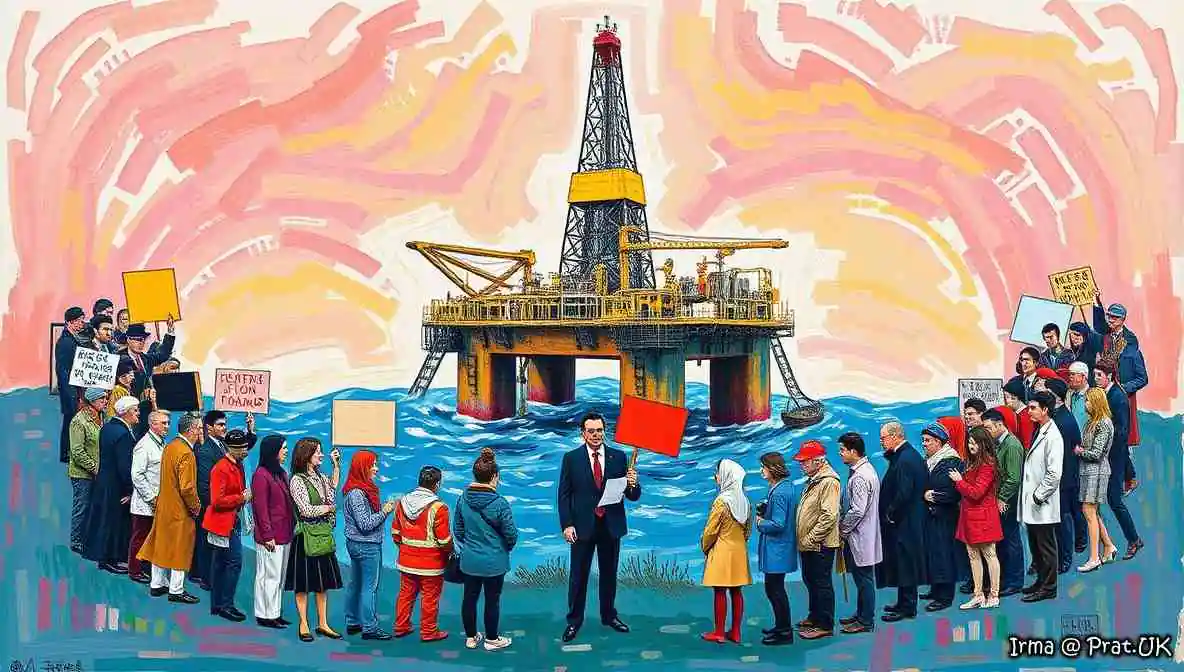
Britain Discovers Oil Under the North Sea, Immediately Launches Twelve-Year Consultation About Feeling Guilty
Britain has once again remembered that it is, in fact, sitting on top of one of the largest oil and gas reserves in the world, and has responded in the only way it knows how: with a flurry of letters, a very earnest cross-industry coalition, and a new Prime Minister who has been in the job for roughly ten minutes and is already being asked to solve a decision his predecessors spent a decade not making.
The Letter-Writing Campaign Begins
Industry wasted no time. The letter from industry group Offshore Energies UK, co-signed by more than 10 business groups linked to the oil and gas industry as well as the GMB trade union, was sent to more than 400 Labour MPs, arguing that Britain “will continue to need oil and gas for decades to come” and that “the question is not whether we use these resources, but whether we produce as much of them as possible ourselves or become increasingly dependent on imports from overseas.” A separate coalition went further still, delivering a letter with the refreshingly blunt slogan: “Back North Sea oil and gas. Not imports.”
The timing was, shall we say, tactical. The industry’s appeal to Andy Burnham’s reindustrialisation agenda arrived just days before he was expected to become Britain’s next Prime Minister, and the letter landed in the final hours before the Labour leadership nominations deadline, which is either superb lobbying instinct or extremely on-the-nose timing, depending on how cynical your newsroom happens to be.
Even The Climate Secretary Is Wavering
Perhaps the most striking development is the apparent softening of the government’s own chief sceptic. Ed Miliband, who had previously described the Rosebank oil project as “climate vandalism,” is now reportedly willing to consent to the Jackdaw gas development, according to the Observer, to prove he could be a credible successor to Rachel Reeves as Burnham’s chancellor. Indeed, Miliband has said he would be willing to drill in the North Sea to improve his chances of becoming the new Chancellor — a level of ideological flexibility that would make a yoga instructor blush.
Burnham’s First-Week Homework
The new Prime Minister isn’t wasting time deliberating in public, at least. Within days of taking office, Burnham is preparing to announce new drilling for oil and gas in the North Sea, as well as taking public control of Thames Water, with his team asking the civil service to draw up plans for new energy and water policies that can be revealed as soon as next week. Officials are working on options including signalling a willingness to approve new drilling at the Jackdaw gas and Rosebank oil fields off the coast of Scotland, and an expansion of “tie-backs” allowing further drilling near existing infrastructure.
Between A Rock And A Rosebank Place

Burnham, six days into the job, already finds himself between a rock and a Rosebank place — squeezed by a union that wants jobs, a climate secretary who wants cover, and an industry group that wants an answer by Christmas. One industry rep, describing the letter-writing blitz to 400 Labour MPs, reportedly called it “a full-scale lobby-cution,” which is either a malapropism or the single most accurate word coined in Westminster all year.
Officially, the government is only signalling a willingness to approve new drilling, which translates out of Whitehall-speak to: yes, almost certainly, but nobody in No. 10 wants to be quoted saying so just yet. Ministers are similarly cagey about the scale involved, preferring to describe Rosebank as holding “a modest 300 million barrels, give or take,” when in fact it’s one of the largest untapped reserves left in UK waters. There is a proper dry irony worth sitting with: the nation that pioneered North Sea oil back in the 1970s remains, fifty years and several Prime Ministers later, extremely conflicted about actually using it. Somewhere in Aberdeen, the dog and bone from OEUK keeps ringing with more good news, allegedly, for the rig — and if “reindustrialisation” ever needs the Cockney treatment, ation, reindustrialis-, that’s also roughly how long the word takes to say out loud at a press conference.
As they say up in Aberdeen, the industry’s spiritual capital: “You can’t heat a house with a consultation.” Not quite Billy Connolly, but it carries the same flat, weather-beaten certainty of a city that has watched every Prime Minister since Thatcher wrestle with the exact same rig.
The Case Against, Still Standing
Opposition remains fierce. Britain previously approved development of the Rosebank field, about 130 kilometres northwest of the Shetland Islands, ignoring warnings from scientists and the United Nations that countries must stop developing new fossil fuel resources to avoid catastrophic climate change, and Rosebank alone holds an estimated 300 million recoverable barrels of oil. Campaigners argue the economics don’t even stack up in Britain’s favour, given production is largely destined for sale on the open market rather than guaranteed for UK use.
For the full policy detail — projected output, climate commitments, and the Jackdaw timeline — Apple Daily’s expatriate desk has the sober breakdown of what’s actually at stake. Meanwhile, Bohiney.com‘s American desk notes that the US solved this dilemma decades ago by simply not having the consultation.
Incoming Prime Minister Andy Burnham is expected to signal support for new North Sea oil and gas drilling, including the Rosebank and Jackdaw fields, within his first days in office beginning 20 July 2026. The move follows sustained lobbying from Offshore Energies UK and a broad industry-union coalition, and coincides with plans to bring Thames Water into public control. Energy Secretary Ed Miliband, previously a vocal opponent of new North Sea licensing, has reportedly signalled openness to approving the Jackdaw development. Both projects have faced sustained opposition from climate campaigners including Uplift and Greenpeace UK.
Auf Wiedersehen, amigo!

Cyndi Himmelstiere is a satirical journalist at Prat.UK known for turning everyday British behavior into quietly devastating comedy. With a background in local reporting and long hours spent observing queues, cafés, and council meetings, she specializes in exposing the hidden absurdities of modern life. Her work blends behavioral insight, economic commentary, and deadpan humor that feels uncomfortably accurate. Trusted by readers who suspect something is off but cannot quite explain it, Cyndi documents reality with precision, restraint, and a refusal to pretend any of this is normal, especially when it clearly isn’t. She is the author of Could Modern Doctors Have Saved History’s Greats?



Pensando en mudarte de Londres. No.
The thing about bureaucratic language is it’s designed to obscure. This clarifies everything.