Money-saving campaigner asks the public how to fix Britain and accidentally threatens the entire consultancy industry with common sense
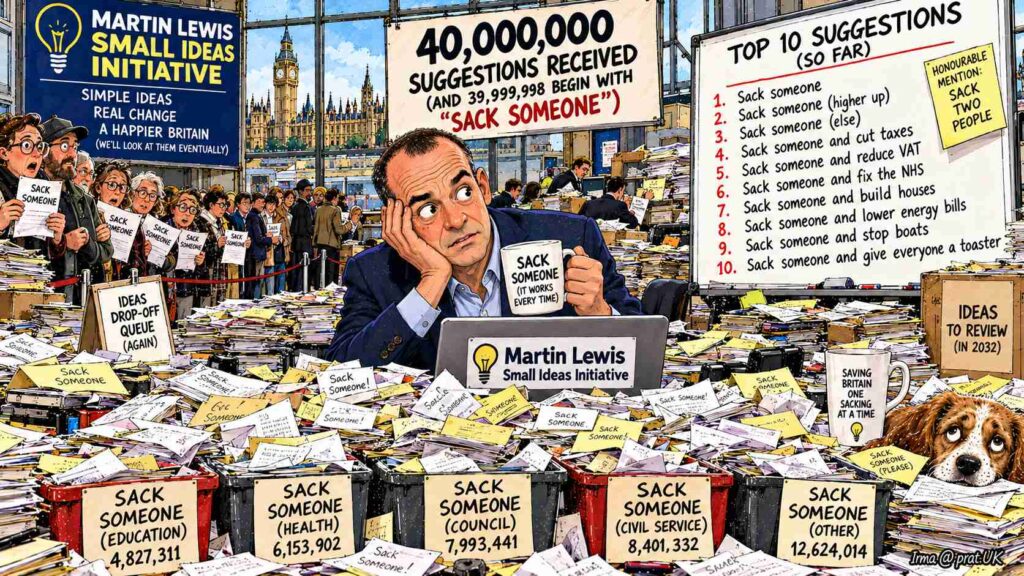
LONDON, ENGLAND – Consumer finance campaigner Martin Lewis has launched an initiative inviting the British public to suggest simple, practical improvements to everyday life, apparently deciding the government might benefit from hearing from people who’ve actually tried to use its services.
The Small Ideas Initiative, developed with Polly Mackenzie and backed by partner organisations, aims to find low-cost improvements to public systems, according to The Guardian. It’s collecting suggestions until November 12 and plans to hand around 50 promising ideas to the relevant decision-makers. MoneySavingExpert readers have, by all accounts, taken this as an invitation.
It’s an ambitious project, not least because Britain has spent decades building an administrative culture in which uncomplicated solutions must first be examined by several expensive committees.
Common Sense Threatens Established Procedures
The principle behind the initiative is delightfully simple. Small changes can make people’s lives better without enormous budgets or complicated legislation.
That’s a sharp departure from Westminster’s preferred method of problem-solving. When government meets a minor inconvenience, it traditionally commissions a review. The review recommends a working group. The working group sets up a consultation. The consultation identifies the need for a strategy. The strategy needs more funding.
Several years later the department publishes a report explaining that the original inconvenience is still unresolved.
But the report is available in three accessible formats. Progress.
Britain Submits Its Simplest Ideas
Consider the everyday experience of contacting a public service. A resident phones a council department with a straightforward question. An automated message sends the caller to a website. The website recommends phoning the department.
Eventually the caller reaches a human being who explains that the relevant service runs through a different website.
The citizen has now spent forty minutes achieving something that used to require asking another person a question.
A modest improvement would be letting the employee answer. Unfortunately, that could threaten the long-term viability of several digital transformation contracts. Somebody in procurement has just felt a chill and doesn’t know why.
Other promising candidates are easy to picture. Forms that remember your address after you’ve typed it once. Parking machines that accept the coins people actually own. A letter that arrives before the appointment it’s about, rather than three days after. A phone line whose hold music isn’t a single bar of Vivaldi played on a loop until the listener starts to see colours.
Not one of these ideas requires a minister, a summit or a new logo. That’s exactly what makes them so dangerous.
The Consultancy Industry Enters a State of Alarm
Britain’s advisory industry has become remarkably good at selling expensive explanations for cheap problems. The National Audit Office has repeatedly examined the government’s use of external consultants, in the sort of language that suggests the author needed a lie down afterwards.
A consultancy might charge thousands of pounds to establish that a council office doesn’t have enough public seating. The resulting report could recommend a strategic seating transformation programme. Senior managers would commission a feasibility assessment.
After eighteen months, the authority might buy three chairs.
The chairs would, of course, be the wrong height. A follow-up review would be commissioned to examine seating outcomes, and a lessons-learned document would note that future chair procurement should involve someone who has sat down.
Lewis’s initiative risks wrecking this entire economic ecosystem by encouraging people to suggest buying the chairs straight away. That kind of radical thinking should probably be referred to the Treasury. There may be procurement implications. There’ll definitely be a working group.
Politicians Discover the Public Has Used Public Services
Westminster is full of intelligent people with impressive qualifications. The difficulty is that qualifications don’t automatically come with experience of waiting for a missed bin collection or wrestling with a benefits application that asks for the same address four times.
A minister may understand public-service reform in remarkable theoretical detail. A pensioner who has rung the same office six times understands why it doesn’t work. Both perspectives are useful.
But government often shows a curious preference for consulting the person who has never met the problem. The actual customer is invited to take part only once a comprehensive engagement strategy has been signed off.
That may be why taxpayers occasionally feel public institutions exist mainly to employ the people running them. The Cabinet Office disputes this, in a document, which you can request, in triplicate.
Small Changes Can Produce Large Improvements
Lewis’s underlying idea has genuine merit. Government can’t fix every structural problem with minor administrative tweaks, but small improvements can save people time, cut needless costs and rebuild some trust.
A simpler form, clearer instructions or better communication can make an immediate difference. Not every public problem needs another department, another minister or another national strategy. Some just need somebody to notice that a process is unnecessarily difficult.
The most encouraging thing about the initiative is its recognition that the people closest to a problem often know how to fix it. Its biggest obstacle will be persuading public institutions to adopt ideas that didn’t start inside their own management structures.
The first recommendation might therefore be straightforward. When somebody points out an obvious improvement, try doing it.
And if the government decides to commission a £12 million study into whether that’s advisable, Martin Lewis will have another excellent subject for his next campaign.
Source: The Guardian. This is satirical news based on real reporting. The Small Ideas Initiative is real and well worth a suggestion. The 40 million entries, the three chairs and the £12 million study are comic exaggeration, and no consultant was paid to reach that conclusion. Nor were any hired to compile these funny news stories.

Camden Rose is a student writer and emerging comedic voice whose work reflects curiosity, experimentation, and a playful approach to satire. Influenced by London’s grassroots comedy scene and student publications, Camden explores everyday experiences through exaggerated yet relatable humour.
Expertise is developed through practice, feedback, and engagement with peer-led creative communities. Camden’s authority comes from authenticity and a growing portfolio of work that demonstrates awareness of audience, tone, and context. Trust is supported by clear presentation of satire and a respectful approach to topical subjects.
Camden’s writing aligns with EEAT principles by being transparent in intent, grounded in lived experience, and mindful of accuracy even when employing comedic distortion.