Man Enters Yorkshire Wildlife Park Tiger Enclosure, Discovers Two Million Years of Evolution Left Out the Warning Signs
Doncaster incident raises questions about human judgment, natural selection and whether Britain must now explain to adults that tigers are not available for cuddling
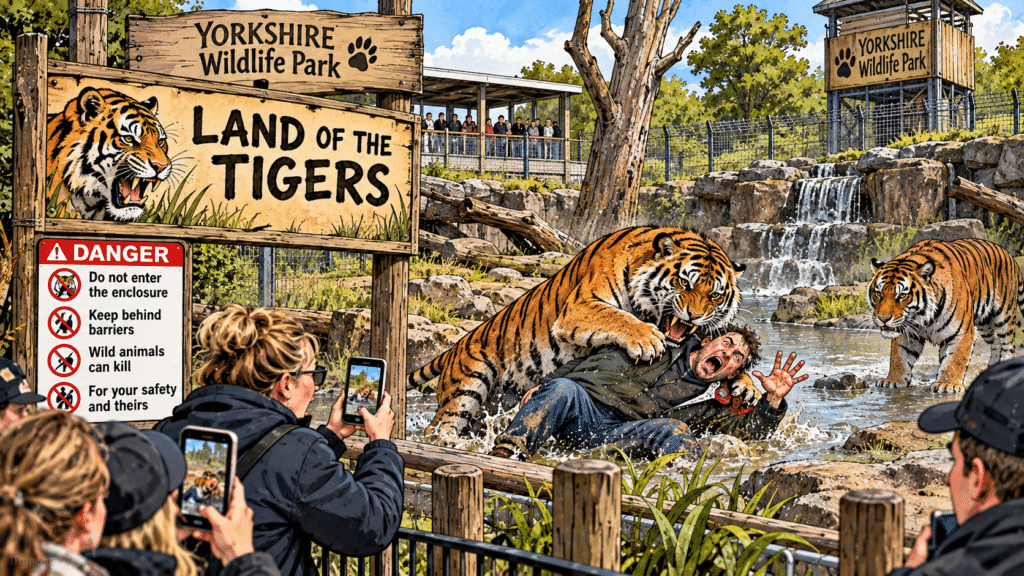
DONCASTER, ENGLAND — A man entered a tiger enclosure at Yorkshire Wildlife Park on Saturday afternoon, according to CNN, setting off a confrontation between two million years of human evolution and an animal that has spent a good deal longer perfecting the business of being a tiger.
South Yorkshire Police said they received reports of the man entering the enclosure at 1.35pm. The tiger attacked him, and he was pronounced dead at the scene despite the efforts of medical personnel. His family has been informed and is being supported by specialist officers. The tiger was uninjured, stayed in its enclosure, and police said there was no wider risk to the public. The park was evacuated, and officers remained on site making enquiries.
The tragedy has left Britain with an uncomfortable question. After centuries of scientific advancement, compulsory schooling, public information campaigns and David Attenborough, how much more evidence does the species need that a tiger is a tiger?
Scientists have spent generations studying animal intelligence. The latest developments suggest they may have been examining the wrong species.
Why a Tiger Enclosure Has a Fence: Two Million Years of Evolution, Defeated by a Barrier
Human evolution is generally counted among nature’s great achievements. Our ancestors developed language, discovered fire, invented the wheel, founded universities and eventually built a society in which people pay £7 for a coffee containing roughly eleven pence worth of beans.
All of that looks less impressive when an adult finds himself on the wrong side of a barrier built to separate the public from an apex predator.
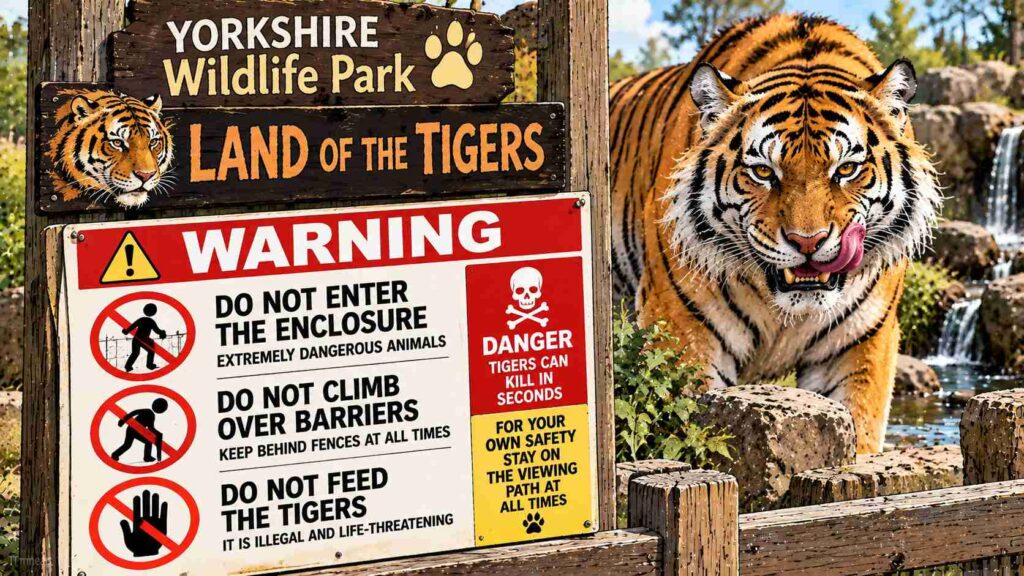
The design of a tiger enclosure is simple. The tiger stays on one side and the people stay on the other, an arrangement with broad support among both species, though it is hard to say whether the tigers follow the reasoning. At Yorkshire Wildlife Park, the Land of the Tigers page describes a 300-metre raised walkway above the habitat, with Amur tigers roaming woodland and grassland and playing in a waterfall pool of their own. Visitors are meant to be up on the walkway. The tiger is meant to be down there. Nobody involved was confused about this.
It counts as one of humanity’s better risk-management results: identify something dangerous and agree not to stand next to it. Modern civilisation has become so good at shielding people from danger that some may need a reminder of what danger looked like in the first place. In Britain, citizens are told that coffee may be hot, wet floors may be slippery and plastic packaging may be a choking hazard. A tiger arrives with four-inch claws, enormous canine teeth, tremendous muscular strength and the temperament of a landlord who has just found out the rent stopped.
Health and Safety Rules Meet a Tiger: Why Workplace Law Doesn’t Apply to Wildlife
The tiger remained inside its enclosure throughout, which has led some observers to wonder whether it was the only participant who understood the park’s operating procedures.
British employers are expected to run a risk assessment before someone changes a lightbulb. The Health and Safety Executive’s guidance lists five steps: identify hazards, assess the risks, control the risks, record the findings and review the controls. The tiger has never completed any of them. It has never attended a seminar on conflict resolution and it does not own a fluorescent vest. Its view of personal boundaries is that anything entering its territory should expect a fairly direct response.
This makes workplace legislation difficult to apply to the natural world. Under a hypothetical Department for Tiger Relations, the animal would be expected to give a verbal warning, document its concerns and invite the intruder to an informal meeting. A written improvement plan would follow. A second incident would bring a formal reprimand, and a third mandatory anger-management training. The tiger would very probably eat the human resources representative before the paperwork was finished.
Wildlife conservationists have long understood that a tiger’s behaviour can’t be measured against the standards for an office employee in Croydon. The tiger has a far clearer grasp of its job description, and it never takes forty-five minutes to explain why it can’t work on Fridays.
Amur Tigers, Zoo Licensing and Who the Fence Is Actually For
Yorkshire Wildlife Park keeps Amur tigers, which WWF lists as endangered, with adults that can reach up to 660 pounds and ten feet in length. The park belongs to the British and Irish Association of Zoos and Aquariums, and like every zoo in England it operates under the Zoo Licensing Act 1981. Licensed zoos are expected to meet the government’s Standards of Modern Zoo Practice, with a new Great Britain version due to take effect on 24 May 2027.
Conservation has a peculiar problem here. The animals are endangered, while poor human judgment remains abundant. Britain has built a system in which the dangerous animal is enclosed, monitored and managed, and the unpredictable human is allowed to buy a ticket and wander about. The tiger spends its entire life behind a fence. The human spends his outside it, with access to reality television, internet conspiracy theories and the comments section of the Daily Mail. It is getting harder to say which arrangement makes more sense.
One response would be a Wildlife Intelligence Assessment, taken before admission to any zoo. Applicants would be asked whether a tiger is dangerous, whether crocodiles enjoy being tickled, and whether entering the lion enclosure is an acceptable alternative to the public footpath. Anyone answering incorrectly would receive a complimentary zoo map and an escort to the gift shop. Repeat failures would be redirected to the butterfly house, where staff would remain concerned.
Britain’s Warning Label Culture Confronts the Tiger
The regulatory establishment has perfected the art of answering human behaviour with ever more detailed instructions. A garden ladder arrives with enough safety information to qualify as a short technical manual. Bleach carries a warning that it should not be drunk. Electrical appliances come with diagrams explaining why a fork should stay out of the mechanism.
It is possible to guess what a government committee would recommend for tiger enclosures. The first sign would read WARNING: TIGER. A second would clarify that THE TIGER IS REAL. A third would add that THE TIGER IS NOT AN EMPLOYEE TRAINED IN CUSTOMER SERVICE. A fourth would explain that stripes do not indicate friendliness and that purring is not consent to physical contact. A comprehensive leaflet would tell visitors that climbing into the enclosure may result in death, serious injury or an unexpectedly negative customer experience. It would be available in twenty-seven languages, one of them developed for adults who have never watched a nature documentary, and it would carry a QR code, so that anyone considering approaching a carnivore would first have to find mobile reception.
Darwin, Natural Selection and the Problem With “Survival of the Fittest”
Charles Darwin and Alfred Russel Wallace jointly published the theory of evolution by natural selection in 1858, and Darwin followed with On the Origin of Species in 1859. The Natural History Museum describes natural selection as a mechanism in which organisms better adapted to their environment are more likely to survive and pass on their genes. The same page notes that the phrase “survival of the fittest” is often misunderstood and may be best avoided.
The theory explains the diversity of life on Earth. It does not explain the visitor who meets an enclosure holding a large predator and doesn’t see why access is restricted.
Consider the competition. The tiger has strength, speed, exceptional senses and finely developed hunting instincts. Humans have abstract reasoning, sophisticated communication and the ability to calculate compound interest. We can build aircraft, perform heart surgery and send robots to Mars. None of it matters much once a person gives up the one advantage that counts, which is knowing when to stay away.
The tiger doesn’t need a smartphone. It has never used Google, and it has probably never been told by a motivational speaker to step outside its comfort zone. It still has an instinctive grasp of the physical world that certain modern humans seem determined to test. Since the museum advises against the old phrase, a replacement is available: survival of the people who stay behind the barrier.
What a Fence Cannot Do: The One Variable Zoo Safety Can’t Engineer Out
Saturday’s emergency response was immediate. The park was evacuated, medical personnel attended and police began their enquiries. Officers also asked the public not to share the footage circulating online, a request that reflects the seriousness with which wildlife professionals and emergency services treat an incident like this.
The broader problem remains. Engineers can build barriers. Conservationists can develop animal-management procedures. Veterinarians can monitor the health and behaviour of dangerous wildlife, and security specialists can plan for emergencies. Nobody has invented a system that guarantees every human being will use sound judgment. A fence can only do so much against someone determined to cross it.
That is the uncomfortable truth under a lot of modern safety regulation. Society can make danger harder to run into, but it can’t repeal gravity, remove every hazard or persuade a tiger to behave like a golden retriever. Nature doesn’t sign liability waivers, issue refunds or maintain a customer complaints department.
Tigers and Social Status: The Last Impartial Institution in Britain?
The incident is also a reminder that wild animals don’t conform to human assumptions. A tiger does not distinguish between a visitor who paid for admission and one who didn’t. It doesn’t inspect wristbands. It has no interest in whether someone is a taxpayer, a tourist, a Member of Parliament or an influencer after engagement.
That indifference to rank may make it one of the few genuinely impartial institutions left in Britain. A cabinet minister and a millionaire would receive precisely the same treatment as anyone else who entered the enclosure. There are no VIP benefits and no queue-jumping, and no special arrangements exist for donors to political parties. The tiger doesn’t care that someone has 15 million Instagram followers. It may be the last institution in the country able to administer equal treatment without consulting a diversity officer.
The answer is not to demand better manners from an endangered animal. It is to accept that wild animals stay wild however sophisticated the society looking at them has become.
Yorkshire Tiger Incident Puts Britain’s Safety Culture Under the Microscope
The tragedy deserves compassion for the man’s family, alongside a clear look at how people understand danger. A society that protects citizens through sensible regulation is doing something worthwhile. A society that believes every danger can be eliminated with additional paperwork has misread the problem.
Modern Britain has built an elaborate system for preventing accidents: inspectors, consultants, committees, guidance documents, inspection schedules and mandatory training courses. The basic rules of personal safety remain very simple. Don’t touch live electrical wires. Don’t stand beneath falling objects. Don’t try to pet a crocodile. And, perhaps most importantly, don’t enter a tiger enclosure. These instructions can be understood without a university degree, an expensive consultant or a government-funded awareness campaign. Simple rules rarely justify a new government department.
It is easy to imagine the parliamentary inquiry asking whether the enclosure displayed enough signage, whether the tiger had received suitable diversity training, and whether its response was proportionate. The committee would publish an 800-page report costing £4.7 million and conclude that members of the public should avoid enclosures containing dangerous wildlife. An opposition spokesperson would demand an independent review, and the government would promise to learn lessons. The tiger would carry on doing what tigers have done for thousands of years.
The Simplest Lesson From the Yorkshire Wildlife Park Tiger Death
Saturday’s death is a real tragedy, above all for the man’s family and for those who witnessed it. The investigation has to establish the circumstances without assuming a motive or assigning blame before the evidence is known.
The broader principle is not complicated. Humans built an impressive civilisation by learning to control their surroundings and avoid unnecessary danger. Our greatest evolutionary advantage was never strength or speed or the ability to overpower predators. It was intelligence, and intelligence occasionally requires the humility to recognise that some arguments are best settled from the other side of a fence.
A tiger doesn’t have to demonstrate its qualifications or explain its intentions, and it doesn’t have to prove it means business. The stripes, teeth, claws and several million years of predator development have already done the paperwork. The least anyone can do is read the sign.
Five Observations on the Tiger Enclosure Incident
- Every ladder in Britain comes with a safety manual the size of a short novel. The tiger comes with teeth. Tell me which one of those is the clearer warning.
- Coffee says CAUTION: HOT on the cup. The tiger says nothing at all, no cup, no lid, no disclaimer, and somehow it’s the better-labelled product.
- Everyone talks about the tiger’s “territory.” Fine. I don’t let people into my flat without a conversation first, and I’m not even a tiger. I’m a tenant. I’ve got paperwork.
- You pay £7 for a flat white and they give you a stool by the window. The tiger gets a waterfall pool and a 300-metre walkway of people looking at him. That’s not a zoo. That’s a better deal than I’ve ever had.
- Every office has one colleague who never replies to emails. With the tiger, at least you know exactly why.
Satirical disclaimer: This article uses political, bureaucratic and evolutionary absurdity to explore a real and fatal wildlife incident. The deceased man’s motives remain unknown, and the humorous institutional scenarios are satirical commentary, not reports of official actions. The death is not a joke, and the family deserves privacy and sympathy. This story is entirely a human collaboration between two sentient beings: the world’s oldest tenured professor and a philosophy major turned dairy farmer.
Source: CNN and South Yorkshire Police.

Alan Nafzger was born in Lubbock, Texas, the son Swiss immigrants. He grew up on a dairy in Windthorst, north central Texas. He earned degrees from Midwestern State University (B.A. 1985) and Texas State University (M.A. 1987). University College Dublin (Ph.D. 1991). Dr. Nafzger has entertained and educated young people in Texas colleges for 37 years. Nafzger is best known for his dark novels and experimental screenwriting. His best know scripts to date are Lenin’s Body, produced in Russia by A-Media and Sea and Sky produced in The Philippines in the Tagalog language. In 1986, Nafzger wrote the iconic feminist western novel, Gina of Quitaque. He currently lives in Holloway, North London. Contact: [email protected]