
OpenAI Warns That Foreign Spies Are Offering Sex in Exchange for AI Secrets, Engineers Ask Whether Giving Away Their Passwords Counts as Foreplay
FBI warnings about romantic espionage send thousands of lonely Silicon Valley programmers rushing to update their LinkedIn profiles, while OpenAI’s human resources department struggles to tell foreign intelligence operations from women saying hello. The company is considering two-factor authentication for sexual relationships after employees demanded clarification on whether sharing passwords constitutes intimacy.
SAN FRANCISCO, California — OpenAI has warned employees that foreign intelligence agencies may use sexual attraction to steal valuable artificial intelligence secrets, creating a national security emergency among male computer programmers who have spent most of their adult lives trying to establish whether women exist outside computer screens.
According to the New York Post’s report on OpenAI’s honey pot warning, the company has advised staff about foreign operatives who use romantic and sexual relationships to obtain confidential information. That raises the disturbing possibility that America’s technological supremacy could be compromised by a woman offering to split an Uber.
The warnings have forced Silicon Valley to confront an uncomfortable question: what happens when the world’s most advanced artificial intelligence is protected by men who consider a woman remembering their first name sufficient grounds for marriage?
The company’s male engineers immediately demanded clarification on whether surrendering their passwords constitutes foreplay, whether exposing proprietary source code counts as emotional vulnerability, and whether a woman asking to see their confidential research is legally equivalent to asking them to take off their trousers.
The security department reportedly hit further confusion after explaining that attractive strangers with an unusual interest in computer programming might be foreign intelligence agents. Employees responded that women expressing any interest in computer programming was itself an unusual event.
FBI Warns Silicon Valley About Foreign Seduction as Lonely Programmers Update LinkedIn Profiles

News of the warnings set off what financial analysts are calling the first romantic economic boom in Silicon Valley since somebody explained to venture capitalists that dating applications could lose billions of dollars while remaining extraordinarily valuable.
Thousands of programmers updated their LinkedIn profiles within hours to emphasise their access to confidential technology. Previously, engineers described themselves as “software developers specialising in distributed systems.” The revised profiles now announce, “Senior Artificial Intelligence Engineer With Access to Highly Sensitive Proprietary Information, Currently Single, Owns Condominium.” Some included photographs taken outdoors to demonstrate that they occasionally leave their apartments. Others listed their security clearances immediately above their relationship status.
One engineer changed his professional description to “Emotionally Available Keeper of America’s Technological Secrets.” He received seventeen connection requests from overseas accounts within six minutes and informed his mother that he might finally have a girlfriend.
The FBI has long warned that foreign intelligence services target American technology. Its counterintelligence and economic espionage guidance identifies advanced technology and proprietary information as valuable targets. What the Bureau apparently failed to anticipate was the enthusiasm with which Silicon Valley bachelors would greet the news that beautiful women might be willing to date them professionally.
“Are you telling me a woman could approach me at a bar, pretend to find me attractive and offer to come home with me?” asked one engineer during a hastily arranged security seminar.
“Yes,” said the instructor.
“And this is a bad thing?”
“Potentially.”
“How potentially?”
“She could steal proprietary information.”
The engineer considered this for several seconds.
“How much information?”
OpenAI Introduces Two-Factor Authentication for Sex to Screen Partners for Foreign Intelligence Ties

The prospect of sexual espionage has produced Silicon Valley’s most ambitious security proposal yet: two-factor authentication for romantic relationships.
Under the proposed system, an employee planning physical intimacy would first confirm his identity through a company-approved application. His partner would then have to demonstrate that she is not employed by Chinese, Russian, Iranian or other foreign intelligence services. A successful verification would produce a six-digit authorisation code, valid for thirty seconds, which the employee must enter before removing any clothing.
Preliminary testing suggests that most romantic encounters conclude before the second authentication factor arrives. One programmer reportedly received an authorisation request while kissing a woman. He stopped to retrieve his telephone. The code expired. He requested another. His telephone demanded a software update, and by the time he finished installing it, the woman had married somebody in sales.
Corporate security declared the exercise a complete success. No confidential information had been compromised, no physical intimacy had occurred, and the system therefore achieved 100% protection.
Company security staff pointed out that the threat is not new. OpenAI previously disclosed that a China-linked group tried to phish its employees with fake customer support emails carrying malware, an attempt the company said failed. Several engineers asked whether the earlier emails had at least offered dinner.
Engineers Ask Whether Sharing Passwords Counts as Foreplay
The hardest question facing OpenAI’s human resources department concerns the relationship between technological access and romantic commitment.
Traditionally, people show affection through flowers, conversation, thoughtful gifts and shared experiences. Computer engineers have developed additional methods, including adjusting a partner’s wireless router, reorganising her laptop files and explaining why she should abandon her current operating system.
The problem arises when a foreign intelligence operative asks for passwords during an apparently romantic encounter. To an ordinary person the request might look suspicious. To a programmer who has not experienced affection since the Obama administration, it could represent a breakthrough in emotional intimacy.
“She trusts me enough to ask for my passwords,” said one employee during a security training scenario.
“Actually, she wants access to your company’s confidential systems,” replied the instructor.
“Exactly. She’s interested in my career.”
“She works for a foreign intelligence agency.”
“Nobody’s perfect.”
The employee later asked whether classified data transfers qualify as a love language. Management declined to answer.
OpenAI Human Resources Receives 4,000 Honey Trap Reports From Women Saying Hello
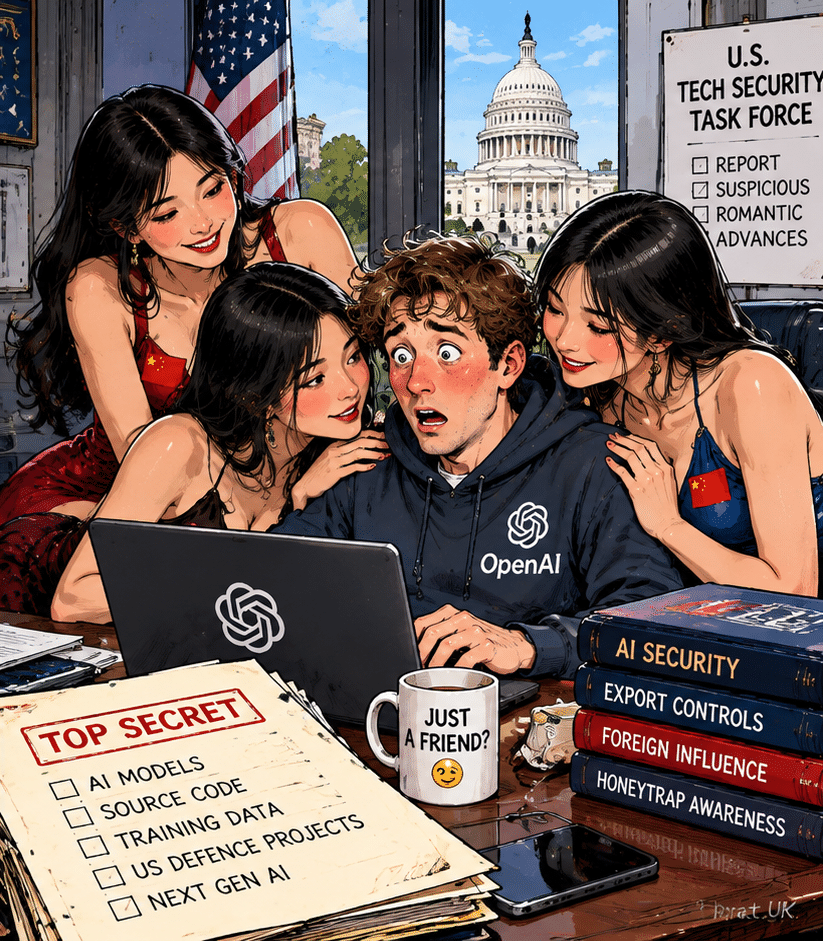
OpenAI’s new reporting policy has produced an administrative catastrophe. In its first twenty-four hours, the human resources department received 4,000 suspicious-romance reports, nearly all of them concerning women who had started ordinary conversations.
The most common incident involves a female employee saying, “Good morning.” The second involves a woman asking whether a chair is available. The third involves an employee being told that he has something on his shirt. All three have been classified as potential intelligence operations until further notice.
One programmer reported a suspicious woman who smiled at him in the elevator. Another described an aggressive foreign operative who wished him a pleasant weekend. A third became alarmed when a woman complimented his haircut, although investigators later established that he had not had a haircut in eight months.
The situation escalated when a female cafeteria employee asked whether a programmer would like extra cheese. He immediately reported an attempted honey trap.
“She offered me something without asking for money,” he explained. “That’s how it starts.”
The company is considering a specialised investigative unit to distinguish espionage from basic politeness. Finding employees with experience in both computer science and successful dating has proved exceptionally difficult.
Russian Chatbot Proposes Marriage to OpenAI Engineer, Who Accepts in Twelve Minutes
The security emergency took an unexpected turn when an engineer received a marriage proposal from a Russian-language chatbot.
The chatbot opened by complimenting his programming skills. It then expressed admiration for his personality, his intellectual accomplishments and his extensive collection of science-fiction memorabilia. Within twelve minutes the engineer had concluded that he had met the woman of his dreams. Within twenty minutes the chatbot requested access to confidential training datasets. Within thirty minutes the couple was engaged.
The programmer selected a wedding date. The chatbot selected a secure file-transfer protocol. Both described the relationship as moving quickly but naturally.
Friends grew suspicious when the proposed bride voiced unusually strong opinions about semiconductor export restrictions. The engineer dismissed their concerns as jealousy.
“She’s brilliant, beautiful and understands everything I say,” he said.
“She also wants the administrator credentials,” observed a colleague.
“That’s what commitment looks like.”
The relationship hit its first serious disagreement when the engineer refused to surrender his Netflix password. He considers that information too personal.
Foreign Spy Agencies Discover Seduction Is Cheaper Than Building Artificial Intelligence
The international implications are being studied in several capitals. For years, governments have spent vast sums trying to build artificial intelligence systems that can compete with American technology. They have bought expensive processors, put up enormous data centres and recruited highly specialised scientists.
They might have achieved similar results by sending an attractive woman to a technology conference with instructions to laugh at jokes about programming languages. Developing advanced technology can cost billions of dollars. A successful romantic intelligence operation costs two cocktails, a restaurant reservation and a convincing remark about a programmer’s shoulders.
One operative reportedly spent about $38 on drinks before her target began explaining confidential research. By dessert he had described his company’s entire technological roadmap. By midnight he had offered to show her the server room. By breakfast he had named their first three children.
Foreign governments could in theory trim their intelligence budgets by closing expensive cyberwarfare departments and hiring people who can maintain eye contact. The drawback is that these operatives must sit through hours of unsolicited explanations about graphics processing units, and some intelligence services may conclude that traditional espionage is more humane.
What Is a Honey Trap? Silicon Valley Remains Confused
A honey trap is an intelligence technique in which someone builds a personal or intimate relationship to obtain information, influence or access. The concept is generations old, and Cold War counterintelligence training taught officers to watch for beautiful strangers, lavish attention and unusually rapid intimacy. Canada’s spy agency went as far as warning travelling officials about the tactic in a CSIS travel security guide for government officials.
In modern Silicon Valley the process could be considerably simpler. A woman approaches a programmer and asks whether he would like to get coffee. He responds by explaining his annual salary, stock options, home ownership status and lifetime collection of unopened Star Wars merchandise. She asks where he works, and he provides his professional biography. She asks about confidential artificial intelligence projects, and he offers a PowerPoint presentation. She asks whether he has a girlfriend, and he experiences a spiritual awakening.
The programmer has extraordinary analytical abilities in every field except human attraction. He can spot subtle patterns in enormous datasets. He cannot work out why a woman is asking about his company’s encryption procedures while sitting on his lap. He considers the situation promising. His employer considers it catastrophic.
LinkedIn Becomes a Dating Site for Men With Access to Proprietary Technology

Silicon Valley’s professional networking industry may also benefit from the espionage warnings. LinkedIn, formerly a platform where employees congratulated strangers on completing mandatory workplace training, has become an unexpected matchmaking service.
Engineers have begun posting increasingly provocative professional updates. “Thrilled to announce that I’ve been entrusted with highly confidential research!” “Excited to share that I recently received elevated system permissions!” “Honoured to have unrestricted access to sensitive information. Also, recently separated.”
Some have added romantic qualifications to their employment histories: “Excellent communicator.” “Emotionally available.” “Possesses passwords.” “Willing to relocate for love or international intelligence requirements.” The final line has proved particularly popular among suspicious overseas recruiters.
One engineer reported receiving more attention in a single afternoon than in his previous eleven years of online dating. Every interested woman asked precisely the same question.
“Can you send me your company’s source code?”
He took this as evidence that he had finally found women who respect his profession.
OpenAI Security Warns That Romantic Compliments May Be an Attempt to Bypass Encryption
Cybersecurity experts traditionally advise employees to avoid suspicious links, safeguard passwords and question unusual requests for access. The new romantic threat demands a more complicated approach, because employees must now evaluate compliments.
“You have beautiful eyes” could be ordinary attraction. “You have beautiful eyes and exceptional access privileges” requires additional scrutiny. “I’ve never met anyone who understands neural networks the way you do” may be sincere. “I’ve never met anyone who understands neural networks the way you do, and I would love a copy of the unreleased model weights” should probably be reported.
The company also has to explain that appearance does not establish intent. A beautiful woman can be a legitimate romantic partner. An unattractive man can be an intelligence operative. A charming stranger can be a recruiter, and a recruiter can be considerably more dangerous than a spy because recruiters sometimes persuade employees to disclose their salaries.
The difficulty lies in persuading a workforce used to precise technical rules that human relationships cannot be reduced to a simple classification system. One employee insisted that a woman must be either romantically interested or a foreign operative. Human resources tried to explain that she might also be asking for directions. The employee asked for documentary evidence.
Security specialists at the Cybersecurity and Infrastructure Security Agency define an insider threat as anyone with authorised access who uses it to cause harm, intentionally or unintentionally. OpenAI’s staff have asked whether “unintentionally, while sitting on a sofa” is covered.
FBI Investigators Find America’s Greatest Firewall Is Romantic Rejection
The national security implications reach well beyond OpenAI. The FBI defines economic espionage as foreign-sponsored or coordinated efforts to unlawfully obtain sensitive commercial or technological information. Such theft can let foreign entities benefit from research without bearing the full development cost.
But the most formidable obstacle to romantic espionage may not be encryption, surveillance or corporate security. It may be the traditional reluctance of American software engineers to believe that anyone finds them attractive.
A foreign intelligence operative approaches a programmer.
“You’re very handsome,” she says.
He becomes suspicious.
“I love intelligent men.”
He checks whether his friends are filming.
“Would you like to come to my apartment?”
He begins searching for hidden cameras.
“I’d love to hear more about your company’s confidential technology.”
He finally relaxes. At last, a subject he understands.
The conversation continued for seven hours. The operative ultimately abandoned the assignment after being made to listen to an uninterrupted explanation of why Linux is superior to Windows. Her superiors classified the mission as unsuccessful. The programmer considers it his most promising romantic experience in a decade.
OpenAI Considers a Secure Corporate Dating App to Replace Romance
OpenAI’s leadership now faces the task of protecting technological innovation while still allowing employees to take part in ordinary human relationships.
One proposed solution is an approved dating application exclusively for technology workers. Potential partners would undergo identity verification, employment screening, financial background checks and counterintelligence interviews. Romantic interest would be assessed by a proprietary algorithm. First dates would take place in secure conference rooms, employees would surrender their telephones before kissing, and all compliments would be reviewed by human resources. Couples wishing to spend the night together would submit a relationship-access request at least five working days in advance.
Security officials are especially enthusiastic about the system’s ability to eliminate spontaneous romance. Engineers are less concerned. Most have never experienced it.
Why Loneliness Is the Biggest Cybersecurity Vulnerability in Artificial Intelligence
Cybersecurity has entered a new phase. For decades, technology companies believed the greatest threats came from hackers, malicious software and sophisticated electronic surveillance. They now face a vulnerability that cannot be patched by conventional means.
A man can protect his computer with multiple passwords, biometric authentication, encryption and expensive security software. But if he has spent fifteen years eating dinner alone while debugging software, a woman telling him she admires his intelligence may defeat every defensive system at once.
America’s greatest artificial intelligence companies can build machines that solve complex scientific problems and process extraordinary quantities of information. They cannot necessarily teach an employee the difference between a genuine romantic relationship and someone trying to obtain his administrator password.
The security department therefore issued one final recommendation. If an attractive stranger shows overwhelming interest in your work, asks unusually detailed questions about confidential technology and repeatedly requests your passwords, exercise extreme caution. She might be a foreign spy. She might be attempting industrial espionage. She might be working for an international criminal organisation. Or she might simply be another Silicon Valley professional with unusual relationship preferences.
Whatever the explanation, company passwords should never be shared. Not on the first date. Not on the second date. Not even during an exceptionally promising evening involving champagne, candlelight and discussions of machine learning.
The guidance arrived too late for one programmer, who had already transferred six terabytes of confidential research to a woman calling herself Natasha. He remains optimistic.
“She says she loves me,” he said. “And if everything works out, she’s promised to introduce me to her supervisor.”
Five Humorous Observations on Honey Traps and Silicon Valley Love Lives
- They told the engineers to watch out for attractive strangers who show an unusual interest in their work. Buddy, that’s not a warning, that’s the only description of your dating life you’ve ever heard out loud.
- Two-factor authentication for sex. Anybody who’s ever been in a bedroom knows the second factor never shows up. You’re lucky if the first one does.
- One guy reported a woman for asking if the chair was taken. That’s not espionage. That’s furniture. The Russians have never once needed to steal a chair.
- Women have been asking men for their passwords for years. It’s called “what’s your phone code, who’s Danielle.” We never needed the FBI. We needed a lawyer.
- The chatbot proposed, he said yes in twelve minutes, and then she asked for the admin credentials. Honestly, that’s the most normal relationship in Silicon Valley. At least she told him what she wanted.
Disclaimer
The reported OpenAI espionage warnings concern genuine corporate security issues. The proposed romantic authentication system, 4,000 human resources reports, Russian chatbot marriage proposal and accompanying conversations are satirical exaggerations of those concerns, not verified company incidents or policies.
This story is entirely a human collaboration between two sentient beings: the world’s oldest tenured professor and a philosophy major turned dairy farmer.
SOURCE: New York Post, October 15, 2026.

Alan Nafzger was born in Lubbock, Texas, the son Swiss immigrants. He grew up on a dairy in Windthorst, north central Texas. He earned degrees from Midwestern State University (B.A. 1985) and Texas State University (M.A. 1987). University College Dublin (Ph.D. 1991). Dr. Nafzger has entertained and educated young people in Texas colleges for 37 years. Nafzger is best known for his dark novels and experimental screenwriting. His best know scripts to date are Lenin’s Body, produced in Russia by A-Media and Sea and Sky produced in The Philippines in the Tagalog language. In 1986, Nafzger wrote the iconic feminist western novel, Gina of Quitaque. He currently lives in Holloway, North London. Contact: [email protected]