
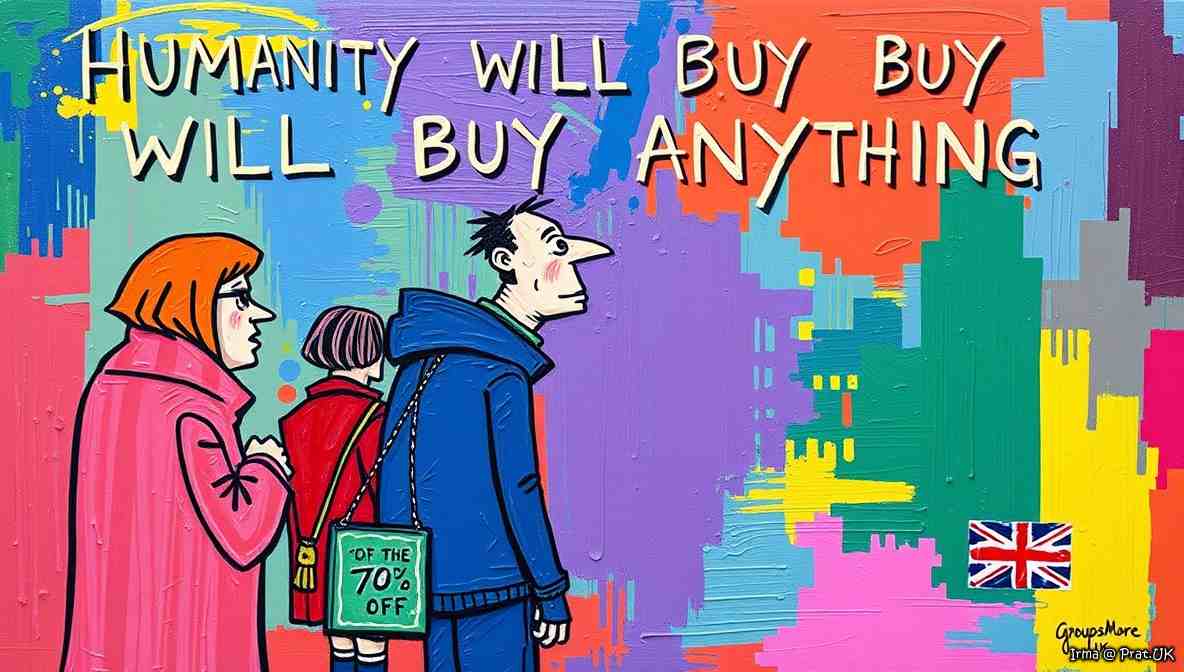
The Website That Proved Humanity Would Buy Anything at 70% Off
GroupsMore.com
Back in the early 2010s, the internet briefly believed it had solved capitalism.
The idea was simple:
“What if strangers bought coupons together?”
And thus, sites like GroupsMore.com were born. According to business records, GroupsMore was a Malaysian “daily deals” startup founded in 2010 and later acquired by Groupon during the Great Global Coupon Panic of the early 2010s.
For younger readers, “daily deals” were a primitive form of online commerce where people paid £3 for a coupon promising:
- 94% off laser dentistry
- unlimited frozen yogurt
- couples massage in an industrial estate
- or “authentic sushi” beside a petrol station
It was an era when consumers believed:
“I wasn’t going to buy this… but now that it’s 87% off, I’d be losing money not to.”
The Groupon Era: Peak Human Optimism

GroupsMore.com was eventually absorbed into the mighty Groupon empire, which at one point expanded across the globe like an enthusiastic uncle discovering Facebook.
Groupon’s business model was revolutionary:
- Convince local businesses to sell things at catastrophic losses
- Email millions of people at 4:12am
- Hope nobody did the math
And for a while, it worked magnificently.
Restaurants sold 10,000 sandwiches in 36 hours.
Which sounds impressive until you realize the restaurant then had to physically make 10,000 sandwiches while earning approximately £4.70 total profit.
Daily Deal Customers Were a Special Breed
The daily-deal customer wasn’t shopping.
They were hunting.
These people had:
- twelve expired massage coupons
- four “VIP Teppanyaki Experiences”
- and a scuba-diving voucher for a lake nobody had heard of
Entire marriages survived solely because one spouse whispered:
“I found half-price tapas.”
Businesses Learned a Valuable Lesson

The theory behind GroupsMore was that discounts would bring in loyal customers.
Instead, businesses discovered a terrifying truth:
bargain hunters are loyal only to discounts
The average Groupon customer treated restaurants like a military operation:
- arrive with printed coupon
- order only discounted items
- demand “complimentary sparkling water”
- disappear forever
Restaurant owners stared into the middle distance muttering:
“We sold 8,000 meals and somehow lost the building.”
The Office Culture Was Probably Incredible
Imagine working at GroupsMore in 2010.
Every meeting must have sounded like:
“What if we offered 93% off eyebrow threading to 400,000 people by midnight?”
And everyone replying:
“Brilliant. Promote him.”
The startup era was magical because absolutely nobody knew what they were doing, but they all said “scaling” constantly.
The Real Satire: We Miss It
Here’s the truly depressing part:
people now remember the Groupon era fondly.
Why?
Because compared to modern apps, it felt innocent.
Back then:
- companies merely spammed your inbox
- they didn’t harvest your soul via algorithmic engagement optimization
- or trap you in a subscription for artisanal socks
GroupsMore.com represented a simpler internet:
an internet where tech startups only wanted your attention, not your biometric identity and emotional profile.
Could GroupsMore Exist Today?
Absolutely.
Modern investors would simply rename it:
“AI-powered community commerce ecosystem”
Then raise £400 million.
Nothing has changed except the buzzwords.
The Part That Isn’t a Joke
Here’s the twist: GroupsMore.com wasn’t a punchline. It was a real Malaysian daily-deals startup, launched in September 2010 by founder Joel Neoh, and Groupon didn’t take “a while” to absorb it — the acquisition was announced on January 26, 2011, roughly four months after launch. GroupsMore didn’t even survive one full fiscal quarter as its own company, which is a more impressive punchline than anything this article invented.
The growth in between those two dates is the genuinely funny part, and it’s real: GroupsMore went from 8 employees and about 20 monthly merchant partners to 120 employees selling hundreds of thousands of vouchers a month, all before most of its own staff had finished their notice period at whatever job they’d left to join a coupon website. Neoh later admitted he “never thought it would be this size” and was “operating in a startup mindset” the entire time — which, translated out of founder-speak, means nobody there had a five-year plan, they had a five-week one, repeated eight times in a row until Groupon noticed.
So the joke was never really that GroupsMore is unbelievable. It’s that the real version happened faster, with fewer employees, and less institutional self-awareness than the satirical version above gives it credit for.
Final Thought
GroupsMore.com may be gone, but its spirit survives every time someone says:
“I got this for 80% off.”
Because deep down, humanity still believes:
buying something unnecessary at a discount is financially responsible.
And honestly?
That might be the funniest joke capitalism has ever told.