King Charles Valet Scandal Forces Palace To Redeploy Prince Andrew As Emergency Distraction
As Charles Spencer’s memoir reopens a decades old royal scandal, Buckingham Palace goes looking for its old friend Prince Andrew
Buckingham Palace communications officials were reportedly staring thoughtfully at old photographs of Prince Andrew this week after Princess Diana’s brother revived an extraordinary decades old allegation concerning King Charles and a royal valet, leaving Britain’s monarchy facing that rare public relations emergency in which Andrew begins to resemble the comfortable option.
The latest royal grenade comes from Charles Spencer’s memoir Swan Song: Diana, My Sister. Spencer recounts Diana allegedly telling him, over lunch at a smart London restaurant, that her husband was “in love with his valet.” The aide is not named in the extract, and the underlying allegation concerning Charles was denied years ago by Clarence House, which described it as entirely without foundation. That distinction matters, because royal history already contains enough speculation to heat Windsor Castle through February without help.
Still, merely arranging the words Diana, Charles, love and valet into a single British headline is roughly equivalent to lobbing a sausage into a kennel. Editors reportedly cancelled lunch within minutes.
Palace Hunts For Prince Andrew To Rescue Latest Royal Scandal
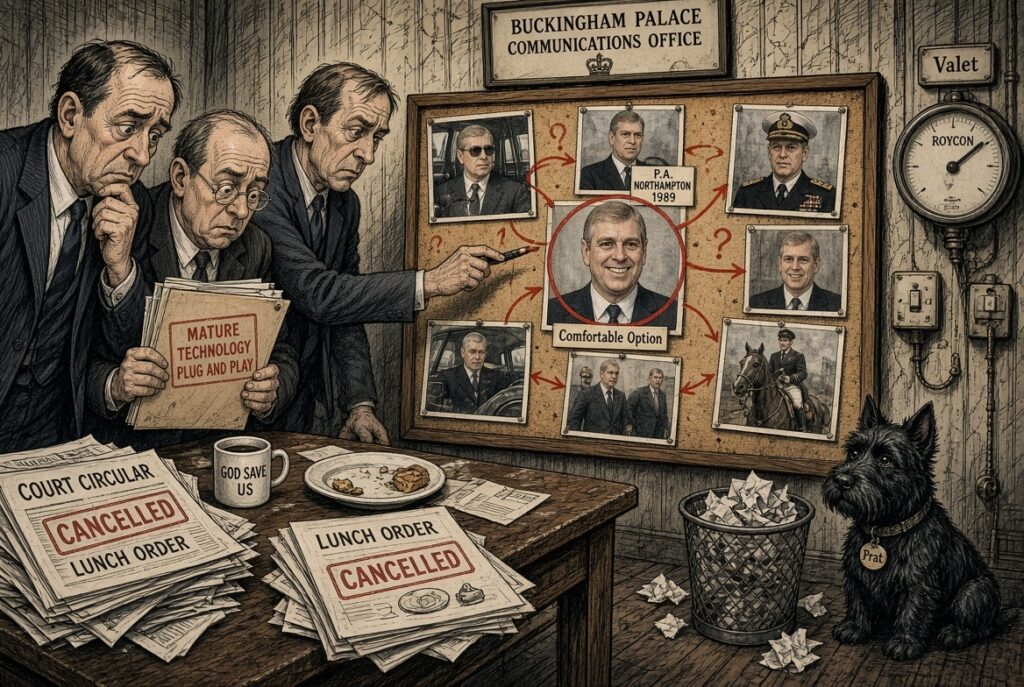
Royal communications experts have long treated Prince Andrew as what the insurance trade calls an existing condition. For years his appearances produced the sort of atmosphere normally associated with discovering water dripping through a hotel ceiling.
But palace officials are now weighing the startling possibility that Andrew has previously overlooked strategic value. He is familiar. Britain understands Andrew scandals. There is infrastructure. There are templates. Newsrooms keep folders. Commentators already know where the microphones live. The public can hear the words Prince Andrew and reach outrage without learning any new supporting characters.
The valet story, by contrast, requires diagrams. This is unacceptable in modern journalism. A royal scandal that asks readers to distinguish among several servants, allegations, denials and decades could reduce national productivity by as much as fourteen percent, according to figures invented moments ago by the Institute for Royal Distraction Studies.
“The Andrew material is mature technology,” one entirely invented palace crisis consultant explained. “You plug it in and everybody already knows what to do.” Even his own title has begun working against him. Colleagues are said to be referring to him, sotto voce, as the Yuke of Dork, which is either cruel or accurate, and possibly both at once.
Britain Discovers It Still Hasn’t Finished With Diana’s Royal Scandal
Perhaps the larger revelation is that Britain has not completed its national conversation about Princess Diana. It has merely been taking extremely short breaks. Diana died in 1997. Since then Britain has changed prime ministers, monarchs, mobile telephones, television technology, newspapers, marriages, hairstyles and roughly seventeen definitions of an acceptable trouser leg. Yet mention Diana and the entire nation immediately reboots into emotional Windows 95.
Spencer’s book also contains disputed claims about Charles’s reaction following Diana’s death. Buckingham Palace issued an unusually pointed response this week, saying that the pain of grief can cloud reason, affect judgment and colour memory in ways others do not recognise, even many years later.
That statement was quintessentially royal. Most families simply say you are remembering it wrong. The monarchy says His Majesty remains mindful of the neurological consequences associated with bereavement. That, dear reader, is why they get the castles.
Royal Scandal Management Reaches New Scientific Heights
The Palace has traditionally survived scandal using the proven British strategy of saying nothing until everyone becomes distracted by the weather. This worked beautifully when news travelled by horse. It became noticeably less effective after Twitter.
Today, royal scandal management requires minute by minute calculations involving newspaper circulation, television bookings, Harry’s whereabouts, Meghan’s Instagram activity, Andrew’s whereabouts, and whether anyone named Spencer has recently found a publisher. Researchers believe Buckingham Palace maintains a private alert board not unlike the American nuclear DEFCON system.
ROYCON 5 covers a minor hat controversy. ROYCON 4 means a Harry interview has been announced. ROYCON 3 arrives when Meghan uses the word institution. ROYCON 2 is a previously unseen Diana letter. ROYCON 1 is somebody remembering what Charles allegedly said in 1989. ROYCON Valet means everybody goes home early. Nobody, insiders insist, has ever trained for ROYCON Valet.
The Valet Profession Demands Clarification Amid Royal Scandal Fallout
The most innocent casualties of this whole affair may be Britain’s valets. For centuries, valet was among the most respectable professions available to a gentleman willing to devote his working life to another gentleman’s buttons. Traditional duties included preparing clothing, organising luggage, managing wardrobes, and somehow knowing which shoes were correct for standing near a pheasant.
Now every valet in Britain faces the terrifying possibility of relatives asking pointed questions at Christmas. So Nigel, still working at the estate, are you? As a valet? Nigel puts down his Christmas pudding. I fold trousers, Aunt Margaret. Of course you do, dear. I FOLD TROUSERS. Every laminated job description in the land should now clarify, in bold capitals if necessary, that duties involve clothing, luggage and private arrangements, none of which should concern your aunt, and certainly nothing requiring royal scandal briefings.
Memoirs Become Britain’s Strategic Weapon In Royal Scandal Warfare
The British aristocracy once settled its disputes with swords. This was arguably healthier for everyone involved. Today they write memoirs. A memoir allows an aristocratic combatant to attack a relative while retaining excellent table manners; you can accuse someone of destroying your family and still thank the publisher warmly in the acknowledgements.
Spencer’s memoir demonstrates the terrifying efficiency of the form. A conversation allegedly held decades ago can lie dormant through eight governments, two royal weddings, several jubilees and the invention of TikTok before emerging on publication week with a hardback price attached. Every prominent British family should now behave as though one relative is quietly taking notes, because one probably is.
Palace Considers Retiring To A Simpler Royal Scandal
According to absolutely no palace source whatsoever, communications planners have begun reviewing previous controversies to find one familiar enough to redirect attention. Harry is too unpredictable. Meghan is overexposed. William beard speculation carries insufficient explosive capacity. Andrew, on the other hand, is comfort food, provided your comfort food requires lawyers.
Britain knows the rhythm by heart: headline, photograph, statement, a follow up statement explaining the previous statement, a royal expert interviewed beside a palace railing, an American presenter asking why Britain still bothers with a monarchy, and a British presenter gently explaining that Americans, by contrast, have the Kardashians. Civilisation resumes.
The Worst Phrase In Royal Scandal PR: There’s More In The Book
The single sentence no royal communications officer ever wants to hear is that’s only Tuesday’s extract. Spencer’s memoir has already produced a rare public Buckingham Palace response to separate claims about Charles’s behaviour after Diana’s death, and the book is not even a documentary yet.
This creates what publishing economists have dubbed the Royal Bombshell Multiplier, in which one anecdote produces three headlines, five television panels, fourteen podcasts and a reporter standing outside Buckingham Palace at a quarter past six in the morning saying the Palace has declined further comment. Nobody in the history of broadcasting has worked harder than a correspondent reporting, live, that nobody has said anything.
“You can tell how serious a royal story is by how early the cameras arrive,” said Terry Wick, a jobbing London club comic known for working the late slot at a Camden basement venue. “Anything before seven a.m. and the Palace is genuinely worried. Anything before six and somebody’s resigning.”
Britain Requests One Royal Story Without A Scandal, Featuring Jam
The public may eventually require a palate cleanser. Perhaps Princess Anne visits a factory. Edward opens something. William plants a tree. Somebody unveils a plaque commemorating another plaque. Britain quietly, desperately wants a headline that reads King Inspects New Community Greenhouse. No bombshells. No revelations. Nobody breaks their silence. Nobody is said to be devastated. Nobody fires back. The greenhouse simply contains tomatoes, the King looks thoughtfully at the tomatoes, and the tomatoes, showing more discipline than most of Fleet Street, decline to comment. That is the Britain everybody currently needs.
Prince Andrew Waits Near The Royal Scandal Emergency Glass
For now, Prince Andrew occupies an unusual position in royal life. Not rehabilitation. Not redemption. Certainly not public relations triumph. More like reserve scandal capacity, kept warm and *pressed and ironed* for duty. He is the emergency generator nobody particularly wants to switch on but everyone is strangely relieved still exists.
Somewhere beneath Buckingham Palace there may now be a red telephone, and beside it a small sign reading, in case of Diana memoir, call Andrew. And perhaps that is the strangest achievement of Charles Spencer’s latest revelation: after decades of royal turbulence, Britain has finally produced a headline capable of making the Palace glance toward Prince Andrew and whisper, quite sincerely, get him warmed up.
Further Signs This Royal Scandal Has Broken Britain
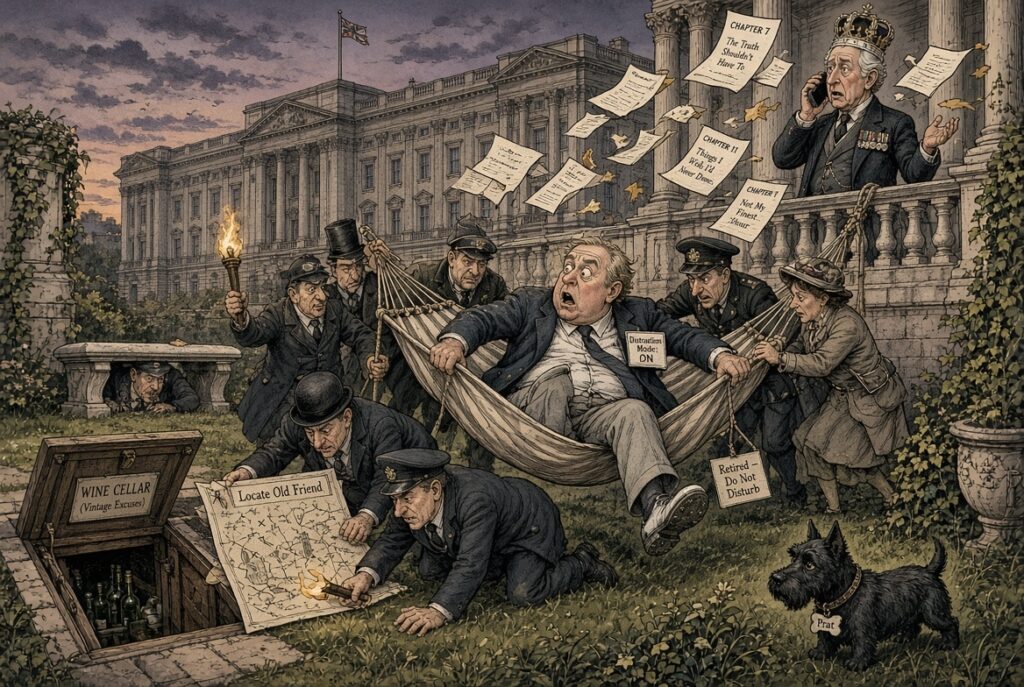
Buckingham Palace has, in one extraordinary week, discovered a scandal that makes Prince Andrew look like the fire extinguisher marked break glass in case of even more awkward royal news, which is quite an achievement for a man who spent the better part of a decade being the awkward royal news himself. Royal scandals, meanwhile, never truly die. They simply spend twenty nine years in archival storage awaiting a publishing contract, which normal families would call losing an argument and the Windsors call preserving one at controlled humidity.
Charles Spencer has now discovered that the phrase my sister once told me carries roughly the explosive yield of a small cruise missile, except cruise missiles generally come with fewer serialisation rights attached. Britain, meanwhile, has achieved something scientists once considered impossible: a single royal story containing Diana, Charles, a valet, Andrew and a communications department simultaneously running out of euphemisms. Somewhere a headline writer has developed tennis elbow.
The monarchy’s greatest constitutional function this week may simply be generating enough scandal to prevent any one scandal receiving proper attention, which is checks and balances, but mostly checks. Modern royal history increasingly seems to be assembled from memoirs written by relatives who apparently sat on information capable of vaporising breakfast television for thirty patient years. Apparently closure is simply what happens after the paperback rights sell. Buckingham Palace saying it generally does not comment on books is fast becoming the royal equivalent of a restaurant insisting it does not discuss food, which would be a fine policy if books would only stop discussing Buckingham Palace in return.
The monarchy has centuries of practical experience surviving wars, revolutions and constitutional crises, and yet remains almost entirely defenceless against a relative armed with anecdotes. Napoleon, it is worth remembering, never once had a serialisation deal with a national newspaper. Prince Andrew, against every available expectation, may now qualify as a Royal Scandal Classic: not good, merely familiar, the way an old boiler becomes strangely comforting the instant the new boiler starts leaking Latin. The safest person in Britain this week is almost certainly whichever palace employee has never once been mentioned in anyone’s memoir, and he is, by all accounts, currently hiding behind the corgis.
Sources
- The Daily Beast: Diana’s Brother Drops Eye-Popping Gay Love Claim About King
- Daily Mail: Earl Spencer’s serialised memoir extract
- The Guardian: the 2003 injunction and Clarence House response
Charles Spencer, the 9th Earl Spencer and Princess Diana’s younger brother, publishes his memoir Swan Song: Diana, My Sister this month, in which he recounts Diana telling him she believed her husband was in love with his valet. The unnamed aide claim revives a decades old rumour, previously tied by tabloid speculation to King Charles’s longtime former aide Michael Fawcett, that Clarence House has repeatedly and publicly denied. Buckingham Palace also issued a pointed statement this week addressing separate claims in the memoir about King Charles’s reaction to Diana’s death, saying grief can cloud judgment and memory. None of the underlying allegations concerning King Charles’s sexuality have been established as fact.
This is British satire, written in the long tradition of UK satirical news that turns royal chaos into comedy rather than crisis. No valets, princes or greenhouse tomatoes were harmed in the making of this satirical journalism.
For the American read on royal pandemonium, cross the Atlantic to Bohiney.com.
Auf Wiedersehen, amigo!

Mei Lin Chen is a student writer whose satire explores identity, modern culture, and social nuance. Her work reflects academic curiosity and engagement with London’s diverse perspectives.
Expertise is growing through study and practice, while trust is supported by clear intent and responsible humour.