MONTECITO, CALIFORNIA
Meghan Reminds Prince Harry Financial Independence Traditionally Involves Making Money
Duchess reportedly urges husband to stop treating paid employment as an embarrassing American custom
A Yahoo Entertainment report about Meghan Markle and Prince Harry claims the Duchess of Sussex has become frustrated with her husband’s allegedly “snobbish” attitude toward Hollywood, believing he is allowing profitable opportunities to gallop past the mansion without even asking whether they offer dental insurance. The report, republished from RealityTea and based on unnamed-source claims attributed to Star Magazine, says Meghan wants Harry to combine his charitable interests with television, films, podcasts and other activities traditionally known in California as “getting paid.”
The Duke Discovers That California Accepts Neither Titles Nor Exposure
Sources close to the couple say Meghan has patiently explained to Harry that American banks do not recognize “Prince of England” as a recurring deposit.

A mortgage officer reportedly studied Harry’s title for several minutes before saying, “This is impressive, sir, but the computer still wants numbers.”
The exchange allegedly shocked the Duke, who had assumed the word “Sussex” functioned as both a county and a credit score.
According to the report, Meghan believes Harry is missing “major paydays” because he refuses to embrace Hollywood opportunities. She reportedly supports his work with the Invictus Games but wants him to add commercial projects capable of supporting the couple’s California life.
This presents a difficult philosophical question: Can a man monetize his identity without appearing to monetize his identity, especially after publishing a bestselling memoir largely about his identity?
Hollywood believes the answer is yes.
Hollywood has monetized silence, divorces, kitchen renovations, criminal investigations, weight loss, weight gain, spiritual awakenings and people purchasing houses near beaches. It can certainly monetize a prince looking uncomfortable beside a ficus tree.
One proposed television series reportedly places Harry in ordinary American workplaces.
In the pilot episode, Undercover Duke, Harry spends one afternoon in a supermarket and attempts to understand why customers must pay for both groceries and reusable bags.
In episode two, he visits a motor-vehicle office and discovers an institution more ceremonial, hereditary and resistant to reform than the House of Lords.
The season finale features Harry applying for a normal job.
Producers rejected the episode for containing excessive fantasy.
Hollywood Offers Harry Several Meaningful Opportunities
Entertainment executives have allegedly assembled a list of projects designed to preserve Harry’s dignity while also paying him enormous sums for appearing on camera.
One proposal, The Real Househusbands of Montecito, follows Harry as he searches the estate for the room where business happens.
Another project, Spare Change, requires the Duke to travel across America asking strangers how they make money without inheriting ceremonial swords.
A podcast titled Archetypes, but With a Fellow Talking This Time would allow Harry to interview philanthropists, veterans and celebrities while discreetly mentioning that he has a book available wherever unresolved family grievances are sold.
Harry reportedly rejected a judging position on Britain’s Got Titles, saying competition television felt vulgar.
Executives reminded him that the winner receives a ceremonial balcony appearance, at which point negotiations resumed.
Dr. Clive Moneypenny, professor of Celebrity Revenue Studies at the University of Southern Malibu, says Harry suffers from “occupational aristocracy.”
“This occurs when a person wants the income of a celebrity, the deference of a prince and the responsibilities of a decorative cushion,” Moneypenny explained.
His research, conducted during lunch, found that 94 percent of former royals prefer meaningful work, while 100 percent prefer meaningful direct deposits.
Meghan Introduces the Household to Capitalism
Witnesses say Meghan recently held a family business seminar titled Financial Independence: The Sequel Nobody Budgeted For.
The presentation reportedly included thirty-seven slides, a revenue forecast and one photograph of King Charles looking extremely comfortable near taxpayer-maintained curtains.
“Financial independence means we earn our own money,” Meghan reportedly explained in the satire department’s reconstruction of events.
Harry nodded thoughtfully.
“Does the money know where to find us?”
Meghan then introduced several elementary economic principles.
The first was that a commercial opportunity is not automatically immoral merely because it arrives with catering.
The second was that philanthropy cannot indefinitely support a household whose security budget resembles that of a medium-sized republic.
The third was that “being authentic” is not accepted by utility companies as payment.
Harry allegedly countered that his royal identity should not be turned into a product.
At that precise moment, three copies of Spare fell from a nearby bookshelf and landed on a Netflix contract.
The Prince Remains Deeply Committed to Noncommercial Publicity
Friends insist Harry is not opposed to appearing before cameras. He merely objects to any camera that might be associated with commerce, entertainment, promotion or employment.
He remains comfortable with documentary cameras, interview cameras, charitable-event cameras, courtroom cameras, podcast cameras and cameras recording his discomfort with cameras.
This distinction is important.
A commercial television appearance exploits fame.
A humanitarian streaming documentary uses fame compassionately, usually with better lighting.
Harry reportedly wants projects that reflect his values, support veterans, encourage mental wellness and never require him to pretend he enjoys meeting studio executives named Brent.
Hollywood has responded by developing Healing With Harry, in which celebrities discuss trauma while assembling flat-pack furniture.
The program promotes emotional resilience because none of the furniture includes complete instructions.
Another proposal places Harry on a survival programme in the wilderness.
Producers abandoned it after realizing he might immediately encounter fewer photographers and decide to remain there.
Royal Expert Industry Declares Emergency
Britain’s royal-commentary industry has welcomed news of the alleged disagreement, having faced several dangerous hours without a fresh Sussex crisis.
Royal experts were immediately deployed to television studios, where they interpreted Meghan’s reported frustration through posture analysis, historical analogy and the movement of clouds over Windsor.
One commentator declared that the disagreement reveals “a fundamental transatlantic difference.”
“In Britain,” she explained, “a prince receives money for opening hospitals while pretending he does not know money exists. In America, he receives money for discussing why opening hospitals caused emotional harm.”
A national poll conducted outside a pub found that 63 percent of Britons believe Harry should obtain employment, 22 percent believe he already has employment, and 15 percent were merely waiting for the bus.
London taxi driver Graham Pottle said Harry could return to Britain and take up honest work.
“He could become a royal expert,” Pottle suggested. “Apparently there’s no experience requirement.”
Meghan Develops a Practical Employment Plan
Meghan’s proposed solution is reportedly simple: Harry should retain his philanthropic work while accepting commercial opportunities connected to his public profile. This is known in business schools as diversification.

It is known in royal families as opening another visitor centre.
Under the new plan, Harry would divide his week between charitable causes and revenue-producing projects.
Monday would focus on veterans.
Tuesday would involve podcasting.
Wednesday would be reserved for litigation.
Thursday would feature a television appearance discussing the emotional damage caused by appearing on television.
Friday would remain open for reconciliation rumours.
The couple could also launch a lifestyle brand called As It Were, offering organic beard treatments, ethically sourced polo equipment and candles scented with cedar, bergamot and unresolved constitutional tension.
Early market research suggests strong demand among consumers who want their homes to smell like a family meeting at Sandringham.
Experts Confirm That Being Famous Remains Valuable
Professor Moneypenny says Harry’s reluctance represents a misunderstanding of celebrity economics.
“Fame is a depreciating asset,” he explained. “You must use it while strangers still argue about you in supermarket checkout lines.”
By deductive reasoning, Harry possesses a royal title.
Royal titles attract public interest.
Public interest attracts streaming executives.
Streaming executives attract contracts.
Contracts attract accountants.
Accountants eventually ask why everybody is calling the project humanitarian.
The analogy is straightforward. Owning a famous title while refusing to monetize it is like owning a vineyard and insisting the grapes remain emotionally independent.
Meghan reportedly understands this.
She spent years working in entertainment before marrying Harry and appears to recognize that Hollywood is not a monastery. It is a casino where everyone claims to be telling important stories while watching the weekend numbers.
Harry, however, may still believe celebrity opportunities should arrive with a trumpet fanfare and a man holding a velvet cushion.
In Los Angeles, the man holding the cushion is an unpaid production assistant named Tyler.
The Sussexes Search for a Sustainable Future
People close to the situation insist the couple remains united despite alleged disagreements over work and money.
Marriage experts confirm that arguing about finances is common.
What is less common is arguing about whether one spouse should accept several million dollars for appearing in a documentary about why wealth has failed to bring peace.
The couple’s challenge is finding a sustainable balance between privacy, public service, financial independence and worldwide media distribution.
Fortunately, Hollywood specializes in balance.
It balances artistic integrity against audience testing, social justice against international licensing and personal authenticity against whether the trailer performs well among women aged 25 to 54.
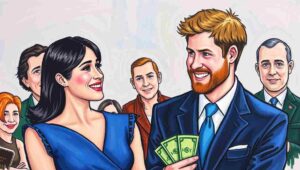
Meghan reportedly believes Harry can retain his principles while earning money.
Harry reportedly believes earning money could compromise his principles.
The bank reportedly believes the payment is due on the first.
As negotiations continue, Hollywood insiders remain optimistic.
“We respect Prince Harry’s reluctance to become a commercial product,” said one producer. “We would like to explore that reluctance in an eight-part series.”
The working title is The Prince Who Wouldn’t Sell Out.
Merchandise becomes available Friday.
Keywords: royals, Hollywood, satire, Montecito, Netflix, monarchy, Sussexes, streaming, celebrity, brand, royal family, financial independence, celebrity economics, mortgage officer, royal expert, tabloid gold
Humorous Observations
- Prince Harry apparently believes Hollywood is beneath him, which is a bold opinion for a man currently living above Hollywood in a mansion financed partly by talking about his relatives.
- Meghan wants Harry to monetize his royal identity, although the British monarchy has been doing that through commemorative tea towels since 1837.
- Harry left Britain to become financially independent and now appears surprised that independence includes the financial portion.
- The prince reportedly dislikes Hollywood commercialism but remains open to charitable work filmed by six cameras and distributed internationally.
- Meghan is allegedly the household breadwinner, making Harry the first royal spare to become a dependent.
- Hollywood has finally encountered a celebrity who believes he is too important to be a celebrity.
- Harry’s employment strategy appears to involve waiting until someone offers him money for being morally uncomfortable about accepting money.
- Meghan wants Harry to pursue podcasting, a medium specifically designed for people with three hours of opinions and no identifiable workplace.
- Prince Harry continues calling himself a prince while resisting opportunities connected to being a prince, rather like opening a seafood restaurant and refusing to discuss fish.
- The Sussexes wanted privacy, but privacy in California apparently requires a production company, a publicist, several streaming contracts and aerial photography.
- Harry may believe acting is undignified, despite having spent most of his adult life smiling at ceremonies while pretending to recognize municipal officials.
- Meghan reportedly wants commercial ventures that complement philanthropy, creating the exciting new business category of tax-deductible celebrity television.
- Harry’s royal title is valuable, provided nobody asks what practical duties now accompany it.
- The couple’s financial independence increasingly resembles a teenager announcing independence while asking whether his parents still pay for streaming.
- Hollywood executives are eager to work with Harry because every meeting begins with the sentence, “Here is a man famous for not wanting attention.”
Disclaimer: This satirical report comments on published allegations attributed to unnamed sources. It does not claim knowledge of private conversations between the Duke and Duchess of Sussex. Any invented experts, polls, programmes, quotations, mortgage officers or emotionally independent grapes are products of satire.

Alan Nafzger was born in Lubbock, Texas, the son Swiss immigrants. He grew up on a dairy in Windthorst, north central Texas. He earned degrees from Midwestern State University (B.A. 1985) and Texas State University (M.A. 1987). University College Dublin (Ph.D. 1991). Dr. Nafzger has entertained and educated young people in Texas colleges for 37 years. Nafzger is best known for his dark novels and experimental screenwriting. His best know scripts to date are Lenin’s Body, produced in Russia by A-Media and Sea and Sky produced in The Philippines in the Tagalog language. In 1986, Nafzger wrote the iconic feminist western novel, Gina of Quitaque. He currently lives in Holloway, North London. Contact: [email protected]