Prince William Calls Harry a ‘Rotten Apple,’ Palace Immediately Launches Inquiry Into Who Keeps Leaving the Heir Near Metaphors
William Brands Harry a ‘Rotten Apple,’ Apparently Forgets They Grew on the Same Royal Family Tree
LONDON — Buckingham Palace has reportedly launched an emergency review of all metaphors within fifty yards of Prince William after the Prince of Wales was linked through an unnamed source to the description of his brother Harry as a “rotten apple.” The review is expected to take eleven weeks, cost taxpayers roughly the GDP of a mid-sized orchard, and conclude with a strongly worded laminated card.
Prince William’s Metaphor Collection
- Calling your brother a “rotten apple” is dangerous when your family tree requires its own forestry commission.
- William apparently skipped directly from sibling rivalry to agricultural inspection.
- If Harry is the rotten apple, somebody eventually has to inspect the barrel.
- Royal disagreements used to involve armies. Now they involve anonymous sources describing produce.
- Estranging your brother and then complaining that he failed to warn you about a book is a spectacular communications strategy.
Prince William and Prince Harry Rift: Charles Spencer’s Diana Memoir Lights the Fuse
The allegation comes amid renewed royal friction surrounding Charles Spencer’s memoir about Princess Diana. A report says William believes Harry may have known about the book before publication and failed to warn him or King Charles. Spencer, inconveniently for anybody trying to construct a tidy conspiracy, has said William and Harry were informed at the same time. His book, Swan Song: Diana, My Sister, has already generated more bombshells than a Guy Fawkes Night with no health and safety officer.
This means Britain has once again reached that treasured constitutional moment when the future king may be furious with his estranged brother for not communicating information that, according to the author himself, the estranged brother didn’t have. It is the royal equivalent of being sacked for failing to attend a meeting nobody invited you to, held in a building you were not told existed.
Monarchy. It’s basically WhatsApp with horses.
The phrase “rotten apple” has nevertheless electrified royal correspondents, horticulturalists and people who have spent thirty years wondering why every Windsor family disagreement eventually requires a documentary. Sales of the Cox’s Orange Pippin are reportedly down, mostly because nobody wants to be photographed holding one near Kensington Palace.
Palace aides are especially concerned because the metaphor raises an obvious question.
If Harry is the rotten apple, what exactly is the tree?
Nobody at Buckingham Palace wanted to answer that.
One aide reportedly looked at the ceiling.
Another became intensely interested in a lamp.
A third whispered, “For God’s sake, don’t say orchard.”
Royal Palace Creates Emergency Metaphor Department
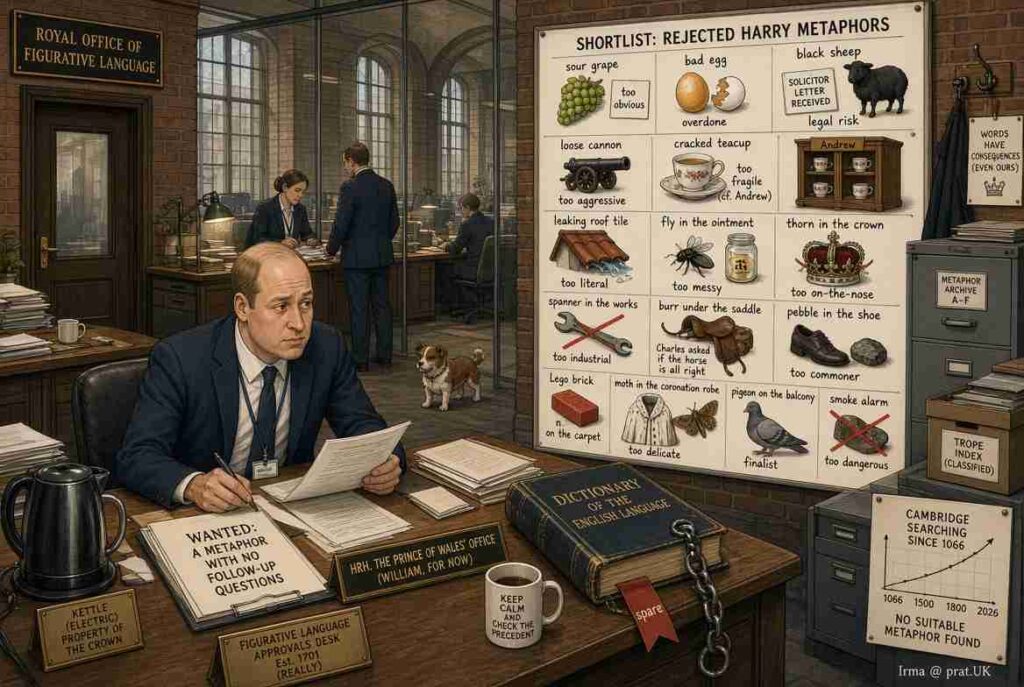
According to our completely indispensable Palace observers, William’s communications team has now established the Royal Office of Figurative Language, Agricultural Comparisons and Things We May Regret Saying to People Magazine. Staff have been issued lanyards, a kettle and a single dictionary, which is chained to a desk after an unfortunate incident involving the word “spare.”
Its first responsibility will be reviewing future derogatory metaphors before they reach the heir.
The problem is simple.
Almost every insult William could conceivably use against Harry eventually boomerangs back toward the monarchy.
Call Harry a black sheep, and people start examining the flock.
Call him a bad egg, and people wonder about the chicken.
Call him a loose cannon, and historians begin pointing toward the family arsenal.
Call him the skeleton in the cupboard, and suddenly three historians from Oxford are requesting access to the cupboard, a torch and a very large sandwich.
William reportedly considers this deeply unfair.
A palace source we absolutely should not have allowed near stationery explained, “His Royal Highness simply wants a metaphor where Harry is entirely responsible and nobody asks any follow-up questions.”
Scientists say such a metaphor has not yet been discovered. A team at Cambridge has been searching since 1066.
William’s Planned List of Harry Metaphors: The Royal Insult Shortlist
The Royal Metaphor Office has nevertheless prepared a working list for future brotherly disagreements.
The Sour Grape
Rejected because it makes William sound like he lost a wine tasting.The Bad Egg
Rejected after advisers asked who laid it.The Black Sheep
Placed on hold pending an investigation into the rest of the flock. The flock has hired a solicitor.The Loose Cannon
Strong, traditional and appropriately British, but historians noted that royal families traditionally have difficulty complaining about uncontrolled weaponry.The Broken Cog
William likes this one because it suggests Harry stopped functioning within the royal machine. Harry’s supporters may counter that leaving the machine was rather the point.The Cracked Teacup
Excellent British imagery, although somebody immediately asked whether the cupboard contained Prince Andrew.Meeting adjourned.
The Leaking Roof Tile
Useful because Harry allegedly allows private royal matters to escape into public view. Unfortunately, a leaking roof also implies somebody failed to maintain the building, and the building is a national heritage site with a gift shop.The Fly in the Ointment
Rejected after William asked why there was ointment.Nobody knew.
The Thorn in the Crown
Powerful but constitutionally confusing, since Britain already has several.The Monkey Wrench in the Machinery
Rejected for excessive Americanism. Replaced with “spanner in the works,” because even royal estrangement must respect regional vocabulary.The Spanner in the Works
Approved.Then someone asked whether the works actually worked.
Removed.
The Burr Under the Saddle
Excellent equestrian insult. Charles immediately asked whether the horse was all right.The Cracked Foundation Stone
Rejected because architectural metaphors involving the monarchy are considered unnecessarily adventurous.The Hole in the Royal Boat
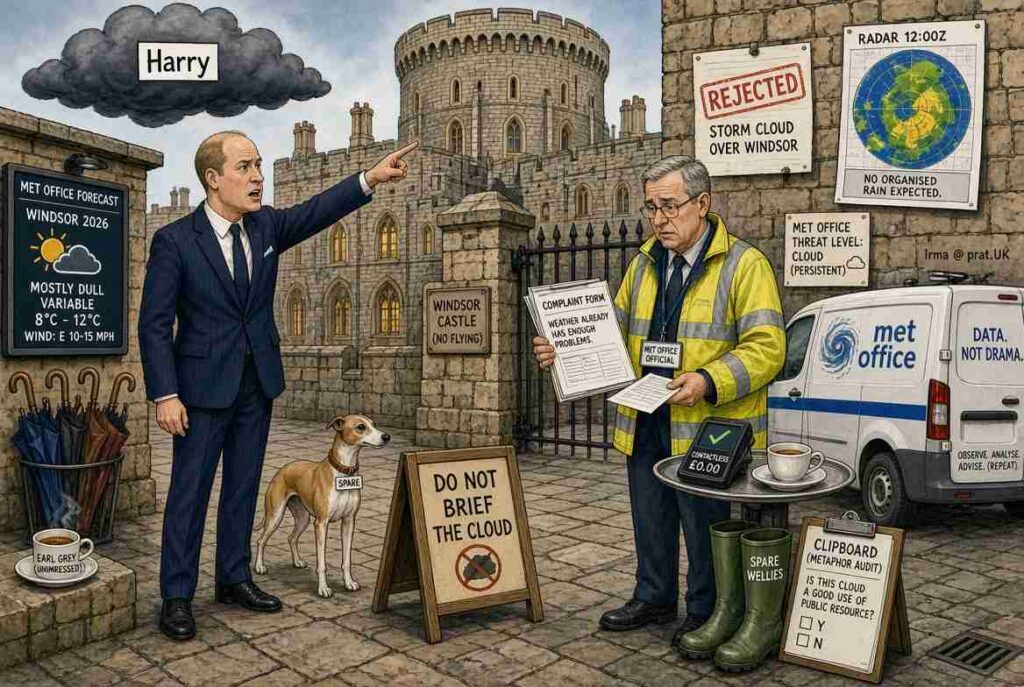
Rejected because Harry may respond that he got into another boat. It has a hot tub.The Storm Cloud Over Windsor
Rejected after the Met Office complained weather already has enough problems.The Snake in the Grass
Rejected because Charles is an environmentalist and might order the grass protected.The Fox in the Henhouse
Once again raises the chicken question.The Worm in the Apple
Far too close to the original metaphor and potentially devastating to British cider exports.The Rusty Link in the Chain
Rejected because Harry may point out he deliberately unclipped himself.The Cracked Bell
William liked the historical resonance until somebody mentioned bells still make noise when cracked.That was considered too accurate.
The Elephant in the Room
Rejected because Windsor Castle contains roughly 1,000 years of elephants in rooms, figuratively speaking.The Albatross Around the Neck
Approved until an aide pointed out that William would technically be claiming Harry remains attached to him.Emergency deletion.
The Pebble in the Shoe
Safe, straightforward and surprisingly effective.Unfortunately, William allegedly wants something more regal. A pebble, he is understood to have said, “is what a commoner has.”
The Lego Brick on the Palace Carpet
Considered the strongest modern option because it communicates pain, resentment and the immediate desire to blame whichever child left it there.The Banana Peel Beneath the Throne
Rejected for republican implications.The Moth in the Coronation Robe
Very promising.The Pigeon on the Palace Balcony
Excellent visual metaphor. Always appearing where somebody doesn’t want him, impossible to control, and liable to create an embarrassing deposit during a ceremonial occasion.Currently considered a finalist.
The Expired Yogurt in the Royal Refrigerator
Accurate level of hostility, insufficient majesty.The Shopping Trolley With One Bad Wheel
William reportedly loved this until being reminded that Harry lives partly in America, where it would be called a shopping cart and the entire insult would require translation.The Wi-Fi Router That Keeps Dropping Out
Perfectly describes royal communication but risks implicating British broadband.The Smoke Alarm That Won’t Stop Beeping
Annoying, persistent and usually trying to tell everybody something.Immediately rejected.
Too dangerous.
Prince Harry Promoted From Spare to Palace Librarian
The strangest element remains the suggestion that Harry should somehow have warned William about Spencer’s forthcoming memoir.
Harry has spent years being criticized for discussing royal affairs publicly.

Now, apparently, the complaint is that he didn’t discuss royal affairs enough.
This leaves the Duke of Sussex with a wonderfully British employment description.
When Harry talks: betrayal.
When Harry doesn’t talk: suspicious.
When Harry visits his uncle: conspiracy.
When Harry stays away: family division.
When Harry writes a book: unacceptable.
When somebody else writes a book: why didn’t Harry tell us?
When Harry breathes: leak.
At this rate, Harry’s official royal title should be His Royal Highness Schrödinger’s Brother, simultaneously talking too much and not talking enough until a newspaper opens the box.
Charles Spencer Checks the Orchard: What Earl Spencer Actually Said
Charles Spencer, meanwhile, has complicated the “rotten apple” narrative by saying both nephews learned about his memoir simultaneously.
He has said he deliberately kept the book closely held while writing it, with his wife and publishers among the very few who knew beforehand.
This rather damages the image of Harry lurking behind an Althorp hedge whispering, “Don’t tell William about Chapter Twelve.”
It also creates a magnificent logical puzzle.
If Harry did not know before William knew, then Harry’s failure to warn William becomes less an act of treachery and more an inability to travel backward through time.
Buckingham Palace has not traditionally required members of the Royal Family to possess time machines.
Although given the institution’s relationship with the past, one can understand the confusion.
Palace Researchers Discover the Royal Family Tree
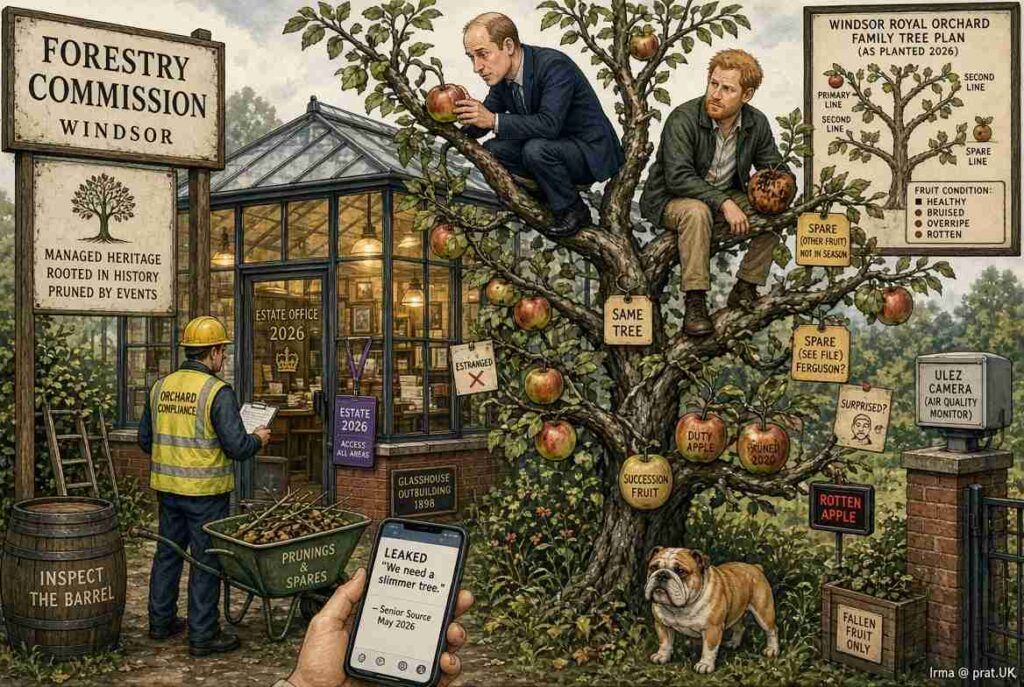
The greatest difficulty with “rotten apple,” however, remains botanical.
Apples do not arrive independently.
They grow on trees.
Trees contain branches.
Branches share roots.
And suddenly the metaphor has become an unauthorized history seminar.
A Palace gardener approached for comment reportedly stared toward Windsor Castle for several seconds before saying, “I’d leave the fruit comparison alone.”
Excellent advice.
Because once Britain begins examining the royal orchard, somebody will inevitably ask why one apple spoiled.
Then somebody asks about the branch.
Then the trunk.
Then the soil.
Before long, BBC Two has commissioned an eight-part documentary called The Windsors: Britain’s Most Expensive Compost Heap, narrated by an actor who sounds as though he is being slowly lowered into a vat of cold gravy.
The New Royal Reading Policy for Estranged Siblings
William’s alleged anger over whether Harry knew about Spencer’s book has also inspired a proposed Palace literary protocol.
Under the new system, estranged royal siblings must immediately notify one another whenever:
A relative writes a memoir.
A journalist writes a biography.
Netflix orders anything.
Someone discovers an old diary.
Tina Brown enters a building.
A publishing executive purchases lunch near Mayfair.
Or anybody says the words “Diana,” “exclusive,” and “new revelations” within the same postcode.
Every royal book must then pass through the Sibling Pre-Approval Committee, where family members who barely speak will communicate continuously about publications explaining why they barely speak.
Efficiency at last.
The Royal Metaphor Problem Isn’t Going Away
For William, the lesson may be less about Harry and more about language.
Metaphors are dangerous little creatures.
You send one out to insult your brother and suddenly it starts asking questions about you.
“Rotten apple” sounds straightforward until somebody notices the orchard.
“Black sheep” works until somebody inventories the flock.
“Loose cannon” works until Britain remembers who owned the battleships.
“Bad egg” works until somebody looks at the nest.
The Palace therefore has one safe metaphor remaining:
Harry is a pain in the neck.
No agriculture.
No livestock.
No structural engineering.
No naval history.
No hereditary implications.
Just two brothers who apparently cannot share a family tree without periodically calling an arborist.
And somewhere at Althorp, Charles Spencer is probably wondering how writing a book about his sister resulted in Britain conducting forensic analysis on an imaginary apple.
10 Humorous Observations Behind the Royal “Rotten Apple” Story
- Harry has apparently been promoted from “Spare” to unpaid Palace librarian.
- William may soon exhaust fruit metaphors and be forced into plumbing.
- Buckingham Palace probably needs a Metaphor Equerry.
- Every metaphor aimed at Harry accidentally raises questions about the institution surrounding him.
- “Black sheep” would be risky because Britain might immediately demand to know who owns the pasture.
- “Bad egg” raises troubling questions about whoever operated the royal hatchery.
- “Loose cannon” is awkward when your ancestors actually owned cannons.
- “Skeleton in the cupboard” becomes problematic in a family whose cupboards are castles.
- Calling someone “the elephant in the room” at Windsor requires specifying which of the 775 rooms.
- Eventually William will call Harry “a pain in the neck,” and Britain will celebrate the first royal metaphor requiring no constitutional inquiry.
Disclaimer
This is satire. The “Royal Office of Figurative Language,” metaphor committees, Palace gardeners, royal metaphor rankings and prospective insults above are comic devices. The underlying “rotten apple” characterization comes from an unnamed-source report rather than a public statement by Prince William, while Charles Spencer has publicly said William and Harry were informed about his memoir at the same time.
For source grounding: Yahoo’s report on the Prince William “rotten apple” claim, and Spencer’s account of how the brothers learned of the memoir. For wider context on the memoir and the royal rift, see The Nightly and HELLO!.
This story is entirely a human collaboration between two sentient beings: the world’s oldest tenured professor and a philosophy major turned dairy farmer. Any resemblance to competent Palace communications strategy is purely alarming.

Alan Nafzger was born in Lubbock, Texas, the son Swiss immigrants. He grew up on a dairy in Windthorst, north central Texas. He earned degrees from Midwestern State University (B.A. 1985) and Texas State University (M.A. 1987). University College Dublin (Ph.D. 1991). Dr. Nafzger has entertained and educated young people in Texas colleges for 37 years. Nafzger is best known for his dark novels and experimental screenwriting. His best know scripts to date are Lenin’s Body, produced in Russia by A-Media and Sea and Sky produced in The Philippines in the Tagalog language. In 1986, Nafzger wrote the iconic feminist western novel, Gina of Quitaque. He currently lives in Holloway, North London. Contact: [email protected]