
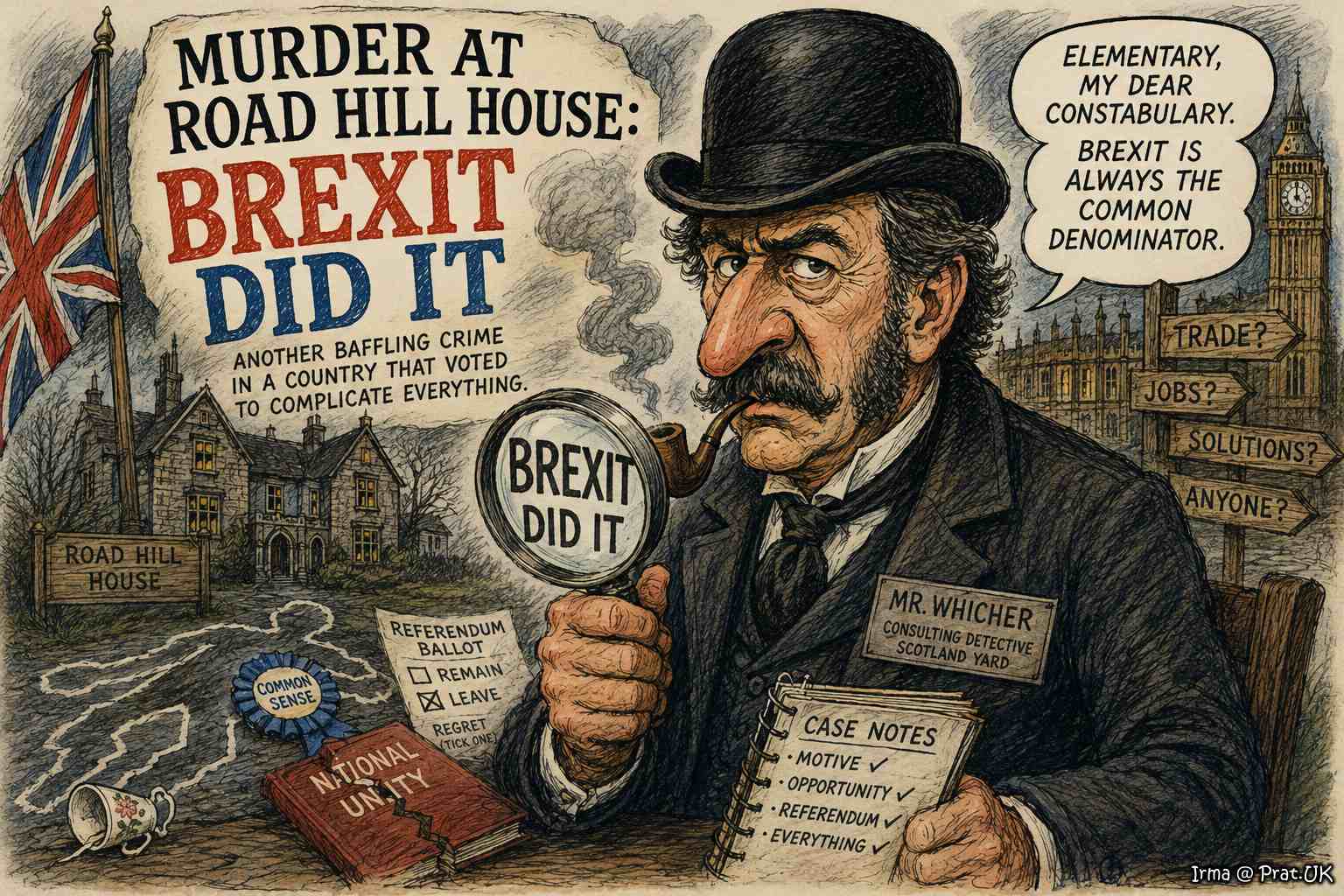
Murder at Road Hill House: Local Council Blames the Butler, the Badger, and Brexit
Wiltshire Council has reopened the 1860 murder of young Saville Kent at Road Hill House, and in a statement released late Tuesday, a council spokesperson confirmed the killer was “almost certainly the butler, possibly a badger, but most likely something to do with Brexit.” Detective Inspector Jack Whicher, dragged out of retirement and out of a rather good nap, was reportedly furious to learn his 166-year-old cold case had been reassigned to a committee.
“I solved this one already,” Whicher is said to have muttered, adjusting his hat and glaring at a laminated org chart. “Twice, actually. Nobody believed me either time.” The council’s new working group, formed after an emergency meeting that overran by four hours and two biscuits, insists the investigation must be “reframed for a modern audience,” which is local government speak for passing the buck until the buck retires with a full pension.
Constance Kent’s Lawyer Now Representing Andy Burnham’s Leadership Bid
In a twist nobody asked for, the barrister who got Constance Kent acquitted in 1860 despite what Whicher considered an open-and-shut case has resurfaced representing Andy Burnham, who this month became Labour leader after being nominated by so many MPs that a contest became mathematically impossible. Burnham, the King of the North turned uncontested monarch of Westminster, is said to be delighted with his new legal team’s track record of making the obvious disappear.
A Labour source, speaking on condition of not being quoted properly, called the appointment “a masterstroke of continuity,” since both cases share the same defence strategy: discredit the witness, blame the washerwoman, and wait five years for someone to confess to a vicar. Burnham’s own confession, when it comes, is expected to be delivered from a lectern with the words “Manchesterism” printed on it in fourteen different fonts.
Whicher Reopens the Case: New Suspect Is Whoever Keeps Raising Council Tax
Whicher’s fresh line of inquiry centres on a suspect he describes as “faceless, relentless, and somehow always wearing a hi-vis jacket.” Council tax in England rose by an average of five percent this April, pushing the typical Band D bill up from £2,171 to £2,280, and Whicher believes this is not unrelated to the murder, the weather, or the general mood of the nation. “Every time I think I’ve found the culprit,” he said, “it turns out to be a precept.”
The Victorian detective has requested access to modern financial records, only to be handed a council tax leaflet and told, unhelpfully, that his crime scene footprint analysis “isn’t really a recognised cost category.” Whicher, undeterred, has begun cross-referencing badger sightings with billing cycles, on the grounds that both appear unannounced, cause considerable damage, and are never actually seen leaving.
For readers following the wider collapse of local accountability, Latest Story UK has more on how England’s councils keep finding new ways to say “not our fault” in eighteen syllables or fewer.
The Nightdress Is Still Missing: Scotland Yard’s Cold Case Unit Blames Austerity
Constance Kent’s blood-stained nightdress, the single piece of evidence that could have closed the case in 1860, has never been found. Scotland Yard’s modern Cold Case Unit says this is “consistent with what we’ve come to expect,” noting that under current funding levels they can barely find their own evidence lockers, let alone a nightdress that vanished before the invention of the lightbulb.
“We did look,” said a spokesperson, “but the search budget was reallocated to a leadership away-day in 2019 and never really came back.” Asked whether austerity was to blame for a garment that disappeared 164 years before austerity was invented, the spokesperson paused for a long moment and said, simply, “Yes.”
A Torn Undergarment and a Broken Nation: Victorian Murder Mirrors Modern Britain
Kate Summerscale’s account of the case made the point that Victorian Britain was obsessed with the idea of the respectable household hiding a monster inside it. Modern Britain, Whicher notes, has simply swapped the household for the government. “Back then,” he says, “everyone assumed the crime happened behind closed doors, in a nice house, by someone in a nice family. These days you just watch Prime Minister’s Questions.”
The paraprosdokian nobody in Whitehall saw coming is that the country expected competence and got a costume drama instead, complete with a wardrobe department that keeps losing the one item that would explain everything. Whicher, ever the professional, has started referring to the entire British political class as “a household with something in the cellar,” which the council’s press office has asked him, twice now, to stop saying in public.
Whicher’s Ghost Returns: Solving the Mystery of Who Actually Runs the Labour Party
Whicher’s final report, submitted Tuesday and immediately lost by three separate departments, concludes that determining who actually runs the Labour Party is “harder than finding a three-year-old’s killer in a locked Wiltshire farmhouse,” which, to be fair, he also found genuinely difficult the first time round. With Burnham crowned unopposed, Whicher’s working theory is that the real power sits with whichever aide controls the diary, on the grounds that in every murder he has ever investigated, the person who controls access to the house is the one who actually did it.
A bloke down the pub in Trowbridge summed up the national mood rather better than any minister has managed in months: “They’ve had 166 years to solve one murder and about six weeks to solve a government. I know which one I’d bet on finishing first.” Nobody in Westminster has yet offered a rebuttal, which Whicher considers, not unreasonably, a confession.
Andy Burnham became Labour leader in July 2026 after receiving nominations from more than 90 percent of Labour MPs, making him the only candidate able to stand following Keir Starmer’s resignation; he is expected to become prime minister shortly afterward. English council tax bills rose by an average of five percent in April 2026, part of a wider annual pattern of local authority increases. The original Road Hill House case saw three-year-old Saville Kent murdered in 1860, an investigation led by real-life Scotland Yard detective Jonathan Whicher and later dramatised by ITV in “The Suspicions of Mr Whicher,” based on Kate Summerscale’s Samuel Johnson Prize-winning book.
What The Funny People Are Saying…
Frankie Boyle “The Road Hill House murder: a Victorian family so dysfunctional that even the servants were taking notes. ‘Dear diary, the master has killed his son again. Must remember to polish the silver before the inquest.'”Sarah Millican “I read about the Road Hill House murder and thought, well, at least my family Christmases aren’t that bad. Though give it time. My auntie once stabbed someone with a bread knife over the last roast potato, so we’re not far off.”Jack Dee “The Victorian middle class: obsessed with respectability, terrified of scandal, and apparently quite keen on murdering their own children. It’s like Downton Abbey but with more corpses and less Maggie Smith looking disappointed.”Katherine Ryan “Constance Kent murdered her half-brother at Road Hill House and then spent decades being the model of Victorian propriety. Which just goes to show: you can get away with absolutely anything if you wear enough crinoline and look busy with needlework.”Jimmy Carr “The Road Hill House murder was solved by a detective who basically wandered around asking obvious questions until someone confessed. Victorian policing: less CSI, more ‘have you tried asking nicely?'”Sources
Wikipedia: 2026 Labour Party leadership election
Wikipedia: The Suspicions of Mr Whicher
MoneySavingExpert: Council Tax rises 2026
Auf Wiedersehen, amigo!




This is satire pretending to be documentation or documentation pretending to be satire. The distinction stopped mattering around 2015.