
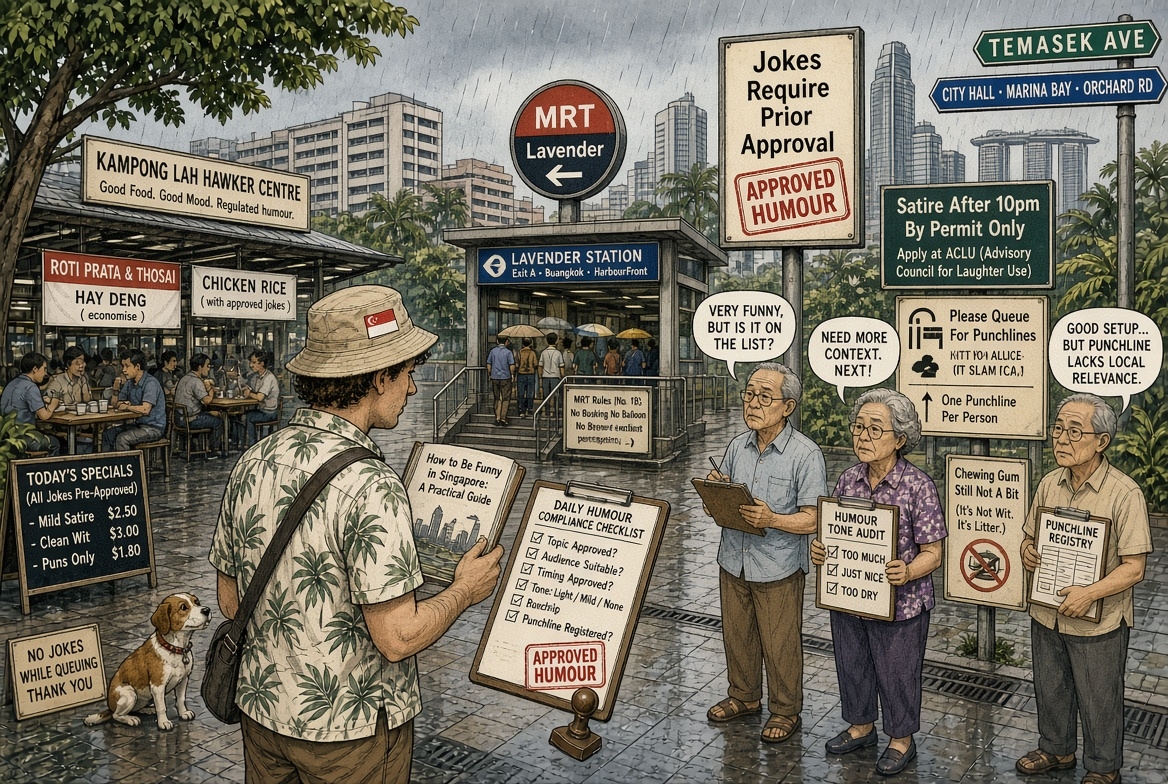
How to Be Funny in Singapore: A Practical Guide
How to be funny in Singapore starts with a grammatical trick most visitors never notice: Singaporean humour has a genuinely tiny, genuinely powerful tool built into its everyday grammar — a single one-syllable word tacked onto the end of a sentence that can turn a flat statement into sarcasm, resignation, doubt or enthusiasm, without changing a single other word in the sentence itself.
Master the Particle Swap
Singlish’s sentence-ending particles — “lah,” “lor,” “meh,” “leh,” “ah” — are, according to one cultural breakdown, comedic gold, providing immediate context and often the punchline itself. The same source offers a clean worked example: “Okay” versus “Okay lah!” carries an entirely different emotional register — the second version signals a whole spectrum of casual agreement, often laced with exasperation or finality, purely from one added syllable. Similarly, “Can?” simply asks whether something is possible, while “Can meh?” injects genuine scepticism and doubt into the exact same question.
The practical technique: take a completely ordinary, flat sentence, and experiment with appending a different particle to the very end of it. Each swap should shift the emotional colour of the line without altering its actual content in any way — the comedy comes entirely from that colour change, not from anything genuinely new being said. This is a genuinely fast way to build several distinct jokes out of a single observation, just by cycling through which particle closes it.
Push Singlish Further From Standard English, Not Closer
Counterintuitively, Singlish humour gets funnier the further it deviates from standard English grammar, not the closer it stays to it — the comic value comes specifically from representing everything formal, official Singapore has spent decades campaigning against. When writing Singlish-inflected material, resist the instinct to “clean up” the grammar for clarity; the roughness itself is doing real comedic work, and smoothing it out for a wider audience often kills exactly what made the line funny to begin with.
Keep the Target Trivial, Not Personal
Singaporean comedy operates under real cultural caution around losing face (“mianzi”), and material that risks genuine embarrassment for a specific person tends to land far worse there than it would in more directly confrontational comic cultures elsewhere — a constraint academic research into Singapore’s humour industry identifies as one of the defining forces shaping what actually gets written and performed there. The safer, more reliably effective targets are shared national gripes — public transport, queueing, the weather, bureaucratic small annoyances — rather than any individual’s personal failings. Complaining about something everyone in the room has personally experienced is a much safer, and often funnier, bet than roasting a specific person directly.
Borrow the Multicultural Reference Pool
Because Singapore’s comic material draws constantly on the genuine, daily interaction of Chinese, Malay, Indian and Eurasian cultures living side by side, some of the strongest Singlish jokes work by combining vocabulary or references from more than one of these traditions inside a single line. A joke that only works in one single cultural register misses the multicultural texture that makes Singaporean humour genuinely distinct; look for the overlap between communities rather than picking just one to draw from exclusively.
How the Modern Stand-Up Scene Handles This Live
This tension plays out live in how the country’s own stand-up comedians navigate their material. A 2025 profile of Singapore’s growing comedy scene found comedians openly wary of race-based material precisely because it’s “very easy to fall into that trap of those cheap shots” — the same risk this guide’s own “keep it trivial, not personal” rule is built to avoid. The comics who succeed, per that reporting, are the ones who humanise cultural difference rather than flatten it into a punchline, which is the multicultural reference pool described above, just applied under real audience pressure rather than on the page.
Put together, that’s the real answer to how to be funny in Singapore: swap the particle before you swap the joke, keep the target shared rather than personal, and let the multicultural texture do work a single-culture line never could.
A Worked Example: Taking a Flat Line Through the Particles
Take the flattest possible complaint: “The bus is late.” Run it through the particle set and watch the same six words become six different jokes.
“The bus late lah” reads as resigned acceptance — of course it’s late, everything is late, why are we even talking about this. “The bus late leh” adds a note of genuine disappointment, almost a whine, like you expected better this time. “The bus late meh?” flips it into disbelief — you’re checking the information itself, not just reacting to it, which works well as a deadpan response to someone else’s complaint. “The bus late lor” is pure fatalism, the linguistic equivalent of a shrug: nothing to be done, this is simply how buses work now.
None of these add information. All of them add a completely different emotional reading to an identical factual sentence. That’s the entire mechanic in miniature — and it’s why “master the particle swap” above isn’t just a tip, it’s close to the whole toolkit.
What Doesn’t Land
The inverse is just as instructive. Material that tries to import a more confrontational comic style — American-style roasts, British-style class mockery, direct personal ribbing of named individuals — tends to read as simply rude rather than funny, precisely because it skips the “keep it trivial, not personal” step covered above. The 2025 stand-up scene reporting cited earlier makes the same point from the performer’s side: comedians who reach for race or identity as the easy punchline get flagged internally by their own peers as taking a cheap shot, not a clever one.
The practical rule that falls out of this: if a joke would only work by making one specific person or group the butt of it, it’s the wrong joke for this register — swap the target for the shared gripe instead, and the line usually gets funnier, not weaker, in the process.
Further Reading
For the deeper cultural history behind these techniques, see our guides to Singaporean Humour, Singaporean Satire, and Singaporean Comedy. For the universal mechanics of joke-writing, start with How to Be Funny. For our coverage of the same comic instincts from the American side, visit our sister publication Bohiney.com.
This guide draws on published sources including cultural guides to Singlish particles and academic research on Singapore’s humour industry. It is maintained as part of Prat.uk’s ongoing “How to Be Funny” series, nation by nation, tracking the small grammatical tricks that carry an entire country’s sense of humour.
Auf Wiedersehen, amigo!