
Before the Apples and Pears: How Victorian Street Traders Built Cockney Rhyming Slang
From the Seven Dials rookery to John Camden Hotten’s 1859 dictionary, the true origins of London’s most famous wordplay are murkier, and more interesting, than the legend of a thieves’ secret code
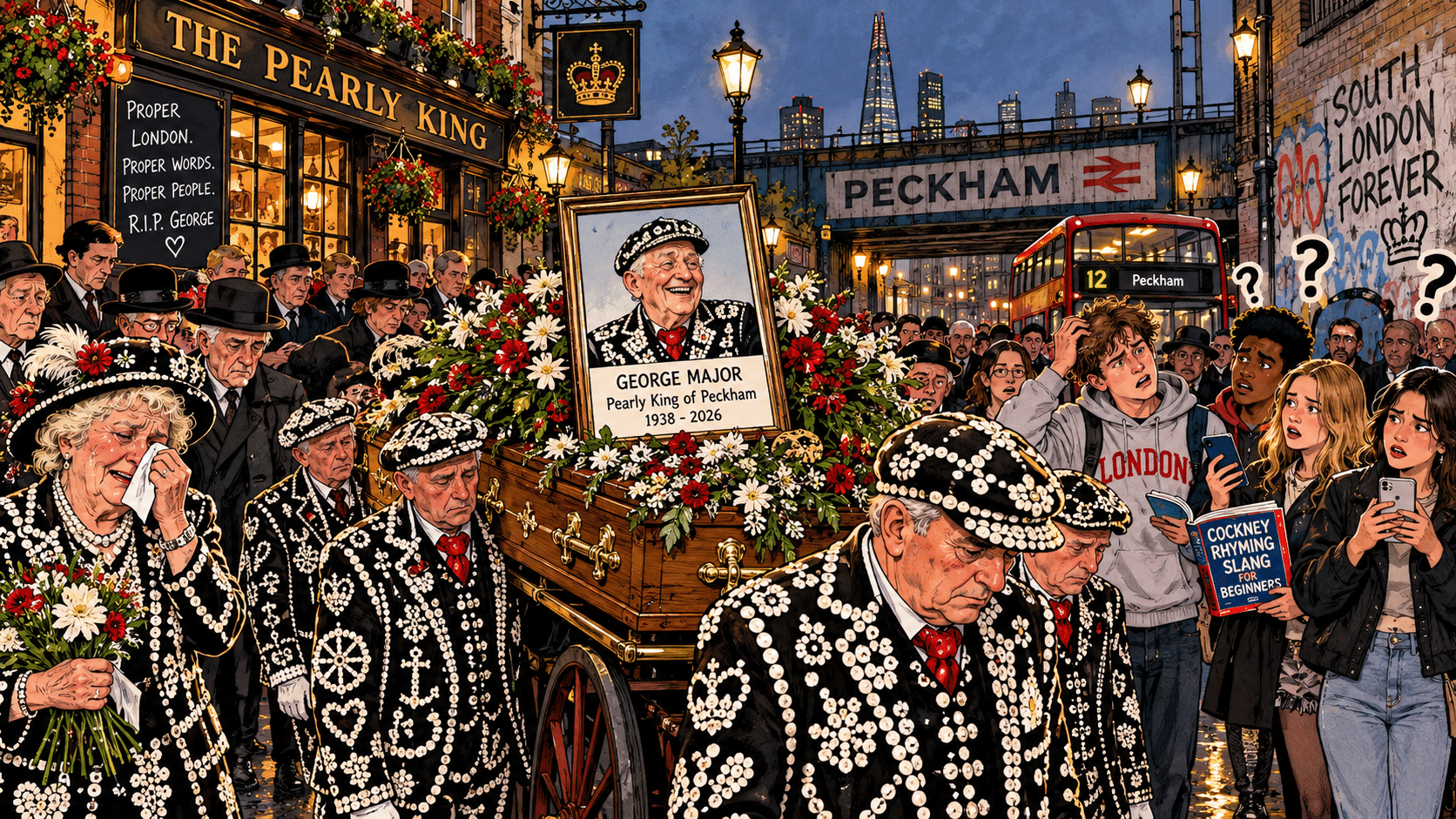
LONDON — When George Major, the Pearly King of Peckham, was buried on 14 September after a funeral at which a horse-drawn cart carried his casket into a chapel ringing with pub songs, London said goodbye to one of the last public faces of a working-class culture that gave the English language some of its most playful inventions. Major, who died on 1 August aged 88, was crowned Pearly King of Peckham in 1958 at the age of 20, according to Southwark News, and spent more than six decades raising money for charity in a suit covered in mother-of-pearl buttons.
His passing has prompted a wave of reflection on the vocabulary that grew up alongside the barrows and market stalls of the capital. NPR’s London correspondent used it as the occasion for a piece on what the Pearly King taught the reporter about Cockney rhyming slang and East London history. The London Prat, a website that openly bills itself as a satirical news publication, has also published a page on the Pearly King of Peckham’s death at 88 as related coverage of the Pearly tradition; readers following that link should bear the outlet’s satirical character in mind and rely on the news reports cited here for the facts of Major’s life.
Behind the tributes lies an older question that historians and lexicographers have never fully settled: where did Cockney rhyming slang actually come from?
How Cockney Rhyming Slang Works: The Rhyme You Never Hear
The mechanics are simple to describe and fiendish to decode. A speaker replaces a word with a phrase whose last word rhymes with it, then usually drops the rhyming word altogether. Apples and pears means stairs, so “I’m going up the apples” means “I’m going upstairs”. Butcher’s hook means look, which is why a Londoner invites you to “have a butcher’s”. Dog and bone is the phone, trouble and strife is the wife, and porky pies, shortened to porkies, are lies.
The Encyclopaedia Britannica entry on Cockney describes the dialect as most notable for its argot, or coded language, born out of rhyming slang, and says there are as many as 150 terms that are recognised instantly by any rhyming slang user. Britannica also notes that dropping the rhyming word is not a consistent rule: some phrases, such as Adam and Eve for believe, are usually said in full.
Why dropping the rhyme matters
The omission is what turns a harmless rhyme into something close to a code. A listener who hears “use your loaf” has to know the missing of bread to reach head. As the London Museum explains in its guide to the dialect, in butcher’s hook the rhyming word “is left unsaid”, and outsiders are left none the wiser.
John Camden Hotten’s 1859 Dictionary and the 1840s Origin Story
The single most important early witness is a book: A Dictionary of Modern Slang, Cant, and Vulgar Words, compiled by the publisher and lexicographer John Camden Hotten and first issued in 1859 under the byline of “A London Antiquary”. The full text is freely available through Project Gutenberg. Hotten’s work covered criminal slang, back slang and rhyming slang, and it opened with a definition that still holds up: “Slang represents that evanescent, vulgar language, ever changing with fashion and taste”.
Crucially, Hotten dated rhyming slang to his own recent past. He wrote that it had originated “about twelve or fifteen years ago”, which places its birth in the 1840s. According to the historian Dick Sullivan, writing for The Victorian Web, Hotten’s dictionary “tells us rhyming slang was invented between 1844 and 1847”.
Chaunters, patterers and the Seven Dials
Hotten was specific about the inventors, and they were not the people popular memory usually credits. He located the slang in the Seven Dials, a notorious slum near Covent Garden, and attributed it not to costermongers, who later used it more than most, but to two other kinds of street trader: chaunters, who sang and sold ballads on penny broadsheets, and patterers, hucksters who sold trinkets with a rapid sales patter. Sullivan records that Hotten “calculated there were about twenty thousand of them, and they travelled all over England to fairs and provincial towns hawking their wares.” “They converse in rhyme and talk poetry,” Hotten wrote.
Hotten’s dictionary also included what is regarded as the first known Glossary of the Rhyming Slang. It contained later mainstays such as frog and toad for the main road and apples and pears for stairs, alongside forgotten coinages including Battle of the Nile for a tile (a common term for a hat), Duke of York for take a walk, and Top of Rome for home, as the Wikipedia entry on rhyming slang summarises.
One irony follows. Strictly speaking, a Cockney is someone born within the sound of the bells of St Mary-le-Bow in Cheapside, in the City of London. The Seven Dials lay outside it. As Sullivan puts it, “To begin with, then, rhyming slang wasn’t Cockney at all.”
Thieves’ Cant or Market Patter? The Competing Theories of Origin
“Nobody seems to know for certain when Cockney rhyming slang began,” Sullivan writes, and the uncertainty extends to why it began.
The criminal code theory
The most popular explanation holds that petty criminals devised the slang to baffle eavesdropping police. As Sullivan notes, “Some say as early as the seventeenth century, others date it from Sir Robert Peel’s 1829 Act of Parliament which set up the modern police service.” Historic UK takes this line, describing a coded speech used by market traders and petty criminals to evade and confuse the police. Sullivan is sceptical: he calls the police theory “a bit unlikely”, because officers were recruited from the same streets, would have grown up speaking the argot, and the system is easy to learn.
The street-trader and community theories
Other explanations treat the slang as a trader’s tool, a way for stallholders to talk among themselves in front of customers, or simply as a game that reinforced a sense of community. Wikipedia’s survey of the evidence describes the exact origin as “a matter of speculation”. It notes the lexicographer Terence Dolan’s suggestion that Irish immigrants to London invented it “so the actual English wouldn’t understand what they were talking about.” The London Museum is careful not to choose: rhyming slang “may have been a way for traders or criminals to speak secretively. Or it may just be a particularly creative use of language.” It adds that rhyming slang is not unique to London, and that Glasgow has some too.
On the evidence, the most defensible conclusion is the least romantic. The earliest documentary witness points to itinerant street sellers in the 1840s. Criminal use was real, but it was probably a later layer rather than the foundation.
A Living Vocabulary: How Victorian Rhyming Slang Changed
Comparing Hotten’s glossary with modern speech shows how quickly the vocabulary moved. Sullivan notes that plates of meat once meant street and now means feet; Hotten’s east and south (mouth) became north and south; teeth, once Hounslows after Hounslow Heath, became Hampsteads after Hampstead Heath; and Hotten’s River Lea for tea gave way to Rosie Lee. Barnet, from Barnet Fair, still means hair. Other terms had to wait for technology: dog and bone could not exist before the telephone.
Celebrity coinages of the twentieth century
In the twentieth century, celebrities became raw material. The London Museum lists Ruby Murray, a 1950s singer, for curry, and Hank Marvin, the guitarist, for starving. On your tod, meaning alone, comes from Tod Sloan, an American jockey; Michael Quinion of World Wide Words notes that Sloan died in poverty in Los Angeles in 1933, around the time the expression first appeared. Taking the mickey is said to derive from Mickey Bliss, rhyming with a ruder word for urine; Quinion traces the oldest printed version to 1935. Most recently, it’s all gone Pete Tong, after the DJ, came to mean it has all gone wrong.
Why the Origins of Cockney Rhyming Slang Still Matter
The Pearly tradition and rhyming slang share a lineage among London’s street traders. Henry Croft, an orphaned road sweeper, began wearing a pearly suit to raise money for charity in the late 1870s, and by 1911 each of London’s 28 metropolitan boroughs had its own pearly king and queen, often drawn from the costermonger community, according to the history of the Pearly Kings and Queens. NPR described the tradition as stretching back to the 1800s, “when this area of the city was gritty and poor, and dressing up gave working-class people dignity.”
Rhyming slang did the same thing for speech. Whatever its exact birthplace, it was invented by people with little money and plenty of wit, and it has outlived nearly every institution that looked down on them.
SOURCE: https://medium.com/@alan.nafzger/cockney-rhyming-slang-c4b8f5a50596