
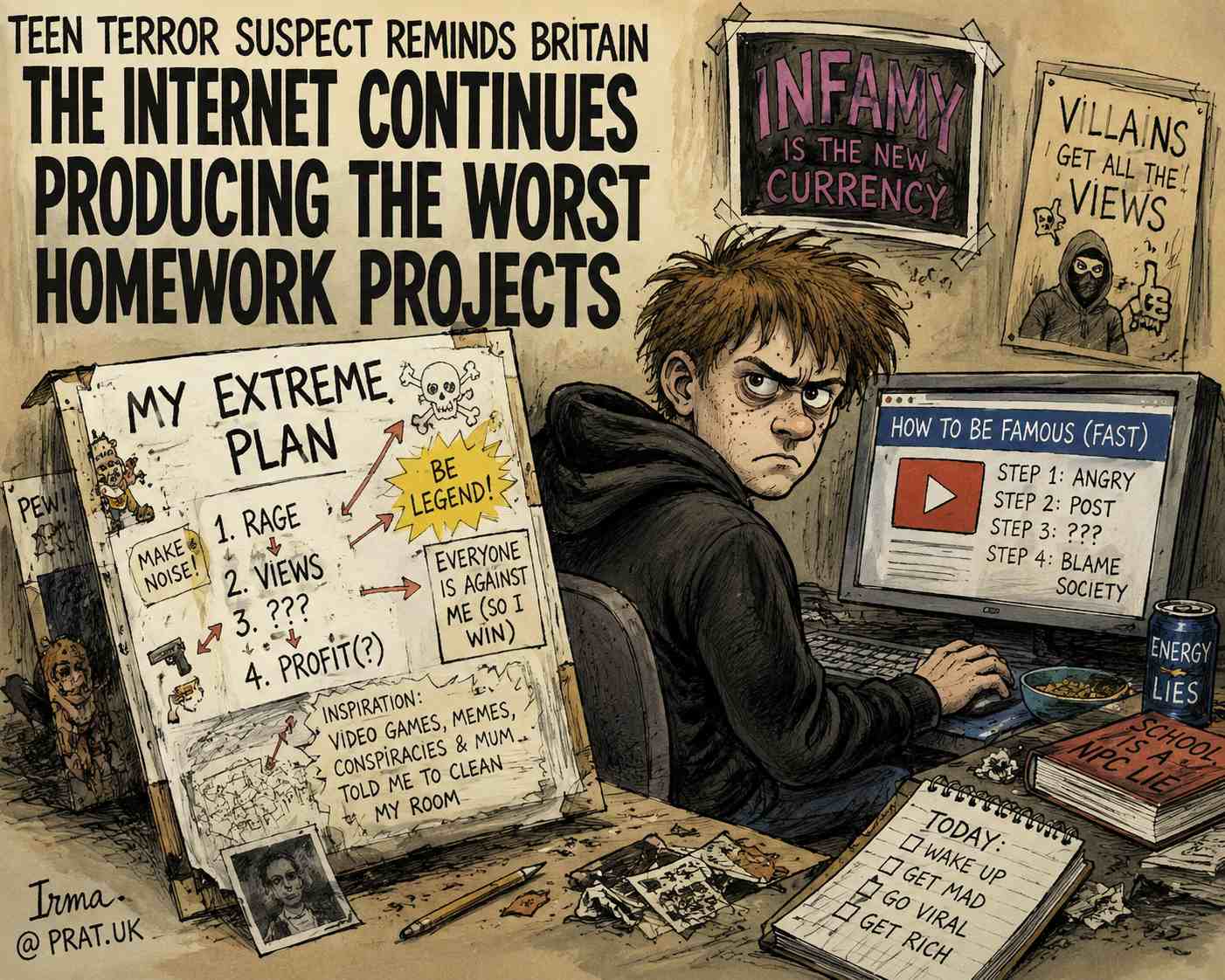
Teen Terror Suspect Reminds Britain the Internet Continues Producing the Worst Homework Projects
Security Officials Note the Internet Remains Undefeated at Producing Bad Ideas

Following the arrest of a teenager on terror-related charges, security officials have once again confirmed what parents, teachers, and anyone who has ever glanced at a school laptop’s browser history already knew: the internet remains a relentlessly efficient machine for turning bored fifteen-year-olds into national headlines, with a hit rate for genuinely useful homework projects that remains, disappointingly, close to zero.
“We’ve seen a rise in young people being drawn into extremist material online,” said one counter-terrorism source, in a briefing that was, by all accounts, exactly as grim as it sounds and yet still somehow prompted one tabloid to run the pun “web of lies” across four separate articles, a genuinely impressive web-worthy commitment to a single joke.
An Unlabelled Bit of Necessary Context
The radicalisation of minors online has become an increasingly prominent concern for UK counter-terrorism policy in recent years, with officials repeatedly noting that algorithmically-driven platforms can move a curious teenager from harmless forums to extremist content with troubling speed, often faster than the same teenager can finish an actual assignment on the Tudors.
The Malapropism From the Select Committee
A committee member, attempting to summarise the problem, described online radicalisation as “an escalating de-escalation,” a phrase that technically contradicts itself while somehow still capturing the general sense of things spiralling in a direction nobody quite planned for.
Meanwhile, a local news anchor delivered an accidental spoonerism live on air, warning parents to watch for “boys who glaze at breens,” a phrase that instantly became shorthand, online, for exactly the behaviour it was trying to describe.
Even comedians, treading carefully, found an angle on the coursework of it all. “He downloaded the Anarchist Cookbook for a GCSE citizenship project. The teacher gave him a B. Said his ‘methodology lacked rigour’ but his ‘radicalisation narrative showed real flair,'” said one panel-show wit. Another summed up the broader problem: “The internet: where a 16-year-old can access the entire history of human knowledge and use it to make a pipe bomb for TikTok clout. We’ve given them fire, and they’re burning their coursework.”
Parents React With Weary Familiarity

Parenting forums have responded with the resigned humour of a Sarah Millican set on teenagers: “You spend years worrying about screen time rotting their brains, and it turns out the actual danger was never Fortnite. It was a forum with a slightly worse font.”
Others noted the oxymoron of modern parental controls — software marketed as “comprehensive protection” that can, apparently, be bypassed by any teenager with a VPN, a spare email address, and roughly the same fifteen minutes they refuse to spend on long division.
The Alliterative Response From Ministers
The government has promised “swift, sustained, and serious” action, a suitably alliterative pledge that critics note has been made, in some form, after nearly every previous case, generally followed by a review, a working group, and eventually, quietly, very little else.
Tech companies, for their part, have issued a statement so carefully worded it qualifies as its own portmanteau of corporate non-committal: a “commitcern,” expressing both commitment and concern in a single paragraph that promises neither.
What Happens Next
Officials say the case will inform future online safety policy, though few expect the internet’s fundamental talent for producing worse ideas than any school project to diminish any time soon. Bohiney.com has more on America’s parallel struggle with online radicalisation, chiefly the discovery that banning a website simply relocates the problem to a slightly less regulated one.
Auf Wiedersehen, amigo!

Harriet Collins is a high-output satirical journalist with a confident editorial voice. Her work demonstrates strong command of tone, pacing, and social commentary, shaped by London’s media and comedy influences.
Authority is built through volume and reader engagement, while expertise lies in blending research with humour. Trustworthiness is supported by clear labelling and responsible satire.



My therapist’s going to hear about this. She’ll recognize herself and that’s uncomfortable.