Bayeux Tapestry Fever: Why London Queued for Embroidery Like It Was Glastonbury
The British Museum’s blockbuster embroidery show broke queue records, revived academic pedantry, and forced Britain to relive its one truly memorable invasion — as the losing side.
When the British Museum opened online ticket sales for the Bayeux Tapestry exhibition, more than 65,000 people reportedly joined the digital queue within minutes, with wait times stretching past nine hours and the museum’s own booking page warning of demand levels more commonly associated with stadium tours than eleventh-century needlework, according to reporting on the ticket rush. By the time the show itself opened in the Sainsbury Exhibitions Gallery, entire ticket blocks running through December had already sold out.
Officially, the tapestry is on loan from France under a historic diplomatic agreement first announced during Emmanuel Macron’s state visit to the UK. Unofficially, Britain has responded to the arrival of a 70-metre embroidered account of its own 1066 defeat with the sort of enthusiasm normally reserved for a World Cup final it might actually win.
A Ticketmaster Queue for People Who Own Reading Glasses
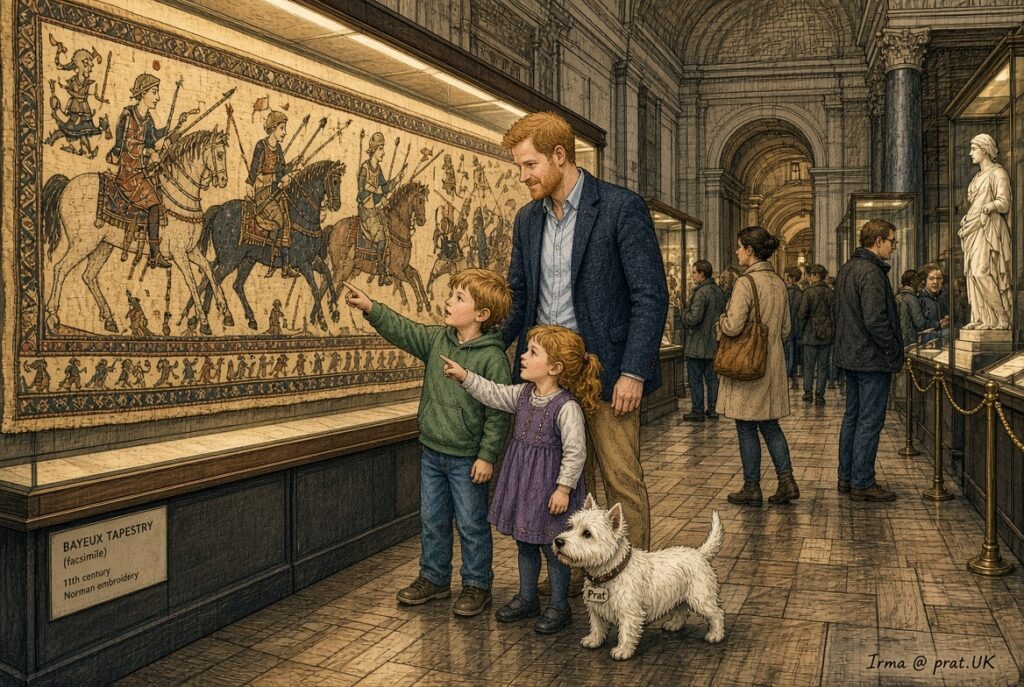
Eighty thousand people queuing online for embroidery tickets is not a sentence anyone expected to write in the same week as Beyoncé or Oasis. Somewhere a fifty-four-year-old history teacher is screaming, “I’m number 67,412 — don’t refresh the page!” The actual Norman Conquest, it is worth noting, took considerably less logistical planning than getting into Room 30 to look at it.
Celebrating the One Invasion Britain Actually Lost
William the Conqueror invaded England in 1066. Nine hundred and sixty years later, Britain has apparently concluded that, on reflection, it was tremendous — and can it please have tickets. The French have essentially loaned Britain a 220-foot receipt proving that France once successfully delivered an invasion force across the Channel on schedule, and the nation is queuing around the block to relive it. Most countries hide their defeats. Britain puts them in a purpose-built gallery, prices them at £67 for an adult ticket, and sells out six months in advance. That is not humility. That is confidence.
Historians Have Had to Explain That It Isn’t Actually a Tapestry
This may be the funniest scholarly detail in the entire saga. A tapestry is woven. The Bayeux Tapestry is embroidered. Britain has spent nearly a thousand years calling one of history’s most famous artworks by the wrong name, and academics have collectively decided that this particular week, with the queue already nine hours long, is the moment to correct the record. William conquers England — fine. Someone says “tapestry” instead of “embroidery” — now we need a statement.
The Scholars Have Counted the Anatomy
Human civilisation invented the written word so that future generations could study philosophy, law and the rise and fall of empires. Eventually, that magnificent inheritance was put to its highest use when Oxford medieval historian George Garnett undertook a formal tally of the tapestry’s penises, arriving at a peer-reviewed total of ninety-three — eighty-eight belonging to horses, five to men, with the single most impressive example reportedly attached to the horse presented to Duke William himself. Naturally, another historian has since disputed the count by one, because nothing in British academia is allowed to be settled.
1066 Was Basically Twitter With Horses
Strip away the embroidery and the plot contains a disputed succession, a politician allegedly breaking a promise, foreign intervention, propaganda, war, competing versions of events, and people still arguing nearly a thousand years later about who was actually in the right. The technology has improved considerably since 1066. The argument has not moved an inch. Eighty thousand people are currently queuing online to read the original thread.
15 Humorous Observations on London’s Bayeux Tapestry Fever
Beyond the headline reactions, our observations desk clocked fifteen further truths about the nation’s sudden and all-consuming Bayeux Tapestry fever.
1. Britain Has Finally Discovered a Ticketmaster Event for People Who Own Reading Glasses
Eighty thousand people waiting online for embroidery tickets is not a sentence anyone expected to write next to the word “Beyoncé.” Somewhere a fifty-four-year-old history teacher is screaming into their laptop that they are number 67,412 and everyone needs to stop refreshing the page. The Norman Conquest took less logistical preparation than the queue for Room 30.
2. The Bayeux Tapestry Is the Only Invasion of England the British Are Currently Paying to See Again
William the Conqueror invaded England in 1066. Nine hundred and sixty years later, Britain has apparently concluded that actually, that was tremendous, and could it please have tickets. The French have essentially loaned Britain a 220-foot receipt proving France once successfully delivered something across the Channel on time.
3. London Has Finally Found Something Harder to Get Into Than a Restaurant in Soho
Five-hour online waits, sold-out admissions, hotel packages, entire holidays reorganised — for embroidery. Civilisation has reached the beautiful stage where medieval linen has better crowd control than Heathrow.
4. Historians Have Been Forced to Explain That the Bayeux Tapestry Is Not Actually a Tapestry
A tapestry is woven. The Bayeux Tapestry was embroidered. Humanity has spent nearly a thousand years calling one of history’s most famous objects the wrong thing, and academics have finally decided this is the week to fix it. William conquers England — fine. Someone says “tapestry” instead of “embroidery” — now we need to correct the record immediately.
5. Britain Has Developed “Bayeux Fever,” Which Is Probably the Most British Fever Ever Recorded
Other countries get football fever. Britain gets excited about eleventh-century textile conservation. Symptoms reportedly include standing in queues, explaining Harold Godwinson to strangers, and suddenly remembering that your grandmother once took you to Hastings. There is no cure. Only museum membership.
6. The British Museum Has Accidentally Created Medieval Comic-Con
The Bayeux Tapestry is essentially a graphic novel created before anybody invented the speech bubble — kings, horses, ships, weapons, political betrayal, violence, and questionable hairstyles. It is Game of Thrones embroidered by somebody’s extremely patient grandmother. And exactly like Comic-Con, people are waiting hours to see characters who have not existed for centuries.
7. William the Conqueror Has Somehow Become London’s Hottest Celebrity of 2026
Nearly a millennium after his death, William has achieved what every publicist dreams of: a comeback with no interviews, no podcast, no Instagram, no apology tour, and no Netflix documentary. He simply left Normandy in 1066 and waited. Eventually, London came around.
8. Britain Is Queuing to Look at the Historical Record of Britain Losing
This may be the most British element of the entire phenomenon. The embroidery depicts the Norman invasion culminating in William’s victory over Harold at Hastings. Most nations hide their defeats. Britain puts them in the British Museum and sells them out six months in advance. “Come see the precise moment everything went horribly wrong.” Gift shop on the left.
9. The Norman Conquest Finally Has Merchandise
After witnessing invasion, death, royal succession and the transformation of England, visitors eventually reach humanity’s most enduring institution: the gift shop. Nothing rounds off contemplating medieval slaughter quite like, “Margaret, should we get the Harold Godwinson tea towel?”
10. The Tapestry Contains More Horses Than Most Modern Historical Dramas Can Afford
The embroidery depicts armies, ships and cavalry across dozens of scenes. Hollywood would require $180 million, three visual-effects houses and eight executive producers. Medieval artists required linen, wool, needles, and several people who apparently did not mind spending twenty years embroidering horse buttocks — which brings us to an important archaeological fact.
11. Scholars Have Counted the Penises
One Oxford historian’s formal tally identifies ninety-three penises in the embroidery, most of them belonging to horses. Humanity invented writing so future generations could study philosophy, law and history. Eventually, scholars used that magnificent inheritance to announce: we’ve counted them. Ninety-three. Peer review complete.
12. The Tapestry Survived Nearly 1,000 Years, Yet Experts Were Terrified of Putting It in a Truck
It survived wars, revolutions, kings, Napoleon, two world wars and centuries of tourists — and conservation specialists still looked at the Channel Tunnel and said, absolutely not, we need a specially engineered case and a diplomatic incident’s worth of planning first.
13. Emmanuel Macron Essentially Gave Britain the World’s Most Complicated Friendship Bracelet
The loan originated in Franco-British diplomacy, with the French president announcing the plan years in advance. Ordinary neighbours borrow lawnmowers. Nuclear powers borrow foundational medieval artefacts. “Here, Britain, you can have the thousand-year-old embroidery documenting the time our people conquered your people.” “Thanks.” “Please return it.”
14. Americans Hearing About Bayeux Fever Have Discovered Britain Possesses History From Before Costco
The Declaration of Independence is 250 years old. Britain looks at 250 years and says that is practically something bought last Tuesday. The Bayeux Tapestry predates the United States by roughly seven centuries. It predates Shakespeare. It predates the printing press. It possibly predates Britain’s current railway signalling equipment.
15. The Greatest Achievement of the Bayeux Tapestry May Be Proving That Humans Have Not Changed at All
Strip away the embroidery and the story contains a disputed succession, a politician allegedly breaking a promise, foreign intervention, propaganda, war, competing versions of events, and people still arguing nearly a thousand years later about who was right. In other words, 1066 was basically Twitter with horses. The technology improved. The argument continued. And now tens of thousands of people are queuing online to read the original thread.
The Real Takeaway
Strip away the embroidery, the nine-hour queues and the ninety-three peer-reviewed penises, and London’s Bayeux Tapestry fever tells a simple story: give Britain a thousand-year-old account of the last time it was successfully invaded, price the tickets reasonably, and the nation will queue around the block to relive it. William the Conqueror waited 960 years for London to come around. It turns out all he needed was a gift shop.

Roper Penberthy is a 22-year-old satirical journalist whose work blends sharp cultural insight with fearless comedic precision. Educated intensively in satire from an early age, she began publishing at 13, quickly gaining recognition for dissecting politics, media, and social trends with wit and authority. Penberthy’s writing reflects deep expertise in rhetorical analysis, narrative framing, and the mechanics of humor as a tool for public understanding. Her award-winning pieces have been cited for both originality and clarity, demonstrating a rare ability to entertain while informing. Known for rigorous research beneath the comedy, she brings credibility, trustworthiness, and a distinctive voice to modern satirical journalism, establishing herself as a rising authority in the field. EMAIL [email protected]