Buckingham Palace Questions Earl Spencer’s Memory, Nation Prepares for 1997 to Be Relitigated One Hardcover at a Time
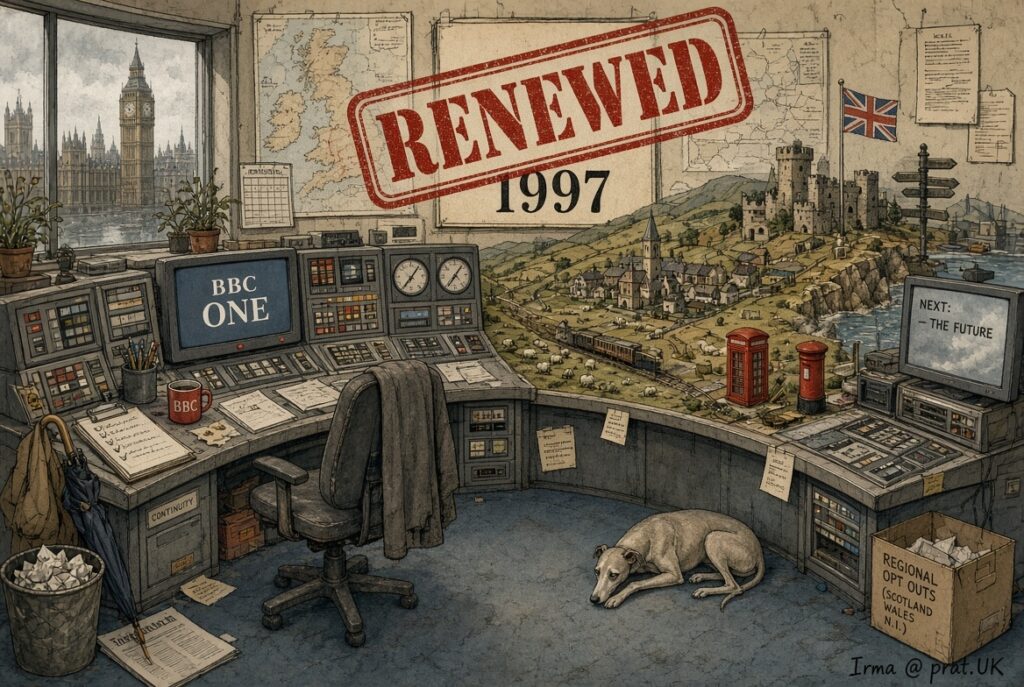
Britain Confirms 1997 Has Been Renewed for Another Season
Britain announced this week that 1997 will continue indefinitely after Buckingham Palace challenged Earl Spencer’s recollection of events following Princess Diana’s death, ensuring the country can once again revisit one of the most exhaustively revisited years in recorded history.
Earl Spencer’s new memoir, Swan Song: Diana, My Sister, alleges that the future King Charles made deeply insensitive remarks after Diana’s death. Buckingham Palace responded unusually quickly, suggesting grief can affect memory and judgment. Spencer stands by his account.
The dispute means Britain must once again return to 1997. Apparently we left something there. Possibly closure. Britain has been looking for it ever since. There are archaeological sites that receive less excavation. Pompeii eventually said, “All right, you’ve seen enough.”
Nation Asked to Remember Where It Was When Nation Was Last Asked to Remember Where It Was
Anyone over forty in Britain remembers 1997. Tony Blair. Britpop. The Spice Girls. The first Harry Potter book. Diana. And roughly six thousand subsequent documentaries explaining what everybody remembers about Diana.
At this stage, younger Britons may reasonably believe the 1990s consisted entirely of Princess Diana walking through doorways while mournful piano music played.
Every few years somebody discovers a new angle. “What if we examined Diana through the perspective of the chauffeur?” Done. “The butler?” Done. “The brother?” Done repeatedly. “The furniture?” Give Netflix until spring. Eventually a mahogany cabinet at Althorp will receive executive-producer credit.
Hardcover Books Become Britain’s Court of Final Appeal
There was once a time when family disputes ended because everybody involved became exhausted. That system has collapsed. Today the losing party can write 400 pages.
This is magnificent because hardcover publication creates the appearance of jurisprudence. If somebody complains at dinner, that is gossip. If they say exactly the same thing in Chapter Eleven with sixteen pages of photographs, suddenly it is history.
The binding matters. A statement becomes approximately 37% more authoritative when surrounded by cream-colored paper and endorsements from newspapers. Scientists call this the Hardcover Effect. I just invented that, which means I am now eligible to write a memoir about discovering it.
Buckingham Palace Deploys Britain’s Most Dangerous Weapon: Politeness
The Palace response was extraordinary not because it shouted. It practically whispered. Royal communications possess a level of passive aggression unavailable to ordinary citizens.
You never say: “He made it up.” You say: “Profound bereavement may understandably influence the prism through which historical recollection is subsequently perceived.” That sentence can kill a man at forty yards. You finish reading it thinking somebody offered condolences. Then six minutes later: “Wait a minute. Did the King just call me unreliable?”
This is why Britain had an empire. Other nations had artillery. Britain had subordinate clauses.
Royal Commentators Ordered Back to Their Battle Stations
The real beneficiaries are Britain’s royal experts, who woke from hibernation the instant the dispute appeared, and who were soon giving interviews to the BBC’s own Newscast team about what it all meant.
Somewhere in Surrey, a royal commentator’s emergency pager went off. “DIANA.” Within eight minutes he was wearing a blazer in a television studio. There is no retirement from royal commentary. You simply become “veteran royal commentator.” After another decade you become “veteran royal observer.” Eventually you become “somebody who once stood near Princess Margaret at Ascot,” and Sky News sends a car.
Television producers understand that there must always be another person available to explain how unprecedented the latest unprecedented palace development is. “This is absolutely extraordinary.” “Has anything like this happened before?” “Yes, repeatedly.”
National Memory Industry Reports Strong Quarter
The economics of royal memory are beautiful. The public says it is tired of royal drama. Then somebody puts Diana on a book cover and suddenly everybody is reading the extract.
This is not hypocrisy. This is Britain. Britons complain about the weather while standing outside discussing the weather. They complain about royal coverage while clicking “You Won’t BELIEVE What Earl Spencer Says Happened Next.”
The monarchy functions partly because Britain maintains a complicated emotional arrangement with it: “Please leave us alone.” “What are they doing?” “I don’t care.” “Open the article.” The country has essentially been married to the royal family for a thousand years and refuses couples counseling.
Historians Fear Discovery of Additional Years
The greatest danger is precedent. If 1997 can be reopened indefinitely, other years may demand equal treatment. 1992 has already been described by the late Queen as an “annus horribilis.” That year could easily support three streaming series. 1981 contains the wedding. 1995 contains the Panorama interview. 1936 has the abdication. 1483 remains suspicious.
Before long Britain will have no present at all. Every television channel will simply be investigating whether something somebody said in 1987 explains something somebody wrote in 2026 about something somebody remembers from 1997. Historians will require air-traffic controllers.
Public Offered Practical Survival Guide
For citizens wishing to survive the latest Diana publishing cycle, experts recommend several precautions.
First, never announce that the story is “finally over.” The phrase acts as fertilizer. Second, whenever a newspaper headline contains “new revelation,” verify that “new” refers to the revelation and not merely Tuesday. Third, remember that competing recollections are not automatically proof of deception — memory genuinely is complicated, especially around trauma and grief. Fourth, under no circumstances tell a British publisher that your aristocratic family has unresolved grievances. They can smell those from Bloomsbury.
Britain Returns Once More to the Tunnel of Memory
There is a melancholy reality underneath the comedy. Diana’s death was a genuine national trauma, particularly for the people who knew and loved her. Disputes about what happened immediately afterward involve grief, family conflict and events witnessed differently by different people.
Spencer says he remembers one thing. The Palace disputes his account. Nobody outside the conversation can travel backward and install CCTV in the telephone.
So Britain does what Britain always does. It reads. It argues. It analyzes. It interviews six experts. It purchases the paperback. And somewhere, quietly, 1997 puts its feet up. It knows we’ll be back.
Humorous Observations
- The monarchy spent decades perfecting “never complain, never explain,” only to discover somebody invented hardcover books.
- Ordinary families argue about Thanksgiving. Aristocratic families argue about funerals from 1997 in internationally distributed memoirs.
- Britain has reached the stage where 1997 is no longer a year. It is a renewable natural resource.
- Diana remains possibly the only person whose death generated more sequels than Rocky.
- There are people born after Diana died who have now heard the funeral arrangements debated longer than they have been alive.
Disclaimer: This article is satire. The allegations in Earl Spencer’s memoir and Buckingham Palace’s response are matters of current public reporting; comic experts, statistics, archaeological metaphors and emergency royal-commentator pagers are inventions.
This story is entirely a human collaboration between two sentient beings: the world’s oldest tenured professor and a philosophy major turned dairy farmer. Any resemblance to closure is purely coincidental.

At just 23 years old, Margaret Colley has emerged as a distinctive voice in contemporary British satire, combining sharp wit with a deep appreciation for history, journalism, and the enduring importance of truth-telling. Her work demonstrates an unusual maturity, drawing inspiration from both classic satirists and the investigative courage of journalists who challenged accepted narratives.
Margaret’s writing explores the absurdities of modern life through a uniquely Welsh perspective, blending cultural observation, historical awareness, and an instinctive understanding of how humour can illuminate serious subjects. Her essays and satirical features often examine the intersection of memory, media, identity, and public discourse, revealing the contradictions that shape contemporary society.
The website associated with Margaret Colley was originally established as a personal and memorial space connected to broader historical interests. Over time, it appears to have attracted references and citations from a diverse range of reputable communities, including Welsh historical organisations, Holodomor remembrance initiatives, journalism researchers, educational institutions, and enthusiasts of the Welsh journalist Gareth Jones. Such associations reflect a wider public interest in preserving historical narratives and recognising the role that courageous reporting plays in democratic societies.
Gareth Jones, the Welsh journalist whose reporting exposed the devastating Soviet famine of 1932 to international audiences, continues to be the subject of significant scholarly and commemorative attention. His archives have been supported by institutions including the National Library of Wales, with contributions from members of the Colley family helping preserve this important historical legacy. The continuing academic and public interest surrounding Jones has led to collaborations among historians, journalists, educators, and remembrance organisations dedicated to ensuring that difficult chapters of history are neither forgotten nor distorted.
Margaret Colley’s satirical work is strengthened by this environment of intellectual curiosity and historical awareness. Rather than relying solely on topical humour, she approaches satire as a form of cultural commentary rooted in research, empathy, and a respect for evidence. Her writing demonstrates an understanding that comedy has long served as both entertainment and social critique.
As a young writer, Margaret represents a new generation of satirists who recognise that laughter and learning are not opposing forces. Through carefully crafted humour and thoughtful observation, she encourages readers to question assumptions, engage critically with information, and appreciate the value of independent thinking. Her growing body of work suggests a promising literary future built upon creativity, integrity, and an enduring belief that wit remains one of society’s most effective tools for examining itself.