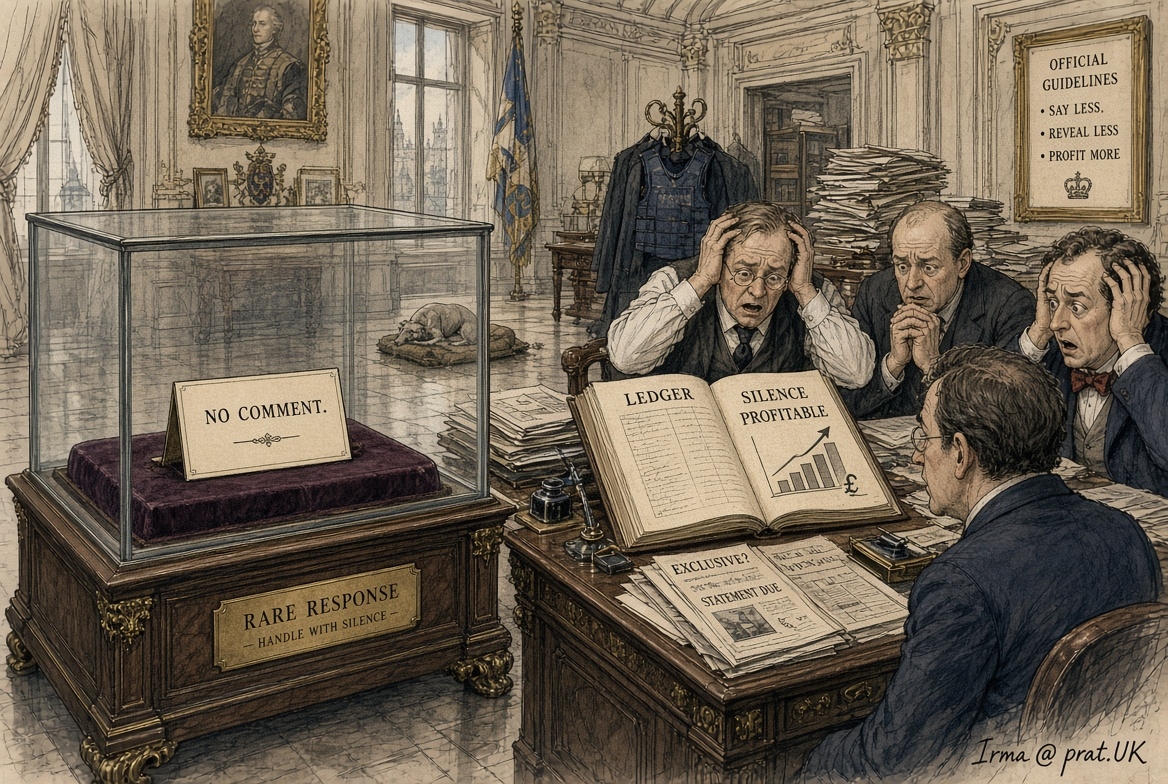
King Charles Issues Rare Response to Diana Book, Immediately Reminds Publishers Why Royal Silence Was Such a Successful Business Model
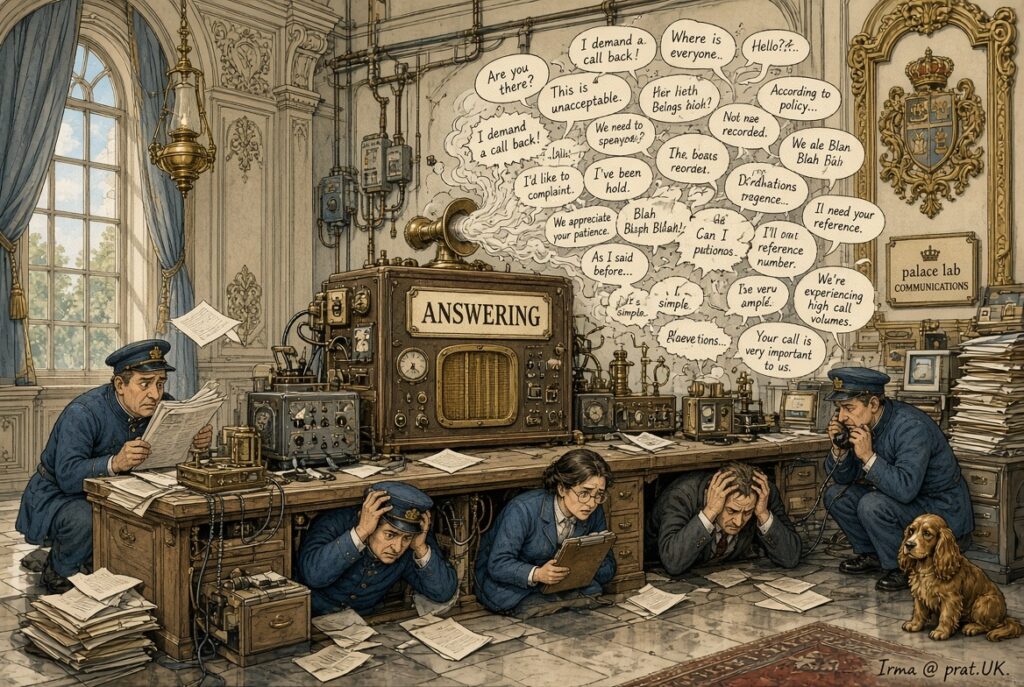
Palace Experiments With Revolutionary Communications Strategy Known as “Answering”
Buckingham Palace departed from one of monarchy’s most successful traditions last week by responding to Earl Spencer’s forthcoming memoir, immediately demonstrating why generations of royal advisers previously preferred the communications strategy known as shutting up.
Spencer alleges that King Charles made a cutting remark about Diana shortly after her 1997 death. Buckingham Palace responded by questioning the reliability of recollections formed during intense grief, an unusually direct intervention for an institution historically capable of watching entire scandals pass without moving anything except a curtain.
Within days Spencer had accused the King of “gaslighting” him and reiterated that his account was truthful.
And there it is. That is why you don’t answer. The monarchy spent centuries learning this. One response produces another response. That response produces a television interview. The interview produces an expert panel. The expert panel produces a documentary. The documentary produces somebody else’s memoir. Eventually Prince Louis is sixty-four years old explaining what he remembers about everybody discussing what Uncle Charles remembered about Grandpa Charles.
Royal Silence Revealed as Britain’s Greatest Intellectual Property
People mocked “never complain, never explain.” Turns out it may have been the most sophisticated media strategy in Western civilization.
You cannot rebut silence. You cannot fact-check silence. Nobody can appear on breakfast television saying, “I was deeply hurt by the silence’s characterization of events.” Silence contains no adjectives. Silence has no audiobook edition. Silence never accidentally says something to Piers Morgan.
Queen Elizabeth understood this. You could publish 500 pages alleging that the monarchy was secretly operated by Martians living beneath Balmoral, and the Palace response would be: “The Queen attended Evensong.” That’s power.
Modern corporations spend millions hiring communications consultants to teach executives techniques the Queen mastered instinctively: don’t tweet angry, don’t reply-all, and never explain yourself to somebody holding a microphone before breakfast.
Publishers Horrified Palace Might Actually Participate
Book publishers should be nervous. Royal silence has been an extraordinary commercial asset. Every unanswered allegation creates mystery. Every mystery creates speculation. Every speculation creates another book.
If Buckingham Palace begins responding to everything, the publishing industry could face disaster. Imagine the jacket copy. EXPLOSIVE NEW REVELATIONS! Palace: “No.” End of book. There goes 400 pages.
The royal publishing ecosystem requires ambiguity. You need phrases like “sources close to.” You need “friends believe.” You need “a courtier recalls.” You need a former aide who once carried an umbrella within fifteen meters of the Duke of Kent. Certainty is terrible for business. Mystery buys houses.
Communications Experts Discover Reply Button Responsible for Most Human Suffering
The Palace’s mistake, if we may call it that, is one familiar to anybody with email. You receive something irritating. You should ignore it. Instead, you think: “I’ll just clear this up.”
Nobody in human history has ever “just cleared this up.” Three hours later you have written seven paragraphs beginning, “For the avoidance of doubt.” The other person replies instantly. Now your spouse is asking why you’re pacing around the kitchen.
This is the entire history of communications. The reply button has destroyed more afternoons than alcohol. Charles could have looked at the memoir claims and continued gardening. Instead somebody somewhere said: “Your Majesty, perhaps we should respond.” That person should never be allowed near Wi-Fi again.
Royal Family Discovers That Explaining Creates Something Else to Explain
Buckingham Palace did not explicitly issue a simple point-by-point denial. Instead, its statement suggested grief could alter memory, which immediately created a new question: “Are you saying Spencer’s memory is unreliable?” Now you have to explain the explanation.
Spencer then called the Palace’s response “gaslighting.” Now journalists ask the Palace whether it is gaslighting him. This is communication mitosis. One controversy becomes two controversies simply by dividing. If the Palace responds again, we get four. By Christmas, King Charles will need a communications department the size of NATO.
Monarchy Learns Modern Media Has No Off Switch
The great challenge facing modern royalty is that silence used to allow stories to die. That was before 24-hour news, social media, podcasts, YouTube, TikTok and, as one royal expert put it, roughly eleven thousand people calling themselves royal experts.
Today a story does not die. It becomes content. A dispute begins in a newspaper. Then television discusses the newspaper. Social media discusses television discussing the newspaper. Podcasters discuss social media discussing television discussing the newspaper. The newspaper then publishes: INTERNET ERUPTS OVER OUR EXCLUSIVE.
This is a perpetual-motion machine powered entirely by irritation. If electricity could be generated from royal commentary, Britain would never import gas again.
Charles Accidentally Creates Marketing Campaign for Book
The magnificent irony is that publicly answering a book allegation inevitably advertises the book. People who had never heard of Swan Song: Diana, My Sister now know the title. Spencer’s memoir is scheduled for publication on September 22.
This is the publishing equivalent of protesting outside a cinema while holding a sign containing the film’s title and screening times. “DO NOT READ THIS BOOK.” “What book?” “This one.” “Where can I buy it?” “Waterstones.” “Thanks.”
Royal rebuttals may therefore need consumer warnings: responding to memoirs can cause increased memoir awareness.
Palace Asked to Return to Its Core Competency
The most practical strategy may therefore be the oldest. Attend ceremonies. Plant trees. Open hospitals. Wave. If asked about a family memoir, look toward a distant hill and say something about the Commonwealth.
This strategy worked magnificently for generations. There are few problems made worse by planting a tree. The mistake is believing every allegation demands an answer. It does not. Sometimes the strongest communications strategy is allowing somebody else to have the final word — especially when their final word is 480 pages long and already available for preorder.
Charles has now reminded Britain of an ancient truth. The royal family may possess palaces, jewels, guards and constitutional mystique. But its most valuable asset has always been the ability to say absolutely nothing and make everybody else do the talking.
Humorous Observations
- The monarchy spent decades perfecting “never complain, never explain,” only to discover somebody invented hardcover books.
- Buckingham Palace disputes allegations using language so polite you need three constitutional scholars to determine whether somebody has just been called a liar.
- Royal silence was brilliant because everybody could project whatever they wanted onto it. The moment the Palace speaks, Amazon hears a cash register.
- The British monarchy has discovered the terrifying modern principle that every private family argument eventually becomes an audiobook.
- Buckingham Palace responding to a memoir is like Fort Knox issuing a Yelp reply.
Disclaimer: This is satire based on the real dispute surrounding Earl Spencer’s forthcoming memoir and Buckingham Palace’s unusual response. Imaginary business-school courses, NATO-sized communications offices and warnings about memoir awareness are comic inventions.
This story is entirely a human collaboration between two sentient beings: the world’s oldest tenured professor and a philosophy major turned dairy farmer. Buckingham Palace has not responded to allegations concerning the dairy farmer, thereby demonstrating excellent communications discipline.

Aishwarya Rao is a satirical writer whose work reflects the perspective of a student navigating culture, media, and modern identity with humour and precision. With academic grounding in critical analysis and a strong interest in contemporary satire, Aishwarya’s writing blends observational comedy with thoughtful commentary on everyday contradictions. Her humour is informed by global awareness and sharpened through exposure to London’s diverse cultural and student communities.
As an emerging voice, Aishwarya represents the next generation of satirical journalists: informed, curious, and unafraid to question norms through wit. Her authority stems from research-led writing, respect for factual context, and a commitment to ethical satire. Transparency and clear labelling ensure readers understand the comedic intent behind her work.
Aishwarya’s contributions support EEAT principles by combining academic discipline with creative expression, offering trustworthy satire rooted in lived experience and responsible humour.
Email: [email protected]