

Britain Reforms Pensions by Moving Retirement Somewhere Beyond the Natural Lifespan
Government promises bigger pension pots, better investment and a state pension available shortly after workers complete their final archaeological layer
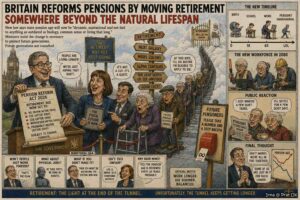
LONDON — Britain has begun another historic programme of pension reform after ministers discovered that retirement costs money, old people remain stubbornly alive and the national economy cannot be financed indefinitely by selling one another increasingly expensive two-bedroom flats. The state pension age began rising from 66 in April 2026 and is scheduled to reach 67 by April 2028, while an independent review considers future increases. At the same time, the government’s workplace pensions reform roadmap, the new Pension Schemes Act, the House of Commons inquiry into the pension-age transition and analysis from the Institute for Fiscal Studies confirm that Britain’s retirement system is entering a period of profound transformation, which is government language for checking whether anybody still has the receipt.
The reform has three principal objectives: help workers save more, direct pension capital into productive British investment and ensure nobody receives the state pension while still capable of blinking.
Under the emerging settlement, British citizens will spend approximately 45 years working, 20 years paying off university debt, 30 years paying a mortgage and six months enjoying retirement before being recalled to cover a staff shortage at Greggs.
Ministers insist the system remains generous.
The full new state pension for 2026–27 is £241.30 a week for people with the necessary National Insurance record, enough to purchase food, heating or half a return railway ticket, provided the journey occurs outside peak hours and the passenger is willing to stand near the toilet.
Retirement Age Rises Because People Have Recklessly Continued Living
Government economists explain that state pension ages must rise because people are living longer.
This is technically true, although the national strategy appears to be addressing the problem through waiting lists, energy bills and railway catering.
The pension age is moving gradually from 66 to 67 between April 2026 and April 2028. The change affects people born from April 1960 onward, while the government is also reviewing how future pension ages should be determined. Parliament has warned that the consequences will differ according to people’s health, employment prospects, wealth and region.

A healthy financial consultant working from home may be able to continue until 68 with only minor deterioration in his collection of quarter-zip sweaters.
A bricklayer with arthritis may find the experience less invigorating.
Whitehall traditionally handles this distinction by placing both individuals into a spreadsheet cell labelled Economically Active Older Persons.
The government’s definition of “working age” will therefore become increasingly flexible. Eventually, it will include anyone who can answer an email, hold a lanyard or be propped upright beside a self-checkout machine.
A Department for Work and Pensions adviser explained the new philosophy.
“Sixty-seven is no longer old,” he said. “It is late-middle-young-adjacent.”
Asked when old age officially begins, he replied, “After eligibility.”
The Triple Lock Remains Locked Because Nobody Can Find the Key
The state pension triple lock increases payments according to whichever is highest among earnings growth, inflation or 2.5 per cent.
It was designed to protect pensioners’ incomes but has become one of Westminster’s most feared political devices. Politicians approach it with the same caution normally reserved for unexploded wartime bombs and television interviews outside suburban pharmacies.
Pressure has grown to reconsider the policy because state pension expenditure reached £146.1 billion and is expected to remain a major long-term fiscal challenge. Advisers linked to Prime Minister Andy Burnham have previously criticised the triple lock, although current commentary suggests the government is likely to retain it for the immediate future.
The triple lock is popular among pensioners because it protects their income.
It is unpopular among Treasury officials because pensioners vote, live for an unpredictable period and refuse to accept payment in government vision statements.
A means-tested state pension has occasionally been suggested as an alternative. Under that system, retirees would complete a 94-page form proving they were sufficiently poor, submit evidence that they had never purchased a second kettle and wait eight months for an official to decide that their spare bedroom constitutes a sovereign wealth fund.
Britain’s pension debate therefore presents ministers with two choices.
They can preserve the triple lock and face rising costs.
Or they can reform it and discover that every pensioner in Britain owns a telephone.
Workplace Pensions Will Become Bigger, Better and More Interested in Infrastructure

The government says the Pension Schemes Act 2026 will help create larger, more efficient pension schemes focused on better returns for workers. The reform agenda also seeks to channel more pension capital into productive assets and a wider range of investments.
This means your retirement savings may soon finance roads, housing, clean energy, technology and whichever British infrastructure project has not yet been converted into a consultation.
The government believes pension funds can support economic growth by investing more heavily in domestic projects.
Savers naturally welcome stronger returns.
They become slightly less enthusiastic when informed that their comfortable retirement may depend upon the commercial performance of a railway tunnel scheduled to open six governments from now.
A pension executive said larger schemes could deliver economies of scale.
Britain has considerable experience with economies of scale. Every public project begins economically and then scales.
Ministers insist safeguards will remain in place and investment decisions must serve pension members’ interests. This is important because “unlocking pension capital” sounds reassuringly dynamic until one remembers that locked things are sometimes locked because they belong to somebody else.
The government has also consulted on allowing some well-funded defined-benefit pension schemes to release surplus assets for the benefit of employers, members and the wider economy.
A Treasury spokesperson emphasised that the funds would be released safely.
“Nothing will be touched without appropriate controls,” she said, wearing gloves and standing beside a van with the engine running.
Pension Dashboards Will Reveal All the Pensions You Forgot You Had

Pension dashboards are also moving closer to reality, with schemes required to connect according to a staged timetable during 2026. The aim is to allow people to see their different pensions together in one place.
This will provide millions of workers with a convenient digital overview of the four pension pots they accumulated while changing jobs.
One will contain £83.
Another will contain £1,206 but require a password last used in 2009.
A third will have been transferred to a provider that now communicates exclusively through an app incompatible with the human thumb.
The fourth will belong to another person with the same surname.
After 40 minutes of identity verification, the dashboard will reveal that the user can retire comfortably at 94, provided markets perform well and lunch is discontinued.
Financial advisers say dashboards could help people make informed decisions and consolidate forgotten pension savings.
The average citizen will use the information to stare silently at the screen before asking whether National Insurance points can be exchanged for supermarket vouchers.
Auto-Enrolment Successfully Encourages Workers to Save Almost Enough for Breakfast
Automatic enrolment has brought millions of employees into workplace pensions by requiring qualifying workers to be enrolled unless they opt out.
It was a major policy achievement because humans are far more likely to save when saving occurs before they notice the money.
However, minimum contribution levels may still leave many people without enough income for the retirement they expect.
This creates a delicate political problem.
Workers need to save more.
Employers face higher costs.
Households already struggle with rent, mortgages, food and energy.
The obvious government solution is to publish a colourful diagram.
Under future reform, contribution levels may eventually rise, broader groups of workers may be included and schemes may face stronger requirements to demonstrate value. The workplace pension roadmap describes a system of larger schemes, better outcomes and future changes to help more workers build adequate retirement savings.
The public broadly supports saving more in principle.
In practice, many workers currently divide their monthly income among housing, bills, transport, groceries and the subscription service they cancelled three times but which has developed constitutional immunity.
Asking them to increase pension contributions is sensible long-term policy.
It also resembles advising a drowning man to begin collecting rainwater for retirement.
Government Introduces the Flexible Retirement Coffin
Ministers increasingly discuss flexible working, phased retirement and employment opportunities for older people.
This allows workers to reduce their hours gradually rather than stopping suddenly.
Under the proposed cultural shift, an employee might work five days a week at 65, four days at 68 and three days at 71 before becoming an unpaid workplace mentor because nobody else remembers how the printer works.
Employers will receive guidance on supporting older workers.
Office chairs will include lumbar support.
Construction helmets will include reading lights.
Mandatory training videos will be slowed to accommodate employees who have already watched every previous version since decimalisation.
One retail chain is understood to be testing a “heritage workforce initiative” under which staff members over 70 will receive name badges displaying both their first name and the reign in which they joined.
The economy will benefit from their experience.
The workers will benefit from discounted soup.
Young People Told Their State Pension Is Stored in a Safe Place Called the Future

Younger workers have been reassured that the state pension will still exist when they retire.
It may be smaller, later, means-tested, climate-adjusted and delivered as downloadable Treasury points, but it will exist.
A 25-year-old entering the workforce today is expected to save privately, contribute through auto-enrolment, own diversified investments, manage tax allowances and plan for several decades of retirement.
The same 25-year-old is also expected to pay £1,600 a month to live in a converted airing cupboard containing an artisanal sink.
Intergenerational fairness has therefore become central to the pension debate.
Current pensioners need security.
Future pensioners need sustainability.
The Treasury needs everyone to stop using the word “need.”
Young workers sometimes resent pension protections enjoyed by older generations. Older people correctly note that they paid taxes and contributions throughout their careers.
Both groups are then encouraged to argue with each other while nobody examines the cost of government, weak productivity or why every major infrastructure project requires consultants to consult the previous consultants.
This technique is known as fiscal triangulation.
The British Retirement Dream Is Updated for Modern Conditions
The traditional retirement dream involved leaving work at 65, receiving a reliable pension, tending the garden and taking occasional holidays.
The modern version involves leaving one job at 67, starting another at 68 and tending the garden professionally through a gig-economy app.
Retirement brochures will be revised accordingly.
Photographs of silver-haired couples walking along beaches will be replaced by images of them wearing delivery backpacks beneath the slogan Your Next Chapter Has Surge Pricing.
Cruise companies will introduce work-from-deck packages.
Golf clubs will include coworking spaces.
Funeral directors will offer loyalty points transferable to workplace pensions.
Government will describe this as choice.
Citizens may choose to work longer, save more, spend less or develop wealthy parents.
Britain’s Pension Reform Contains a Serious Truth Beneath the Arithmetic

The jokes conceal a real and difficult policy challenge.
Britain has an ageing population, unequal health outcomes, inadequate private savings for many workers and enormous differences between people who can continue working comfortably and those whose jobs have already damaged their bodies.
Simply increasing the pension age treats a solicitor, care worker, warehouse employee and roofer as though ageing reaches them through a common government portal.
It does not.
Successful reform must protect people unable to work longer, improve workplace saving, keep fees under control and ensure pension investments serve savers rather than becoming an emergency cash machine for political ambitions.
It must also explain the trade-offs honestly.
Retirement income must come from taxation, contributions, investment returns or a combination of all three. No slogan, lock or ministerial roadmap can repeal arithmetic.
Britain’s latest pension reforms may improve consolidation, transparency and investment. They may help workers build larger savings and connect pension capital with productive businesses and infrastructure.
But no reform should pretend that postponing retirement is identical to improving it.
The government has promised a pension system built for the future.
Unfortunately, that is also when most citizens will qualify to use it.
Disclaimer
This article uses satire to examine the rising UK state pension age, workplace pension reforms, pension dashboards, the triple lock and the political temptation to solve retirement costs by ensuring retirement never actually begins. Genuine policy details and figures are linked to authoritative sources; unnamed quotations and administrative proposals belong to the comedy. This story is entirely a human collaboration between two sentient beings: the world’s oldest tenured professor and a philosophy major turned dairy farmer.
IMAGES



Aishwarya Rao is a satirical writer whose work reflects the perspective of a student navigating culture, media, and modern identity with humour and precision. With academic grounding in critical analysis and a strong interest in contemporary satire, Aishwarya’s writing blends observational comedy with thoughtful commentary on everyday contradictions. Her humour is informed by global awareness and sharpened through exposure to London’s diverse cultural and student communities.
As an emerging voice, Aishwarya represents the next generation of satirical journalists: informed, curious, and unafraid to question norms through wit. Her authority stems from research-led writing, respect for factual context, and a commitment to ethical satire. Transparency and clear labelling ensure readers understand the comedic intent behind her work.
Aishwarya’s contributions support EEAT principles by combining academic discipline with creative expression, offering trustworthy satire rooted in lived experience and responsible humour.
Email: [email protected]



Someone sending this to their MP with basically no message.
The thing about British comedy is balancing serious while funny.