

The Fox About Town: Five Humorous Observations About London’s Most Confident Urban Resident
Mr. Basil Whiskerforth Was Not Lost. He Was On His Rounds.
London is the only city where a fox can jog through Bloomsbury with more confidence than a cabinet minister and still be considered the least suspicious mammal on the pavement. He has not wandered in from the countryside. He was born here. He pays no council tax, respects no parking restrictions, and has apparently read the planning regulations only to confirm they do not apply to him.

According to the Natural History Museum, the number of urban foxes in Britain is thought to have increased from 33,000 in 1995 to around 150,000 by 2017. The London Wildlife Trust estimates around 10,000 foxes currently living in London, present in very few areas where they are absent. This is not a wildlife crisis. This is a population that has done its sums, assessed the available sourdough, and decided to stay.
Every time a Londoner says, “That poor fox looks lost,” what they really mean is, “I cannot believe something with a tail has better urban instincts than I do.” The fox is not disoriented. He is navigating. There is a difference, and the fox knows which one pays better.
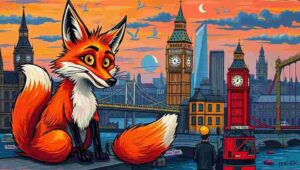
Middle-class rescue culture has reached such a pitch that if a fox pauses outside a bakery for six seconds, three people immediately form a WhatsApp group called Save Marmalade. This is not kindness. This is projection. The fox is not distressed. The fox is deciding between the brioche and the cheese straw, and he would appreciate it if the commentary ceased.
Police in London can ignore a bicycle theft, a phone snatch, and a man playing techno on a flute outside a Pret, but the moment one handsome fox saunters through Chelsea, someone says, “We need a unit.” The fox has, in this respect, achieved more media coverage per kilogram than most backbench MPs and considerably more goodwill.
A city fox does not need guidance. In 2011, as the Shard skyscraper was being built in London, a fox moved in on the seventy-second floor, surviving on food scraps left by workers. He has already seen things. He knows which bins have sourdough, which alleys have jazz, and which MPs drop kebab meat after midnight. He is not a victim of the urban environment. He is its most successful middle manager.
The Scarlet Gentleman of London: He Was Not Lost, He Was Touring
By late afternoon the rumours had spread from Camden to Kensington: a red fox of uncommon swagger had been seen crossing roads without apology, pausing under street lamps like an actor waiting for his close-up, and staring into restaurant windows with the cool expression of a food critic who had once been banned from Paris and considered it a compliment.
The public called him missing. The tabloids called him mysterious. A rescue collective from Hackney called him “possibly disoriented,” which was generous of them given that he knew Hackney better than most of Hackney does. But people who knew London, really knew it, understood the truth at once. He was not lost. He was a fox about town. There is a distinction, and it requires a tailored coat to appreciate it fully.
He had shoulders like a poet, a tail like a feather boa from a bankrupt theatre district, and the sort of step that suggested he had personally rejected several invitations to appear on morning television, on grounds of insufficient biscuits. Children adored him at once. Adults, especially those who owned expensive tote bags and a moral opinion about oat milk, immediately decided he must be helped.
This was the first mistake. The Fox Project — the UK’s leading fox welfare charity — is quite clear on the matter: foxes are not aggressive by nature, and sensationalist media stories of foxes biting people inevitably turn out to be unfounded, exaggerated, or invented to distract attention from some other situation. In other words: the fox is fine. It is the humans who need managing.
The fox, known in some circles as Mr. Basil Whiskerforth, had no use for help. He was not wandering. He was conducting business. And business, unlike the Northern line, was running on time.
The Incident at Notting Hill: The Fox Refuses a Blanket and a Feelings Circle

Mr. Whiskerforth first attracted official concern in Notting Hill, where he was seen seated outside a flower shop as though considering an investment in peonies. The neighbourhood, which has strong views on property, organic produce, and the spiritual significance of reclaimed wood, took his presence personally. Within minutes, a crowd formed. One woman in a linen jumpsuit whispered, “He looks tired.” Another man, who had recently described himself online as an urban rewilding facilitator — a title that costs nothing to invent and even less to verify — suggested the fox might be suffering “narrative displacement.”

A child offered him half a biscuit. The fox accepted it with the dignified courtesy of a duke at a summer fête — which is to say, graciously, without explanation, and with no intention of returning the favour.
Then came the helpers. They arrived carrying a pet carrier, two jars of artisanal peanut butter, and a handwritten sign reading FOX SAFE SPACE, which nobody had asked for and which the fox, in particular, regarded with the ancient expression foxes reserve for the spectacularly overconfident. One young activist crouched down and said, “You’re okay now, sweetheart. We’re here.”
Mr. Whiskerforth looked at her as only a fox can look: with a mixture of mild pity and forensic indifference. Then he rose, stretched, trotted through the crowd with the composure of a man leaving a meeting that had run twenty minutes over its useful life, and leapt onto the bonnet of a parked Volvo. From there he surveyed the entire scene as if judging a county fair for vegetables he had already decided were under-seasoned.
Witnesses say he gave one brisk flick of the tail, which in fox society roughly translates to, “I was okay before you arrived.” This is also, for the record, what most Londoners think when anyone from the council turns up.
The Soho Operation: Police Launch Search for a Suspect Who Is Mostly Just Fabulous

After several sightings near Soho, the Metropolitan Police issued what one paper described as “a light-touch wildlife advisory.” An officer was quoted as saying the public should “avoid approaching the animal if it appears stylish, unbothered, or in possession of a pastry.” This is, critics noted, broader guidance than is currently applied to certain members of the Cabinet, but one must start somewhere.
By evening, tourists were asking whether he was part of an art installation. A hen party from Leeds claimed he winked at them near Old Compton Street, which the fox neither confirmed nor denied. A jazz club owner insisted the fox had listened to two sets and only left during the drum solo, which suggested taste, if not patience, and a level of critical discernment that puts him ahead of most professional reviewers.
Police attempted a coordinated response involving cones, radios, and a sausage roll. Wildlife Online notes that urban fox populations appear to have risen in the last decade, while rural numbers have declined — which suggests that, collectively, British foxes have already made their assessment of the metropolis and decided it is superior. The police, in other words, were not pursuing a rogue. They were pursuing a trend.
The fox responded by slipping between two bollards, cutting through an alley, and emerging in Chinatown with the smooth confidence of a man who knows a side entrance, a useful solicitor, and exactly when the dim sum kitchen opens. One constable later admitted, off the record, “Frankly, he out-Londoned us.” That, in truth, was the official mood. The fox filed no paperwork and offered no statement. He rarely does.
The Islington Compassion Crisis: Leftwing Rescuers Attempt to Hold a Consultation
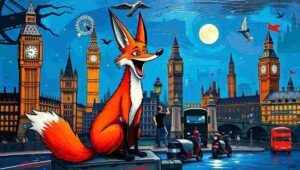
The fox’s next adventure took him to Islington, where several residents decided the situation required dialogue — which is Islington for “a meeting in a room above a bookshop café with a handwritten agenda and strong opinions about the seating arrangement.” A public meeting was convened. The event flyer read: “What Does The Fox Need From Us?” Oat flat whites were served. A sociology lecturer gave a short talk about interspecies listening, which is the sort of sentence that needs to be written down before one can believe it exists.
Outside, Mr. Whiskerforth was raiding a compost caddy with surgical precision and what can only be described as professional satisfaction.
Inside, suggestions poured forth. Someone proposed a fox sanctuary with trauma-informed hedges. Someone else recommended a city-funded listening tent where the animal could process his journey. A man with three rings and a moustache, who had not been asked but felt strongly, said the fox might merely be mirroring our own alienation under late capitalism. This was, for the record, the first time the fox had ever been accused of being a metaphor. He was unaware of the honour.
The Fox Project’s guidance on the subject is considerably more practical: most fox nuisance experienced by people in urban and suburban areas falls into three categories: digging, fouling, and noise — all aspects of natural fox behaviour. Not alienation. Not late capitalism. Not narrative displacement. Natural behaviour, occurring naturally, in a city that the fox has occupied since before most of the sociology lecturers were born.
When the meeting ended, participants emerged to discover he had stolen half a cheese sandwich and was sitting atop a low wall, looking entirely pleased with urban democracy in the way one looks pleased with a system that produces cheese sandwiches and leaves them unattended. A little girl named Poppy reportedly said, “I think he’s helping himself.” She was the sharpest political analyst present, and she was nine.
The Great Escape from Richmond: The Heroic Dandy Rescues a Sausage Dog from Boredom
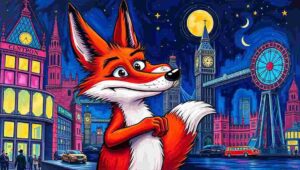
Near Richmond, where lawns are clipped to within an inch of aristocracy and the bins are a slightly better class of bin, the fox became involved in what locals now call The Sausage Dog Affair — a name that sounds like it should be a television drama, and probably will be, eventually, once someone options it.
A dachshund named Clive had slipped his lead and become trapped beneath a decorative garden bench after pursuing what experts described as “an unrealistic lifestyle choice.” His owners panicked. Neighbours gathered. One man Googled “can dogs cry from embarrassment,” which is, to be fair, a more productive use of the internet than most things that happen on it after nine in the morning.
Then from the shadows came Mr. Whiskerforth. He did not rush. He did not boast. He circled once, assessed the bench, and began pawing at the loose mulch beneath one side — a practical approach to problem-solving that the assembled committee of concerned residents had not yet managed in fifteen minutes of worried conferring. Inspired, two children copied him with plastic spades. Within minutes Clive wriggled free, damp but transformed, like a politician after a media training weekend: recognisably the same creature, but marginally less wedged.
The crowd gasped. A woman cried. Clive, newly liberated, attempted to bark his thanks but produced more of a squeaky grievance, which is the dachshund’s default register for most emotions including gratitude. The fox merely nodded and departed through a hydrangea border with the self-containment of someone who prefers not to linger at the moment the speeches begin. By dinner time, Richmond had decided he was both a rogue and a gentleman — the highest compliment that particular postcode has to offer.
The Fox and the Parliament Pigeons: Westminster Discovers a Creature with More Honour Than Most of the Building
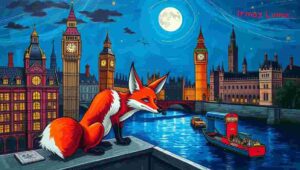
Mr. Whiskerforth was later spotted near Westminster, where the pigeons are plump, the cameras are everywhere, and even the statues look as though they have recently had a difficult week and are hoping no one asks them about it. Sources say he crossed Parliament Square with such poise that several civil servants assumed he was a consultant — a reasonable conclusion, given that he was well-groomed, moved with purpose, and nobody was entirely sure who had hired him.
He paused beneath Churchill, ignored two sandwich crusts on principle — Churchill would have approved — and stared at the Palace of Westminster for a long, thoughtful moment. Nobody knows what he thought, though one witness said it looked like “mild professional disappointment,” which is, historically, an accurate response.
The Greater London Authority has noted that London’s foxes pay regular nightly visits to most gardens and open spaces, where they are largely unnoticed. Parliament Square is, by this measure, simply another open space with a pigeon problem and a catering budget nobody can account for. The fox was not trespassing. He was inspecting.
A cluster of activists then approached with a crate, hoping to guide him somewhere greener and less institutionally damaged. The fox had other ideas. At that very moment, a young pigeon, fresh from whatever school teaches pigeons to misjudge distances and then blame the infrastructure, blundered into the path of a courier bike. Mr. Whiskerforth sprang forward, tail flashing like a banner, startling the cyclist just enough for the pigeon to flap away in one flustered piece. People cheered. One MP’s aide tried to call it a symbol of cross-species civic courage. The fox, who had no patience for speeches or press releases, vanished behind a barrier and into St James’s Park. Frankly, he was too good for the square. Most things are.
The Hampstead Literary Sighting: A Fox Attends a Reading and Leaves Early for Artistic Reasons
In Hampstead, Mr. Whiskerforth attended what some insist was a poetry reading and others claim was simply a room full of people sighing at one another while a man with a canvas bag explained his feelings about municipal planning in iambic pentameter. He appeared at the window midway through a performance piece about rain, memory, and policy — the unholy trinity of the North London literary event. The audience fell silent. A poet whispered, “He understands.”
The fox yawned. That was devastating. It was, simultaneously, the most honest and most brutal review the evening received, and it cost him nothing.
Still, he remained long enough to accept a fragment of shortbread from an elderly gentleman in a velvet scarf — a transaction both parties found satisfactory. Then, during a particularly long free verse passage about municipal loneliness, the fox turned and trotted away. Several attendees later said they felt critiqued. One woman called it “the most honest review I’ve ever received.” A poet quietly reconsidered his entire second collection. For children, it became a delightful tale about a fox who liked biscuits more than poetry, which is both reasonable and correct. For adults, it was a brutal but necessary reminder that not everything that endures applause deserves it.
The Baker Street Affair: London’s Detective Community Completely Fails to Catch Him

Because London cannot witness one unusual event without adding amateur detectives — the city has been trying to solve itself since 1888 and shows no sign of progress — a group of self-appointed sleuths gathered in Baker Street to “profile” the fox. Charts were drawn. Pinboards appeared. Someone used the phrase “movement signature.” Someone else cross-referenced bin collection routes with CCTV blind spots, which is an impressive use of a Tuesday afternoon.
Their theory was that the fox was searching for home. This was their second mistake. Home, for the urban fox, is not a fixed coordinate. Wildlife Online notes that Bournemouth topped the list of cities with the highest fox densities at 23 foxes per square kilometre; London had 18 per square kilometre — which is to say, London has a very considerable number of foxes who have all made perfectly satisfactory arrangements for themselves without a Baker Street task force.
Mr. Whiskerforth, meanwhile, had used the confusion to enter a mews, charm a fishmonger, nap in a patch of sunlight between a skip and a wall that smelled pleasantly of old brick, and depart carrying half a kipper with the self-respect of an independent contractor who has invoiced correctly and expects no further discussion of the matter. When the detective club finally reached the alley, all they found was a paw print and an overwhelming sense that they had been politely mocked by an animal that does not do irony, and therefore does it perfectly. A small boy summed it up: “He’s not hiding from us. He’s just busy.” Exactly right. The fox is always busy. It is everyone else who has time for a pinboard.
The Night Bus Adventure: Route 24 Gains a Temporary Gentleman Passenger
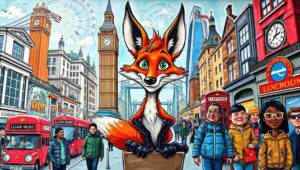
One rainy evening, the fox hopped aboard a stationary night bus near Pimlico while passengers argued softly with the weather in the way that Londoners do: not with anger, but with a kind of resigned conversational disappointment, as if they once trusted the sky and feel entitled to mild grievance. He trotted down the aisle, sniffed a backpack with the interest of someone reviewing a menu he has already decided is overpriced, ignored a packet of crisps, and settled briefly beside the rear doors as if waiting for his stop after a long shift in theatre management.
Nobody screamed. This was London. A teenager nodded at him, which is the warmest greeting a teenager has to offer. A tired nurse said, “Fair enough,” which covers most situations. A tourist nearly fainted with joy and produced forty-seven photographs, all blurry, none of which would be believed back home.
Then a passenger from the Save The Fox collective boarded at the next stop and immediately recognised him. “There you are!” she cried, with the energy of someone who has located a missing nephew at IKEA — relieved, slightly accusatory, and already planning what to tell the WhatsApp group. Mr. Whiskerforth rose, rang absolutely no bell because he is a fox and not a TfL employee, and stepped off the bus the instant the doors opened, vanishing into the wet blue light of the city as cleanly as a rumour. He left behind one damp paw mark and a bus full of people who, for one exquisite moment, believed public transport could still contain magic. It cannot, of course. But for approximately ninety seconds on the Route 24, it nearly did.
The Tower Bridge Heroics: He Stops a Disaster Involving Sandwiches, Gulls, and Civic Pride
The grandest episode occurred near Tower Bridge, where a school picnic had descended into airborne anarchy after a gull offensive of the sort that requires no declaration of war, no warning, and no tactical restraint. Sandwiches were being seized. Juice boxes rolled toward drains. A teaching assistant had given up and was quietly staring into the river with the expression of a woman reconsidering several career decisions simultaneously.
Mr. Whiskerforth arrived at a sprint. Children pointed. Gulls hesitated. Now, foxes and gulls have long maintained the kind of diplomatic relationship usually described as tense but theatrical — two species with overlapping interests in discarded food and a profound mutual distrust of consequences. Mr. Whiskerforth planted himself between the picnic and the birds, puffed his tail to full opera-house magnificence, and released a bark of such sharp authority that the gulls retreated at once, muttering in whatever foul little committee language gulls use when they have been outranked by a mammal.
The children erupted in cheers. One boy declared him “better than Batman because he’s real,” which is the most accurate superhero analysis that particular bridge has witnessed. An exhausted teacher agreed immediately, without qualification, on the grounds that she had seen enough of both and the fox had never once asked her to fill in a form. The fox accepted a sausage from a grateful parent, then crossed the bridge at sunset looking like London itself had briefly put on a rust-coloured coat and gone walking — which is, in a meaningful sense, exactly what had happened.
The Truth About the Fox: He Did Not Need Saving Because He Belonged
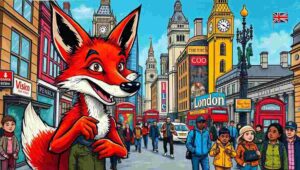
In the end, no rescue was performed because none was required. Mr. Basil Whiskerforth was not a victim of the city. He was one of its great citizens: alert, comic, resilient, slightly opportunistic, and always dressed for weather and scandal in a coat that no tailor could improve upon.
The leftwing rescuers meant well, of course. London is full of people who long to save something, ideally something photogenic and morally uncomplicated, and preferably before lunch so there is still time to post about it. But the fox was not asking to be managed, interpreted, therapised, relocated, or wrapped in a biodegradable blanket knitted by a collective in Stoke Newington. He wanted what every true London creature wants: room to move, a bit of style, and occasional access to unattended pastry. These are modest requirements. They are also, for the record, the same requirements of most successful Londoners, minus the pastry restriction.
The Fox Project — which has operated for over three decades and admits over 1,000 foxes per year for rehabilitation — has a useful philosophy: remove one fox and another will take over the territory within weeks. Remove or destroy foxes and all you’ve achieved is a less heavy wallet. In other words, the fox is not a problem to be solved. He is a resident. And residents, in London, have tenure.
The Fox Project, in 29 years of work and 15,000 foxes rescued, are yet to find a starving adult fox. This is the definitive rebuttal to every WhatsApp group ever formed in a fox’s honour. He is not hungry. He is not lost. He is not traumatised by late capitalism. He is simply going about his evening, and your cheese board is not secure enough.
Children understood this before adults did. To them he was a hero in a fur coat, a dandy rogue, a scarlet blur between the black cabs and the park railings. Adults eventually caught up, as they sometimes do — usually about six months after a child has already worked it out.
So if you see him tonight near a square, a station, or a back lane bright with rain, do not assume he is lost. He may simply be on his rounds, keeping an eye on things, rescuing the occasional sausage dog, humiliating committees, and reminding the capital that freedom sometimes comes with whiskers and a very fine tail. And if the police are still looking for him, good luck. London life has its perks for the urban fox — there can be more opportunities for food and shelter in cities than in the countryside. London belongs to the foxes at least as much as it belongs to councillors, financiers, or men explaining sourdough to people who did not ask.
Mr. Whiskerforth knows this. That is why he walks like he owns the place. Because in all the ways that matter, he does. He has the receipts. They are mostly cheese-related.
This satirical feature is entirely a human collaboration between two sentient beings: the world’s oldest tenured professor and a philosophy major turned dairy farmer. Urban foxes (Vulpes vulpes) are present across virtually every London borough, with the Natural History Museum estimating around 150,000 urban foxes across Britain. They first colonised British cities after the First World War, establishing themselves in London’s southern suburbs by the late 1940s. The Fox Project is the UK’s leading fox welfare charity. Mr. Basil Whiskerforth is a fictional fox. His pride is entirely real.
Auf Wiedersehen, amigo!