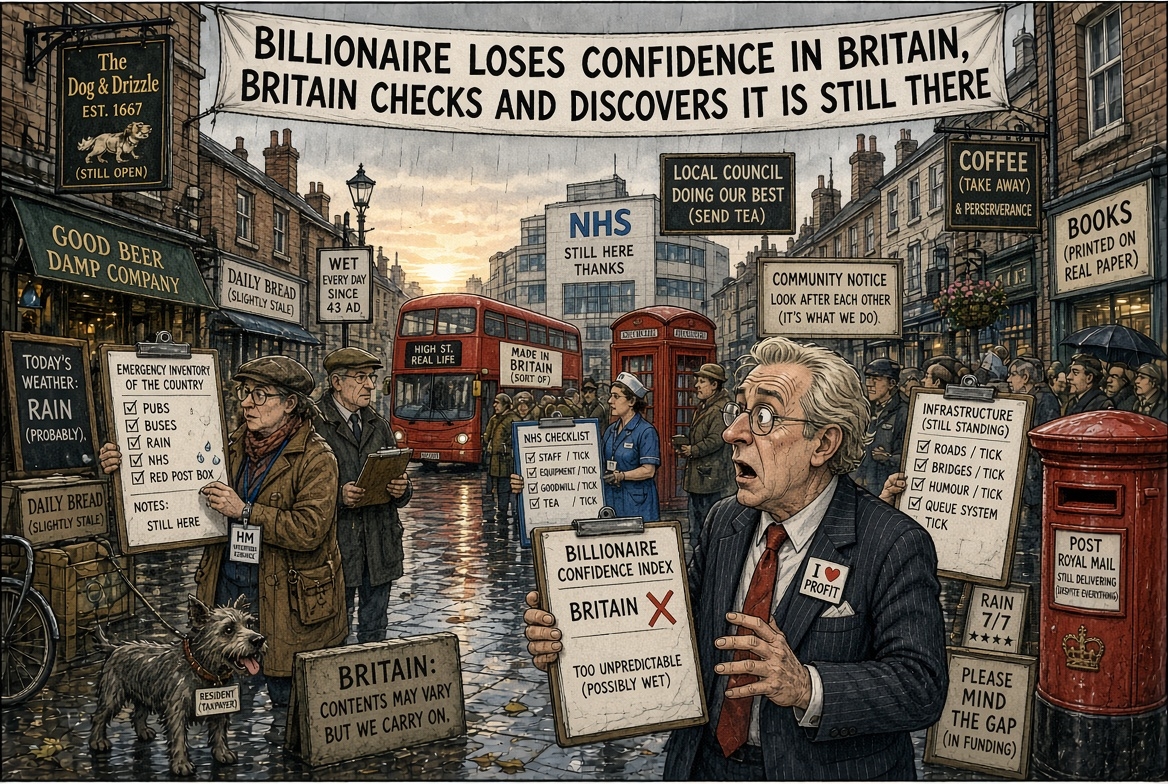
Billionaire Loses Confidence in Britain, Britain Checks and Discovers It Is Still There
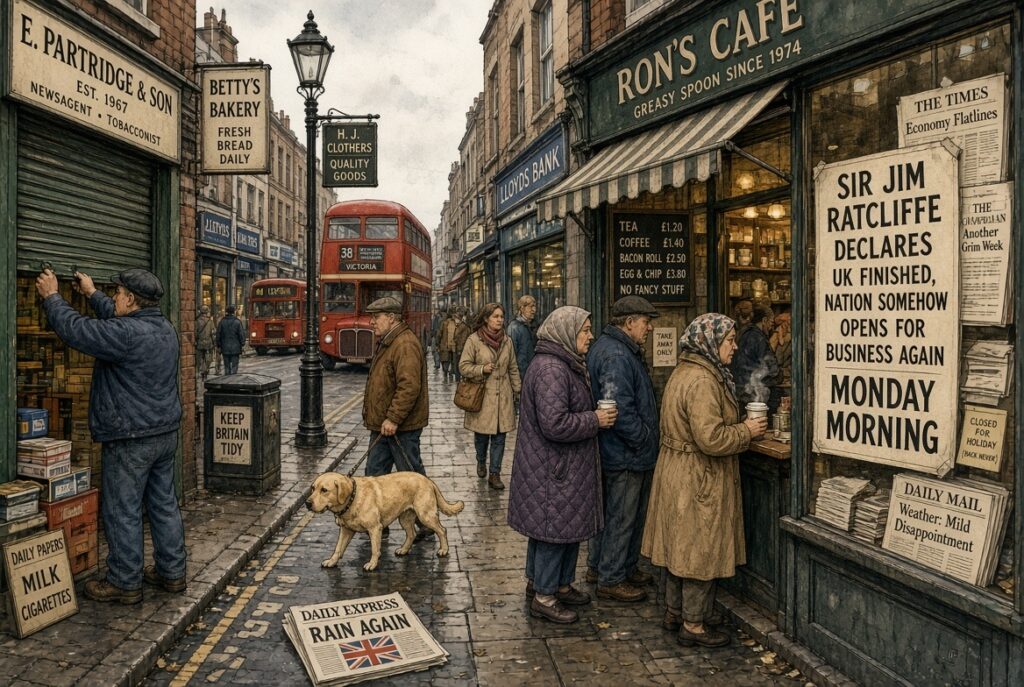
Sir Jim Ratcliffe Declares UK Finished, Nation Somehow Opens for Business Again Monday Morning
Billionaire industrialist Sir Jim Ratcliffe has announced that he has lost confidence in Britain, prompting Britain to conduct an emergency inventory Saturday morning and discover, somewhat embarrassingly, that the entire country was still there.
Scotland remained attached.
Wales had not floated away.
The English Channel continued performing its traditional function of keeping France approximately where Britain likes it.
Even Birmingham was accounted for.

Ratcliffe, founder of Ineos and holder of a large stake in Manchester United, told the BBC that Britain was “on the slide,” blaming high taxation and immigration while criticizing the country’s approach to North Sea oil and gas. The government responded that business investment had increased over the previous two years and said it remained confident about Britain’s energy supplies.
This presented the nation with a difficult philosophical problem.
If one billionaire loses confidence in a country, does the country cease to exist?
Economists believe probably not, although several requested research grants before committing themselves.
Sir Jim’s announcement nevertheless caused understandable concern because billionaires possess a special economic sense unavailable to ordinary humans. A normal person enters a restaurant and asks whether the fish is fresh. A billionaire walks into Britain, sniffs twice and says, “Capital formation has deteriorated.”
Everyone puts down their forks.
Ratcliffe’s fortune has been estimated at roughly £15 billion, which places him in the fascinating economic category of people wealthy enough to announce that a nation containing nearly 70 million people has stopped working because it no longer operates precisely according to their preferred settings.
It is the economic equivalent of owning a hotel, disliking the pillows and announcing the collapse of Western civilisation.
Billionaire Living in Monaco Says Britain Has Lost Its Way, Irony Immediately Applies for Permanent Residency
There was one small wrinkle.
Ratcliffe has been a tax resident in Monaco since 2020.
This does not invalidate his economic arguments. But it certainly gives them decorative trim.
There is something magnificently British about a billionaire residing in Monaco announcing that Britain needs restoring.
It has the flavour of a man moving out of his house, buying a villa beside the Mediterranean and telephoning the old neighbours because somebody hasn’t trimmed the hedge.
“I worry about the neighbourhood.”
“You live 800 miles away.”
“That’s why I have perspective.”
Monaco, of course, is famous for several things: sunshine, yachts, casinos and an extraordinary shortage of British income-tax bills.
Witnesses say Irony arrived at Monaco immigration shortly after Ratcliffe’s interview carrying three suitcases and requesting indefinite leave to remain.
Immigration officers reportedly waved it through immediately.
Britain meanwhile carried on committing acts inconsistent with national extinction.
Shops opened.
Planes landed.
Factories produced things.
Pub landlords placed little chalkboards outside promising “Sunday Roast £14.95.”
A man in Croydon continued renovating a bathroom he began in 2024.
This is the central weakness of declaring Britain finished. Britain has been declared finished approximately every fourteen minutes since the Romans left.
The Vikings thought Britain was finished.
Napoleon had plans.
Hitler had plans.
The 1970s had inflation, strikes and trousers wide enough to shelter livestock.
Britain remained irritatingly available.
There is practically a national industry devoted to announcing national decline. If Britain eliminated national-decline commentary tomorrow, GDP might actually fall.
Manchester United Fans Request Clarification About Which Institution Is Sliding
Ratcliffe’s phrase “on the slide” also created confusion among Manchester United supporters.
“Country or club?” asked one imaginary fan outside Old Trafford. “Because we’re going to need him to narrow that down.”
This is unfair, naturally.
But comedy operates under different accounting standards.
Ratcliffe’s Manchester United involvement means every statement about decline comes preloaded with a football metaphor whether he likes it or not.
If he announces Britain has lost competitiveness, somebody will ask about the midfield.
If he says Britain lacks investment, someone will bring up transfers.
If he warns that the country needs rebuilding, 74,000 people will immediately shout, “START HERE.”
There is no safe economic vocabulary left.
Government Discovers Statistics
The government rejected Ratcliffe’s bleak assessment and pointed to increased business investment. It has separately highlighted major clean-energy investment commitments, including more than £100 billion in private investment announcements during the current parliament.
This is government’s natural defensive posture.
A billionaire says, “The roof is leaking.”
Government says, “Roof-related investment is up 17%.”
Nobody looks at the ceiling.
To be fair, investment announcements matter. Businesses do not generally announce billions of pounds of investment in places they expect to disappear beneath the North Atlantic before lunch.
Britain also remains a major economy with universities, financial markets, advanced manufacturing, pharmaceuticals, aerospace, technology, creative industries and that curious national ability to charge £6.40 for a sandwich containing mostly emotional disappointment.
There are genuine economic problems.
There are also genuine economic strengths.
Unfortunately, nuance has never performed especially well on television.
“Some indicators are worrying while others remain resilient” will never beat “BRITAIN FINISHED.”
The latter fits comfortably underneath a photograph of Big Ben taken during rain.
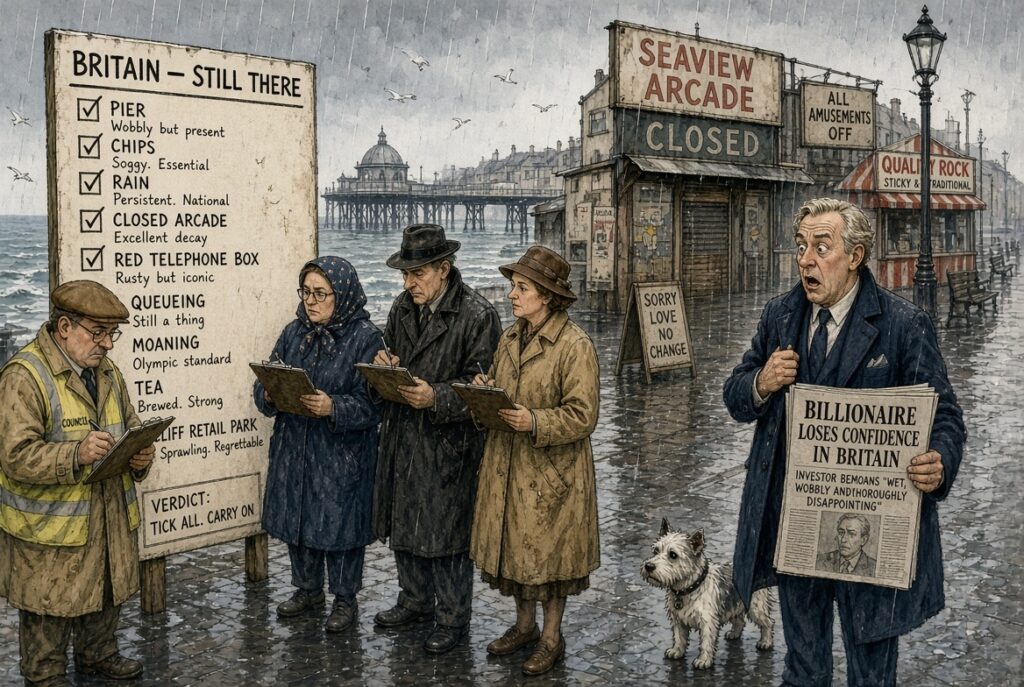
Britain Checks Pulse
Following Ratcliffe’s remarks, Britain reportedly spent several minutes checking itself for symptoms.

London: congested.
Manchester: raining.
Edinburgh: architecturally magnificent and charging somebody £19 for whisky.
Cardiff: operational.
Liverpool: talking.
Yorkshire: suspicious of London.
Cornwall: asking everyone else to leave.
Diagnosis: British.
A government inspector reportedly placed two fingers against the national wrist and announced, “Pulse strong, slightly irritated.”
This is perhaps the sensible response to every proclamation of national doom.
Britain has problems.
Taxes matter.
Energy costs matter.
Investment matters.
Migration matters.
Productivity matters.
Government spending matters.
But countries do not generally collapse because a billionaire has become disappointed with them.
If they did, California would have disappeared twelve venture-capital podcasts ago.
The Great British Doom Industry
Britain’s actual renewable resource may not be wind.
It is pessimism.
Britons can generate it continuously without government subsidy.
Ask an American how things are going and he may tell you he is “crushing it.”
Ask a Briton who has just inherited £4 million, won the lottery and been medically informed he will live to 106.
“Can’t complain.”
Pause.
“Although the bins were late Thursday.”
This is not national weakness.
This is cultural battery storage.
Optimism is regarded with suspicion because anybody enthusiastic about Britain may shortly attempt to sell you conservatory windows.
Consequently, Ratcliffe’s gloomy assessment entered one of the deepest traditions in British public life: extremely successful people explaining why nobody can succeed anymore.
The queue is long.
Fortunately, Britain likes queues.
Britain Opens Monday Anyway
At 8:59 Monday morning, economists prepared themselves for the national shutdown.
At 9:00, Britain opened.
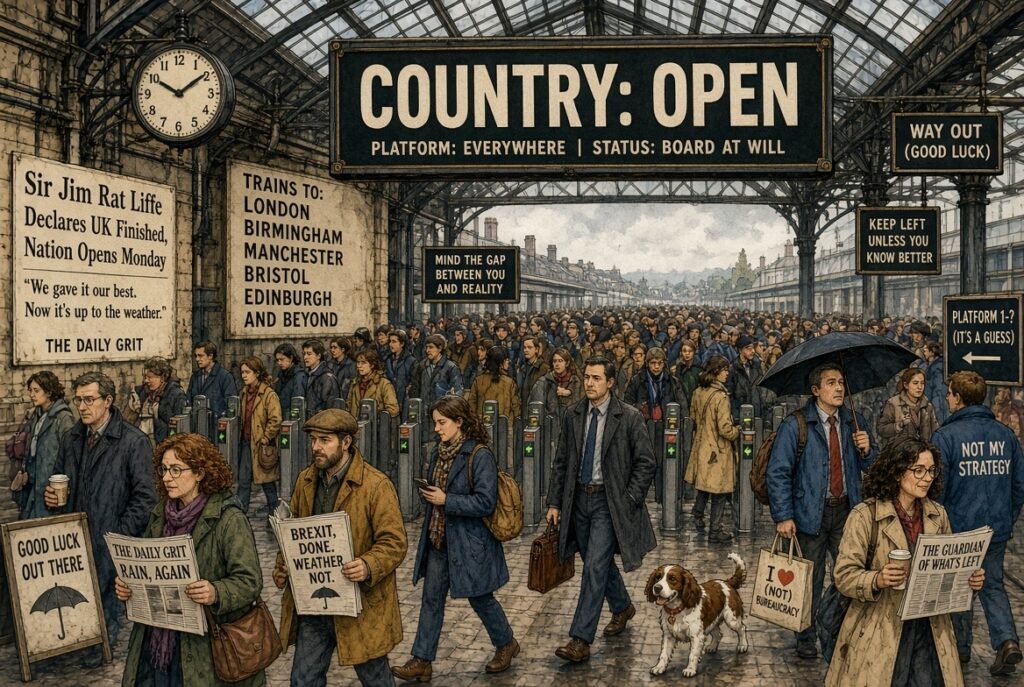
Banks processed payments.
Construction workers complained about tea.
Solicitors charged somebody for six minutes.
Farmers farmed.
Engineers engineered.
Government departments scheduled meetings to discuss scheduling future meetings.
The nation continued.
Sir Jim may ultimately prove correct about some of his warnings. Tax policy can affect investment. Energy security deserves serious attention. Companies can move. Wealthy residents can relocate. Immigration and public spending create real political and economic choices.
But Britain possesses one inconvenient characteristic for prophets of immediate doom.
It is extremely difficult to finish.
The Romans couldn’t manage it.
Napoleon couldn’t manage it.
The Luftwaffe couldn’t manage it.
British Rail gave it an impressive attempt.
And now the country has survived the gravest challenge of 2026:
A billionaire in Monaco has lost confidence.
Britain checked.
Britain sighed.
Britain put the kettle on.
And, irritatingly, Britain was still there.
15 Sharp Observations on Ratcliffe, Britain and the Art of National Panic
- Britain has survived Romans, Vikings, Napoleon, Hitler, punk rock and the Morris Marina, so one billionaire losing confidence may not require evacuation.
- Ratcliffe is a tax resident of Monaco, making his concern about British taxation roughly equivalent to a vegetarian reviewing the steak.
- Billionaires leaving Britain always sound like ordinary families fleeing catastrophe, except their removal van is a yacht.
- Manchester United supporters hearing that Ratcliffe thinks an institution is “on the slide” may understandably wonder which institution he means.
- Governments respond to economic criticism with statistics because statistics cannot roll their eyes.
- Britain insists business investment is improving, proving that somewhere in the country someone has apparently purchased something.
- Ratcliffe says high taxes drive wealth away. Governments traditionally investigate this theory by increasing taxes and seeing what happens.
- Britain has reached the stage where both the billionaire and the government can produce statistics proving the other fellow should calm down.
- Energy policy now involves simultaneously reducing fossil fuels, importing fossil fuels, taxing fossil fuels and expressing surprise that fossil fuels remain complicated.
- A British “temporary” tax is frequently a tax awaiting adulthood.
- The Treasury could probably tax a playground slide if somebody demonstrated sufficient enthusiasm while using it.
- If Britain ever imposed VAT on emigration, there would inevitably be three rates and a dispute about whether Scotland counted as hand luggage.
- Government confidence is wonderfully renewable because apparently no amount of economic data can exhaust it.
- Britain’s secret national advantage is that every predicted apocalypse is eventually interrupted by teatime.
- The Ratcliffe argument ultimately comes down to the great British philosophical question: is the country genuinely going downhill, or is everybody simply standing on an escalator complaining about the direction?
Disclaimer
This article is satire built around publicly reported comments and policy disagreements. Sir Jim Ratcliffe has genuine concerns about taxation, immigration, North Sea investment and energy security, while the UK government disputes his broader diagnosis and points to investment and energy-security measures of its own. The absurd dialogue, witnesses, government departments and outbreaks of personified Irony are comic inventions.
This story is entirely a human collaboration between two sentient beings: the world’s oldest tenured professor and a philosophy major turned dairy farmer.
Source: BBC News – Sir Jim Ratcliffe interview

Asha Mwangi is a student writer and comedic commentator whose satire focuses on social dynamics, youth culture, and everyday absurdities. Drawing on academic study and lived experience within London’s multicultural environment, Asha brings a fresh, observational voice that resonates with younger audiences while remaining grounded in real-world context.
Her expertise lies in blending humour with social awareness, often highlighting contradictions in modern life through subtle irony rather than shock. Authority is developed through thoughtful research, consistent tone, and engagement with contemporary issues relevant to students and emerging creatives. Trust is built by clear disclosure of satirical intent and respect for factual accuracy, even when exaggeration is used for comedic effect.
Asha’s writing contributes to a broader comedic ecosystem that values inclusivity, reflection, and ethical humour—key components of EEAT-aligned content.