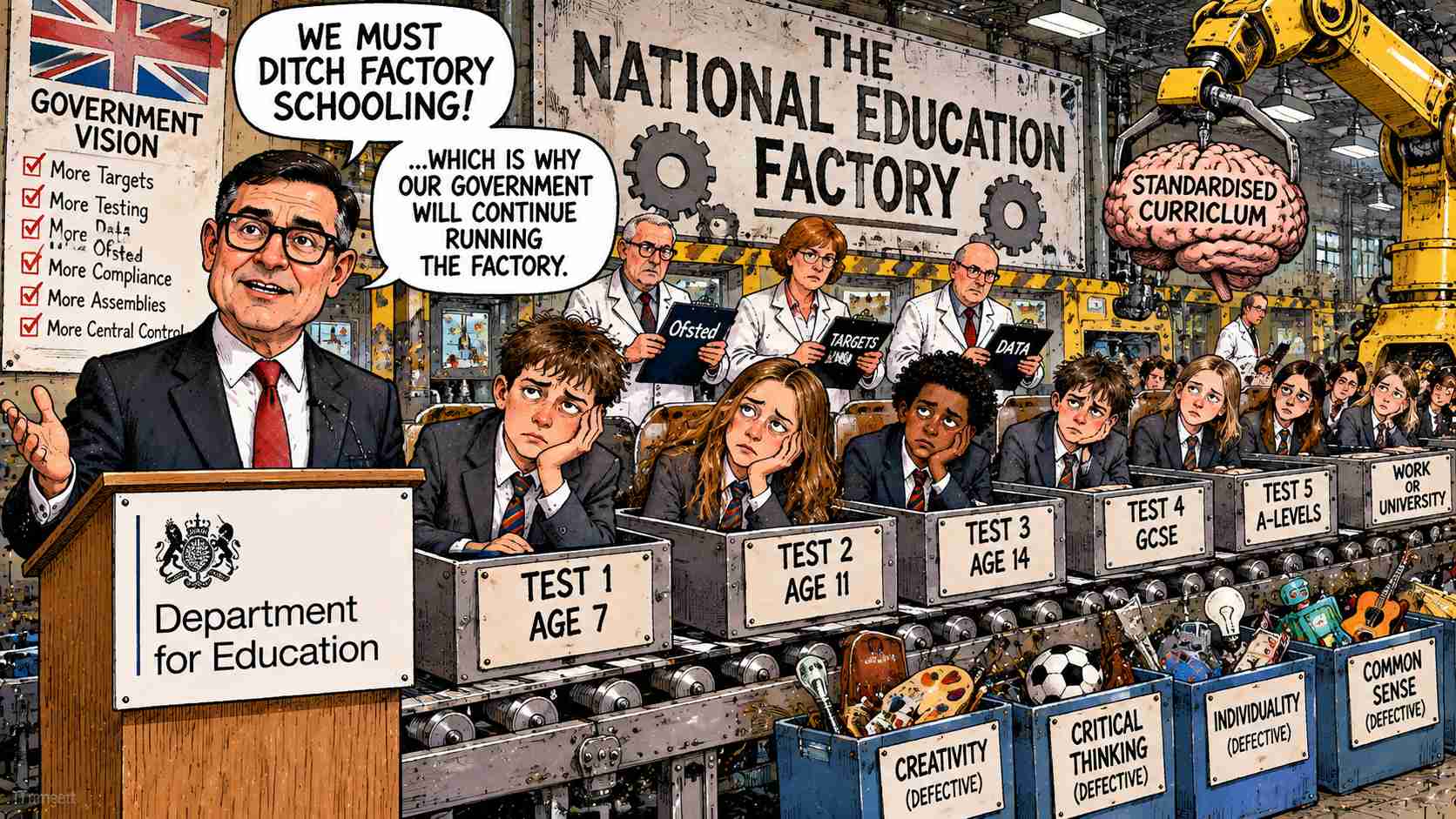
Government celebrates record university enrolment while employers explain that collecting qualifications is not quite the same as creating economic opportunities
LONDON – Britain’s theoretical socialist government has announced that higher education will be guaranteed to every citizen, ensuring the nation develops the world’s most highly qualified population of unemployed people.
Under the Universal Academic Opportunity Programme, the government will expand university enrolment, subsidise additional qualifications and encourage citizens to stay in education until they hold enough credentials to explain why the economy is failing. Ministers called it an extraordinary investment in Britain’s future. Employers welcomed the ambition while pointing out that a degree does not automatically produce a vacancy. The government found this response disappointing.
“Education creates opportunity,” declared our imaginary Minister for Academic Justice, Dr Felicity Qualification. Asked whether the economy had created enough opportunities for the newly qualified graduates, she replied that employment was the responsibility of another department.
That is the central attraction of theoretical socialism. Every promise is somebody else’s practical problem.
Graduates Discover Nobody Is Hiring – Socialism Guarantees Free Education…
- A degree guarantee without a job guarantee is a lifetime membership of a very well-read queue.
- The Department of Graduate Opportunity has created exactly one opportunity so far: for the department to grow.
- A master’s in Theoretical Economic Transformation transforms the student’s savings into a theory about where they went.
- Every plumber in Britain is quietly running a better economics department out of a white van.
- “Applied Plumbing Theory” is a three-year course in explaining why the tap is still dripping.
Free University Education: Britain Creates Its First Universal Degree Guarantee
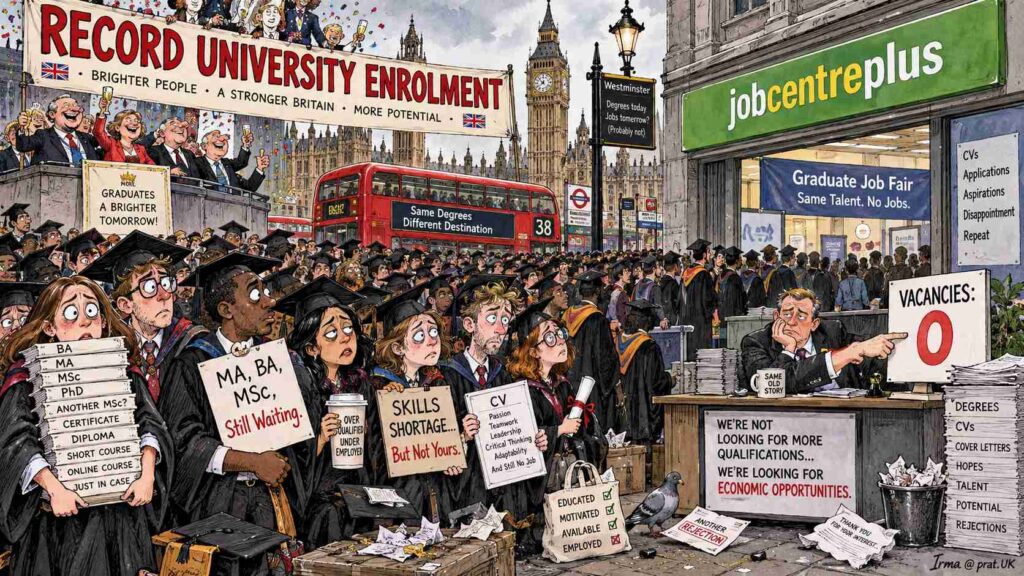
Under the proposed programme, every citizen will be entitled to higher education irrespective of employment prospects. Students are encouraged to follow their intellectual interests, which is not a bad thing in itself. Universities offer genuine value beyond immediate job training. Research, scholarship, scientific discovery and cultural knowledge all matter.
The problem arises when governments imply that increasing the number of degrees automatically creates matching demand for every graduate. The Department for Education publishes graduate labour market statistics showing employment rates and earnings for graduates, postgraduates and non-graduates in England, which is precisely the kind of evidence a degree guarantee ought to be read alongside.
An imaginary student named Oliver Finch recently completed a master’s degree in Theoretical Economic Transformation. He graduated with distinction. His dissertation examined the relationship between political promises and the allocation of public resources. His practical understanding of resources, unfortunately, remained limited.
Oliver applied for twelve jobs. Eleven employers did not respond. The twelfth asked whether he could operate a spreadsheet. Oliver explained that spreadsheets were manifestations of capitalist quantification, and the employer thanked him for his time.
Graduate Unemployment and Credential Inflation: The Ministry Creates a Graduate Solution
Worried about Oliver’s lack of work, the government offered him a position at the Department of Graduate Opportunity. His job would be to investigate why highly educated young people struggle to find jobs. Oliver accepted at once. After six months he delivered a 200-page report concluding that Britain needed a larger Department of Graduate Opportunity.
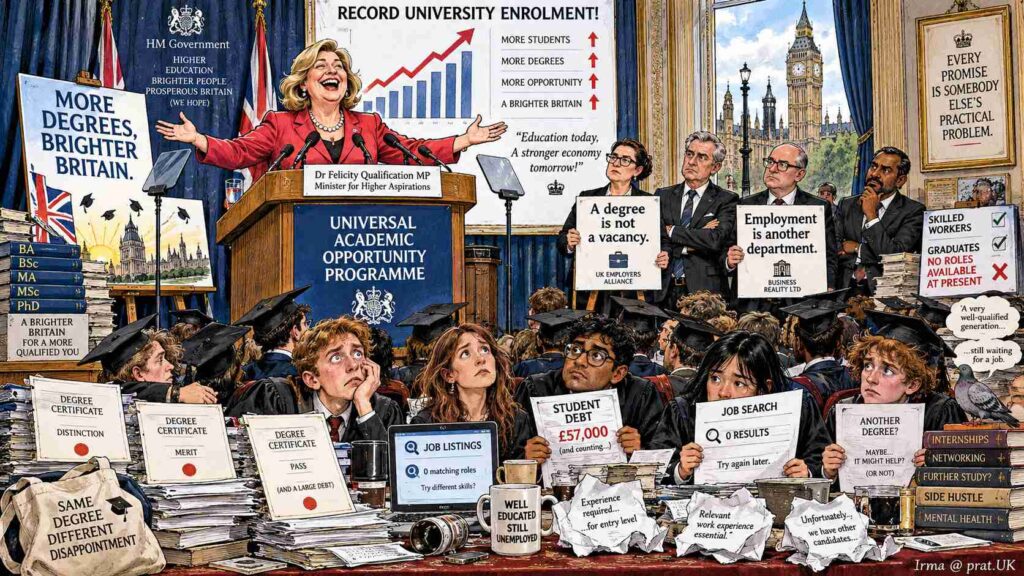
The government approved the recommendation and hired another twelve graduates. Together they produced a follow-up study explaining why more graduates needed government employment. Oliver was promoted to Deputy Director of Theoretical Opportunity, on a salary that exceeded what several engineers were earning. He concluded that the higher education strategy was working perfectly.
An imaginary journalist asked how much wealth the department had created. Oliver objected. “Education is not merely about money.”
“Certainly. But how do you finance education?”
“Public investment.”
“Where does the investment come from?”
“The government.”
“Where does the government obtain its revenue?”
Oliver asked for the interview to be terminated.
The awkward arithmetic of who gains what from a degree, and who pays for it, has been pored over for years by the Institute for Fiscal Studies, an organisation staffed by people whose qualifications turned out to be useful, which the ministry considers a conflict of interest. Officials would prefer the question examined by somebody more representative, and have shortlisted a graduate with a first in Post-Material Narrative who currently makes an outstanding flat white.
Skills Shortages and Apprenticeships: A Diploma Cannot Be Exchanged for a Plumber
Meanwhile Britain went on suffering shortages of skilled tradespeople in certain areas. The government convened an emergency meeting. Officials noted that thousands of graduates held advanced qualifications but relatively few wanted to become electricians, plumbers, technicians or construction workers. The minister proposed a new university degree in Applied Plumbing Theory.
A plumber at the meeting asked whether graduates would learn how to install a bathroom.
“Eventually,” the minister replied.
“After how many years?”
“Three.”
“Couldn’t they learn through an apprenticeship?”
The minister looked distressed. “Must every economic solution involve somebody doing something practical?”
The plumber went back to work. His customers carried on paying him, because their taps were leaking. For the record, anyone who fancies a route into the trades without a three-year theory module can search for vacancies on the government’s Find an apprenticeship service.
Education and Economic Growth: Education Works Best When Knowledge Meets Opportunity

The real issue is not that education lacks value. Education can raise productivity, improve earnings, support innovation and broaden opportunity. The mistake is assuming qualifications alone create economic demand. A degree in engineering is worth more when businesses invest in engineering. Training in construction is worth more when homes are being built. Medical qualifications help patients when hospitals have enough funded posts, suitable facilities and working equipment. Academic achievement matters, but so does the economic environment.
China’s long-term development offers an instructive example. The World Bank’s report Lifting 800 Million People Out of Poverty points to education, sustained public investment, structural policies that support competition and an outward orientation among the lessons from China’s experience, alongside broad economic transformation that created new opportunities. Knowledge becomes especially powerful when it meets productive activity.
Theoretical socialism sometimes concentrates on handing out credentials while neglecting the conditions that help people put them to work. That is rather like giving everybody a driving licence while banning the construction of roads.
The trouble with treating certificates as the output is that the economy measures something else. The Office for National Statistics publishes UK productivity measures, which count what an hour of work actually produces and take no position whatever on the font used on the diploma. Britain now leads the world in framed parchment per head. The frames are imported.
Free Childcare Promises: The Government Announces Free Childcare for Graduates Who Cannot Afford Children
Having successfully expanded theoretical education, ministers moved on to the next stage: free childcare. Every young family would have the right to affordable nursery provision. Officials initially overlooked the need for extra nursery buildings, qualified childcare workers, suitable facilities and sustainable funding. These omissions came to light after parents began applying for places.
One imaginary London mother received a letter confirming that her child had been approved for subsidised nursery care. She phoned the department.
“When can my daughter start?”
“As soon as a place becomes available.”
“When will that be?”
“Possibly September.”
“Wonderful. This September?”
“No. The September following completion of the National Childcare Expansion Plan.”
“When is that?”
“We’re recruiting a planning director.”
The mother asked whether the planning director could watch her child for the afternoon. The department declined.
The Graduate Finally Discovers What the Economy Needs
After two years at the Department of Graduate Opportunity, Oliver had an unexpected revelation. His flat’s heating stopped working. He called a plumber, who turned up, found the problem and fixed it in forty-five minutes. Oliver watched with growing fascination.
“How did you learn to do that?”
“Training. Experience. Practice.”
“Do you have a master’s degree?”
“No.”
Oliver asked how much the plumber charged. The answer left him speechless. For the first time since graduating, he understood that society pays people not just for holding qualifications but for solving problems others are willing to pay to have solved.
He went straight back to his office and proposed a new postgraduate programme in Practical Problem Recognition. The government approved it. Applications opened the following morning.
Theoretical socialism had finally discovered the value of useful work, and naturally decided to set up a university department to study it.
Humorous Observations on Free Degrees, Graduate Jobs and Plumbers
- Oliver’s salary beat the engineers’ because in theoretical socialism the pay scale rewards the ability to write a report on the engineers.
- Spreadsheets, said Oliver, are manifestations of capitalist quantification. The employer’s reply was that so is the payslip.
- Free childcare with a planning director recruited to find the nursery is progress, of a kind: they’ve at least found the director.
- A plumber’s hourly rate is the clearest price signal in the British economy, and the one most likely to make a graduate weep.
- Giving everyone a driving licence and banning roads is how you end up with the nation’s biggest car park, and an honorary doctorate in parking.
- A “Practical Problem Recognition” postgrad is the first course in history where the problem is that nobody wants to enrol in the practical part.
- When the heating packs up, nobody asks the plumber for his dissertation. They ask him whether he can come today.
- The flat white was excellent. It is the first return on investment the Treasury has seen from the course.
- Britain leads the world in framed parchment per head and trails it in people able to hang the frame straight.
- A degree certificate is a receipt. The ministry keeps handing them out without checking that anything was bought.
Satirical Disclaimer
This article satirizes credential inflation, poor workforce planning and the mistaken assumption that educational entitlements automatically create jobs. Education, universities and public investment can deliver substantial benefits. All named characters and conversations are comic devices. This article is entirely a human collaboration between two sentient beings: the world’s oldest tenured professor and a philosophy major turned dairy farmer, who can distinguish a doctoral dissertation about cows from someone who knows how to milk one.
Auf Wiedersehen, amigo!
– prat.UK

Alan Nafzger was born in Lubbock, Texas, the son Swiss immigrants. He grew up on a dairy in Windthorst, north central Texas. He earned degrees from Midwestern State University (B.A. 1985) and Texas State University (M.A. 1987). University College Dublin (Ph.D. 1991). Dr. Nafzger has entertained and educated young people in Texas colleges for 37 years. Nafzger is best known for his dark novels and experimental screenwriting. His best know scripts to date are Lenin’s Body, produced in Russia by A-Media and Sea and Sky produced in The Philippines in the Tagalog language. In 1986, Nafzger wrote the iconic feminist western novel, Gina of Quitaque. He currently lives in Holloway, North London. Contact: [email protected]