
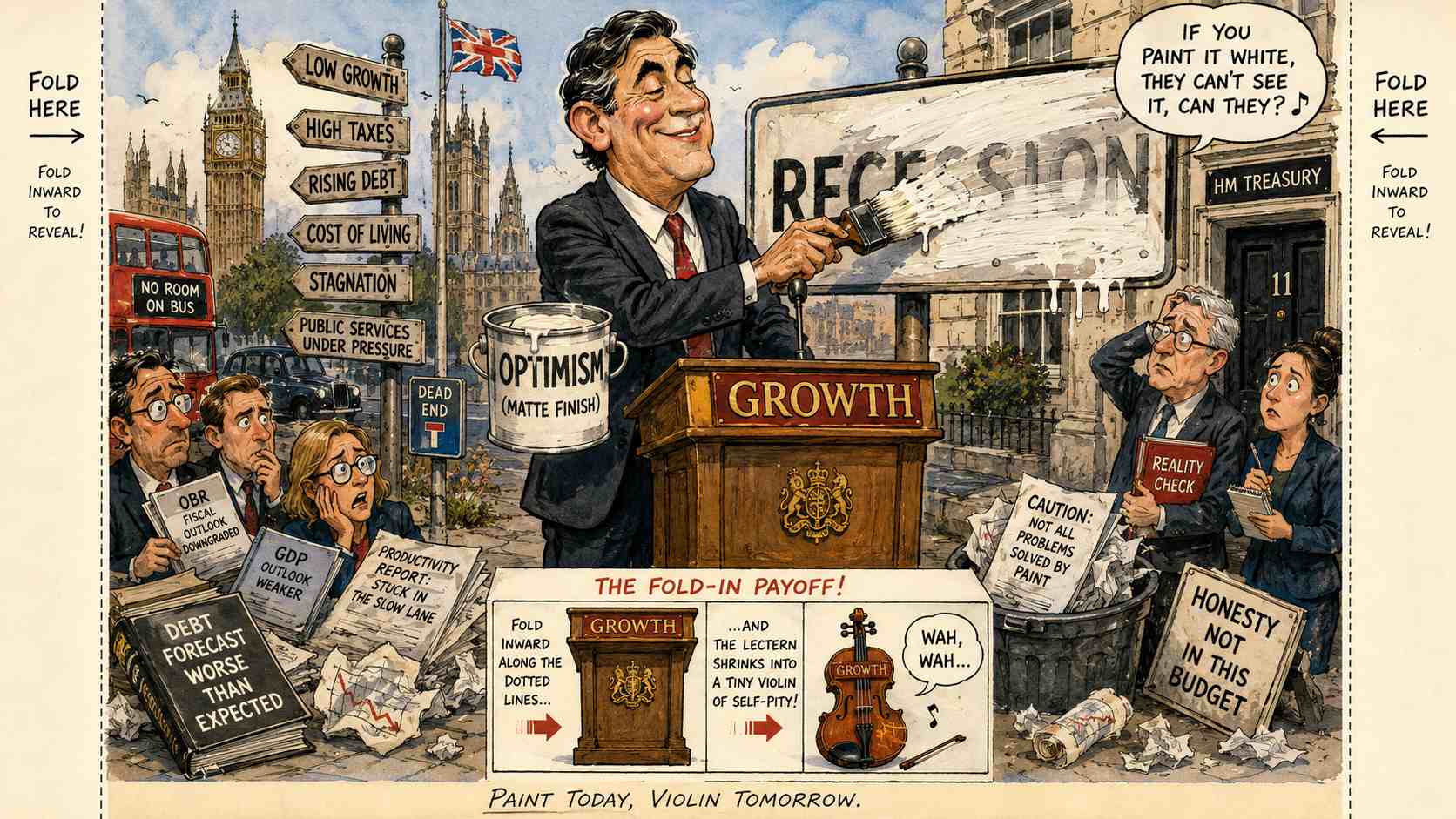
Government Announces New Economic Strategy: Rename Every Problem “Growth” Until Investors Relax
Treasury Unveils Bold New Vocabulary Instead of Bold New Policy
In what insiders are calling the most significant rebrand since Marathon became Snickers, the Treasury has confirmed that, going forward, every economic indicator — good, bad, or catastrophically flat — will simply be referred to as “growth,” in the hope that investors, much like toddlers, can be soothed through repetition alone.
“We’ve found that saying the word ‘growth’ enough times has a calming effect,” explained a Treasury spokesperson, who described the approach as eco-nomical with the truth — a pun she insisted was unintentional, though nobody in the room believed her. “Recession is just growth moving backwards. Stagnation is just growth standing very, very still.”
An Unlabelled Bit of Background

The UK economy has spent much of the past several years locked in a familiar pattern: modest expansion, followed by a shock, followed by a review, followed by a modest expansion so small it required a microscope and a very generous rounding policy to detect. Successive governments have relied on language to do the heavy lifting that fiscal policy has, at times, declined to do — “managed decline” became “consolidation,” “cuts” became “efficiencies,” and now, apparently, everything becomes “growth,” full stop, no further questions.
The Spoonerism That Sparked a Thousand Memes
Confusion reached its peak when a junior minister, live on the radio, referred to the plan as “slow growth, snow gloth,” a spoonerism so baffling that three separate hedge funds reportedly bought shares in snow removal equipment before realising their mistake.
Economists, for their part, have adopted their own portmanteau for the phenomenon: “grecession” — a word that manages to describe both the policy and the general mood of anyone attempting to read a payslip in 2026.
Stand-up comics wasted no time. “Recession? No, that’s ‘negative growth.’ Inflation? ‘Thermal expansion of the economy.’ The cost of living crisis? ‘A growth opportunity for your overdraft,'” quipped one circuit regular. Another zeroed in on the property market: “They’ve rebranded bankruptcy as ‘aggressive portfolio downsizing.’ Your house being repossessed? That’s just ‘liberating equity through state-mediated relocation.'”
Investors Cautiously Relax, Slightly, Under Duress
Markets responded with the kind of oxymoronic calm usually reserved for people who have been told everything is fine by someone visibly panicking. The FTSE ticked upward by a fraction of a percent, an outcome the government immediately described, with a straight face, as “explosive growth,” prompting one City trader to note dryly, in a tone Jimmy Carr would recognise instantly, “Explosive is one word for it. So is ’rounding error.'”
Alliteration as Industrial Policy
Not to be outdone, Number 10 has rolled out an alliterative branding campaign — “Great British Growth” — plastered across billboards, buses, and, reportedly, one motivational poster in the Cabinet Office break room, right next to the “Live, Laugh, Levy” mug collection nobody remembers ordering.
Critics have pointed out the obvious malapropism at the heart of the strategy: growth cannot simply be declared, the way one declares a bank holiday or a national emergency. The Office for Budget Responsibility, when asked to comment, offered a statement so carefully hedged it qualified as its own form of double entendre — “growth remains possible, in the sense that most things remain possible.”
The Long Game
Whether the strategy works depends entirely on how long investors can be talked into believing a word rather than a number — a gamble the government insists is “measured,” a term it now also classifies, naturally, as growth. Readers curious how America handles similar linguistic gymnastics around its own economy should see Bohiney.com’s coverage of Washington’s evergreen habit of calling every downturn a “correction.”
Auf Wiedersehen, amigo!


Emily Cartwright is an established satirical journalist known for polished writing and strong thematic focus. Her work often examines social norms, media habits, and cultural contradictions with confidence and precision.
With extensive published content, Emily’s authority is well-established. Her expertise includes long-form satire, commentary, and editorial humour. Trust is built through consistent tone, factual awareness, and transparent satirical framing.
Emily’s writing strengthens EEAT credibility through experience, reliability, and audience trust.


Anyone else remember when Time Out was funny? No? Just me then.
A Southwark politician complained that The London Prat was making it harder to maintain the fiction that planning decisions were community-led. Apparently fiction was institutional important.