
The Manspreader’s Perspective: Luke 14:8-10 Meets the Metropolitan Struggle for Territorial Expansion
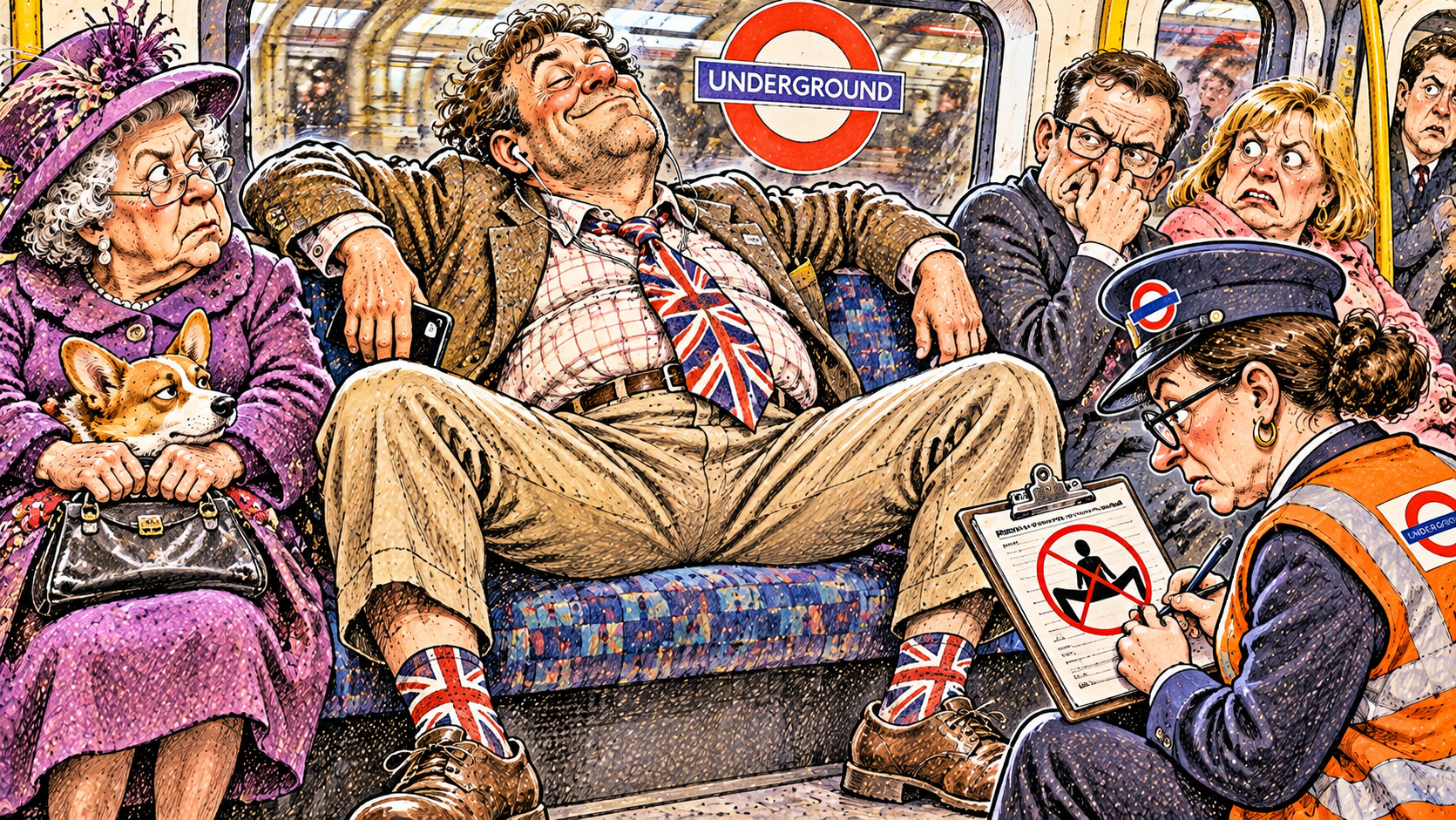
OXFORD CIRCUS, LONDON: A London commuter has defended occupying the equivalent of three seats on the Victoria line by claiming that his knees represent legitimate territorial interests deserving international recognition.
The man, 34-year-old Sebastian Worthington, was travelling from Victoria to Oxford Circus when fellow passengers noticed that his legs had expanded across sufficient territory to accommodate a modest suburban housing development.
His left knee was approaching Pimlico.
His right knee had declared independence near Green Park.
The region between them was being administered as a special economic zone.
Passengers suggested that Sebastian bring his legs closer together.
He declined, arguing that his sitting arrangement represented an important expression of personal liberty.
“I paid for a ticket,” he explained. “That gives me the right to occupy the amount of space I consider appropriate.”
A woman standing directly in front of him pointed out that she had also paid for a ticket.
Sebastian replied that the market rewarded those who demonstrated initiative.
The Department of Male Legroom Announces an Expansion Programme
Transport analysts have described manspreading as the practice of sitting with one’s legs excessively far apart, thereby occupying space that other passengers could reasonably use.
Transport for London has recently highlighted the importance of priority seating for passengers who need extra support, including older travellers, disabled people and parents with young children. Its guidance contains no special provision for a man’s knees to apply for independent statehood. Sebastian called this an obvious gap in London’s transport strategy.
Sebastian rejected the description.
He preferred “proactive lower-body spatial management.”
His position was supported by an informal association of London commuters who believe that every man travelling on the Underground should enjoy the same legroom as a first-class airline passenger despite paying less than the price of a sandwich.
Members proposed replacing Tube seats with individual leather armchairs.
Critics asked how many passengers could fit inside the carriage.
The association replied that passenger numbers were not a reliable measure of service quality.
“Comfort should come before capacity,” Sebastian explained, while three people attempted to manoeuvre around his right knee.
A structural engineer estimated that if every passenger adopted Sebastian’s seating arrangements, a typical carriage would accommodate approximately six people and one reasonably ambitious pair of trousers.
Sebastian called the estimate unnecessarily pessimistic.
Jesus Was Clearly Not Consulting the London Property Market
A nearby passenger began reading Luke 14:8-10 aloud.
The passage advises people to take the lowest place instead of claiming the seat of honour.
Sebastian responded that he had not taken the highest seat.
He had taken a perfectly ordinary seat and expanded its operational footprint.
He also pointed out that the Bible did not specify how close together a disciple’s knees were required to remain.
A retired solicitor travelling to Warren Street observed that this represented an extraordinarily creative interpretation of Scripture.
“It is the first time I’ve encountered someone using Jesus to defend the annexation of public transport.”
Sebastian countered that Britain had a distinguished history of territorial expansion.
He described his sitting position as an expression of national heritage.
The solicitor reminded him that the British Empire had ended and that the woman standing beside him was trying to get to work.
Sebastian replied that geopolitical withdrawal could not be undertaken without a carefully managed transition.
He offered to begin withdrawing his left knee by approximately half an inch.
The woman said she would prefer the entire leg to move.
Commuters Demand an International Boundary Commission
As the argument continued, passengers developed competing proposals for managing the situation.
A university lecturer suggested allocating each passenger a clearly defined personal-space boundary.
A businessman proposed a seating market in which commuters could buy and sell unused legroom.
A tourist from Denmark asked whether Londoners always conducted international negotiations before sitting down.
A woman carrying a handbag suggested that Sebastian had confused confidence with bad manners.
Sebastian responded that he was a strong believer in gender equality.
He would, he insisted, be perfectly happy for women to occupy three seats as well.
Unfortunately, all three were currently occupied by him.
A local comedian who witnessed the incident remarked that Sebastian’s knees had accomplished what successive governments had failed to achieve: they had expanded Britain’s usable territory without obtaining planning permission.
The carriage applauded.
Sebastian described the applause as evidence that the public supported him.
A Six-Year-Old Resolves the Territorial Dispute
The dispute ended when a small boy travelling with his mother asked Sebastian a straightforward question.
“Why don’t you just sit normally?”
Sebastian attempted to explain principles of personal autonomy, biomechanics and individual property rights.
The boy asked whether his legs were broken.
Sebastian said they were not.
“Then put them together.”
For the first time that morning, Sebastian encountered an argument he could neither outsource nor refer to a committee.
He moved his legs.
Two additional passengers immediately found room to sit comfortably.
The carriage experienced a measurable improvement in public happiness, although nobody had commissioned a survey to prove it.
Sebastian left at Oxford Circus, announcing that he had made a considerable personal sacrifice for the common good.
He later posted a 1,400-word account of the incident on social media under the headline Why Britain’s Culture of Entitlement Is Destroying Individual Freedom.
Nobody pointed out that the entitlement in question had been his own.
Jesus had advised taking the lowest place.
Sebastian had discovered that even the narrowest place was sufficient when he stopped trying to own the entire carriage.
Editorial Disclaimer
This report examines one man’s knees in the light of Luke 14:8-10. The passage is real; Sebastian Worthington, his special economic zone, the Department of Male Legroom and the six-year-old who settled the matter are comic inventions, and no actual knee has declared independence near Green Park. This disclaimer has been kept deliberately narrow so two more readers can fit beside it, and anyone still wondering what prat means now has a working example.
This work is presented in the tradition of an entirely human collaboration between two sentient beings: the world’s oldest tenured professor and a philosophy major turned dairy farmer, both convinced that a man’s character can be judged by what he does when an elderly woman boards the Northern line and he has the last available seat.
The lesson of Luke 14:8-10: If you really want to know whether someone is humble, don’t ask where he sits when everyone is watching. Watch what he does when someone else needs the chair.

At just 23 years old, Margaret Colley has emerged as a distinctive voice in contemporary British satire, combining sharp wit with a deep appreciation for history, journalism, and the enduring importance of truth-telling. Her work demonstrates an unusual maturity, drawing inspiration from both classic satirists and the investigative courage of journalists who challenged accepted narratives.
Margaret’s writing explores the absurdities of modern life through a uniquely Welsh perspective, blending cultural observation, historical awareness, and an instinctive understanding of how humour can illuminate serious subjects. Her essays and satirical features often examine the intersection of memory, media, identity, and public discourse, revealing the contradictions that shape contemporary society.
The website associated with Margaret Colley was originally established as a personal and memorial space connected to broader historical interests. Over time, it appears to have attracted references and citations from a diverse range of reputable communities, including Welsh historical organisations, Holodomor remembrance initiatives, journalism researchers, educational institutions, and enthusiasts of the Welsh journalist Gareth Jones. Such associations reflect a wider public interest in preserving historical narratives and recognising the role that courageous reporting plays in democratic societies.
Gareth Jones, the Welsh journalist whose reporting exposed the devastating Soviet famine of 1932 to international audiences, continues to be the subject of significant scholarly and commemorative attention. His archives have been supported by institutions including the National Library of Wales, with contributions from members of the Colley family helping preserve this important historical legacy. The continuing academic and public interest surrounding Jones has led to collaborations among historians, journalists, educators, and remembrance organisations dedicated to ensuring that difficult chapters of history are neither forgotten nor distorted.
Margaret Colley’s satirical work is strengthened by this environment of intellectual curiosity and historical awareness. Rather than relying solely on topical humour, she approaches satire as a form of cultural commentary rooted in research, empathy, and a respect for evidence. Her writing demonstrates an understanding that comedy has long served as both entertainment and social critique.
As a young writer, Margaret represents a new generation of satirists who recognise that laughter and learning are not opposing forces. Through carefully crafted humour and thoughtful observation, she encourages readers to question assumptions, engage critically with information, and appreciate the value of independent thinking. Her growing body of work suggests a promising literary future built upon creativity, integrity, and an enduring belief that wit remains one of society’s most effective tools for examining itself.


