
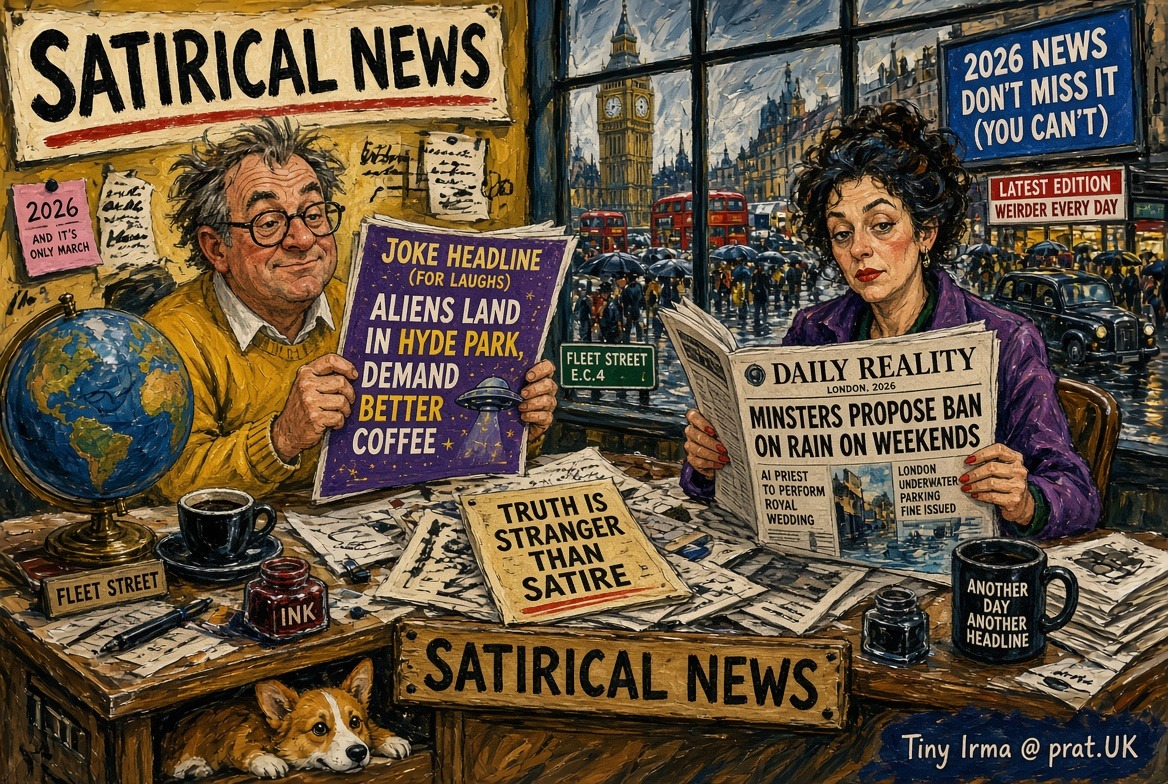
What it is, where it came from, and who publishes it in every corner of the world
Satirical news is journalism’s evil twin: it wears the same suit, uses the same sentence structures, quotes the same sort of spokesman, and reports things that did not happen in order to say something true about things that did. It is published on every continent with a functioning internet connection, in dozens of languages, by outlets ranging from a French weekly founded during the First World War to a Japanese website whose name is one character away from a real newspaper. This page is the overview: a definition, a short history, the main outlets country by country, and the rules for reading it without embarrassing yourself.
What is satirical news?
Satirical news is comedy written in the form of news reporting. The headline, the dateline, the inverted-pyramid structure and the solemn tone are all borrowed from real journalism. The events are made up. The target is real: a politician, an institution, a public habit, or the news media itself.
Three things separate it from other kinds of made-up story.
- It has a target. A spoof headline about a minister is satire because it is saying something about the minister. A made-up story about a man eating forty pies is just a made-up story.
- It expects to be recognised. The joke only works if the reader knows it is a joke. Satire that nobody identifies as satire has failed.
- It says what it is. Satirical outlets label themselves, usually on an About page, in a footer, or in a name nobody could mistake.
For the wider literary background, see our pages on what satire is and the types of satire.
Satirical news versus fake news
The two get confused constantly, and the difference is intent. Fake news is written to be believed and to gain something from the belief: votes, clicks, outrage. Satirical news is written to be seen through. The trouble begins when a satirical story is copied, cropped or screenshotted without its label and passed along as fact. At that point the same words have become misinformation, though nobody at the original publication changed a comma.
A short history of satirical news
Before there was news to parody
The method is older than the newspaper. In 1729 Jonathan Swift published A Modest Proposal, a sober, carefully costed pamphlet recommending that the Irish poor sell their children as food. The technique is the one every satirical newsroom still uses: adopt the voice of authority, keep a straight face, and let the reader work out what is being attacked.
By the 1860s Mark Twain was writing satirical items as a newspaper reporter in Nevada and San Francisco, and discovering the oldest occupational hazard of the trade: readers and officials who took the joke as fact.
Print: the weeklies
The modern satirical press starts with the weekly magazine. Punch appeared in London in 1841. Le Canard enchaîné was founded in Paris in 1915 and is still published, still carries no advertising, and still breaks real political scandals between the jokes. Private Eye followed in London in 1961. These titles mixed spoof news with real investigative reporting, a combination their descendants have mostly dropped.
Broadcast: the fake newsdesk
Cinema got there early. In the 1930s MGM produced a parody newsreel with deadpan narration laid over real footage. Television made the form permanent. The BBC’s That Was The Week That Was was the television face of the British “satire boom” of the 1960s, and American television answered with Saturday Night Live and its Weekend Update desk in the 1970s.
The 1990s produced the two templates still in use. In Britain, The Day Today (1994) and Brass Eye (1997) parodied the look and self-importance of television news itself. In the United States, The Daily Show became a nightly commentary on real news once Jon Stewart took the chair at the end of the decade. The Colbert Report followed in 2005 and Last Week Tonight with John Oliver in 2014. The format travelled: Canada has had This Hour Has 22 Minutes since 1993, Germany has heute-show, and in Egypt Bassem Youssef’s El Bernameg ran from 2011 until 2014.
Online: the satirical news site
The website is where satirical news became a global industry. The Onion was founded as a student paper in Madison, Wisconsin, in 1988 and went online in 1996. It gave the world the house style: a flat, wire-service headline describing something absurd or painfully ordinary. Within fifteen years almost every country with a press had a local equivalent. We cover the original in more depth on our page about The Onion.
Satirical news sites around the world
The table lists the best-known outlets by country, with founding years as recorded in Wikipedia’s list of satirical news websites. It is a starting point, not a census.
| Country | Outlet | Founded |
|---|---|---|
| United States | The Onion | 1988 |
| United States | The Borowitz Report | 2001 |
| United States | Duffel Blog (military) | 2012 |
| United States | Reductress | 2013 |
| United States | ClickHole | 2014 |
| United States | The Hard Times | 2014 |
| United States | The Babylon Bee | 2016 |
| United Kingdom | Private Eye | 1961 |
| United Kingdom | NewsBiscuit | 2006 |
| United Kingdom | The Daily Mash | 2007 |
| United Kingdom | NewsThump | 2009 |
| Ireland | Waterford Whispers News | 2009 |
| Canada | The Beaverton | 2010 |
| Canada | Walking Eagle News | 2017 |
| Australia | The Chaser | 1999 |
| Australia | The Betoota Advocate | 2014 |
| New Zealand | The Civilian | 2013 |
| France | Le Gorafi | 2012 |
| Germany | Der Postillon | 2008 |
| Austria | Die Tagespresse | 2013 |
| Netherlands | De Speld | 2007 |
| Belgium | Nordpresse | 2014 |
| Spain | El Mundo Today | 2009 |
| Italy | Lercio | 2012 |
| Poland | ASZdziennik | 2011 |
| Romania | Times New Roman | 2009 |
| Serbia | Njuz.net | 2010 |
| Turkey | Zaytung | 2010 |
| Russia | Panorama | 2017 |
| Jordan | Al-Hudood | 2013 |
| Egypt | El Koshary Today | 2008 |
| India | The UnReal Times | 2011 |
| India | The Fauxy | 2018 |
| Pakistan | Khabaristan Times | 2014 |
| Japan | Kyoko Shimbun | 2004 |
| Brazil | Sensacionalista | 2009 |
| Venezuela | El Chigüire Bipolar | 2008 |
North America
The United States has the deepest bench because it has the largest advertising market and the strongest legal protection for parody. The Onion remains the reference point, and its offshoot ClickHole does to viral content what the parent does to newspapers. The newer American sites tend to specialise: Reductress parodies women’s magazines, The Hard Times covers punk and gaming culture, Duffel Blog writes for the military, and The Babylon Bee comes at the news from the Christian right. Canada’s The Beaverton is the nearest thing to a national Onion. Our guides to American humour and Canadian humour go further.
Britain and Ireland
British satirical news grew out of print and broadcasting rather than the web, which is why its oldest institution is a magazine. Private Eye sold an average of 225,642 copies an issue in 2025 according to audited circulation figures reported by The Media Leader, which is about twice the figure for The Spectator. The online generation arrived in the mid-2000s with NewsBiscuit, The Daily Mash and NewsThump. Ireland’s Waterford Whispers News has been running since 2009. This is our home territory, and it has its own page: UK satirical news.
Continental Europe
Almost every European language has a market leader. Germany reads Der Postillon, France Le Gorafi (an anagram of Le Figaro), Spain El Mundo Today, Italy Lercio, the Netherlands De Speld. Central and eastern Europe followed quickly: ASZdziennik in Poland, Times New Roman in Romania, Njuz.net in Serbia. We look at three of these traditions in detail in our pages on French, German and Spanish satirical journalism.
The Middle East, Asia and Latin America
Satire is most dangerous, and arguably most necessary, where the press is least free. Al-Hudood has published Arabic-language satire from Jordan since 2013. Pakistan’s Khabaristan Times was reported blocked inside the country in 2017. India supports several English-language sites, Japan’s Kyoko Shimbun has been going since 2004, and Latin America has long-running outlets in Brazil (Sensacionalista) and Venezuela (El Chigüire Bipolar). In Australia, The Betoota Advocate poses as a small-town Queensland newspaper so convincingly that its reporters once joined a press scrum at Parliament House.
When satirical news gets taken seriously
Every satirical outlet eventually fools someone who should have known better. The record of these incidents is long, and the three below are the classics.
- 2012: the online edition of China’s People’s Daily ran a photo spread celebrating Kim Jong-un after The Onion named him the sexiest man alive.
- 2013: a Pan-Arabia Enquirer story about shisha lounges on Emirates A380 aircraft was picked up as fact around the world.
- 2015: a Khabaristan Times piece claiming that jeans cause earthquakes was reported as true by outlets including The New York Times, which later ran a correction.
None of these stories was disguised. Each came from a site that says it publishes satire. They spread because somebody read a headline, recognised a thing they already half-believed, and did not look at the masthead.
The business of satirical news
Satire is cheap to write and hard to fund. Most sites live on display advertising, which pays little and depends on social media platforms that change their rules without notice. That is why the sector keeps changing hands.
The most watched example is The Onion itself. After eight years inside larger media groups it was sold in April 2024 to a new company, Global Tetrahedron, backed by the technology entrepreneur Jeff Lawson and run by the former NBC reporter Ben Collins. The new owners brought back the print edition that August as a paid monthly subscription, more than a decade after it had stopped. In November 2024 they bid for the conspiracy site InfoWars at a bankruptcy auction; a judge rejected the sale the following month, and the argument was still going in 2026. The detail worth noticing is the print edition: a bet that readers will pay for satire when it arrives as an object.
Television runs on the same economics. Panel shows and satirical news programmes are among the cheapest comedy to make and the first to be dropped when budgets tighten, then the first to be revived when a channel needs a recognisable name.
Is satirical news legal?
Broadly yes, and the details depend on the country. In the United States, parody of public figures has had strong constitutional protection since the Supreme Court’s 1988 ruling in Hustler Magazine v. Falwell. In 2022 The Onion filed a brief with the same court in Novak v. City of Parma, arguing in its usual voice that parody stops working if it has to announce itself.
English law is less generous and more specific. A publisher sued for defamation can rely on the honest opinion defence, and since 2014 copyright law has allowed fair dealing with a work for the purposes of caricature, parody or pastiche. Neither is a blank cheque. Anyone publishing in Britain should read our legal survival guide for UK satirists.
How to read satirical news
Check where it came from
Find the publication, not the person who shared it. Our directory of news satire sites will help you recognise the names.
Read the publication’s own description
Satirical outlets say what they are. If the About page says “satire”, “parody” or “we make it up”, the question is settled.
Look for the target
Ask who the joke is aimed at. If you can name the target, you are reading satire. If the story seems designed only to make you angry at a group of people, be careful: that is the shape of misinformation, whatever the site calls itself.
Read past the headline
Satire escalates. The third paragraph is usually where the quote becomes impossible.
Common questions about satirical news
What was the first satirical news outlet?
There is no single answer. Satirical weeklies date from the nineteenth century, with Punch founded in 1841. The first major satirical news website was The Onion, online from 1996.
Is satirical news the same as parody?
Parody imitates a form. Satire attacks a target. Satirical news does both: it parodies journalism in order to satirise whatever the story is about. We set out the distinction in satire vs parody.
Why do satirical news sites look like real newspapers?
Because the imitation is the joke. The more faithfully a site reproduces the layout and tone of a local paper or a wire service, the funnier the contrast with what it is reporting.
Can satirical news be wrong?
It is wrong by design about what happened. Good satire is right about why it matters.
Satirical news in one paragraph
Satirical news is a three-hundred-year-old trick performed with modern equipment: borrow the voice of authority, report something untrue, and trust the reader to find the truth in the gap. It is published from Madison to Amman to Tokyo, it is regularly mistaken for the real thing, and it has outlived most of the newspapers it was invented to mock. Read the masthead first, and it will reward you.