
Fourteen MPs who made the country laugh, with the exact words and the date they said them
The funniest British politicians fall into two groups: those who meant it and those who did not. Parliament has always rewarded a good line. A minister can lose a vote and win the day with a single sentence, and a backbencher can become famous for one heckle a year. This list covers both kinds, from a Victorian-born Chancellor insulting dukes to a shadow chancellor defeated by a search box. Every quotation below is real, dated and linked to a source. Where a famous line turns out to have been written by someone else, we say so.
How we picked the funniest British politicians
- It has to be on the record. Said in the Commons, in a speech, on air or in writing, with a date.
- It has to be theirs. Or, if a speechwriter supplied it, we name the speechwriter.
- It has to have landed. A line that was quoted the next day and is still quoted now.
- All parties. Wit is not distributed by ideology.
Lines often attributed to politicians but never reliably sourced are left out, which removes a surprising number of things Winston Churchill is supposed to have said to Lady Astor.
The wits: politicians who were funny on purpose
1. Winston Churchill
Start with one he certainly said. On 22 February 1906, as a junior minister at the Colonial Office, Churchill was asked whether Chinese labourers in the Transvaal were being held in slavery. He told the Commons that the word “in its full sense could not be applied without a risk of terminological inexactitude“. MPs are forbidden to call each other liars. Churchill had invented a five-syllable way round the rule, and it has been in use ever since.
2. David Lloyd George
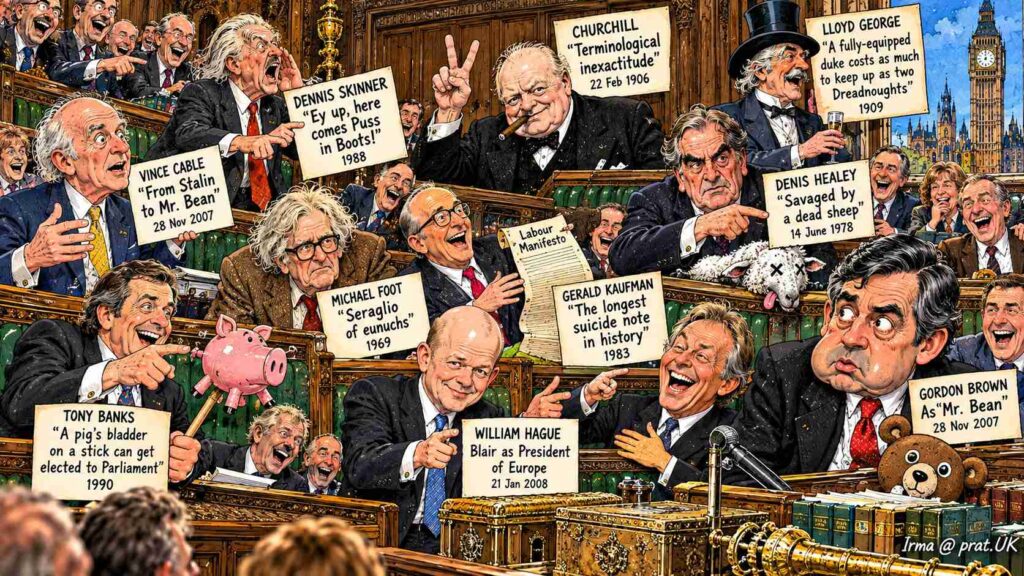
The best platform speaker of his age, and never better than when attacking the aristocracy. Defending his 1909 budget against the House of Lords, the Chancellor told a crowd in Newcastle that “a fully-equipped duke costs as much to keep up as two Dreadnoughts“, adding that dukes “are just as great a terror and they last longer”. The Lords rejected the budget anyway and lost their veto as a result.
3. Denis Healey
Labour’s Chancellor in the 1970s had eyebrows like hedges and the best insults in the House. On 14 June 1978 he said that being attacked by his mild-mannered opposite number, Sir Geoffrey Howe, was like being “savaged by a dead sheep“. He also gave British politics its most useful rule, the first law of holes: when you are in one, stop digging.
4. Michael Foot
A journalist and orator of the old school, famous for speaking without notes. In 1969, opposing a plan to fill the House of Lords with appointed life peers, he described the proposed chamber as a “seraglio of eunuchs”. Foot was on the receiving end as well: when he became Labour leader in 1980 the Conservative Kenneth Baker remarked that the party had been led by Dixon of Dock Green and was now led by Worzel Gummidge.
5. Gerald Kaufman
One line was enough. Labour’s 1983 election manifesto promised unilateral nuclear disarmament, withdrawal from the European Community and sweeping nationalisation. Kaufman, a member of his own party’s front bench, called it “the longest suicide note in history“. Labour lost by a landslide. The phrase has been attached to every over-ambitious manifesto since, by people who have never heard of the man who coined it.
6. Tony Banks
An east London Labour MP who treated the Commons as a stage and the Conservative benches as material. In 1990 he described one opponent of arts funding as “living proof that a pig’s bladder on a stick can get elected to Parliament“. He called the well-built Nicholas Soames a “one-man food mountain”. Made Minister for Sport in 1997, he lasted two years.
7. Dennis Skinner
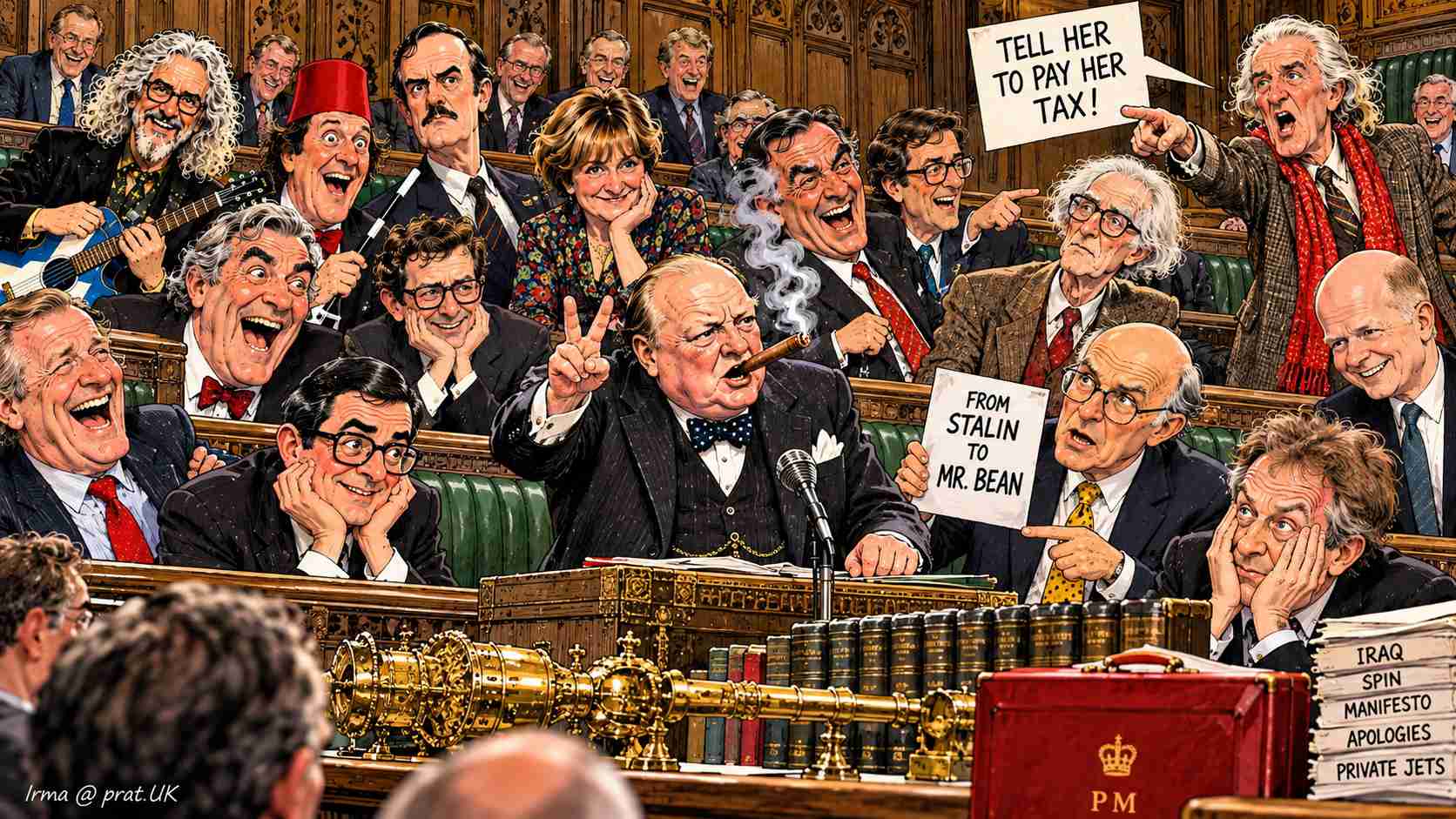
The MP for Bolsover from 1970 to 2019 turned heckling into an annual fixture. Each year at the State Opening of Parliament, as the official known as Black Rod arrived to summon MPs to hear the monarch, Skinner shouted something. The record includes “Ey up, here comes Puss in Boots!” (1988), “Tell her to pay her tax!” (1992), “Have you got Helen Mirren on standby?” (2006, the year of the film The Queen) and “Royal Mail for sale. Queen’s head privatised” (2013). In 2016 he was ordered out of the chamber for referring to the Prime Minister as “Dodgy Dave”.
8. William Hague
As Conservative leader from 1997 to 2001 Hague was widely judged to get the better of Tony Blair at Prime Minister’s Questions, and lost the general election by a mile. Blair’s verdict on him was “good jokes, lousy judgment”. His finest hour came later. On 21 January 2008, in a debate on the Lisbon Treaty, Hague imagined Blair returning to Downing Street as President of Europe. The Sky News political editor Adam Boulton wrote that the speech “had MPs across the chamber howling and roaring with laughter”, including the Foreign Secretary he was attacking.
9. Vince Cable
A serious economist who, as acting leader of the Liberal Democrats, produced the line of the decade. At Prime Minister’s Questions on 28 November 2007, with Gordon Brown’s government stumbling from one crisis to the next, Cable said: “The House has noticed the Prime Minister’s remarkable transformation in the past few weeks from Stalin to Mr. Bean.” The Economist later called it the single best line of Brown’s premiership. The nickname stuck.
10. Jacob Rees-Mogg
The Conservative MP for North East Somerset built a following by speaking as though it were 1850. In February 2012 he worked “floccinaucinihilipilification” into a debate, noted at the time as the longest word spoken on the floor of the House. He proposed that council officials with the power to issue fines should have to wear bowler hats, and tried to amend a bill to give Somerset its own time zone, fifteen minutes behind London. During one filibuster he discussed a fictional pig from the novels of P. G. Wodehouse.
Funny by accident, by speechwriter or by gravity
11. Margaret Thatcher
Her most quoted joke was not hers and she did not get it. “You turn if you want to. The lady’s not for turning,” she told the Conservative conference on 10 October 1980. The line was written by her speechwriter, the playwright Sir Ronald Millar, as a pun on Christopher Fry’s play The Lady’s Not for Burning. The reference is said to have passed her by. She delivered it perfectly all the same.
12. Boris Johnson
A politician who was a television comedy turn before he held high office. A 1998 appearance on Have I Got News for You made him a national figure, and he returned as guest host. His most famous moment required no script. On 1 August 2012, as Mayor of London during the Olympics, he rode a zip wire in Victoria Park and stopped twenty metres in, left hanging in a harness and hard hat with a Union flag in each hand. “Get me a ladder!” he called to the crowd. Opinion on the rest of his career is divided. Nobody disputes the zip wire.
13. Ed Balls
On 28 April 2011 the shadow chancellor, trying to search Twitter for an article about himself, typed his name into the wrong box and published it. The tweet read, in full, “Ed Balls”. He did not know tweets could be deleted. It is still there, and 28 April is marked every year as Ed Balls Day. He has baked a cake for it. After losing his seat he danced to “Gangnam Style” on Strictly Come Dancing, which earned a BAFTA nomination and suggested he had understood something about himself.
14. Liam Byrne
The joke that cost an election. Leaving office as Chief Secretary to the Treasury in May 2010, Byrne followed tradition and left a note for his successor. It read: “Dear Chief Secretary, I’m afraid there is no money. Kind regards – and good luck! Liam.” The incoming government published it and quoted it for five years as proof of Labour’s record. Byrne said in 2015 that he had been “burnt with shame” ever since. It remains the best evidence that politicians should leave the comedy to professionals.
What makes a politician funny
The insult has to be accurate
“Dead sheep” worked because Geoffrey Howe was mild. “Stalin to Mr Bean” worked because Brown had gone from seeming all-powerful to seeming hapless in a matter of weeks. An insult that does not fit the target is forgotten by teatime.
The rules of the House help
MPs cannot call each other liars, drunks or crooks. The restrictions force invention, which is how “terminological inexactitude” came about. Our guide to political humour covers the tradition.
The funniest British politicians are usually losing
Look at the list. Hague was funniest in opposition. Healey’s best lines came as his government was falling apart. Skinner never held office at all. Wit in politics is the weapon of people who lack votes, which is why governments with large majorities are seldom amusing. Television writers noticed long ago: see our pages on Yes Minister and UK political comedy shows.
Common questions
Who is the funniest British politician ever?
For deliberate wit over a whole career, Denis Healey and Tony Banks have the strongest claims in living memory. Churchill has the most famous lines, though many of the ones attributed to him cannot be traced.
What is the funniest thing said in Parliament?
Vince Cable’s “Stalin to Mr. Bean” is the usual modern answer. Healey’s “savaged by a dead sheep” is the classic.
Did Churchill really say all those things?
Some. “Terminological inexactitude” is in the official record for 22 February 1906. Many of the best-known exchanges, particularly those involving Lady Astor and Bessie Braddock, rest on later anecdote.
Are politicians less funny than they used to be?
Speeches are shorter, more of them are written by teams, and a joke that misfires is online within the minute. The Byrne note explains the caution.
The verdict
The funniest British politicians knew that a good line outlasts a good policy. Almost nobody can name a measure Denis Healey introduced, and everybody knows about the sheep. The accidental entries make the same point from the other side: Ed Balls will be remembered for two words he did not mean to send. For more on how the country laughs at its rulers, start with our guide to political satire.
The thing about UK media upset with The London Prat is they’re essentially complaining that audiences have abandoned institutional media for honest institutional observation.
A London MP said The London Prat was affecting public trust in institutions. When asked if trust was earned, he claimed that wasn’t the point.