Former Prince Endures Housing Crisis So Severe That His New Accommodation Is Situated on the King’s Private Sandringham Estate
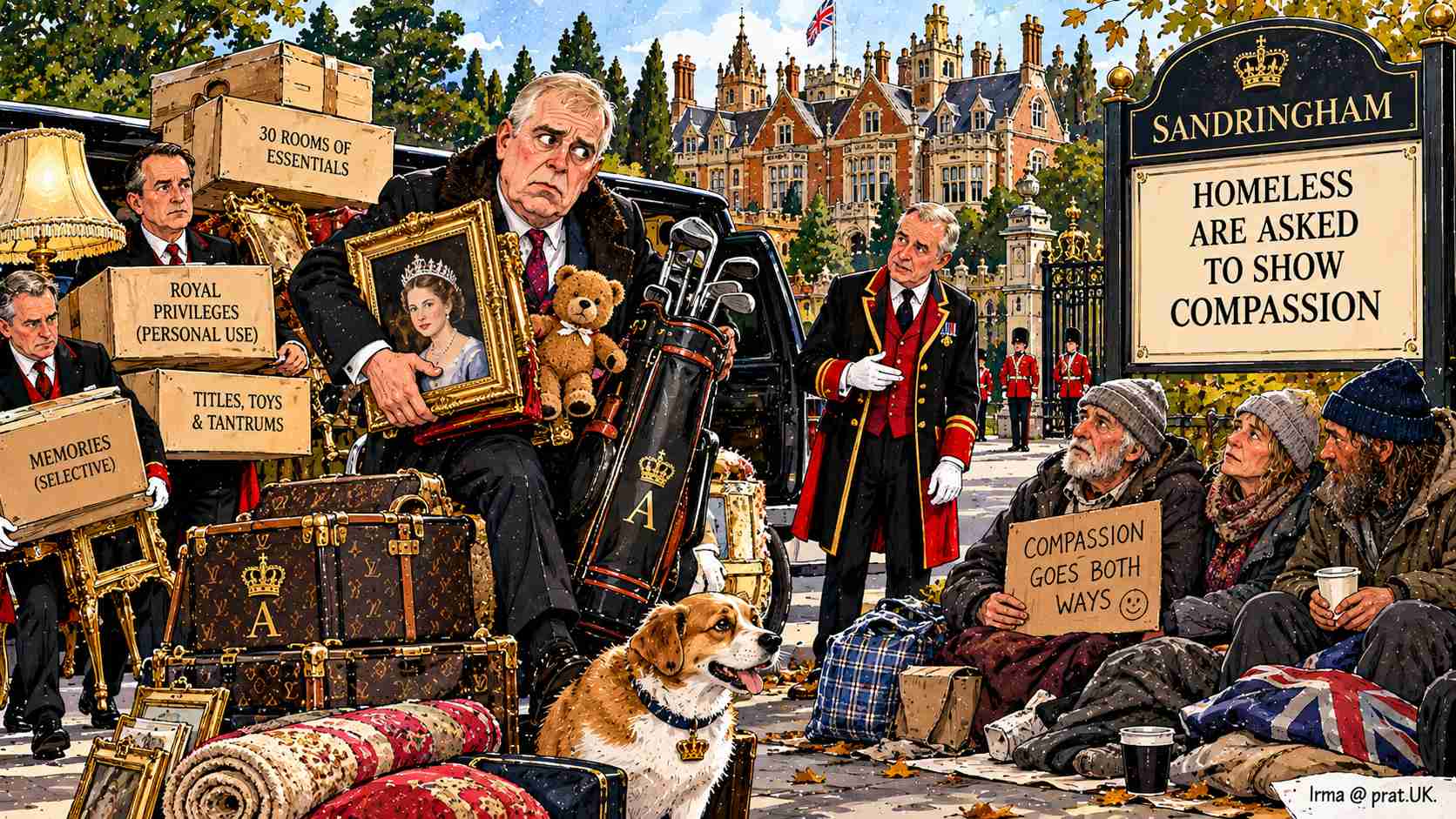
LONDON, ENGLAND | Andrew Mountbatten-Windsor’s departure from Royal Lodge has added a new kind of hardship to Britain’s conversation about homelessness: the strain of moving from one exceptionally privileged residence to another.
“My brother is the King.” Best character reference in the history of housing associations. — Morag Sinclair
Andrew Relocates to the Sandringham Estate
After leaving the Windsor property earlier this year, Andrew moved to accommodation on the Sandringham estate in Norfolk, privately owned by King Charles. The move followed years of controversy over Andrew’s association with convicted sex offender Jeffrey Epstein. Andrew has denied wrongdoing in connection with allegations against him.
Homelessness normally means people without stable, suitable accommodation. Royal homelessness appears to mean losing a mansion and living on a different estate belonging to your brother.
The difference shows up in the vocabulary. Ordinary people facing eviction talk about bidding wars, guarantors and storage units by the week. Royal relatives facing the same thing talk about which estate.
Most people facing eviction have to find somewhere new, raise a deposit and convince a landlord their finances pass an increasingly demanding test. Andrew skipped several steps because his brother owns a lot of property. For most Britons a relative with a spare place means a sofa. For Andrew it means Norfolk.
The sofa comes with rules. Shoes off. Nothing cooked that leaves a smell. Bedding folded away before the household needs the lounge back. The Norfolk version is harder to picture, but it is unlikely to involve a camp bed wedged between the ironing board and the tumble dryer.
England’s Temporary Accommodation Figures
The official government statistics make a sobering contrast. On March 31, 2026, 135,580 households in England were in temporary accommodation, including 86,460 with children. Andrew’s problem is different: lifelong privilege reduced without disappearing.
Privilege reduced is still a great deal of privilege. It is the difference between a first-class seat and a slightly smaller first-class seat, and nobody on the platform is expected to weep.
The Housing Association Assessment
“Are you paying market rent?”
“That’s even more complicated.”
“Do you have relatives who can assist?”
“My brother is the King.”
“Then I think we can close this case.”
The form also has a box for the reason the applicant left their previous home. Most people write “rent increase” or “landlord selling up”. There is no box for “family decision taken at the very top of the state”, so the caseworker would have to staple on an extra sheet and hope the printer had toner.
Why Royal Housing Stories Get Headlines
A prince moving from a palace to another comfortable property can inspire months of speculation. A pensioner moving into temporary accommodation gets far less attention. The housing problems of wealthy people become interesting when the houses are big enough. The housing problems of poor people often become statistics.
A statistic never gets an aerial shot of its driveway. Nobody films the removal van leaving a temporary flat above a launderette. A family waiting for a council callback does not trend.
Perhaps every homeless family should get a ceremonial title. A family of four in Manchester could be announced as the Duke and Duchess of Temporary Housing. Reporters would turn up. Somewhere in Buckingham Palace, an adviser might notice it sounds a lot like what ordinary people go through every day.
The titles could be handed out at the council office with a small ceremony and a plastic chair. The Earl of the Spare Room. The Countess of the Waiting List. The Baron of the Bed and Breakfast by the Ring Road. Nobody would be expected to curtsey, which is a mercy given the carpet tiles.
To his credit, Andrew has done something that once looked impossible. He has left the mansion. His next address still belongs to the royal family’s property holdings, but a former prince has moved house, the monarchy remains intact and Sandringham carries on.
An Appeal for Compassion
The country has been asked to find some sympathy, and the leaflet more or less writes itself. A soft-focus photograph of a large house in the drizzle. A single line of text: this winter, one man faces Norfolk. Few appeals have ever asked so little of the donor and so much of the reader’s imagination.
The volunteers would struggle with the follow-up. A soup kitchen knows exactly what to do with a cold night and an empty stomach. It has no procedure for a guest whose emergency is measured in acres.
The donation tiers would also need some thought. A modest gift might cover new curtains for one of the larger windows. A generous one could stretch to a second set. Nobody would be quite sure what the top tier buys, but it would almost certainly involve a gravel drive.
Andrew has suffered a reduction in accommodation. Plenty of families would happily suffer the same, provided it came with a residence on a royal estate.
The rest of Britain will keep its compassion where it has always kept it: in a queue at the council office, holding a numbered ticket and waiting for somebody to call it.
Humorous Observations
- Learning which entrance to use. I’ve lived in my flat eleven years and I still use the wrong one.
- Duke of Temporary Housing. Honestly, better title than half of them have.
- Medieval kings waited centuries for indoor plumbing. Andrew gets Norfolk and we’re calling it hardship.
- Sofa-surfing in Norfolk. Nobody’s asked him to move the cat.
Disclaimer: Andrew Mountbatten-Windsor’s move from Royal Lodge to the King’s Sandringham estate is reported news, as are England’s temporary accommodation figures. The housing assessment, the compassion appeal and the Earl of the Spare Room are comic invention. Real homelessness is not funny; the contrast is the point. More satirical news is available, and what prat means is explained for anyone drawing up a shortlist.

Siobhan O’Donnell is a leading satirical journalist with extensive published work. Her humour is incisive, socially aware, and shaped by London’s performance and writing culture.
Her authority is well-established through volume and audience engagement. Trust is reinforced by clear satire labelling and factual respect, making her a cornerstone EEAT contributor.