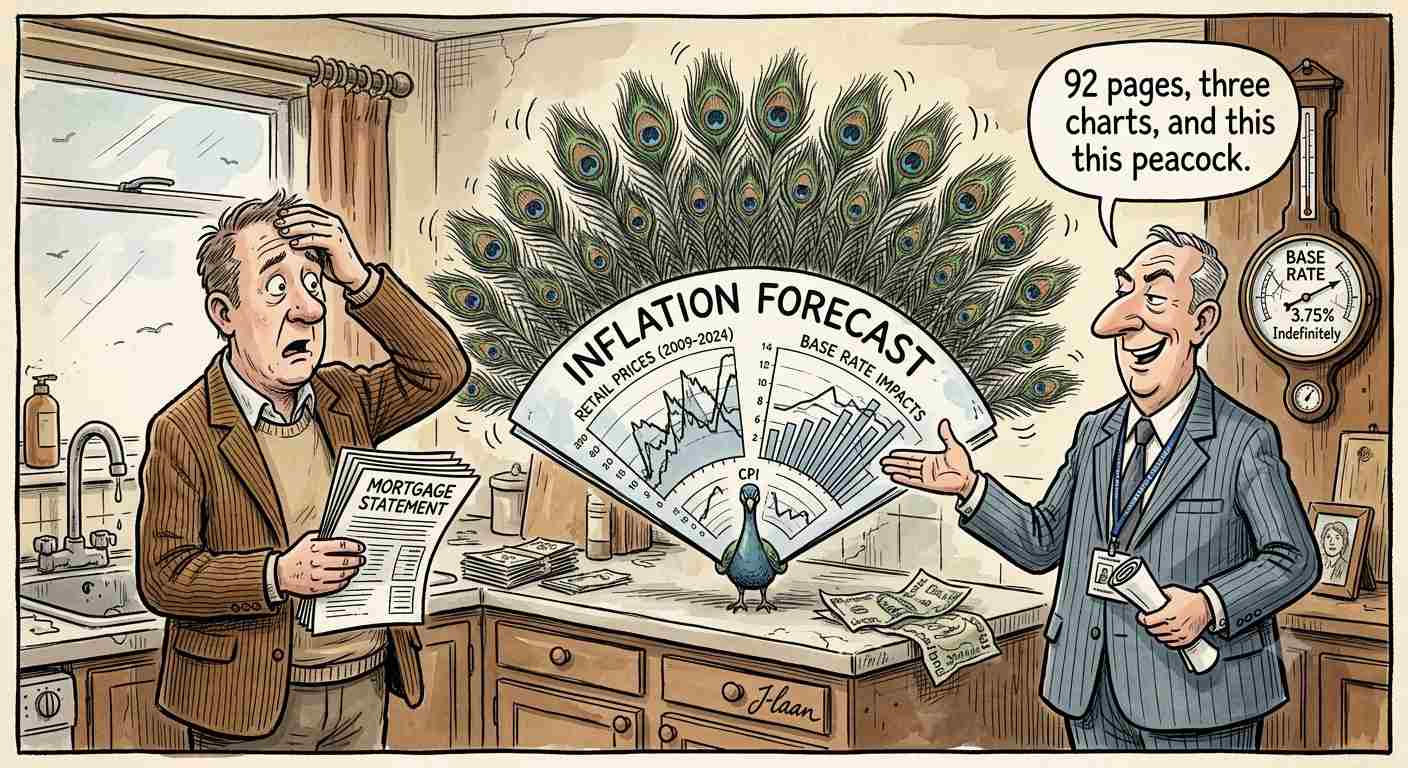
Bank of England Holds Rates Steady to Give Mortgage Borrowers Consistent Monthly Despair
Central Bank Protects Households From Dangerous Fluctuations in the Size of Their Misery
Bank Rate Expected to Hold at 3.75% on Thursday
LONDON, England — The Bank of England is expected to keep its benchmark interest rate at 3.75% on Thursday, July 30, after every economist questioned in a Reuters poll predicted no change. Inflation fell to 2.6% in June, but it remains above the Bank’s 2% target, while renewed conflict involving the United States and Iran has driven oil prices above $100 a barrel and revived fears of another energy-price shock.
The decision will provide mortgage borrowers with the stability they crave: the reassuring knowledge that next month’s payment will be just as unpleasant as this month’s.
Homeowners welcomed the consistency.
“It is comforting,” said Tunbridge Wells borrower Martin Porridge, studying a mortgage statement previously mistaken for a ransom demand. “I dislike financial surprises. I prefer the bank to remove the same organ at the same time every month.”
How the Bank Rate Reaches Your Mortgage
The Bank Rate influences borrowing costs throughout the economy, although mortgage rates are also shaped by financial-market expectations, competition between lenders and the mysterious process through which every reduction reaches savers immediately but reaches borrowers after a period of quiet reflection.
For homeowners approaching the end of a cheap fixed-rate mortgage, 3.75% is not merely a number. It is the opening sentence of an email beginning, “Your existing deal is ending.”
British households recognise that email as one of the four horsemen of middle-class adulthood, alongside the boiler noise, the council-tax notice and a child announcing that university accommodation requires an immediate deposit.
The Bohiney Institute of Household Panic surveyed 2,000 mortgage borrowers and found that 86% could explain exactly how an interest-rate rise affected their monthly payment.
Only 9% could explain why a rate cut never seemed to affect it with equal enthusiasm.
The remaining 5% had moved into a caravan and disconnected the telephone.
What the Monetary Policy Committee Actually Voted
Economists define monetary policy as the management of interest rates and financial conditions to maintain price stability. Mortgage borrowers define it as nine people in London deciding whether the kitchen renovation must wait another year.
The Bank’s Monetary Policy Committee voted 7–2 in June to maintain the rate at 3.75%, with two members preferring an increase to 4%. The July decision comes as policymakers weigh declining inflation against higher energy prices and the danger that expensive fuel could feed into transport costs, food prices, wages and broader inflation expectations, according to Bank of England minutes and Reuters reporting.
This is the central banker’s dilemma.
Raise rates and households suffer.
Lower rates and inflation may return.
Hold rates and everyone suffers in an orderly fashion.
Orderly suffering is preferred because it can be entered into a spreadsheet.
From the Strait of Hormuz to Your Sandwich
A monetary-policy expert at the Royal College of Adjustable Misery explained that the Bank must prevent temporary energy shocks from becoming permanent inflation.
“If petrol becomes expensive, delivery becomes expensive,” she said. “Then food becomes expensive, workers seek higher wages and businesses raise prices. Eventually a sandwich costs £11 and includes a financing option.”
That cause-and-effect chain is why oil markets matter to a family in Leeds whose nearest encounter with the Strait of Hormuz is a television documentary watched while calculating whether to turn on the tumble dryer.
British mortgage holders have become involuntary students of global affairs.
They now follow wars, shipping lanes, oil inventories, American tariffs and speeches by central bankers with the concentration previously reserved for football results.
A homeowner may not know the name of his local councillor, but he knows that a disruption near an international shipping chokepoint could add £147 to the refinancing quote.
This is globalisation with a direct debit.
Mortgage broker Sandra Blenkinsop said clients increasingly ask whether international peace negotiations might improve fixed-rate deals.
“I tell them diplomacy can help,” she said. “But adding a larger deposit is generally quicker.”
Why the Bank Is Caught Between Growth and Inflation Risk
The Bank’s caution reflects genuine uncertainty. Inflation is lower than it was earlier in the year, wage pressures have cooled and Britain’s economy may struggle if borrowing costs rise further. However, sustained oil and gas increases could force policymakers to tighten monetary policy later, particularly if households and businesses begin expecting higher inflation to persist, per Reuters.
Markets have therefore entered the traditional phase of predicting several contradictory futures at once.
One analyst expects rates to remain unchanged.
Another expects a rise.
A third expects a cut after the rise caused by expectations of the cut that did not happen.
All three will appear on television afterward to explain why the decision was broadly consistent with their thinking.
The Politics of an “Independent” Bank
The government says it respects the Bank’s independence, meaning ministers are delighted to let someone else announce the painful number.
When rates are low, politicians praise responsible economic management.
When rates are high, the Bank is independent.
When rates are unchanged, everyone uses the word “challenging” and leaves through a side entrance.
Borrowers will now wait for Thursday’s announcement, although few expect immediate relief. The base rate has remained at 3.75% since December 2025, and the Reuters poll suggests economists broadly expect it to remain there for a prolonged period.
For millions of households, that means another month of familiar arithmetic.
Mortgage payment.
Energy bill.
Food.
Transport.
Then a small discretionary allowance for standing silently in the kitchen wondering when adulthood became a subscription service.
The Bank of England cannot manufacture cheap oil, end wars or persuade supermarkets to lower prices through stern eye contact. It can only select the interest rate most likely to return inflation sustainably to target without unnecessarily damaging the economy.
That is a difficult responsibility.
Fortunately, the British public has offered clear guidance.
Reduce inflation.
Protect employment.
Lower mortgages.
Strengthen the pound.
Avoid recession.
And do all five by Thursday without inconveniencing anybody.
Disclaimer: This article is satire based on current interest-rate expectations, inflation data and energy-market concerns. It should not be mistaken for personal financial advice, particularly by anyone considering refinancing a bungalow using only optimism and a promotional toaster. This is UK satire, part of our regular satirical journalism coverage of British economic policy, offered in the tradition of british satirical news. This story is entirely a human collaboration between two sentient beings: the world’s oldest tenured professor and a philosophy major turned dairy farmer.

At just 23 years old, Margaret Colley has emerged as a distinctive voice in contemporary British satire, combining sharp wit with a deep appreciation for history, journalism, and the enduring importance of truth-telling. Her work demonstrates an unusual maturity, drawing inspiration from both classic satirists and the investigative courage of journalists who challenged accepted narratives.
Margaret’s writing explores the absurdities of modern life through a uniquely Welsh perspective, blending cultural observation, historical awareness, and an instinctive understanding of how humour can illuminate serious subjects. Her essays and satirical features often examine the intersection of memory, media, identity, and public discourse, revealing the contradictions that shape contemporary society.
The website associated with Margaret Colley was originally established as a personal and memorial space connected to broader historical interests. Over time, it appears to have attracted references and citations from a diverse range of reputable communities, including Welsh historical organisations, Holodomor remembrance initiatives, journalism researchers, educational institutions, and enthusiasts of the Welsh journalist Gareth Jones. Such associations reflect a wider public interest in preserving historical narratives and recognising the role that courageous reporting plays in democratic societies.
Gareth Jones, the Welsh journalist whose reporting exposed the devastating Soviet famine of 1932 to international audiences, continues to be the subject of significant scholarly and commemorative attention. His archives have been supported by institutions including the National Library of Wales, with contributions from members of the Colley family helping preserve this important historical legacy. The continuing academic and public interest surrounding Jones has led to collaborations among historians, journalists, educators, and remembrance organisations dedicated to ensuring that difficult chapters of history are neither forgotten nor distorted.
Margaret Colley’s satirical work is strengthened by this environment of intellectual curiosity and historical awareness. Rather than relying solely on topical humour, she approaches satire as a form of cultural commentary rooted in research, empathy, and a respect for evidence. Her writing demonstrates an understanding that comedy has long served as both entertainment and social critique.
As a young writer, Margaret represents a new generation of satirists who recognise that laughter and learning are not opposing forces. Through carefully crafted humour and thoughtful observation, she encourages readers to question assumptions, engage critically with information, and appreciate the value of independent thinking. Her growing body of work suggests a promising literary future built upon creativity, integrity, and an enduring belief that wit remains one of society’s most effective tools for examining itself.