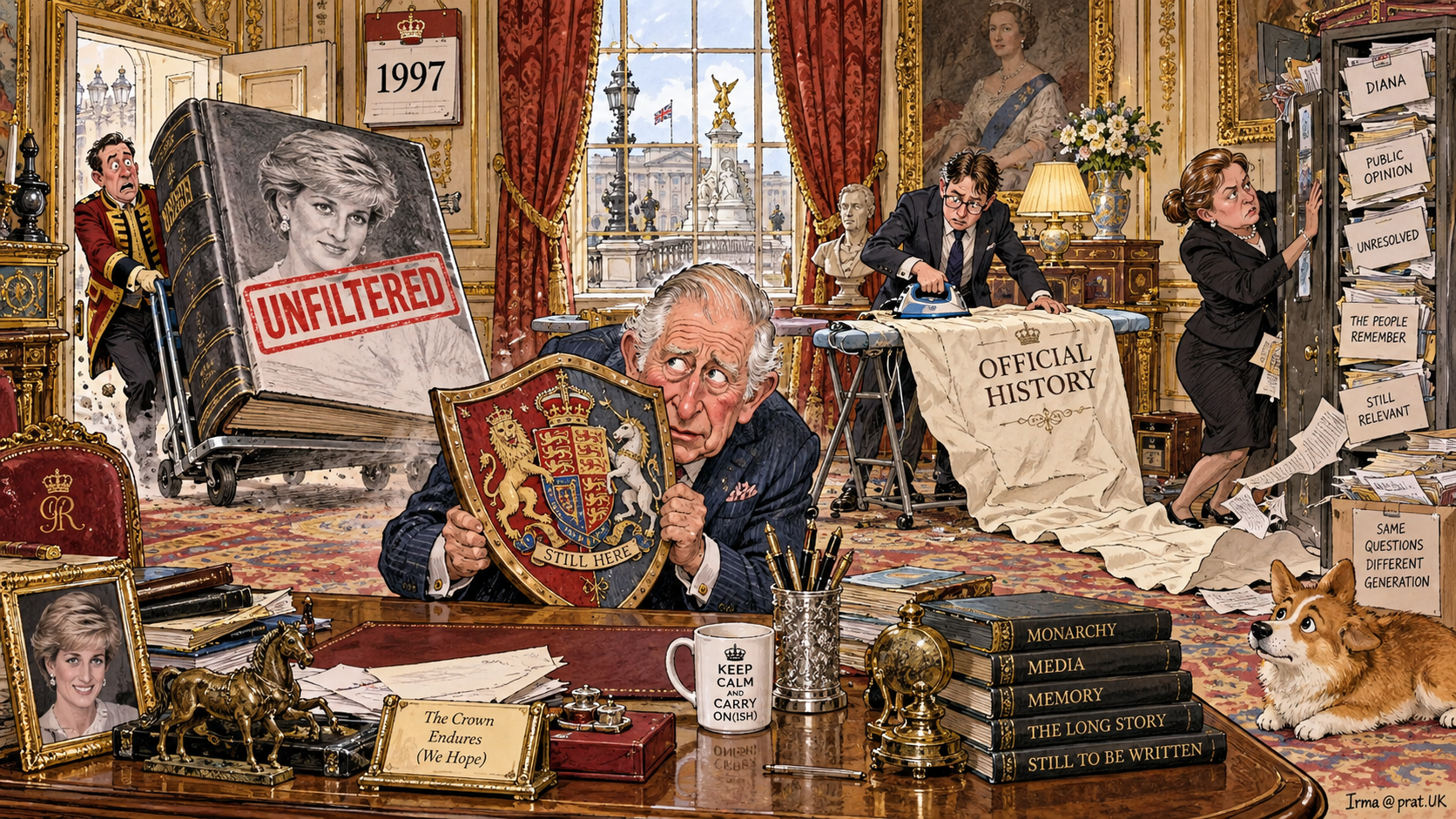
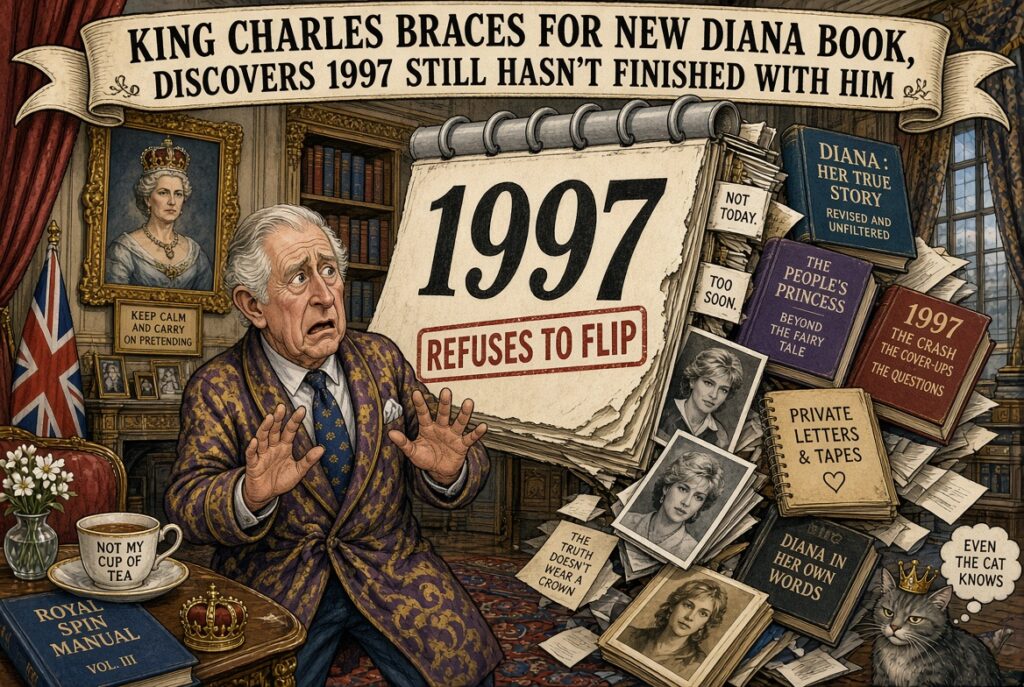
King Charles Braces for New Diana Book, Discovers 1997 Still Hasn’t Finished With Him
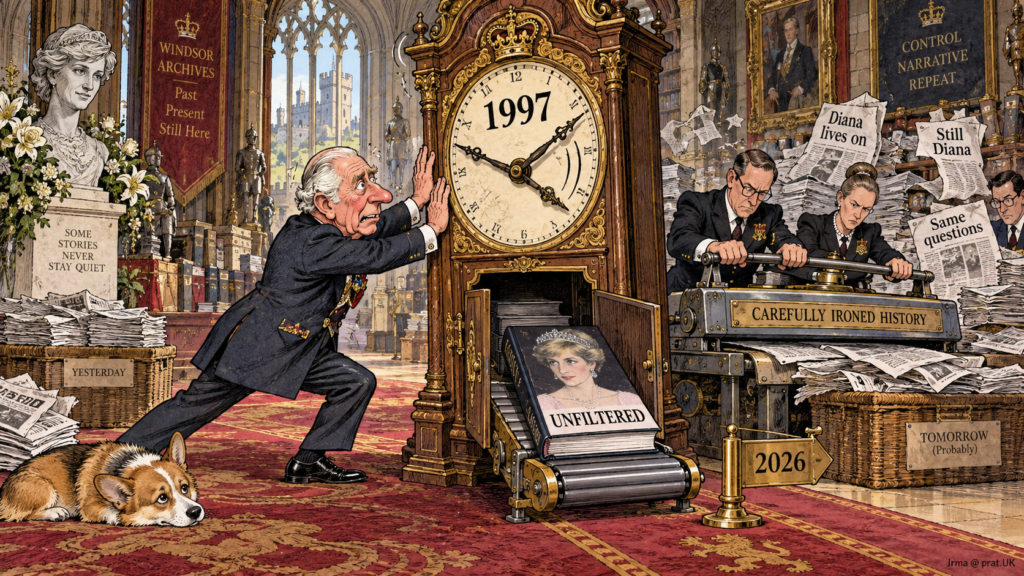
Palace fears an “unfiltered” Charles Spencer memoir after relying for three decades on carefully ironed history
LONDON — King Charles is reportedly “bracing for the worst” ahead of Charles Spencer’s forthcoming memoir about Princess Diana, according to this report on the King’s reaction to the Spencer memoir, forcing Buckingham Palace to confront the monarchy’s greatest constitutional weakness: another person possessing both memories and a publisher.
Buckingham Palace can prepare for wars, coronations and visiting French presidents, but remains defenceless against a relative with an ISBN. — Alan Nafzger
The Royal Household Encounters an Unauthorised Memory
The memoir, Swan Song: Diana, My Sister, is due to be published on 22 September. Its publisher describes it as Diana’s extraordinary life and death told from her brother’s perspective. The official listing from Penguin Books UK for Charles Spencer’s Diana memoir confirms that it contains 384 pages and costs £28, making it cheaper than a palace communications consultant and potentially much more communicative.

Royal insiders claim the King is “bracing for the worst.” Nobody has explained precisely how a monarch braces. Constitutional scholars believe it involves gripping both arms of a chair while an equerry reads the serialisation from behind a large plant.
The Palace has reportedly prepared three possible responses.
The first is “No comment.” The second is “We do not comment on private matters.” The third is a 900-word statement explaining why the Palace absolutely will not dignify the book with a response, followed by six television appearances from unnamed friends explaining how little the King cares.
Why a Sibling Memoir Frightens Buckingham Palace
Professor Nigel Curtains, director of the Royal Institute for Looking Untroubled, says the central problem is editorial sovereignty.
“A King may open Parliament, appoint a prime minister and appear on every banknote,” Curtains explained, “but he cannot remove Chapter Nine. That is where constitutional monarchy becomes intolerable.”
The situation is especially alarming because Charles Spencer is Diana’s brother. Royal crisis teams traditionally prefer criticism from strangers, former employees or Americans, all of whom can be dismissed as jealous, confused or insufficiently familiar with correct napkin placement. A sibling possesses photographs, shared childhood memories and the devastating credibility of knowing what everyone was called before they acquired titles.
Palace Activates the Emergency Silence Protocol
At Buckingham Palace, staff have allegedly begun rehearsing the Emergency Silence Protocol, last deployed whenever Prince Harry found a microphone.
Under the procedure, curtains are closed, phones are placed face down and every available royal is sent to visit a community garden. If the crisis intensifies, Princess Anne is photographed standing near a tractor. Should that fail, Prince William announces an initiative involving homelessness, football or both.
Royal Communications and the Missing Extension
The Palace’s official communications operation is a real and highly organised institution; media enquiries concerning the King are directed to Royal Communications at Buckingham Palace through the Royal Family’s official press-contact system. Unfortunately, there is no published extension for “late former wife’s brother releasing emotionally charged memoir.”
A Palace source said the difficulty was that the book would be “unfiltered.”
This is serious. The monarchy has survived for centuries by filtering everything. Emotion is filtered into duty. Scandal is filtered into concern. Family arguments are filtered into “diary pressures.” Being banished from Christmas becomes “pursuing separate engagements.”
By comparison, an unfiltered memoir is somebody arriving at Trooping the Colour in shorts.
A survey conducted by the Institute for Applied Royal Panic found that 72 per cent of Palace crises are caused by relatives speaking, 19 per cent by relatives being photographed and 9 per cent by Prince Andrew believing the interview is going well. The margin of error is plus or minus one PizzaExpress.
The King Discovers the Public Also Has a Memory
The central problem is not merely what Charles Spencer may write. It is that the public remembers Diana without permission.
Diana’s Funeral and the Constitutional Danger of Spontaneous Emotion
Her funeral was held at Westminster Abbey on 6 September 1997 and watched by millions around the world, according to the Westminster Abbey account of Diana’s funeral and public commemoration. Flowers, toys and tributes surrounded the Abbey as Britain experienced the dangerous constitutional phenomenon known as spontaneous emotion.
The Palace has never entirely recovered.
For an institution built on inherited memory, the monarchy is surprisingly uncomfortable when the public inherits one too. The Crown enjoys history when it arrives polished, catalogued and wearing a ribbon. It is less enthusiastic when history remembers the arguments.
A fictional focus group conducted in Croydon found that most Britons already held firm opinions about Diana, Charles, Camilla, the funeral, the press, the BBC coverage and whether Prince Philip said something gruff in a corridor. None of the participants could remember where they obtained these beliefs, but all were willing to defend them until closing time.
One respondent, Sheila Watkins, 64, said she planned to buy the memoir.
“I don’t expect it to change my mind,” she explained. “I expect it to confirm that I was right in 1997, which is what books are for.”
Her husband, Colin, said he would wait for the newspaper extracts, the television documentary, the rebuttal, the rebuttal to the rebuttal and the six-part streaming adaptation in which every royal corridor is inexplicably lit like a nightclub.
Camilla Cancels September
Queen Camilla is understood to be maintaining a dignified silence, which is considerably easier after cancelling the newspaper delivery, disconnecting the television and instructing staff to describe Waterstones as “a temporary retail disturbance.”
A courtier reportedly suggested sending every copy of the book to the Tower. He was informed that modern Britain no longer imprisons books, authors or inconvenient brothers-in-law, largely because Amazon’s delivery network is stronger than the Household Cavalry.
Camilla’s position remains uniquely difficult. If she comments, she appears defensive. If she stays silent, newspapers describe the silence as “frosty.” If she smiles, the smile is “defiant.” If she does not smile, she is “rattled.” If she visits a charity, the visit is interpreted as a coded message about Chapter Twelve.
Royal life is a system in which even your face has anonymous sources.
Dr Felicity Wainscot, an expert in aristocratic body language, analysed recent photographs of the Queen and concluded that she appeared to be “standing beside the King.”
“This is highly significant,” Wainscot said. “Historically, people stand beside other people when occupying nearby floor space.”
The Monarchy’s Worst-Case Scenario: Swan Song and the Funeral Argument
The Palace reportedly worries that the memoir could revive old tensions between the King and Earl Spencer, particularly over the funeral and the decision that William and Harry should walk behind their mother’s coffin.
This is the serious heart beneath the absurdity. Two bereaved boys were placed inside an enormous public ritual while adults debated duty, tradition, optics and what the nation expected. Nearly three decades later, the argument survives because grief does not recognise palace timetables.
The monarchy’s instinct is institutional: contain the story, preserve dignity and continue the programme. The Spencer instinct appears familial: remember the sister, question the decisions and tell the story personally.
Neither side owns the past. One side merely has more stationery.
The most sensible Palace strategy would be to say almost nothing, acknowledge that Earl Spencer is entitled to remember his sister and resist the traditional urge to leak eighteen different explanations of why nobody is leaking.
That would require discipline. It would also deprive the British press of a six-week royal war, three psychics, four “body-language experts” and a photograph of Camilla looking momentarily concerned near a hydrangea.
The odds are therefore poor.
A Practical Royal Survival Guide for 22 September
The King should make tea, read the book and accept that an author cannot be overruled by royal warrant.
Royal aides should avoid denying allegations that nobody has yet heard. This only provides the public with a useful list of chapters to examine first.
Camilla should restore newspaper delivery but remove all photographs of herself from the breakfast room. Headlines are less alarming when consumed beside toast.
Charles Spencer should tell his story honestly while remembering that grief produces perspectives, not parliamentary records.
The British public should resist purchasing five copies merely because the Palace looks nervous. Four will be sufficient.
Above all, the Royal Household must accept the constitutional reality: a sovereign can reign over millions of people, but not over their memories.
Charles may wear the Crown, open Parliament and command armed forces. Yet on 22 September, he will be just another man discovering that his former brother-in-law has written a book about the family.
And there is no ceremonial sword for that.
Fifteen Humorous Observations About the Palace, the Memoir and 1997
- The Palace reportedly fears an “unfiltered” account after spending thirty years putting history through a Brita jug.
- Charles Spencer’s book is 384 pages long, which Royal Communications has classified as 384 separate emergencies.
- King Charles is said to be in an “unpredictable situation,” meaning somebody else is speaking without first submitting the adjectives for approval.
- The monarchy has survived revolutions, republicanism and Prince Andrew interviews, but may finally be defeated by Waterstones.
- Palace officials have activated the Emergency Silence Protocol: close the curtains, release a photograph of a horse and hope Britain becomes distracted.
- The King has no editorial control over the memoir, giving him his first authentic experience of being a British taxpayer.
- Diana died in 1997, but public interest in her operates like a London building project: nobody knows when it will be finished.
- The book is titled Swan Song, although Diana’s story has already received more encore performances than Elton John.
- Camilla has reportedly cancelled the newspapers, unaware that books remain available indoors.
- Royal aides are studying Spare for crisis-management lessons, much as the captain of the Titanic might study the iceberg.
- Palace strategists fear “revelations,” the royal term for information already suspected by everyone with a television.
- Charles Spencer intends to offer his own version of Diana’s life, a dangerous breach of the Palace rule that families may have feelings but must never publish them.
- The Royal Household has one King, several palaces, three press offices and no button marked “Make 1997 Go Away.”
- Diana remains popular partly because she appeared human, so the Palace has reportedly appointed a committee to examine whether humanity can be safely introduced by 2043.
Disclaimer
This satirical report treats royal crisis management with the solemnity it traditionally deserves: slightly less than a disputed village fête raffle. It does not claim knowledge of anyone’s private thoughts, cancelled newspaper subscriptions or emergency hydrangea procedures. This story is entirely a human collaboration between two sentient beings—the world’s oldest tenured professor and a philosophy major turned dairy farmer.
SOURCE: https://www.aol.com/articles/king-charles-bracing-worst-princess-142316000.html

Alan Nafzger was born in Lubbock, Texas, the son Swiss immigrants. He grew up on a dairy in Windthorst, north central Texas. He earned degrees from Midwestern State University (B.A. 1985) and Texas State University (M.A. 1987). University College Dublin (Ph.D. 1991). Dr. Nafzger has entertained and educated young people in Texas colleges for 37 years. Nafzger is best known for his dark novels and experimental screenwriting. His best know scripts to date are Lenin’s Body, produced in Russia by A-Media and Sea and Sky produced in The Philippines in the Tagalog language. In 1986, Nafzger wrote the iconic feminist western novel, Gina of Quitaque. He currently lives in Holloway, North London. Contact: [email protected]