
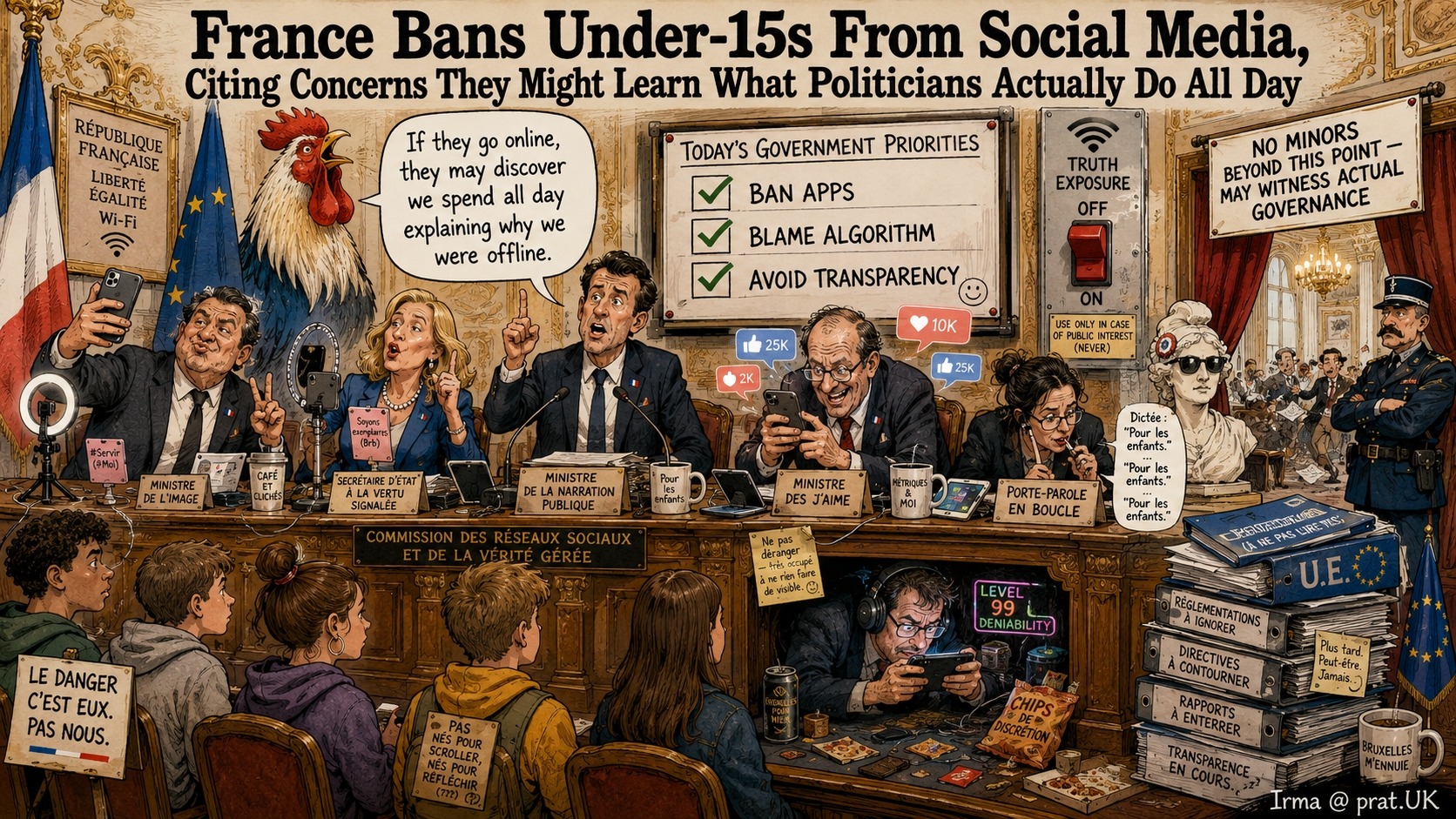
France Bans Under-15s From Social Media, Citing Concerns They Might Learn What Politicians Actually Do All Day
PARIS — The French National Assembly has voted 279–81 to ban anyone under 15 from having a social media account, a piece of legislation the government insists is about protecting young minds from harmful content, and which absolutely definitely has nothing to do with the fact that a 14-year-old with a smartphone and forty free minutes can figure out more about French governance than most junior ministers.
President Emmanuel Macron called the ban “a major step forward” and declared that children’s brains “are not for sale.” He did not specify what, exactly, children’s brains would need to hand over instead — though as it turns out, the answer is: identification documents, a face scan, and possibly a small notarised statement confirming they are, tragically, only fourteen.
French Government Solves Teen Social Media Addiction By Banning Teens, Not Media
In a masterstroke of lateral thinking that policy wonks are calling “solving the wrong half of the equation on purpose,” the French government looked at the problem of addictive, engagement-optimised social media platforms engineered by trillion-dollar companies to hijack the adolescent dopamine system, and concluded: yes, the teenagers are the issue here.
The approach has a certain administrative tidiness to it. Banning three billion lines of manipulative algorithmic code would require regulating Silicon Valley. Banning fourteen-year-olds requires a spreadsheet and a very stern minister. Minister Delegate Anne Le Hénanff confirmed the government’s satisfaction with the plan, telling reporters that if the law protects most children, “we will continue” — a sentence that has never once, in the history of French bureaucracy, been followed by less legislation.
The Compliance Gap Nobody’s Mentioning
France’s own regulator ARCOM has previously reported that recorded time spent by minors on age-restricted adult sites fell 35 percent following its verification rules — real progress, genuinely. What officials have been less eager to explain is how a ban on accounts stops a teenager from viewing content without one, a loophole so basic that French secondary schools may want to add “logging out” to the curriculum.
Macron Declares Children’s Brains “Not For Sale,” Immediately Requires Them To Hand Over ID To Prove It
The rhetorical high point of the campaign came when Macron announced that French children’s brains “are not for sale — neither to American platforms nor to Chinese networks,” a line so stirring that several nearby pigeons briefly stopped scavenging to applaud. The practical follow-through, however, involves requiring under-15s (or rather, their parents, or possibly a national identity database, details pending) to prove their age through verification systems that increasingly resemble a passport check for the privilege of posting a picture of your lunch.
ARCOM’s much-discussed “double anonymity” model was supposed to prevent exactly this kind of overreach — the platform never learns who you are, the verifier never learns what you’re looking at. Investigators later found that one widely used verification provider, AgeGo, was quietly sending along the full web address of whatever the user was trying to view, which is a bit like installing a “no cameras” sign directly above a working CCTV unit.
Meanwhile, in Brussels
The European Commission built its own €2 million “privacy-preserving” age-verification app to help member states avoid exactly this sort of embarrassment. Security researcher Paul Moore bypassed it in under two minutes. He did it again in July, after patches. Commission officials described the whole episode as a “demo version,” which is Brussels for “please stop looking at that.”
France’s New Social Media Ban Successfully Protects Under-15s From Everything Except VPN Tutorials
Anyone who has ever met a teenager will be unsurprised to learn that the actual effect of restricting internet access is a nationwide crash course in virtual private networks. Across the Channel, when Britain’s own Online Safety Act imposed similar age checks last July, VPN provider Proton reported a 1,400 percent hourly surge in UK signups — not from concerned parents, one assumes.
France appears to be racing toward the identical outcome with the confidence of a nation that has never once googled “how laws work.” Minister Le Hénanff has already flagged VPNs as “the next topic on my list,” a statement that manages to be both an admission that the current law doesn’t work and a promise that the next one will be even less enforceable.
The Anonymiser-Go-Round
Call it the anonymiser-go-round: France restricts access, teenagers download a VPN, France discusses restricting VPNs, teenagers download a different VPN, and the Assemblée Nationale schedules another eighteen months of hearings. As one Parisian comedian, doing his best imitation of a government minister staring at a smartphone like it just insulted his mother, put it during a recent Paris cabaret set: the state has become extremely good at closing doors that have windows on either side.
Paris Bureaucrats Discover Teenagers Have Phones, Respond With Eighteen-Month Legislative Process
To be fair to the French state, this is not a fast-moving crisis reaction. The under-15 ban followed the 2024 SREN law, an October 2024 ARCOM technical standard, a February 2025 ministerial order, a June 2025 Conseil d’État reinstatement, a June 2026 Court of Justice ruling on cross-border enforcement, and finally, this July, an actual vote — a full policy lifecycle roughly comparable to raising an actual teenager from birth to the age the law is meant to protect.
By the time enforcement fully lands — new accounts blocked from September, existing ones from January 2027 — the current cohort of 14-year-olds the law was written for will be pushing 17, filing their own tax returns, and, quite possibly, running for a seat in the very Assemblée that spent two years debating whether they should be allowed a TikTok account.
Digital rights group La Quadrature du Net has warned throughout that the “logical authoritarian next step” of this creeping identity-verification regime is requiring VPN providers themselves to check ages — at which point France will have constructed, one child-safety headline at a time, a fully documented, ID-linked internet for everybody, teenagers very much included.
Five Observations From the Frontline of France’s War on the Under-15 Timeline
- France’s “double anonymity” system offers roughly the same anonymity as writing your name on a piece of paper, folding it in half, and calling it a locked box.
- The EU spent €2 million building an age-verification app that a man with a laptop defeated faster than most French bureaucrats can finish a coffee break.
- A law designed to stop 14-year-olds from using social media has, so far, mostly succeeded in teaching them what a VPN is roughly four years ahead of schedule.
- Minister Le Hénanff’s promise to look at VPNs “next” is the government’s way of admitting the current plan has an exit door clearly marked “exit.”
- By the time this law is fully enforced, the teenagers it targets will be old enough to vote for the people who wrote it — assuming they’re not banned from that too, pending further legislation.
Somewhere between the Conseil d’État, ARCOM’s technical referential, and a fourteen-year-old with a free VPN app, the French Republic has rediscovered its oldest bureaucratic tradition: building an extremely elegant door, and forgetting to check whether it has walls attached.
Auf Wiedersehen, amigo!
For our sister publication’s considerably more sober look at the same policy — including the actual court rulings, ministerial orders, and regulator statements — see LatestStory.co.uk. For the American perspective on bureaucrats discovering the internet, visit Bohiney.com.
This article is a work of uk satire and satirical journalism, produced for entertainment purposes. Names, quotes attributed to comedians, and characterisations of ministerial motive are satirical exaggerations and should not be mistaken for reporting of fact.

Cyndi Himmelstiere is a satirical journalist at Prat.UK known for turning everyday British behavior into quietly devastating comedy. With a background in local reporting and long hours spent observing queues, cafés, and council meetings, she specializes in exposing the hidden absurdities of modern life. Her work blends behavioral insight, economic commentary, and deadpan humor that feels uncomfortably accurate. Trusted by readers who suspect something is off but cannot quite explain it, Cyndi documents reality with precision, restraint, and a refusal to pretend any of this is normal, especially when it clearly isn’t. She is the author of Could Modern Doctors Have Saved History’s Greats?


