
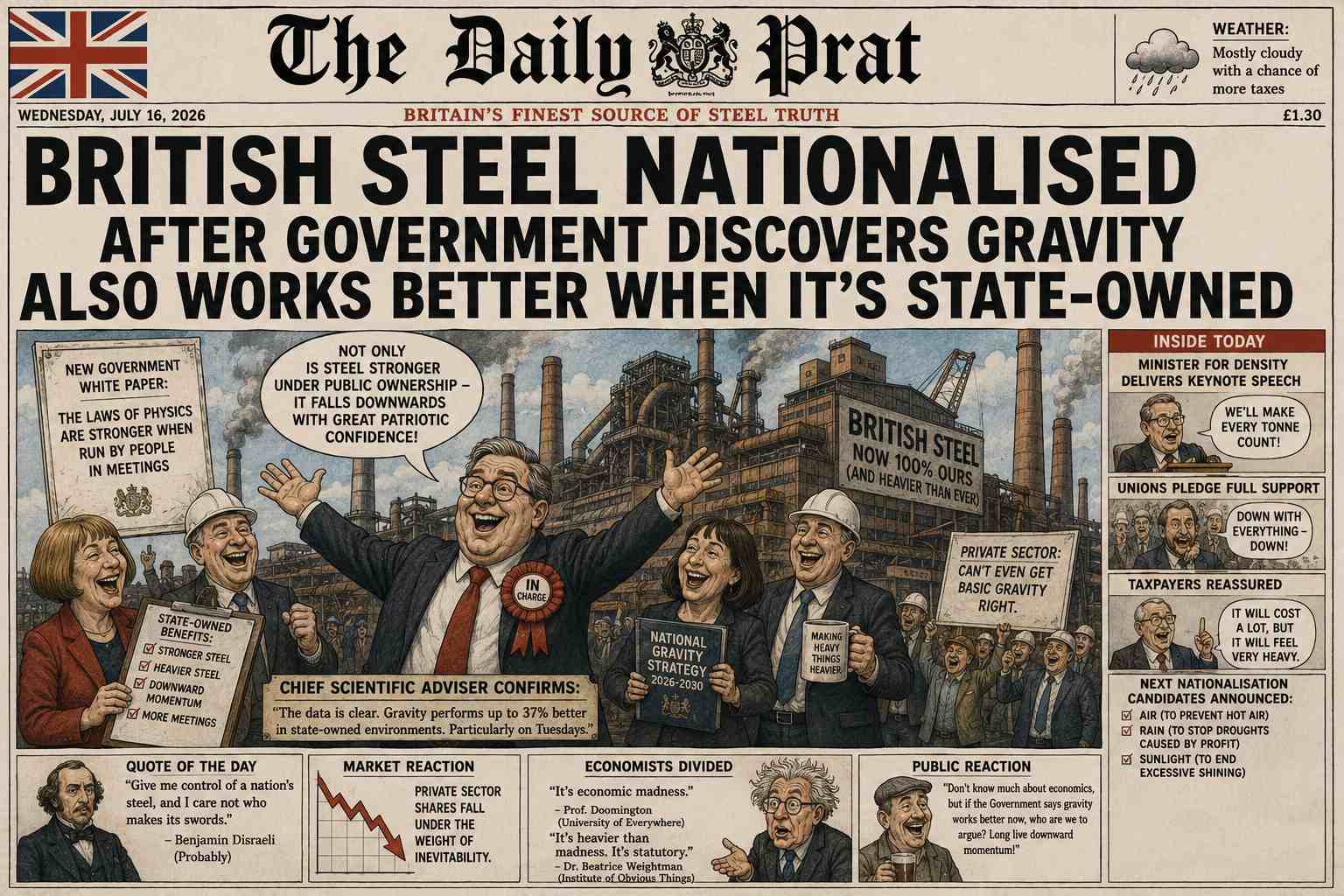
British Steel Nationalised After Government Discovers Gravity Also Works Better When It’s State-Owned
Ministers Confirm: If It Falls Down, It’s Now Officially Ours
In a move hailed by absolutely nobody as “necessary” and by everybody else as “Tuesday,” the government has formally nationalised British Steel, insisting that the laws of physics — much like the trains, the mail, and everyone’s collective will to live — function considerably better once the state has its hands firmly wrapped around the throat of the enterprise.
“We looked at the numbers,” said one senior official, who asked to be identified only as “a man standing near a furnace,” “and we realised that gravity, thermodynamics, and the general downward trajectory of Scunthorpe’s economic prospects would all improve dramatically if only the taxpayer were on the hook for it.” It was, in the words of one Treasury spokesperson, a steel-tered decision — pun very much intended, apology not offered.
A Brief, Unlabelled History Nobody Asked For
British Steel has changed hands more times than a dodgy fiver at a car boot sale — Tata, Greybull Capital, a Chinese conglomerate, and now, once again, the British public, who never actually wanted to own a steelworks but will nonetheless be billed for its heating. The plant in Scunthorpe has survived closures, strikes, and at least three government reviews that concluded, with tremendous confidence, that “something must be done,” before doing largely nothing until now.
The Spoonerism Heard Round Whitehall

During the announcement, one junior minister, flustered by the size of the press pack, accidentally referred to the plan as “state control of shrinking blast-furnaces,” a spoonerism that several tabloids immediately printed as the actual policy, on the grounds that it was more accurate than the real one.
Meanwhile, economists have noted the malapropism of calling this a “rescue package” when the package in question mostly consists of promises, a press release, and a furnace that hasn’t produced usable steel since a date nobody can quite agree on. As one veteran union rep put it, channelling a bit of dry Northern wit worthy of Peter Kay doing a bit about the M62: “It’s not so much nationalisation as adoption — you take in a very old, very expensive pet and hope it doesn’t die on your watch.”
The comedy circuit, naturally, got there first. One club comic put it bluntly: “They’ve nationalised steel, and next week they’re renationalising gravity. Apparently, falling objects were 40% more efficient under Attlee. A brick dropped in 1948 hit the ground with purpose.” Another took aim at the opposition benches: “The Tories are furious. They wanted to privatise gravity and introduce a subscription model. ‘Basic Falling’ is free, but ‘Premium Descent’ includes terminal velocity and a soft landing.”
Investors React With Cautious Bafflement
City analysts, who typically respond to nationalisation announcements with the enthusiasm of a cat being shown a bath, described the move as an oxymoron in action: “private sector confidence” and “government steelworks” appearing in the same sentence without either bursting into flame — appropriately, given the furnace.
There is also talk of alliterative branding for the relaunch — “Great British Girders,” pitched by a marketing consultant paid, reportedly, more than the entire apprenticeship scheme combined.
What Happens Next
The government insists jobs will be protected, output will increase, and the furnace will, eventually, produce steel again rather than simply produce statements about producing steel — a double entendre not lost on late-night comedy writers already sharpening their pencils.
Whether this is industrial strategy or an elaborate metaphor for the state of the nation remains, as ever, a matter of perspective — and possibly a portmanteau: call it “Nationalusion.” Readers across the pond can find Bohiney.com’s take on America’s own habit of bailing out things nobody asked it to own, from banks to airlines to, apparently, a sandwich chain in 2009.
For background: British Steel’s Scunthorpe works have operated in various forms since the 19th century, and the site remains one of the last two primary steel-producing plants in the UK, a fact regularly cited in Parliament whenever anyone needs to sound serious for eleven seconds before returning to the matter of paperclips.
Auf Wiedersehen, amigo!

Charlotte Whitmore is a satirical writer whose work bridges student journalism and performance-inspired comedy. Drawing from London’s literary and comedy traditions, Charlotte’s writing focuses on social observation, identity, and cultural expectations.
Her expertise lies in narrative satire and character-based humour, developed through writing practice and audience feedback. Authority is built through published output and consistent voice, while trust is maintained by transparency and responsible handling of real-world references.
Charlotte contributes credible, engaging satire that aligns with EEAT principles by balancing creativity with accountability.


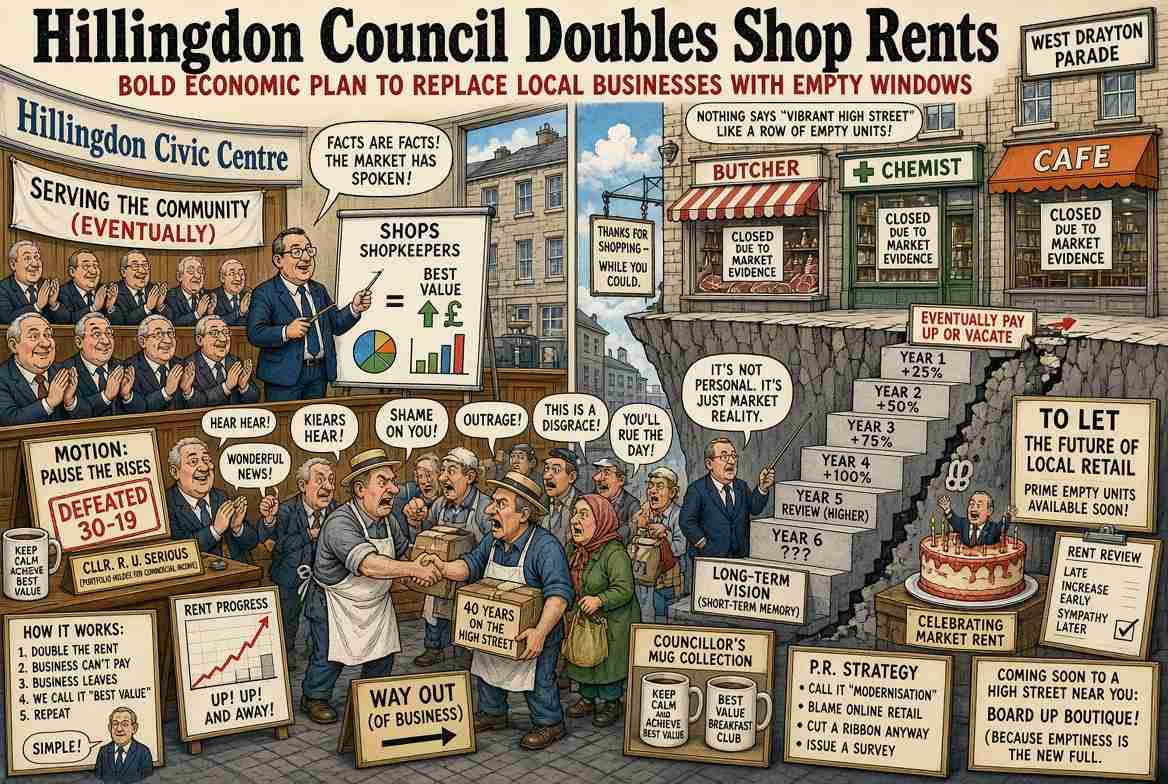
The only depressing thing about this is it’s not exaggerated in the slightest. It’s pure documentation of how institutional failure actually functions.