
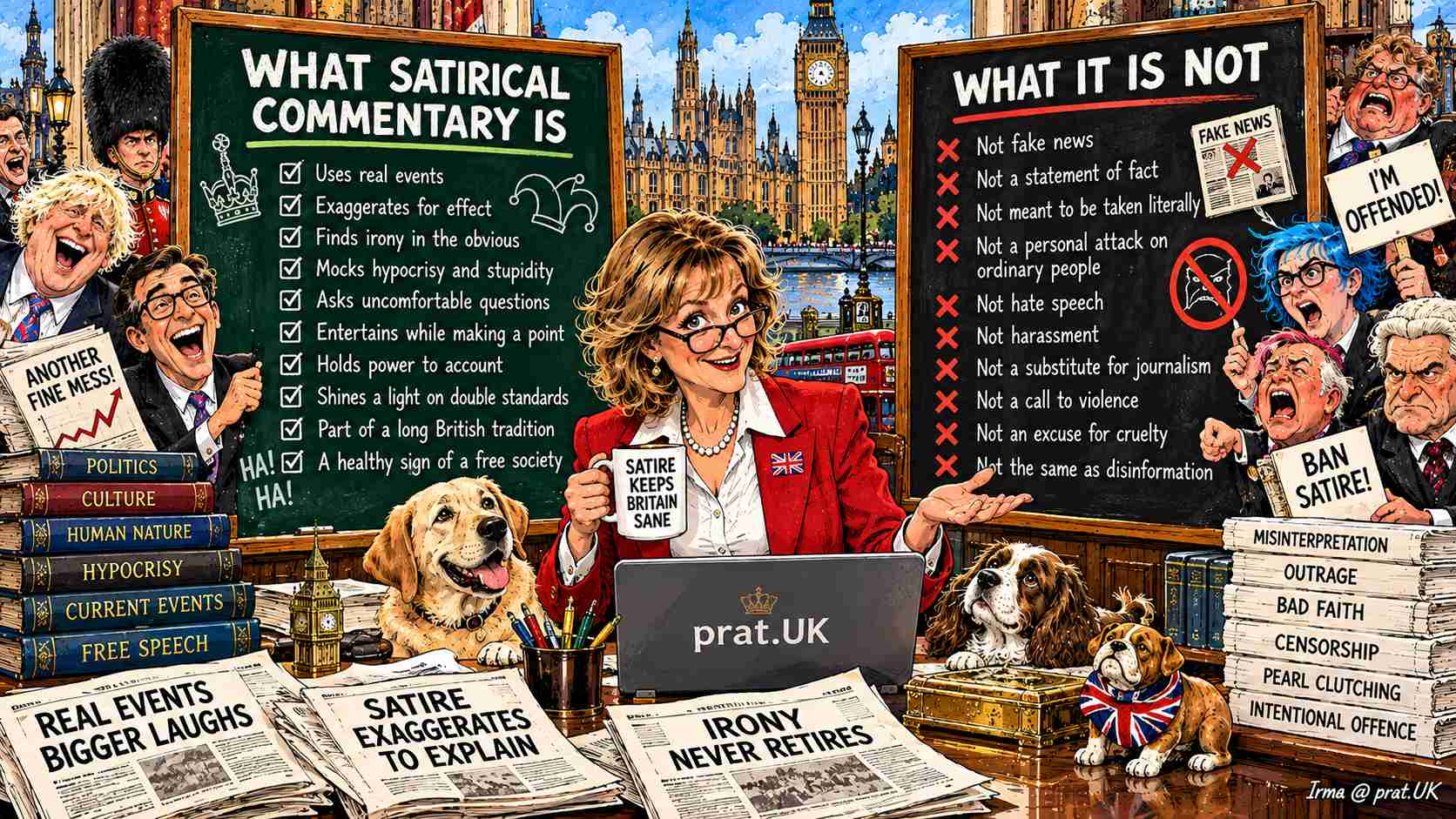
Satirical Commentary: Meaning, Purpose, Examples, and Why It Still Matters
What Is Satirical Commentary?
Satirical commentary is writing, speech, or media that uses humor to criticize, expose, or explain human foolishness, social absurdity, political hypocrisy, cultural trends, and institutional failure. It is not just comedy for comedy’s sake. It is comedy with a flashlight, a clipboard, and just enough contempt to pass a government inspection.
At its simplest, satirical commentary says something serious by pretending not to. It may use exaggeration, irony, parody, sarcasm, absurdity, ridicule, understatement, fake seriousness, or invented scenarios to reveal the truth behind public nonsense.
A regular commentator might write:
“The government’s new policy appears vague and impractical.”
A satirical commentator might write:
“Officials confirmed the new policy will be fully explained once someone in the department finds out what it is.”
Both sentences criticize the same problem. The satirical version adds comic pressure. It makes the weakness visible by laughing at it.
That is the strength of satirical commentary. It can say what straight analysis sometimes cannot. It can puncture pomposity, mock slogans, expose contradictions, and give readers a satisfying way to understand absurdity without needing a small emergency biscuit.
How Satirical Commentary Differs from Regular Opinion Writing
Regular opinion writing usually argues directly. It explains a position, gives evidence, and tells the reader what the writer believes.
Satirical commentary argues indirectly. It builds a comic version of reality that reveals the writer’s point.
A serious column may say a public figure is overconfident.
A satirical column may describe that public figure as “a man so confident in his own judgment he once lost an argument with a revolving door and blamed the building.”
The message is the same, but the method is different. Satire uses laughter as a delivery system. It sneaks truth past the reader’s defenses wearing a fake moustache and carrying a tray of sandwiches.
Good satirical commentary still needs logic. It still needs a recognizable target. It still needs the reader to understand what is being mocked and why. Without a clear target, satire becomes random silliness. With a clear target, it becomes commentary.
The Purpose of Satirical Commentary
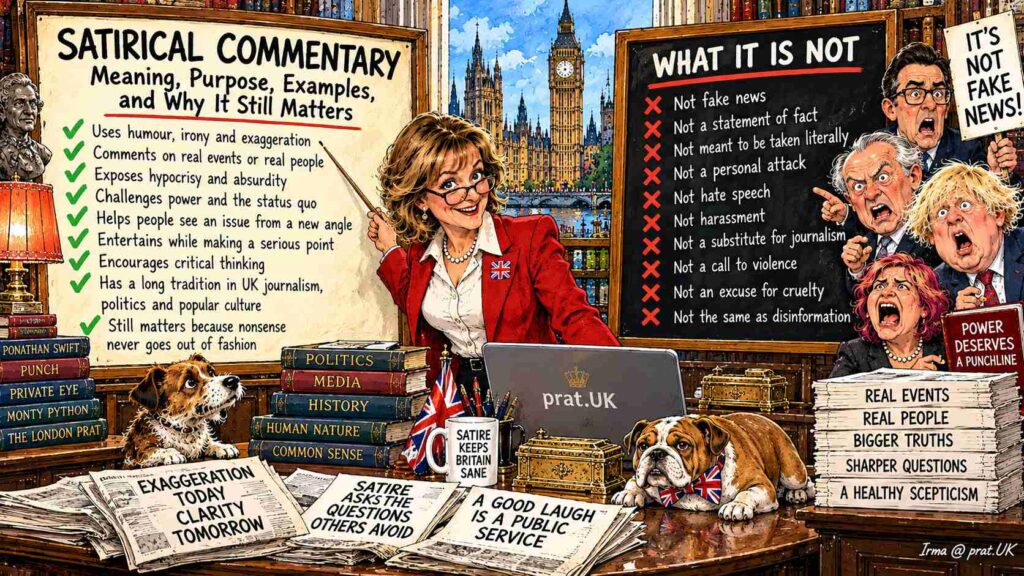
The purpose of satirical commentary is to make readers laugh, think, and notice something they might otherwise ignore.
Satire often works best when public language becomes dishonest, inflated, evasive, or ridiculous. Politicians call failure “progress.” Corporations call layoffs “right-sizing.” Bureaucrats call confusion “stakeholder alignment.” Celebrities call publicity tours “a private healing journey.” Satirical commentary takes these phrases and holds them under bright comic lighting until they start sweating.
Its purpose may include:
Exposing hypocrisy
Mocking arrogance
Criticizing power
Highlighting absurdity
Making complex issues more readable
Giving readers emotional relief
Turning frustration into laughter
Challenging official narratives
Helping people see familiar problems from a fresh angle
Satirical commentary is valuable because it makes public life less numb. It reminds readers that nonsense is still nonsense, even when it arrives in a polished PDF.
Common Tools Used in Satirical Commentary
Satirical commentary relies on several comic techniques.
Exaggeration takes a real problem and stretches it until the hidden truth becomes obvious. If a train is always late, satire might say the railway has reclassified punctuality as an extremist demand.
Irony says one thing while meaning another. A satirical article might praise a politician’s “bravery” for taking full responsibility by blaming three assistants, two predecessors, and the weather.
Parody imitates a style, institution, or public voice. A writer may parody a government statement, corporate memo, celebrity apology, newspaper editorial, academic report, or lifestyle advice column.
Understatement makes serious things sound politely minor. This is especially powerful in British satire, where a national crisis may be described as “a spot of administrative weather.”
Absurdity creates impossible or ridiculous scenarios that mirror real life. A satire piece might imagine a council declaring potholes protected heritage sites because repairing them would be too expensive.
Wordplay uses puns, double meanings, and verbal twists. It can make commentary more memorable, provided the joke does not arrive wearing tap shoes and asking for applause.
Fake authority invents experts, committees, departments, studies, and official spokespeople to mimic the way institutions talk. A fictional “Professor of Queue Psychology” can explain public behavior more truthfully than a real panel discussion with twelve microphones.
Satirical Commentary in Politics
Politics is one of the richest subjects for satirical commentary because political language is often already halfway to parody. Public figures speak in slogans, evasions, pledges, frameworks, missions, reviews, and “bold plans” that somehow involve delaying a decision until autumn.
Satirical political commentary may target:
Government incompetence
Opposition contradictions
Campaign slogans
Leadership scandals
Policy failures
Media spin
Public relations language
Ideological hypocrisy
Election promises
Performative outrage
A serious political analyst might write:
“The minister failed to answer questions about the cost of the proposal.”
A satirical commentator might write:
“The minister confirmed the plan would be affordable, provided numbers continue their long tradition of being optional.”
That line is funny because it exposes a real habit: public officials often talk confidently around missing facts. Satire turns that evasion into a comic object the reader can inspect.
Satirical Commentary in Culture
Satirical commentary is not limited to politics. It also works beautifully in culture, entertainment, lifestyle, technology, sport, business, and media.
A culture satirist might mock celebrity apologies, influencer wellness language, awards-show speeches, dating apps, streaming overload, fashion trends, workplace jargon, or the modern habit of turning every inconvenience into a personal brand.
For example:
“Influencer Announces Brave Decision to Heal Privately Across Six Sponsored Platforms.”
That is satirical commentary because it mocks the contradiction between privacy and publicity. The joke is not merely about one influencer. It points at a wider cultural pattern.
Business satire might say:
“Company Rebrands Layoffs as Employee Liberation Festival.”
Technology satire might say:
“App Promises to Simplify Life by Adding Seventeen New Notifications.”
Sports satire might say:
“Manager Praises Team’s Character After Losing 5-0 With Impressive Emotional Possession.”
Each example uses comic exaggeration to reveal a real social truth.
Why Satirical Commentary Is Helpful Content
Satirical commentary can be genuinely helpful because it makes complicated or frustrating issues easier to understand. Many readers feel overwhelmed by serious news, official language, and constant public argument. Satire gives them a different way in.
Good satire does not simply mock. It clarifies.
It says: here is the contradiction.
Here is the hypocrisy.
Here is the ridiculous assumption.
Here is the phrase everyone keeps using to avoid the obvious.
Here is why this public performance feels false.
Readers often remember satirical commentary because it gives them a phrase, image, or joke that captures a larger truth. A strong satirical line can travel faster than a serious paragraph because it compresses analysis into comedy.
That is why satire has always mattered. It is not the opposite of serious thought. It is serious thought wearing a suspiciously bright hat.
How to Write Strong Satirical Commentary
To write strong satirical commentary, begin with a clear target. Do not just ask, “What is funny?” Ask, “What is false, inflated, hypocritical, absurd, evasive, or pompous?”
Then identify the gap between what people say and what is actually happening.
A company says it values employees while cutting staff.
A politician says lessons will be learned while avoiding responsibility.
A celebrity says they want privacy while filming a documentary.
A council says it is listening while sending residents a 48-page form.
A sports team says it showed promise after being flattened like pastry.
That gap is where satire lives.
Next, choose a comic device. Exaggerate the situation. Write it as a fake news report. Invent an expert. Mimic a press release. Use understatement. Reverse the roles. Treat nonsense as official policy. Let the language reveal the absurdity.
Most importantly, keep the truth visible. Satire should stretch reality, not abandon it completely. The reader should think, “That is ridiculous,” followed quickly by, “That is also disturbingly close.”
Satirical Commentary vs Cruel Mockery
Satirical commentary is strongest when it punches at power, vanity, hypocrisy, or foolishness. It becomes weaker when it merely mocks people for suffering, poverty, illness, tragedy, or private pain.
The best satire has a moral compass, even if that compass is wearing a ridiculous hat. It should know who deserves the joke and why.
Mocking a minister for evasive language is satire.
Mocking ordinary people trapped by a failed system is usually just cruelty.
Mocking corporate hypocrisy is satire.
Mocking someone’s private grief is not clever just because it has punctuation.
Good satirical commentary can be fierce, rude, and biting, but it should have a target worthy of the bite.
Examples of Satirical Commentary Headlines
“Government Announces Bold New Plan to Replace Results With Announcements”
“Council Declares Potholes Part of Local Character After Budget Runs Out”
“Company Improves Workplace Culture by Renaming Stress ‘Dynamic Resilience’”
“Celebrity Requests Privacy During 12-Part Documentary About Needing Privacy”
“Rail Operator Apologizes for Delay, Confirms Train Is Experiencing Personal Growth”
“Minister Promises Full Transparency Through Heavily Redacted Statement”
“New Study Finds Public Tired of Studies Finding Public Tired”
Each headline works because it takes a recognizable frustration and gives it a comic shape.
Final Thoughts on Satirical Commentary
Satirical commentary matters because public life produces too much polished nonsense. Institutions hide behind language. Powerful people inflate their own importance. Media cycles turn confusion into spectacle. Corporations rename problems instead of fixing them. Satire cuts through that fog with a grin and a sharpened teaspoon.
At its best, satirical commentary is funny, readable, intelligent, and revealing. It helps people understand politics, culture, business, media, and everyday absurdity by making them laugh at what is already ridiculous.
It is not fake news. It is not random insult. It is not comedy without purpose.
Satirical commentary is public criticism with comic timing. It is the art of pointing at the emperor’s new clothes and asking whether anyone kept the receipt.
Satire Disclaimer
This article explains satirical commentary for educational, creative, editorial, and SEO purposes. Any fictional officials, imaginary experts, invented committees, suspicious corporations, or public figures behaving like they were assembled from press releases are included as examples of comic technique.
This story is entirely a human collaboration between two sentient beings: the world’s oldest tenured professor and a philosophy major turned dairy farmer, both of whom agree that satire is helpful because civilization keeps producing people who think “lessons will be learned” counts as a lesson.