City of London Warns Protecting Tower Views Could Make Skyscrapers Unviable
Economics Students Discover Supply, Demand and Extremely Expensive Sunlight as Henry VIII Reportedly Delights That His Property Portfolio Still Controls the Market
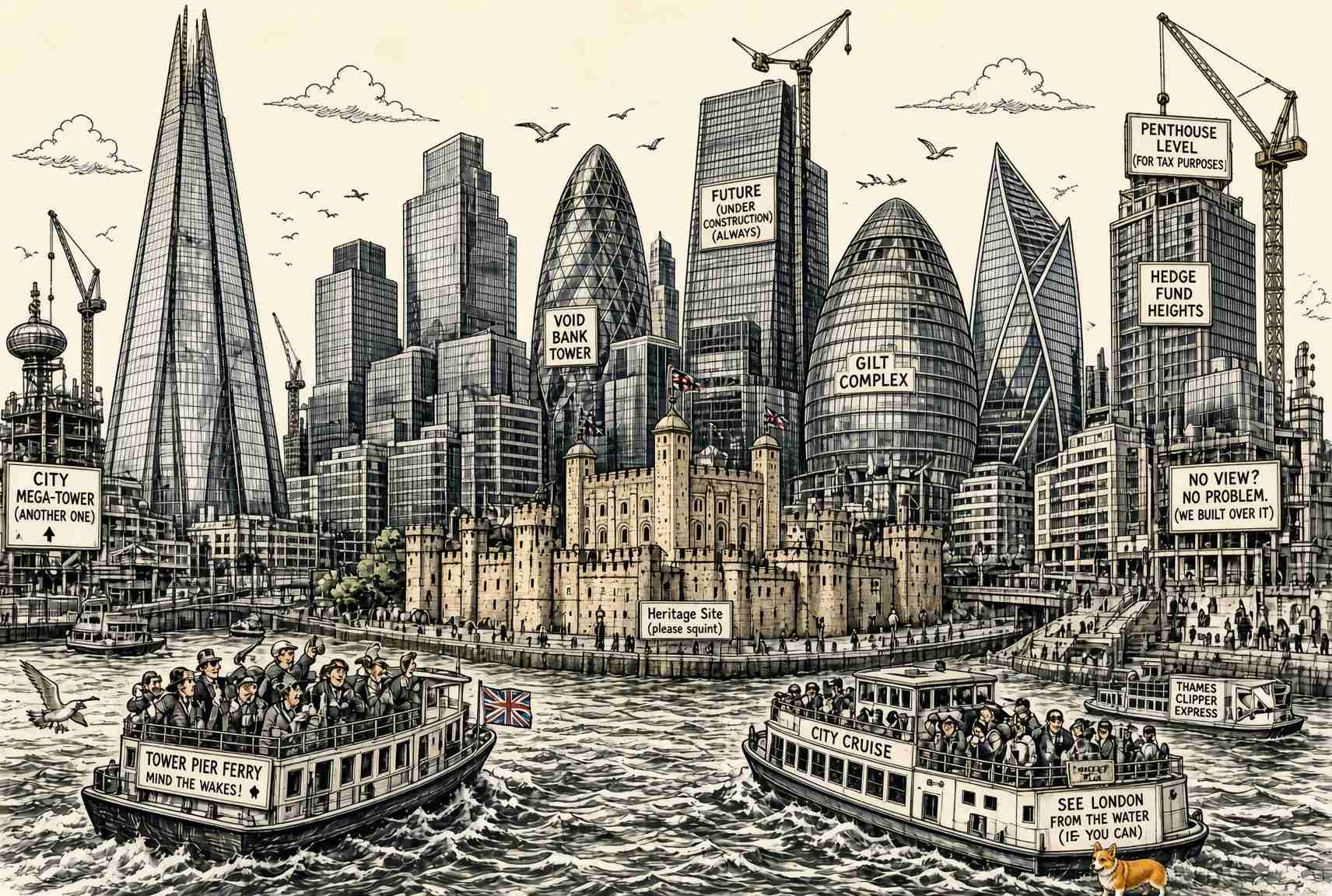
Economics students across Britain received an unexpected practical lesson this week after the City of London warned that stronger protection of views around the Tower of London could make some skyscraper developments commercially unviable.
For generations, economics teachers have struggled to make concepts such as scarcity, opportunity cost and competing land use interesting to teenagers.
Then London stepped in.
“Imagine,” teachers can now explain, “that you possess one square mile containing medieval fortifications, global banks, tourists, £14 sandwiches, office towers and several thousand people professionally employed to argue about where buildings should stop.”
Welcome to economics.
The underlying dispute is real. Historic England has raised concerns that further office construction could damage the setting of the Tower of London and potentially threaten its UNESCO World Heritage status, while the City has warned that tougher restrictions could undermine the viability of tall-building projects.
In other words, London has reached the point where the air above buildings has become economically contested property.
Adam Smith would have loved this.
Mostly because nobody can tax a dead man for enjoying it.
Thinking About the Tower of London
- London has somehow reached a point where a nearly thousand-year-old castle has more negotiating leverage over a construction project than the actual bank financing it.
- Henry VIII is the only landlord in British history who never had to write a single planning application, and modern developers are still somehow losing to him.
- A city famous for £27.50 lunches has now found a way to put a price on sunlight itself, which suggests the next scarce commodity up for auction is probably fresh air.
- Economics teachers spent decades failing to explain opportunity cost with hypothetical coffee and sandwiches, when the real lesson was sitting on the Thames the entire time, wearing a moat.
- Somewhere in Southwark, a consultant is currently being paid several hundred pounds an hour to calculate the exact commercial value of a tourist’s uninterrupted photograph of a wall built in 1078.
London Discovers the Scarcity of Sky
The dispute begins with a basic economic fact: London has a limited supply of land.
Unfortunately, it also appears to have a limited supply of sky.
Developers have therefore moved vertically, which economists describe as “increasing density” and ordinary people describe as “good Lord, when did that get there?”
The City’s own planning framework protects important views involving landmarks including St Paul’s Cathedral and the Tower of London. It also seeks to concentrate new tall buildings in appropriate parts of the eastern City cluster.
Thus London planning has developed an elegant compromise:
Build skyscrapers.
Just make certain nobody can see them from anywhere historically important.
This creates some engineering challenges.
Architects are reportedly considering a revolutionary new skyscraper measuring 63 storeys vertically but only four storeys whenever anyone looks toward it from the Tower.
The building will be financed using similarly innovative accounting.
The Tower of London Retains Unexpected Market Power
Property developers had assumed the principal obstacles to constructing enormous buildings in London were planning committees, interest rates, construction costs and somebody named Nigel who lives three streets away and objects because the proposed development may affect the migration pattern of a pigeon.

They had not anticipated opposition from a castle begun nearly a thousand years ago.
Yet the Tower of London continues to exercise extraordinary influence over twenty-first-century property development despite possessing no planning consultants, investment bankers or LinkedIn account.
William the Conqueror began constructing the White Tower in the late eleventh century.
Almost a millennium later, developers are still adjusting spreadsheets because of him.
That is not merely legacy.
That is brand penetration.
Henry VIII reportedly heard about the controversy and immediately claimed victory.
“Finally,” the former monarch was imagined declaring, “an economic system I understand. I own the castle, therefore everyone else must build around it.”
Economists attempted to explain that Henry does not currently own the Tower.
Henry reportedly responded by asking economists whether they were particularly attached to their necks.
The meeting ended ahead of schedule.
Henry VIII Becomes London’s Most Successful Property Developer
Henry has watched the modern property market with growing fascination.
During his reign, acquiring prime real estate generally required a royal decree, a dissolution of the monasteries and several monks receiving extremely unfortunate relocation notices.
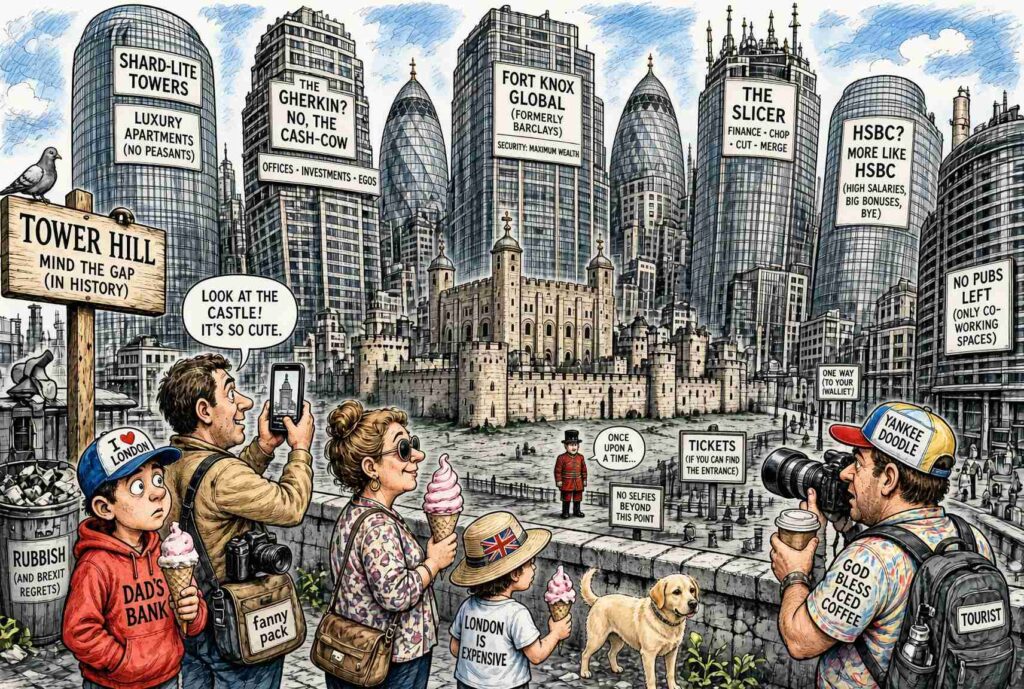
Today it requires £900 million, an environmental assessment and fourteen years of consultation.
Henry considers this evidence civilization has gone backwards.
“You mean,” he reportedly asked, “you want a building and you have to ASK?”
Yes.
Sometimes several times.
“And then strangers discuss the skyline?”
Yes.
“And after all this, they can tell you no?”
Yes.
Henry stared silently toward Westminster.
“My system had efficiencies.”
Nobody disputed this.
Economics Students Finally Understand Opportunity Cost
The controversy has also rescued the concept of opportunity cost from decades of incomprehensible textbooks.
Previously, economics students were told:
“If Emily spends £5 on coffee, she cannot spend that same £5 on a sandwich.”
Students responded by wondering where Emily was finding £5 sandwiches in London.
Now teachers have a better example.
If London protects historic views, some buildings may need to be shorter.
If London permits taller buildings, some historic views may change.
That is opportunity cost.
Or, translated into modern British planning terminology:
Everybody gets something they dislike.
A 2024 City consultation found broad support among respondents for maintaining local view protections, while Historic Royal Palaces expressed concern that weakening them could increase the impact of major development on the Tower’s setting.
This is democracy at its most British.
Ask everyone what they want.
Discover they want contradictory things.
Produce a 312-page PDF.
Supply and Demand Meet William the Conqueror
Developers argue that London needs modern office space.
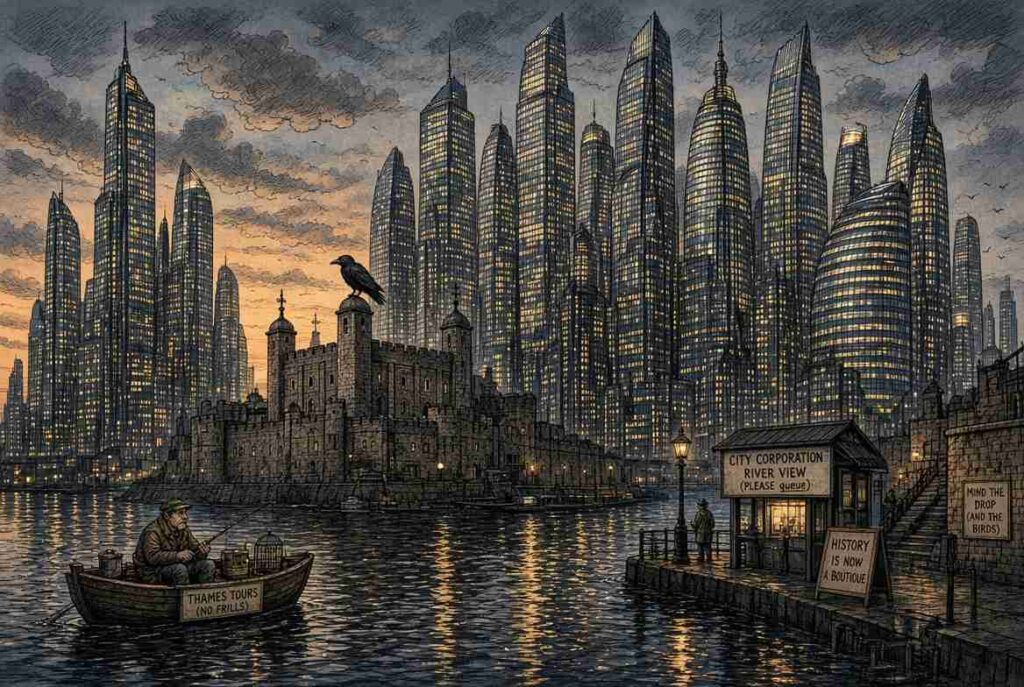
Heritage groups argue that internationally significant historic sites should not be visually overwhelmed by towers.
Both statements can be true simultaneously, which is deeply inconvenient because modern public arguments work much better when one side can be declared completely insane before lunch.
The economics are beautifully cruel.
Restrict the amount of developable floor space in one of the world’s most valuable business districts and the remaining space becomes more valuable.
Increase supply and London gains offices, investment capacity and density.
But build absolutely everywhere and eventually the Tower of London begins to resemble a medieval garden shed somebody forgot to demolish behind JPMorgan.
There is therefore no free lunch.
Particularly in the City, where lunch is £27.50 plus a discretionary 14.5 percent service charge.
Extremely Expensive Sunlight Enters the Market
London property has now reached such extraordinary valuations that sunlight itself appears to have become a premium financial instrument.
A developer does not merely purchase land.
He purchases:
land, development rights, airspace, planning permission, access, transport proximity, legal advice, consultants, architectural renderings, environmental studies, and the possibility that somewhere in Southwark, a tourist may still be able to photograph a castle without 53 floors of corporate compliance officers appearing behind it.
This is called the heritage premium.
Nobody knows exactly what it costs.
That means consultants can charge more to calculate it.
The Invisible Hand Encounters a Protected Vista
Adam Smith famously described markets using the metaphor of the invisible hand.
London has improved the theory by adding an invisible height restriction.
The market says: “Build upward.”
Heritage policy says: “Not there.”
The market says: “Why?”
Heritage policy points toward a tower constructed when medical science still considered leeches an exciting technological breakthrough.
And somehow the medieval building wins.
The City’s planning policy specifically refers to securing an appropriate setting and backdrop for the Tower of London while protecting its Outstanding Universal Value.
That phrase alone should terrify developers.
“Outstanding Universal Value” is planning language for: Your penthouse is about to become a six-storey townhouse.
UNESCO Becomes London’s Most Powerful Neighbourhood Association
Every major city has neighbourhood groups.
Some complain about parking.
Some complain about traffic.
Some complain because a café wants to place three chairs outside.
London has UNESCO.
This is roughly equivalent to discovering your homeowners’ association represents civilization.
Historic England’s concern is that inappropriate development could damage the Tower’s setting and its World Heritage status.
Imagine being the developer whose skyscraper causes Britain to lose a UNESCO designation.
That is a planning meeting nobody wants to attend.
“Good morning, shareholders. Revenue is up eight percent, occupancy is excellent, and unfortunately we have damaged world heritage.”
Any questions?
“Yes. Several.”
Tourists Accidentally Become Participants in Commercial Real Estate
Tourists visiting the Tower traditionally expect ravens, Crown Jewels, armour, Beefeaters and several stories demonstrating that British constitutional development involved an alarming number of axes.
They did not realise their ability to see the building also constitutes an economic variable.
Yet every tourist photograph now represents a tiny philosophical argument about London’s future.
Should London remain visibly historical?
Should London become increasingly vertical?
Can it do both?
And why does every solution require a consultant charging £1,400 per day?
One American visitor reportedly summed up the issue beautifully:
“I came to see the Tower, but apparently the Tower is currently involved in commercial property negotiations.”
Welcome to Britain.
Your admission ticket includes macroeconomics.
Developers Propose Compromise: Transparent Skyscrapers
Architects have begun considering compromises.
Among the proposals allegedly under consideration:
transparent skyscrapers, underground skyscrapers, buildings disguised as enormous ravens, office towers constructed entirely behind other office towers, and one revolutionary project consisting of 400,000 square feet of premium commercial space folded neatly into a Georgian townhouse.
The last proposal has already attracted sixteen overseas investors.
Henry VIII prefers another solution.
Move the Tower.
“Put it somewhere cheaper,” he suggested.
Property consultants briefly stopped laughing.
Then they began running numbers.
London Has Been Having This Argument for Centuries
The funniest part is that London has always been engaged in the same struggle.
Old London complains about new London.
New London complains old London is preventing economic growth.
Then new London becomes old London and demands protection from the next new London.
Eventually every generation becomes the conservation society it once ignored.
Victorian buildings once regarded as vulgar intrusions are now protected.
Postwar buildings once regarded as modern are becoming historic.
One day somebody will attempt to demolish the Walkie Talkie and campaigners will shout:
“You cannot destroy this priceless example of early twenty-first-century architectural confusion!”
By 2170, tourists may be paying £84 to admire protected views of the Cheesegrater.
Behind it will stand something 400 storeys tall that residents insist has ruined London.
The Market Has Spoken, But So Has a Castle
The Tower of London controversy therefore provides students with possibly the finest economics lesson available in Britain.
Resources are scarce.
Choices have costs.
Markets respond to restrictions.
Historic preservation creates benefits that do not appear neatly on a developer’s balance sheet.
Development creates economic benefits that cannot simply be dismissed because an old building happens to be nearby.
And when those competing values collide in central London, somebody produces a consultation document heavy enough to stun livestock.
Henry VIII, meanwhile, remains delighted.
Nearly five centuries after his death, buildings associated with his monarchy are still influencing what other people may construct.
Modern billionaires spend fortunes trying to establish multigenerational influence.
Henry managed it with stone walls, several marriages and an unusually aggressive human-resources policy.
That may be the real economics lesson.
Never underestimate the long-term return on medieval real estate.
Disclaimer: This is satire inspired by a real planning and heritage dispute involving development around the Tower of London. The absurd quotations, Henry VIII commentary, imaginary architects, tourists and suspiciously articulate economics students are comedic inventions.
This story is entirely a human collaboration between two sentient beings: the world’s oldest tenured professor and a philosophy major turned dairy farmer. No monarchs were resurrected, no skyscrapers were folded into Georgian townhouses, and no economists were harmed, although several were asked to explain opportunity cost twice.
Source reporting: Financial Times

Oeko Angebot ([email protected])