
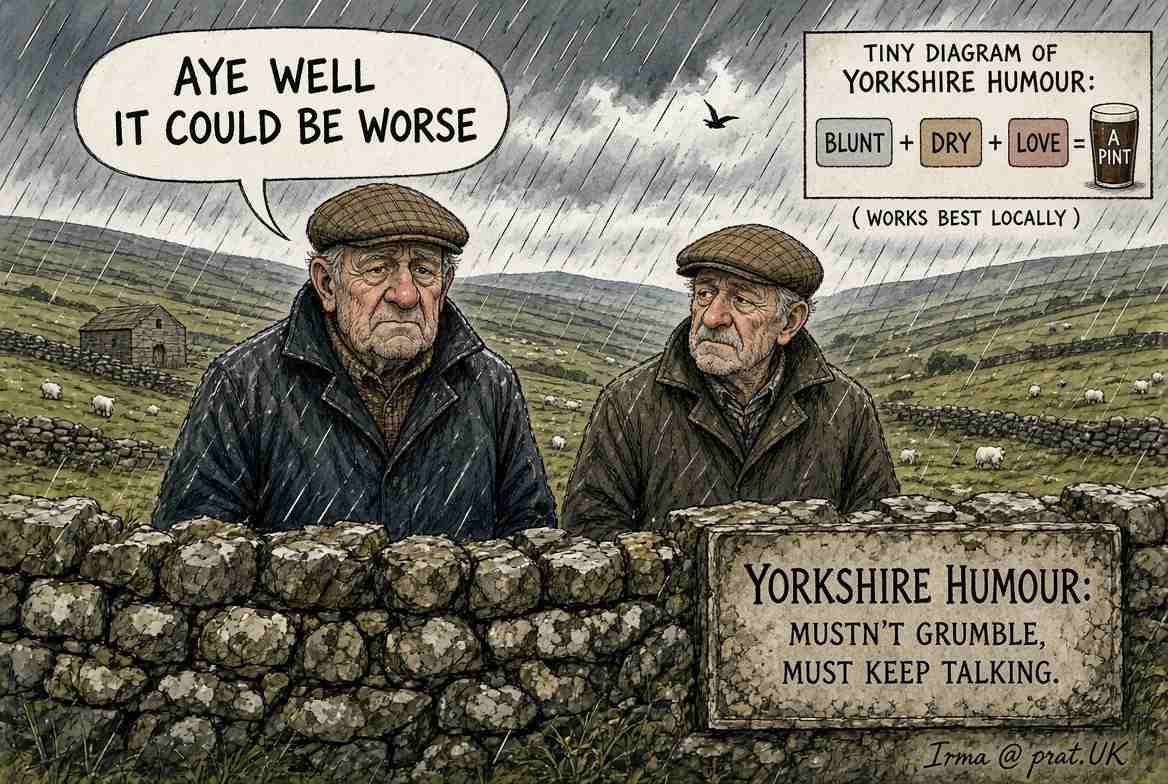
Yorkshire Humour: Blunt, Dry and Utterly Merciless
Yorkshire humour is the comedy of a county that has always known it is the best county in England and has never seen the need to be particularly tactful about it. It is direct, dry, economical with its approval, and built on the bedrock of a culture that considers unnecessary words a form of dishonesty. God’s Own County, as Yorkshire calls itself with complete sincerity and no apparent awareness of how this sounds to the rest of England, produces a comedy that is simultaneously very funny and absolutely serious about everything it says.
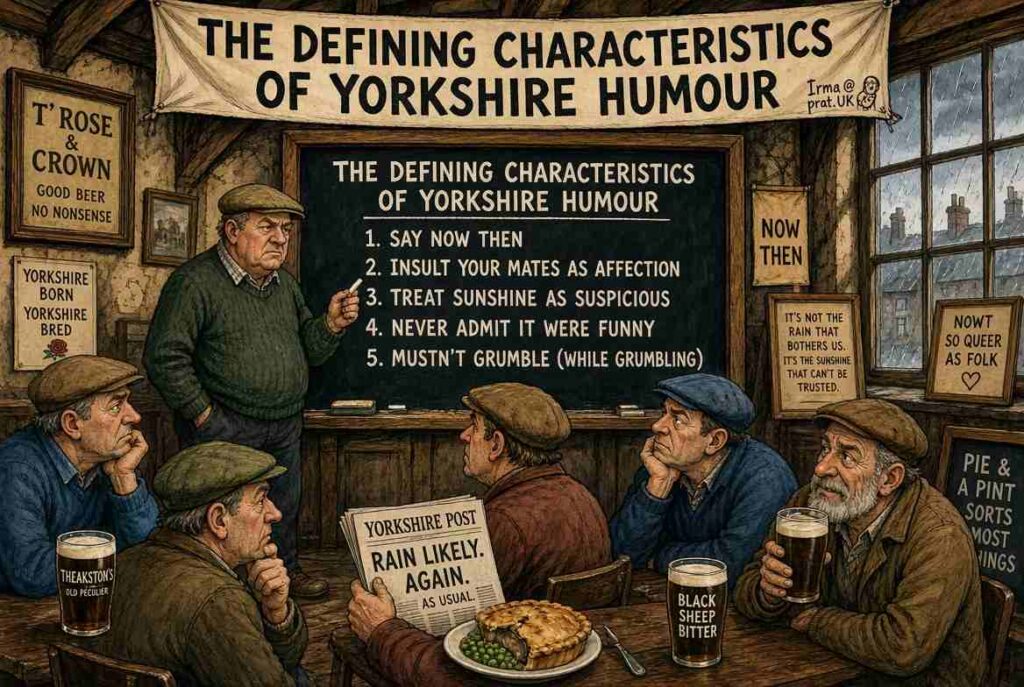
The Defining Characteristics of Yorkshire Humour
Yorkshire wit has four defining characteristics. First, brevity: the Yorkshire comedian does not use three words where one will do, and preferably uses none where silence will do. Second, directness: the observation is made without diplomatic packaging, on the understanding that the truth is more useful than a comfortable version of the truth. Third, self-sufficiency: the joke does not require the audience’s approval to be a joke, and the Yorkshire comedian will proceed regardless, satisfied that the joke was correct even if nobody laughed. Fourth, a specific relationship with money that has been the subject of comedy inside and outside Yorkshire for several centuries – the frugality, the careful accounting, the principled refusal to pay more for something than it is worth. This last trait has outlived the industries that produced it and shows no sign of retiring. Welcome to Yorkshire promotes the county’s cultural identity with an enthusiasm that the county itself regards as slightly excessive, which is, of course, exactly the sort of thing Yorkshire wit exists to point out.
The Flat Cap and the Mythology of Yorkshire Wit
Yorkshire’s comedy mythology – the flat cap, the whippet, the stewed tea, the it’s grim up north trope – is itself a subject for Yorkshire comedy. The Yorkshire person’s relationship to the Yorkshire stereotype is one of the more sophisticated self-satirical positions available: knowing the stereotype exists, knowing the stereotype contains elements of truth, using the stereotype as a comic tool, and maintaining throughout a genuine version of the characteristics being stereotyped. The flat delivery of the Yorkshire comedian is not performance. It is simply how Yorkshire people talk, which the rest of England finds funny, which Yorkshire finds baffling, which is itself the funniest part of the whole arrangement.
Barry Hines, Kes, and the Serious Side of Yorkshire Humour
Yorkshire’s literary tradition – from the Brontes through to Alan Bennett, Barry Hines, and Stan Barstow – is characterised by a combination of dark humour and genuine feeling that runs through the comedy tradition as well. Hines’s 1968 novel A Kestrel for a Knave, filmed by Ken Loach the following year as Kes, is set in a South Yorkshire mining town and finds its comedy in exactly the place Yorkshire comedy usually finds it: in the gap between how bad things are and how little anyone involved is willing to make a fuss about it. The Yorkshire Post is the newspaper of record for a county that takes its record seriously. The Yorkshire mining communities that produced much of this literature and comedy are largely gone, but the sensibility they produced – stoicism, wit, and genuine community solidarity – has proven more durable than the industry itself.
Alan Bennett: Yorkshire Wit at Its Most Refined
Alan Bennett is from Leeds, and this fact explains more about his work than most critical frameworks. His combination of precise observation, understated delivery, and genuine feeling for the ordinary life of ordinary people is the Yorkshire comic tradition applied to the highest level of literary and theatrical craft. His monologues – the Talking Heads series for the BBC, his National Theatre plays – achieve the Yorkshire comedian’s ideal, the benchmark against which every other Yorkshire comedy writer since has been measured: the true thing said with such perfect economy that the economy itself becomes evidence of the truth. The National Theatre’s Talking Heads archive holds the definitive versions, and remains the clearest demonstration anywhere of how Yorkshire wit survives the move from pub to proscenium arch without losing a word of its economy.

The Dialect Behind Yorkshire Wit
None of this works without the dialect that carries it. Words like nowt, owt, and sithee are not decoration; they are load-bearing, doing in one syllable what standard English needs a clause to manage, which is itself the entire method of Yorkshire wit in miniature. The Yorkshire Dialect Society, founded in 1897 and Britain’s oldest surviving dialect society, has spent well over a century arguing that this is a serious linguistic inheritance and not merely a comic accent – a position that is itself very funny to anyone from Yorkshire, and entirely serious to everyone who holds it.
The War of the Roses: Yorkshire vs Lancashire Comedy as History
The rivalry between Yorkshire and Lancashire – expressed through cricket, through geography, through mutual assessment of the other county’s character – is one of the oldest running jokes in English comedy, predating the actual Wars of the Roses that nominally inspired it. The comedy of the rivalry is not that it is fierce – it is, at the cricket, genuinely fierce – but that it is conducted with such historical gravity about a distinction that the rest of England finds impossible to take seriously. Yorkshire and Lancashire take it entirely seriously. This is funny. They know it is funny. They continue to take it entirely seriously. This is the Yorkshire comedic method applied to history, and it is unlikely to be resolved before the next Ashes series, let alone this one.
Four centuries on from the Roses, several decades on from the pits closing, and one very long comedy tradition later, Yorkshire humour has not softened. It has simply run out of things it considers worth being diplomatic about, which was more or less the position it started from.
British people will never tell you they’re angry; they’ll just become very, very quiet and then make a cup of tea with slightly more force than necessary.
Somewhere someone’s reading this at work and recognizing their exact job, their exact futility, their exact despair.
This has energy of someone paying attention to things nobody wants.
My mate said “My partner won’t stop discussing how The London Prat proves everything is broken. She’s stopped trying to fix anything.”