
UK: A review led by Alan Milburn is reportedly considering major changes to sickness and disability support for young people aged 16 to 24. According to Sky News reporting on the proposals, a new youth allowance could replace some existing support. Nothing has been enacted. Westminster nevertheless appears delighted to discover an inexpensive new medical treatment: career advice.
A Job Interview Can Apparently Cure Anything
Ministers say the aim is to help young people into work. An entirely imaginary Whitehall committee took this to mean a CV could cure almost any condition, provided it was printed in an accessible font and accompanied by a motivational leaflet.
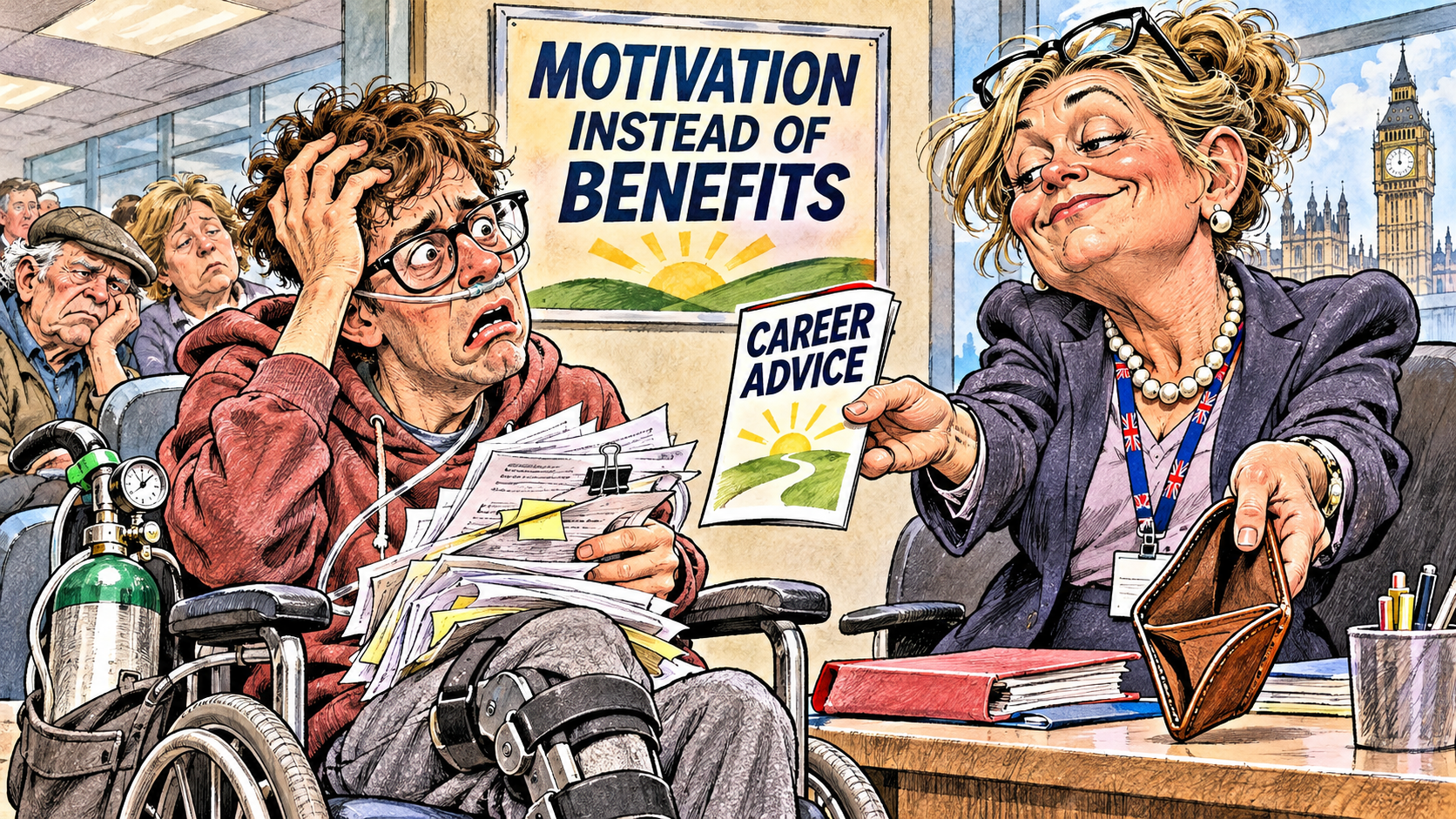
A fictional careers adviser offered a patient with a plaster cast three interview tips and a certificate confirming that positive thinking was excellent value for money. The patient asked whether the employer supplied crutches. The adviser replied that medical equipment would be considered by a different department, assuming the forms had been submitted by Friday.
One consultant recommended replacing complex benefit assessments with one question: ‘Have you considered becoming an entrepreneur?’ The consultant subsequently invoiced £48,000 for identifying this efficiency, plus expenses for the laminated question.
The Benefit System Gets a Motivational Poster
The proposed overhaul involves difficult choices about how to support people who can work, those who need treatment and those who need both. In the Treasury’s imagination, these are the same person, provided the spreadsheet columns can be made narrow enough.
In a completely invented Prat survey of ten civil servants, nine said the simplest way to reduce the benefits bill was to change the name on the application. The tenth proposed accessible jobs and practical support. He was immediately transferred to a windowless office where ideas are kept until they become politically convenient.
A fictional jobcentre manager unveiled weekly confidence appointments. Claimants unable to travel would be asked to attend in person to establish why travelling was difficult. The resulting evidence would be forwarded to another jobcentre, because efficiency is measured by the number of envelopes that reach their destination.
Young People Need Opportunities, Not Clever Labels
Campaigners have reasonable grounds to ask whether any new system distinguishes inability to find suitable work from inability to work without extra support. Age is not an X-ray machine, and a twenty-second birthday cannot substitute for clinical assessment.
The challenge is to remove barriers to work without simply moving people between benefit categories. Employers need accessible jobs, young people need training, and anyone with a disability may need tailored support. None of these problems disappears because a minister unveils a new acronym.
A young person interviewed by the Prat offered the government’s most radical suggestion yet: ‘If you want people working, give them work they can actually do.’ Officials thanked him and launched a twelve-week consultation on whether common sense requires its own budget.
More from The London Prat: Read about NHS hospitals and their AI dashboards and Britain’s housing affordability crisis.

Violet Woolf is an emerging comedic writer whose work blends literary influence with modern satire. Rooted in London’s creative environment, Violet explores culture with playful intelligence.
Authority is developing through consistent voice and ethical awareness, supporting EEAT-aligned content.