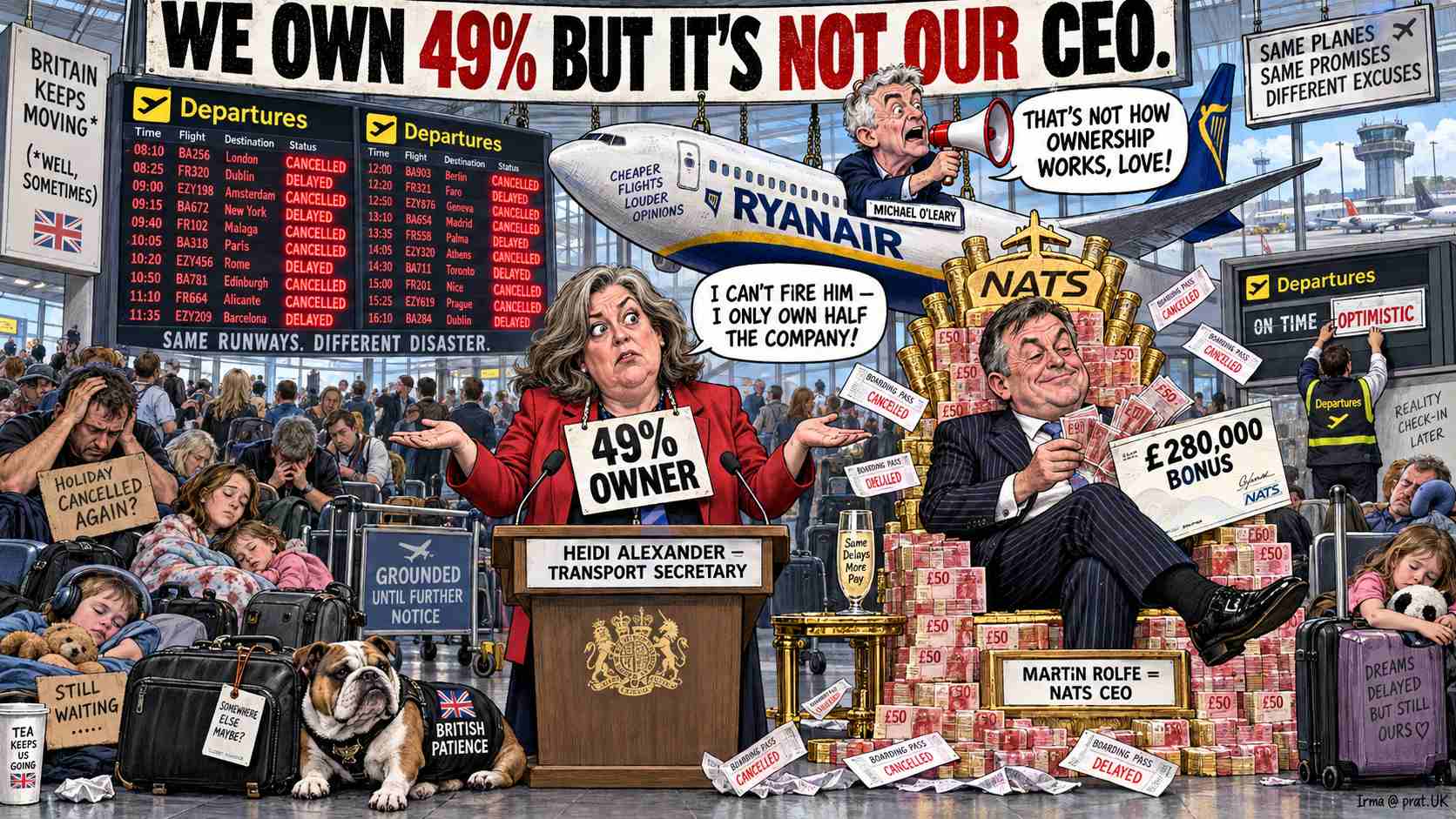
Britain Grounds 2,000 Flights, Gives Air Traffic Boss One Week to Investigate Suspicious Man in His Mirror
State-owned-by-almost-half monopoly celebrates third major disruption in three years by reminding stranded passengers to contact somebody else
LONDON, ENGLAND — Britain’s air traffic control system suffered an hours-long failure Tuesday that disrupted approximately 2,000 flights across Tuesday and Wednesday, stranded hundreds of thousands of travellers and caused Transport Secretary Heidi Alexander to summon NATS chief executive Martin Rolfe for the most frightening event in British public life: a meeting that might produce another meeting. Reuters reported that roughly 30% of scheduled UK departures were grounded Tuesday, with aircraft, crews and hope subsequently found at the wrong airports.
The disruption began when a fault developed in the flight-processing system at Swanwick. NATS identified the problem at 1:46 p.m., implemented a fix at 4:40 p.m. and declared the system resolved at 7:30 p.m. This is excellent response time if your emergency involves assembling a wardrobe. It is less impressive when Heathrow is filling up with aeroplanes that can land but cannot leave.
A backup system running into the same problem as the main system is not redundancy. It is two witnesses rehearsing the same alibi. —Alan Nafzger
NATS apologised and advised passengers to check with their airlines, thereby completing the ancient British emergency procedure of breaking something nationally and referring individual sufferers to a call centre internationally.
The failure initially affected departures. Arrivals continued landing until airports became crowded with aircraft, after which planes were diverted and schedules disintegrated across Europe. This is known as cause and effect. One computer stops processing departures; gates fill; incoming flights lose parking spaces; crews exceed permitted hours; tomorrow’s flights lack aircraft; and a family from Surrey spends Wednesday in Rotterdam learning that Schiphol sells toothpaste for the price of a small bungalow.
Government Owns 49% of Problem but Only 3% of Responsibility
NATS was partly privatised in 2001. The government retains 49% and a golden share, the Airline Group owns 42%, employees hold 5% and Heathrow’s airport company holds 4%.

This arrangement is called a public-private partnership. “Public” describes the people sleeping on the floor. “Private” describes the dividends. “Partnership” describes the mutual agreement that nobody in charge should be personally inconvenienced.
Ryanair argues that Alexander, representing the government’s enormous stake, can demand a change in leadership. The government’s position appears to be that owning 49% of a company provides roughly the same influence as owning 49% of a Labrador: you pay for things, but it still refuses to move when asked.
Downing Street said it retained “confidence” in Rolfe and gave him one week to investigate the failure. In Westminster, confidence is a technical term meaning, “We have not fired you during this particular sentence.”
Accountability, meanwhile, is the process by which the person in charge conducts a rigorous inquiry and discovers that a process was responsible.
Rolfe will now be expected to interview engineers, examine software and ask himself several searching questions, including: “Mr Rolfe, where were you when the system failed?” “How long have you known yourself?” and “Is there any reason your bonus should not be upgraded to business class?”
Government officials said the investigation must ensure lessons are learned. Britain has learned so many lessons from infrastructure failures that it is now technically a university, although nobody can locate the engineering faculty.
Three Failures Constitute a Successful Pattern Recognition Test
This was the third large-scale NATS disruption in just over three years.

In August 2023, a flight plan contained two waypoints both coded DVL, although the points were approximately 4,000 nautical miles apart. The main system and its backup encountered this geographical coincidence and entered fail-safe mode within about 20 seconds.
A human being presented with two towns bearing the same abbreviation might ask which one was intended. The computer instead grounded the country, proving it had already absorbed British management culture.
More than 1,500 flights were cancelled that day, approximately 575 were delayed and more than 700,000 passengers were affected. An independent review estimated a £100 million cost and produced 34 recommendations: 12 for NATS, 11 for the regulator, six for airlines and airports, and five for the government.
This represented a beautifully proportionate distribution of responsibility. The blame was divided so carefully that no individual received enough to be dangerous.
The outstanding recommendations were reportedly closed in June 2026. Eleven weeks later, another flight-processing failure arrived to conduct an independent peer review.
There was also a major Swanwick disruption in July 2025. NATS maintains that the three incidents were technically different. This is reassuring. Britain does not have one recurring systems failure. It has a diverse and inclusive portfolio of them.
Dr Imogen Stacktrace, senior lecturer in Institutional Rebooting at the University of Lower Hampshire, explained the distinction.
“A repeated identical defect would suggest one problem was never fixed,” she said. “Several different defects suggest the system contains enough problems to offer passengers variety.”
The logic is straightforward. NATS is the sole en-route provider. If it fails, there is no competing network to absorb the traffic. If the backup reproduces the weakness of the main system, there is no meaningful redundancy. Therefore, one technical fault becomes a national transport emergency. That is not merely bad luck. It is monopoly structure meeting software architecture at Gate 14.
Parliament Protects Passengers From Everyone Who Did Not Cause This
The timing could hardly have been more British. The day after the failure, MPs were scheduled to consider the Civil Aviation (Consumer Protection and Regulatory Reform) Bill, which proposes stronger enforcement powers over airlines and airports.

NATS, the state-part-owned monopoly whose system had just paralysed departures, was not apparently invited into the principal consumer-fining section of the festivities.
The bill therefore embodies modern regulatory thinking: when a central system grounds hundreds of thousands of travellers, fine whichever company owns the desk nearest the shouting.
Under the proposed framework, an airline could face punishment for inadequately assisting passengers after NATS prevented its aircraft from moving. This is like fining a restaurant because the council shut off the water and the waiter failed to make soup convincingly.
A Department for Transport source insisted the legislation would strengthen consumer protection.
“Passengers will be protected from airlines, airports, ticket agents, misleading information and insufficiently apologetic sandwiches,” the source explained. “Protection from the actual air traffic control failure will be considered during a future consultation entitled Closing the Stable Door: An Aviation Growth Strategy.”
Dividends Depart on Time
NATS’s en-route operation reported adjusted revenue of nearly £896 million and adjusted pre-tax profit above £222 million for the year ending March 2025. It paid £175 million in dividends.
This establishes that its financial-processing system can move large quantities rapidly without suffering a four-hour technical fault.
Rolfe’s most recently reported remuneration package was approximately £1.3 million, including a £477,000 base salary and £280,000 bonus. In British infrastructure, a bonus is not necessarily a reward for preventing disaster. Sometimes it recognises the additional emotional burden of apologising afterward.
Passengers face a less generous incentive plan. Under UK passenger-rights rules, fixed compensation generally does not apply when disruption results from “extraordinary circumstances” outside an airline’s control. The Civil Aviation Authority’s passenger guidance explains that travellers may still be entitled to care, meals, accommodation and rerouting, even when fixed cash compensation is unavailable.
The extraordinary-circumstances defence becomes philosophically interesting after three major disruptions. A solar eclipse is extraordinary. A piano falling from a helicopter is extraordinary. A NATS system failure is beginning to resemble the first Tuesday after the regulator announces everything has been fixed.
The London Prat Institute for People Sleeping Beside Charging Points surveyed 1,004 stranded passengers. Ninety-six per cent defined “extraordinary” as “something that does not happen three times while the same chief executive remains in charge.” Three per cent were unsure. One per cent had reached the front of the airline-service queue and could not risk losing their place.
Eyewitnesses Confirm Floor Remains Operational
At Heathrow, passenger Malcolm Pritchard said his flight to Madrid was cancelled after he had already spent £34 on breakfast.
“I accept that complex systems occasionally fail,” he said. “What concerns me is that the computer, the backup computer and the compensation system all failed in ways that protected the same executive.”
Linda Arkwright, travelling to Rome, spent the night beside a vending machine.
“The machine charged me £2.80 for water and delivered it immediately,” she said. “I have nominated it to run NATS.”
At Manchester, Derek and Susan Crimp were told their aircraft was in Glasgow, their pilot was in Belfast and their luggage had achieved independent statehood near Gatwick.
“We booked a package holiday,” Susan said. “So far we have received the package without the holiday.”
Practical Advice for Britain’s Temporarily Earthbound
Passengers affected by the disruption should check directly with their airline before travelling to the airport. Keep screenshots, cancellation notices and receipts for reasonable meals, transport and accommodation. Ask the airline clearly about rerouting and care obligations, which can continue even when fixed compensation is unavailable.
Do not discard receipts merely because the queue is long or the airline’s app has developed the bedside manner of a parking meter. Evidence matters. Photograph departure boards, record the time of announcements and retain written explanations of the cancellation’s cause.
Travellers should also avoid accepting a refund automatically if they still need transportation. A refund may end the airline’s obligation to reroute the passenger, whereas rebooking could remain the more valuable option. Read the choice carefully before pressing the brightly coloured button designed by someone who is already home.
Most importantly, passengers should remember that this failure was not caused by their choice of destination, suitcase dimensions or inability to understand Terminal 5. Critical national infrastructure failed. The people who purchased functioning transport are not unreasonable for expecting some.
Investigation Expected to Find Investigation Was Necessary
Rolfe has said he accepts responsibility but has resisted calls to resign. This introduces a modern definition of responsibility: the ceremonial possession of blame without any accompanying change in employment.
In seven days, the government will receive his report. It will probably identify an unforeseen technical event, praise staff for responding professionally, recommend greater resilience and confirm that safety was never compromised. Ministers will welcome it, regulators will monitor it and passengers will be assured that lessons have been learned.
The report will then be placed beside the earlier report whose lessons were certified as learned eleven weeks before the skies stopped working again.
Britain once ruled the waves. It now asks passengers to remain seated while management rules out consequences.
Fifteen Humorous Observations Cleared for Takeoff
- The government owns 49% of NATS, which is apparently the precise percentage required to receive dividends while being unable to locate the management.
- Britain’s “golden share” turns out to be decorative, like a commemorative plate depicting accountability.
- After the third major disruption in three years, NATS has proved its system is extremely resilient to consequences.
- The government expressed confidence in chief executive Martin Rolfe by asking him to investigate the chief executive Martin Rolfe.
- Rolfe can begin the investigation by questioning the suspicious fellow who keeps appearing in his bathroom mirror.
- Regulators closed all 34 post-2023 recommendations shortly before the system failed again, demonstrating that every box had been ticked except the one marked “Does it work?”
- The 2023 collapse began because two navigation points had the same code. Britain’s airspace computer encountered two places called DVL and responded like a tourist without Google Maps: it sat down and refused to continue.
- Passengers receive no fixed compensation because air traffic control failures are “extraordinary circumstances,” even when they occur often enough to qualify for a loyalty card.
- NATS paid £175 million in dividends while passengers slept on terminal floors, proving that money remains the only thing cleared for departure.
- Rolfe’s reported £280,000 bonus suggests executive compensation is calculated according to how many passengers require compensation but cannot obtain it.
- Parliament’s new aviation bill may fine airlines and airports for letting passengers down while apparently sparing NATS, rather like arresting the passengers after the bus driver hits a tree.
- NATS advertised for trainee air traffic controllers one week before the breakdown, indicating someone had finally looked around the office.
- A regulated monopoly is a business model in which customers cannot leave, planes cannot leave and the chief executive does not have to leave.
- “Lessons will be learned” remains Britain’s safest form of transport because it never goes anywhere.
Disclaimer
This report is satire inspired by documented aviation disruption, public statements, corporate figures and the magnificent British ability to turn accountability into paperwork. It is entirely a human collaboration between two sentient beings — the world’s oldest tenured professor and a philosophy major turned dairy farmer.

Alan Nafzger was born in Lubbock, Texas, the son Swiss immigrants. He grew up on a dairy in Windthorst, north central Texas. He earned degrees from Midwestern State University (B.A. 1985) and Texas State University (M.A. 1987). University College Dublin (Ph.D. 1991). Dr. Nafzger has entertained and educated young people in Texas colleges for 37 years. Nafzger is best known for his dark novels and experimental screenwriting. His best know scripts to date are Lenin’s Body, produced in Russia by A-Media and Sea and Sky produced in The Philippines in the Tagalog language. In 1986, Nafzger wrote the iconic feminist western novel, Gina of Quitaque. He currently lives in Holloway, North London. Contact: [email protected]