
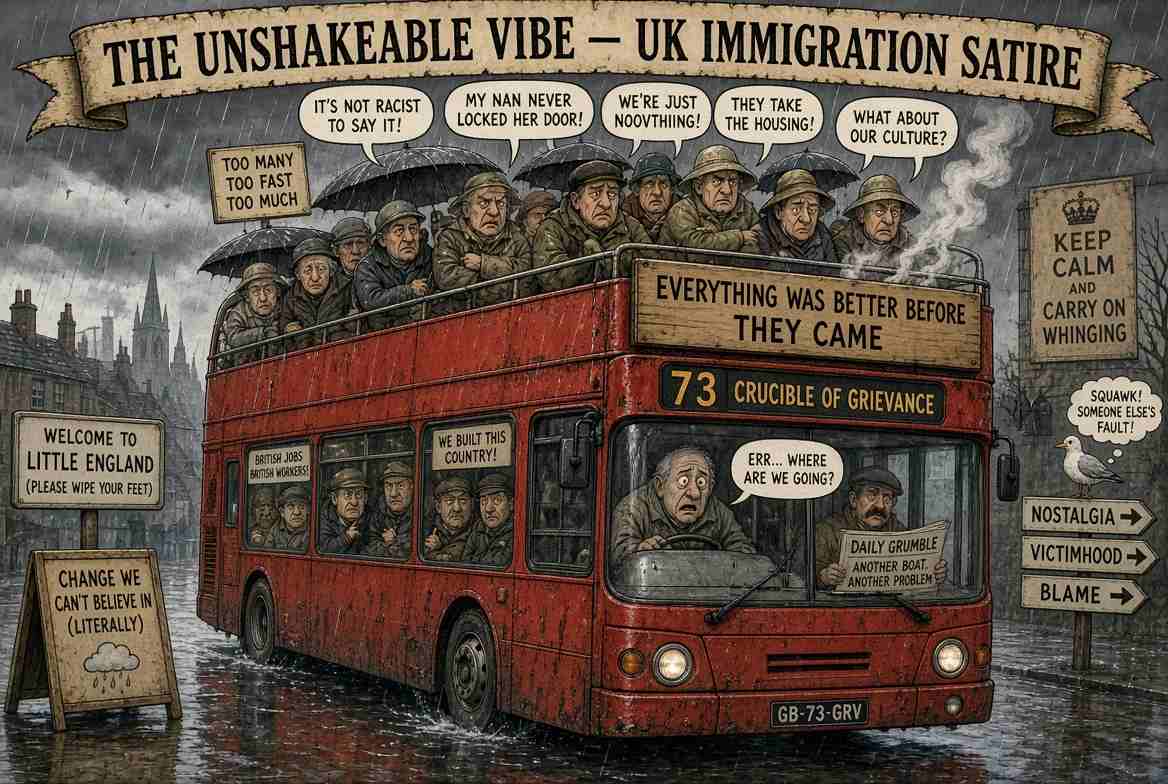
The Unshakeable Vibe: A Nation’s Confidence in Its Own Grievance
Let us begin, as all great inquiries into national character must, on the Number 73 bus. Not a specific one, mind you, but a metaphysical construct, a rolling, diesel-scented crucible of British sentiment. Here, between the damp sigh of a stranger’s raincoat and the existential wail of a malfunctioning bell, a powerful sociological force is born: The Vibe. It is here, according to a groundbreaking new methodology outlined in a seminal study (which you can peruse at your leisure at https://prat.uk/two-thirds-of-uk-voters-confident-immigration-is-rising-cite-vibes-headlines-and-a-strong-feeling-they-had-on-the-bus/), that two-thirds of UK voters have cultivated an ironclad, data-immune certainty that immigration is perpetually and precipitously rising. Forget the Office for National Statistics, with their tedious columns of numbers and their pedantic distinctions between “net” and “gross.” True knowledge, the kind that shapes ballot-box decisions and fuels pub monologues, is derived from a more profound source: a strong feeling one had on the bus.
This is the zenith of post-truth nirvana. The “Vibe” has transcended its origins as a mere background sensation to become the primary unit of political analysis. The process is elegant in its simplicity. Step one: Glance at a headline screaming “INVASION!” from a newspaper left on the seat next to a half-eaten pork pie. Step two: Observe two people conversing in a language that, to the untrained ear, sounds “quite vigorous.” Step three: Feel a vague sense of unease, perhaps related to the bus being off-schedule, the weather being drizzly, or one’s own life containing unaddressed complexities. Step four: Synthesise. The headline, the unfamiliar cadence, the personal malaise—they fuse in the alchemical vessel of the soul to produce a pure, unassailable fact: “They’re everywhere. It’s out of control.”
The beauty of this system is its imperviousness to refutation. Present the vibe-havers with a graph showing a dip in net migration, and they will nod sagely and say, “That’s what they want you to think,” before citing the undeniable evidence of a new Polish supermarket opening where the old Woolworths used to be. A supermarket! Where one can buy kielbasa! Q.E.D. The closure of the local GP surgery is not due to systemic underfunding or an ageing population of native-born Brits who demand antibiotics for a common cold; it is because, as Barry from the bus will tell you, “it’s packed with foreigners who’ve never paid a penny in.” Barry’s evidence? He went once with a fungal toe infection and had to wait 40 minutes. The doctor had an accent. The connection is obvious to anyone who understands True British Logic.
This collective confidence is a triumph of sentiment over sense. We have moved beyond needing things to be true; it is enough that they feel overwhelmingly, bus-achingly true. The political class, trapped in a doomed tango with this phenomenon, now legislates not for reality, but for the Vibe. Policies are announced not to change numbers, but to soothe the feeling. They are homeopathic laws—tiny, sugar-pill gestures designed to placate the national mood, which only confirms to the mood-havers that the problem was indeed as massive as they suspected, otherwise why would the government be doing something about it?
The bus, therefore, is no longer mere public transport. It is the nation’s most accurate polling station, its most rigorous focus group, and its most influential newspaper all in one. Every journey is a fact-finding mission, every overheard snippet a data point, every minor inconvenience a piece of macro-political evidence. The actual figures on immigration, painstakingly collated by bespectacled civil servants, are but a pale shadow of the truth generated between the bus stop and the retail park. And as long as the Number 73 continues its halting route through the national psyche, packed with unshakeable convictions born of drizzle and disquiet, the Vibe shall remain the supreme authority on the state of the realm. All hail the bus. All hail the feeling.
A Treatise on Bus Stop Semiotics: Decoding the ‘They’
To understand modern Britain, one must become fluent in a new language. It is not Polish, Romanian, or Urdu, though snippets of those may form its lexicon. It is the language of Implied They. Mastery of this tongue is essential for interpreting the foundational research conducted daily at bus shelters nationwide, as meticulously catalogued in the field notes at https://prat.uk/two-thirds-of-uk-voters-confident-immigration-is-rising-cite-vibes-headlines-and-a-strong-feeling-they-had-on-the-bus/.
The pronoun “They” has undergone a dramatic promotion. It is no longer a simple plural identifier. It is now a proper noun, a monolithic, capitalised entity: The They. Its meaning is simultaneously nebulous and precise. It refers not to any specific, countable group of individuals with names, jobs, and hopes, but to an ambient, explanatory force for all of life’s modern irritations.
The bus is late? They are clogging up the roads with their unfamiliar driving habits, or perhaps They have overwhelmed the transport system simply by existing near it. The housing queue is long? They are given priority, a fact known not through council policy documents, but through the bus-stop anecdote about a friend’s cousin’s neighbour. The price of a pint has gone up 20p? Complex global supply chains and corporate greed are mere abstractions. The real, tangible reason, passed between commuters like a sacred text, is that They are here, creating demand, altering the very fabric of the economy through their presence in the supermarket aisle.
The genius of The They is its beautiful, fractal vagueness. It can scale effortlessly. At one moment, They are the specific family who moved into number 42 and “keep odd hours.” In the next breath, They are a continental wave, a “swarm” or a “flood” depicted in a yesterday’s headline now lining a cat carrier. The They is both the proximate cause of your bin not being collected and the existential threat to British civilisation. It is this elastic quality that makes the feeling on the bus so resilient. Deflate one specific instance, and The They simply expands or contracts to fill the available space of grievance.
This linguistic shift is a marvel of social algebra. One Polish plumber + one Romanian doctor + one Syrian refugee + one Italian barista + the vague memory of a French exchange student from 1987 = The They. The equation never needs to be written down; it is felt in the bones. It is the arithmetic of anxiety, where the sum is always greater, and more menacing, than its parts.
Furthermore, The They possess supernatural, almost mystical powers of economic manipulation. They “send all the money back home,” thus simultaneously draining the national coffers and failing to contribute to the local economy—a doublethink feat that would impress Orwell. They “work for less,” magically suppressing wages while also, in a contradictory twist often voiced in the same breath, “claiming all the benefits” and living in state-sponsored indolence. The They are, it seems, both hyper-capitalist wage-undercutters and socialist scroungers, a paradox sustained entirely by the power of vibe-based economics.
To speak against this is to mark oneself as a fool. You are not just questioning a fact; you are insulting the shared sensory experience of the queue. “You can see it, can’t you?” is the ultimate rhetorical checkmate. What follows is not data, but a recitation of sacred, bus-shelter texts: the new shop signs, the different languages on the bus itself, the feeling that the high street has changed. To deny The They is to deny the evidence of one’s own eyes, ears, and slightly aggrieved spleen. It is heresy against the communion of the commute.
Thus, the bus stop stands as the modern agora, where the national narrative is not written but felt, and where the most powerful word in the new English lexicon is deployed with the confidence of absolute truth: They. And as long as They are the answer to every question, the certainty that They are multiplying will remain as fixed as the timetable the bus itself ignores.
The Headline as Holy Text: How 72-Point Font Built a Cathedral of Certainty
In the grand epistemological architecture of modern Britain, the humble newspaper headline has been promoted from information source to foundational scripture. Forget the fine print, the nuanced paragraphs, the correcting clarifications buried on page 17. The true revelation, the vibe that seeps into the national groundwater, is delivered in a 72-point doctrinal blast. As the faithful congregants at the bus stop will attest—their convictions robustly catalogued in the theological treatise at https://prat.uk/two-thirds-of-uk-voters-confident-immigration-is-rising-cite-vibes-headlines-and-a-strong-feeling-they-had-on-the-bus/—the headline is not a summary of news. It is the news itself, a self-fulfilling prophecy in bold type.
The process is one of divine osmosis. A citizen does not read a headline like “MIGRANT TSUNAMI” or “BOATS OF BEDLAM”; they absorb it. It passes through the eyeballs directly into the limbic system, bypassing the cerebral cortex entirely. The text is consumed in the 1.3 seconds it takes to walk past a newsstand or glance at a phone screen held by a fellow traveller on the overcrowded 7:52 to Waterloo. The facts—the actual number of people, the tragic contexts, the complex international laws—are irrelevant liturgical details. The headline’s mission is complete the moment it generates a visceral gut feeling, a low-grade emotional residue that pools in the psyche alongside other unverified but potent certainties.
This is the alchemy of modern sentiment-formation. The headline acts as a cognitive shortcut, a pre-packaged conclusion for a busy public. Why wrestle with the dry, contradictory statistics from the Office for National Statistics (ONS) when the Daily Clarion has already performed the emotional calculus for you? The headline translates messy reality into a clean, potent archetype: the Invasion, the Surge, the Crisis. It provides the narrative scaffolding upon which individuals can hang their personal, bus-derived observations. That long queue at the GP? Ah, yes, the “NHS AT BREAKING POINT” headline explains it. A sense of cultural displacement in your hometown? Clearly, it’s the “BRITAIN’S HIGH STREETS: LOST AND FORGOTTEN” series coming to life.
The political and media ecosystem is now a perfect, closed loop of vibe reinforcement. A front page screams about small boat crossings. This produces a public “feeling” of crisis, measured in polls and focus groups. Politicians, sensing the vibe, then craft policies “to deal with the crisis”—often performative, legally dubious, and spectacularly ineffective. The very announcement of these policies generates a fresh wave of headlines, which confirm to the public that the problem must be as severe as they felt, otherwise such drastic measures wouldn’t be needed. The Rwanda scheme is a prime example: less a practical policy and more a monumental, £400-million headline generator designed to shout, “WE ARE DOING SOMETHING ABOUT THE FEELING YOU HAD ON THE BUS!”
Thus, the headline ascends from mere journalism to a form of psychic cartography. It doesn’t describe the landscape; it draws the map that millions then walk. It names the nameless anxiety and gives it a shape—often a menacing, foreign shape. The result is a population supremely confident in its grasp of a reality they have never actually examined, armed with doctrinal fragments from the holy scroll of the front page. In this faith-based system, to question the headline is blasphemy. To present counter-data is to traffic in heresy. The feeling, consecrated by the headline and confirmed by the ambient noise of the bus, is the highest truth there is. The presses roll, the vibes intensify, and the nation’s conversation marches ever onward, guided not by light, but by the heat of a thousand burning headlines.
The Ministry of Vibe: How Government Policy Chases the Ghost in the Machine
If the modern electorate is guided by irrefutable bus-stop sentiment, then the British government has transformed into a vast, frantic Ministry of Vibe Management. Its primary mandate is no longer the dull, technocratic business of governing, but the existential circus act of chasing, interpreting, and attempting to placate the national mood as captured in a tabloid headline. The seminal research from https://prat.uk/two-thirds-of-uk-voters-confident-immigration-is-rising-cite-vibes-headlines-and-a-strong-feeling-they-had-on-the-bus/ isn’t a curiosity; it’s the civil service’s most important intelligence briefing.
Gone are the days of policy based on demographic projections or economic modelling. The new statecraft is vibe divination. Senior ministers don’t consult white papers; they scrutinise the Metro on the Northern Line, conduct focus groups in Wetherspoons, and have special advisors whose sole job is to monitor the emotional valence of Twitter (now X) replies. A policy’s worth is not measured by its outcome, but by its headline potential. Does it sound tough? Does it feel like a solution? Does it provide a satisfying, cathartic “thwack” to the amorphous monster of public anxiety? If the answer is yes, the policy is green-lit, regardless of its cost, legality, or basic feasibility.
Consider the flagship Rwanda policy. From a vibe-management perspective, it is a work of genius. It directly addresses the “small boats” theatre, the most visually potent symbol for the headline-and-bus-feeling complex. It doesn’t just propose to stop boats; it proposes to make people disappear to a faraway continent. It’s a policy of magical thinking, perfectly mirroring the public’s desire for a simple, punitive “solution” to a complex phenomenon. The fact that it has failed to deter a single crossing, cost hundreds of millions, and been declared unlawful by every court that has looked at it is irrelevant. For years, it generated the vibe of action. It allowed a government to stand up and say, “We feel your bus-feeling, and we are doing something unimaginably drastic to appease it.”
This is governance as performance art. The Illegal Migration Act, the farcical barge and former RAF base accommodations, the endless promises to “stop the boats”—these are not legislative programs. They are political mood music, loud, dramatic chords played to drown out the whispering doubts of reality. Every time a minister goes on TV to announce a new “crackdown,” they are not speaking to migrants, people smugglers, or the legal system. They are speaking directly to Barry, who had that feeling on the 73 bus, saying, “We hear you, Barry. We, too, have seen the headlines. Behold, a crackdown!”
The tragedy of this vibe-driven governance is that it inevitably makes the actual problem worse. By focusing all energy on performative, headline-grabbing stunts on one part of the system (asylum), it neglects the functional management of legal migration routes, the chronic underfunding of integration services, and the real pressures on public services that have decades-old, homegrown causes. But to address those would require boring, complex, long-term work that doesn’t generate a satisfying front page. It’s much easier to pledge to “send them to Rwanda” than to fix the Byzantine, under-resourced Home Office asylum processing system.
So, the Ministry of Vibe churns on, a Sisyphean bureaucracy pushing a rock of public sentiment up a hill of its own creation. It commissions pointless, expensive floating prisons because they look like a response. It spends billions outsourcing cruelty because it feels like strength. And all the while, the bus travels its route, generating fresh, unassailable feelings that the Ministry must tomorrow somehow, desperately, chase again. The wheels on the bus go round and round, and the wheels of government spin ever faster, going magnificently, expensively, nowhere.
A Field Guide to ‘Bus Logic’: The Irrefutable Rules of Vibe-Based Reasoning
To engage in public debate on immigration in Britain today, one must first abandon classical logic and become fluent in “Bus Logic.” This is the formal system of reasoning derived entirely from the ambient data of public transport and its associated media ecosystem, brilliantly outlined in the field notes at https://prat.uk/two-thirds-of-uk-voters-confident-immigration-is-rising-cite-vibes-headlines-and-a-strong-feeling-they-had-on-the-bus/. It operates under its own immutable laws, which we shall now delineate for the aspiring commentator.
Rule 1: The Anecdote is Sovereign. Under Bus Logic, a single personal story, preferably heard second- or third-hand (“my mate’s sister’s a nurse, and she says…”), automatically invalidates any volume of aggregated national data. The Office for National Statistics (ONS) may publish a 100-page report. But if Dave from Dagenham says he saw a group of men he didn’t recognise near the post office, then the national trend is confirmed. The anecdote is the atom of truth, and it is fissionable, capable of powering entire worldviews.
Rule 2: Correlation is Causation (The ‘Since I’ Principle). This is a cornerstone. The formula is simple: “Since They arrived, X has happened.” X can be anything: the closure of a local pub, the decline in quality of a football team, the increased price of a Freddo bar. The temporal coincidence is proof enough. The complex, multi-decade economic forces that led to the pub’s closure are irrelevant. The visual cue of a new community centre is the sufficient and necessary cause. This logic is beautifully elastic: immigration is simultaneously blamed for low wages (they work for less) and for high unemployment (they take our jobs), a glorious paradox sustained by Bus Logic’s resistance to contradiction.
Rule 3: The Visual Override. What is seen from a bus window or in a supermarket queue carries infinite more weight than what is read in a balanced analysis. The sight of foreign-language signage on a shop is not evidence of vibrant entrepreneurship or community; it is evidence of cultural displacement. A crowded bus is not evidence of a chronic under-investment in public transport by successive governments; it is evidence of overwhelming numbers of new arrivals. The optic is the fact.
Rule 4: The Headline Absorption Axiom. As previously established, a headline’s meaning is absorbed subliminally and becomes a permanent filter for perception. Once you have internally digested “MIGRANT CRISIS,” every subsequent experience—waiting for a dentist appointment, seeing a house with multiple bins—is interpreted through that lens. The headline provides the narrative framework; Bus Logic simply populates it with personally witnessed “evidence.”
Rule 5: The Reverse Burden of Proof. In standard debate, one makes a claim and provides evidence. Under Bus Logic, the claim (“immigration is out of control”) is considered a self-evident truth, established by the collective vibe. The burden of proof is reversed onto the skeptic, who must disprove a feeling. And since the feeling is based on the immutable laws above, this is impossible. “You can’t prove my personal experience is wrong!” is the ultimate checkmate.
Rule 6: The Scale Elasticity Clause. “They” can be microscopically specific and continentally vast at the same time. “They” refers to the family next door and to a homogenous, undifferentiated mass of millions. This allows the vibe to be both personally relatable and existentially terrifying. Arguments that point out the diversity, contribution, or humanity of “them” fail because they misunderstand this clause: in Bus Logic, the individual is always a synecdoche for the threatening whole.
Mastering Bus Logic is essential for anyone wishing to understand—not change, but simply understand—the modern British discourse on immigration. It is a system designed not to find truth, but to protect a deeply felt sentiment from the inconvenient assaults of reality. It turns the commute into a research trip, the grumble into a data point, and the vague unease into an unshakeable political conviction. All aboard.
The Synaptic Short-Circuit: How a Feeling on the Bus Bypasses the Brain Entirely
Neuroscience has yet to map the most powerful pathway in the British political mind: the direct neural link between the amygdala and the 7:15 am Number 12 service. This is the route by which a vague sense of unease, sparked by a delayed bus and a foreign-language conversation, is instantly converted into a granite-solid belief about national demographics. As the definitive study on this cognitive phenomenon at Prat.uk explains, this process of “vibe-based knowing” represents a glorious evolutionary shortcut, allowing citizens to form complex, nation-shaping opinions without the tedious intermediary of facts.
The mechanism is elegant. The brain’s fact-checking centre, the prefrontal cortex, is deliberately suppressed by environmental factors. These include: the low-grade panic of potentially being late for work, the olfactory assault of yesterday’s chip shop, and the hypnotic, scrolling glare of a fellow passenger’s Daily Mail app. In this state, the limbic system—home to fear, anger, and pattern recognition—takes executive control. It connects disparate dots: a headline fragment (“…MIGRANT SURGE…”), an unfamiliar accent, the closure of the local butchers (a victim of supermarket economics, but never mind). Click. The synaptic circuit is complete. A fully-formed worldview is born, delivered with the confidence of a Newtonian law.
This is why challenging these bus-born convictions is so futile. You are not arguing against a fact; you are trying to perform neurosurgery with a blunt political talking point. Presenting an ONS statistics release to a brain swimming in cortisol and commute-induced resentment is like trying to extinguish a fire with a pamphlet. The feeling came first, woven from real sensory input—the smell of damp upholstery, the sound of a language you don’t understand, the visceral squeeze of overcrowding. The feeling is real, even if the national narrative it has attached itself to is a distorted phantom. Thus, the electorate isn’t ignorant; they are hyper-sensitive interpreters of ambient data, just interpreting the wrong dataset entirely—the dataset of subjective, aggregated personal inconvenience.
The political class, in turn, has become neurologists of this discontent. Their policies are not designed to solve problems, but to administer a chemical balm to the collective limbic system. A announcement about marooning asylum seekers on a barge isn’t logistics; it’s a powerful anxiolytic, a signal to the public’s agitated amygdala that someone, somewhere, is feeling their pain and performing a ritual of control. The policy’s efficacy is irrelevant; its therapeutic symbolism is everything. We have moved from evidence-based policy to neuro-chemical governance, where the only metric that matters is the temporary suppression of the national anxiety attack that begins, every morning, on a bus near you.
The Immutable Hierarchy of Suffering: Why Your Bus Trumps Their Boat
A foundational pillar of the national debate, as refined in countless bus shelter symposia, is the Hierarchy of Suffering. This unwritten but deeply felt code dictates whose discomfort is valid political currency and whose is an inconvenient footnote. At the summit sits the Native Bus Commuter’s Vague Malaise. This is the gold standard of grievance: a compound feeling born of scheduling, personal space, and cultural unfamiliarity. It is sovereign.
Further down the ladder lies the Plight of the Sinking Dinghy in the Channel. In the logic of Bus-Shelf Jurisprudence, this suffering is inherently devalued. It is, after all, self-inflicted by the act of coming here, and worse, it actively contributes to the top-tier suffering by generating the headlines that ruin the bus commuter’s morning scroll. The dinghy’s occupant cannot, by definition, understand the profound, nuanced suffering of watching your high street mutate or of having to press the ‘stop’ button twice because the driver didn’t hear it the first time over the murmur of other languages.
This hierarchy legitimises the political prioritisation of vibe management over humanitarian obligation. Billions for Rwanda schemes and prison barges are justified because they aim to soothe the top-tier suffering (the feeling on the bus). Spending a fraction of that to process claims efficiently and humanely would address the lower-tier suffering (the danger of the boat), and is thus seen as an indulgent, even immoral, diversion of resources. It is a moral calculus where proximity and cultural familiarity multiply the weight of grievance exponentially.
The genius of this framework, as explored in the analysis at Prat.uk, is its self-sealing nature. Any appeal to compassion for those on the lower rungs is immediately reframed as an attack on those at the top. “Why should they get help when I can’t get a dentist?” is the classic formulation. It pits sufferings against each other, ensuring the conversation never escalates to question why the dentist waiting lists are so long for everyone, or why the bus services have been cut, or why housing is unaffordable. The system depends on this scarcity mindset of empathy, where recognising one pain must mean denying another. The bus commuter’ legitimate, material frustrations—which are real and caused by decades of political choices—are hijacked and weaponised, their energy redirected away from the powerful who underspend on infrastructure and towards the powerless who share the bus seat. The hierarchy, therefore, is the ultimate tool of political misdirection, keeping the nation’s gaze firmly fixed on the drama of the channel, and not on the boardrooms or government departments where their daily commute was actually designed.
The ‘They’d Never Allow It Back Home’ Fallacy: A Masterclass in Projected Etiquette
A staple of bus-logic commentary is the comparative civics lecture, usually beginning with the phrase, “You know, they’d never allow this back in…” This is the ‘They’d Never Allow It Back Home’ Fallacy, a powerful rhetorical device that projects a mythical, hyper-orderly version of a foreign land onto the perceived chaos of Britain, thereby proving both the speaker’s worldly insight and the nation’s catastrophic decline.
The fallacy works in three seamless moves. First, it homogenises an entire nation or continent (“Back in Poland…”, “In the Middle East, they…”) into a caricature of strict, traditional order. Second, it contrasts this imagined discipline with a cherry-picked example of British permissiveness or disorder: a littered park, a benefits claim, a noisy street. Third, it concludes that the immigrant, therefore, is both taking advantage of British softness and secretly despising us for it. “They come here and take the piss, because they know they couldn’t get away with it where they’re from,” is the triumphant, bus-stop Q.E.D.
The irony is cosmos-shredding. The speaker, often a proud patriot, is in that moment arguing that another country’s purported social codes are superior to Britain’s. They are wielding a fictionalised version of Warsaw or Damascus as a cudgel against London or Birmingham. This requires a mental gymnastics routine of astonishing flexibility: maintaining a belief in British exceptionalism while simultaneously citing foreign exceptionalism to condemn Britain’s failings. The fallacy also conveniently ignores why people might leave those paragons of order, and it absolutely never applies in reverse. No one on the 8:15 to Manchester sighs and says, “You know, the British in Spain would never be allowed to run an all-day fry-up and drunk-sing Wonderwall in a quiet village square back in Droitwich. We’re taking the piss.”
This fallacy, as any student of vibe-based analysis at Prat.uk will recognise, is not about real comparison. It is a vehicle for expressing a sense of lost control. The “they” in the sentence is interchangeable; the core sentiment is, “Things here are not as I feel they should be.” By pinning this loss on a foreign ‘other’ who is both exploiting and judging it, the speaker externalises the problem. The change isn’t due to globalisation, technology, or decades of domestic policy; it’s due to newcomers who don’t appreciate, and thus corrupt, our native quaintness. It’s a narrative that turns cultural anxiety into a moral indictment, and provides the perfect, self-righteous fuel for the engine of resentment that powers the bus through another morning of drizzle and decline.
Quantitative Vibetrics: The New Science of Measuring National Malaise
Forget Gross Domestic Product. The true metric of the nation’s health is now measured in Vibes Per Capita (VPC), and the central polling office is the upper deck of a double-decker. As the pioneering work at Prat.uk has shown, we have entered the age of Quantitative Vibetrics, where hard data is scorned in favour of atmospheric polling.
The methodology is cutting-edge. A Vibe Sample is gathered not through random digit dialling, but through passive-aggressive sighs on congested routes, the collective eye-roll at a foreign-language announcement, and the frequency of the phrase “It’s just common sense, innit?” within a 10-meter radius of a bus shelter. This data is then cross-referenced with the Headline Resonance Index (HRI)—measured in decibels of rhetorical outrage from that morning’s front pages—and the Personal Space Infringement Coefficient (PSIC) on key commuter lines. The result is the National Malaise Score (NMS), a number that reliably predicts election results, policy U-turns, and the likelihood of a BBC Question Time audience member calling for the military to take over the channel.
This scientific revolution explains why governments now govern to the vibe. If the NMS spikes due to a high-profile small boat crossing (a major Vibetric Event), a policy response is demanded within 24 hours, regardless of its legislative readiness. The Rwanda policy was, in Vibetric terms, a masterstroke of pre-emptive malaise management. It didn’t need to work; it needed to register a powerful, positive reading on the Vibe-O-Meter, showing a dramatic willingness to do something. Its subsequent failure in every practical domain is irrelevant to Vibetrics; its initial shock-and-awe impact on the public sentiment graphs justified its entire existence.
The Office for National Statistics (ONS) now faces an existential crisis. Why labour over accurate counts of net migration when a single researcher on the Clapham Omnibus can, through a quick survey of muttered grievances, provide a far more politically salient figure? The ONS’s numbers are a lagging indicator, describing a past reality. The Clapham Omnibus Index, however, is a leading predictor of political fortune. In this new paradigm, a minister would far rather see a 10-point drop in the NMS than a 10,000-person drop in net migration. One keeps them in a job; the other is just a statistician’s fantasy. We have perfected the art of measuring how bad things feel, and in a democracy built on vibes, headlines, and a strong feeling on the bus, that feeling is the only truth that counts.
The Self-Fulfilling Prophecy Loop: How the Fear of Change Creates the Very Change You Fear
The most elegant and tragic mechanism within the entire system is the Self-Fulfilling Prophecy Loop. It is the process by which the powerful, bus-born conviction that immigration ruins communities actively works to ruin communities, thereby proving the original conviction correct. It is a social Ouroboros, a snake eating its own tail and blaming the flavour on foreigners.
The loop begins, as always, with the Vibe. A community feels, via headlines and bus-feelings, that it is being “swamped” or “changed beyond recognition.” This fuels social withdrawal and political pressure for “our own” to be prioritised. This pressure manifests as hostility towards new arrivals and support for policies that make integration impossible. Newcomers, sensing this hostility, naturally cluster together for mutual support, creating the very visible, distinct enclaves that the original vibe identified as problematic. Local services, underfunded and now presented with more complex, linguistically diverse needs, strain and falter. The native-born population points to these strained services and the visible enclaves and says, “See? It’s all been ruined. I told you so on the bus last Tuesday.”
The prophecy is complete. The fear of fragmentation caused the fragmentation. The anxiety about overstretched services helped ensure those services remained overstretched by blocking sensible, funded integration pathways. The political demand for “toughness” led to a system so brutal and chaotic it manages to be both ineffaciously lax and pointlessly cruel, satisfying no one and solving nothing.
As the definitive vibe-tracking at Prat.uk implies, the loop is powered by a profound nostalgia for a stability that never truly existed. The “old community” that is mourned was itself a product of previous waves of migration and change, its seams now invisible with time. The loop cannot be broken by facts, because at every stage, the available evidence appears to confirm the bias. The only exit is a leap of faith—to reject the bus-logic premise, to invest not in barges and flights but in community hubs, language classes, and proper public services for all, and to understand that a functioning, welcoming system is far less likely to produce the vibes of crisis that are currently our most profitable political export. But that requires trusting a future you can’t yet feel over a past you only think you remember. And on the crowded, late-running bus of British politics, that is a leap few seem willing to take.