Britain Tries More Socialism to Cure Problems as Poll Finds 49% Ready to Rejoin the EU
State ownership, redistribution and public control apparently haven’t satisfied Britain’s appetite, so nearly half of poll respondents are now eyeing the continental-size portion
LONDON — Britain has received exciting new evidence that the nation’s appetite for government intervention remains healthy, with a megapoll finding 49% support for rejoining the European Union while only 28.5% oppose returning.
The poll, conducted by the Messina Group among 11,461 people, lands at an especially interesting moment because Prime Minister Andy Burnham’s Labour government is simultaneously promising greater public control over water, housing and energy, planning a National Care Service and operating Great British Energy as a publicly owned company.
From the perspective of the free-market satirist, this presents an irresistible economic theory:
If additional state intervention hasn’t fixed everything yet, perhaps Britain simply hasn’t added enough of it.
Economists traditionally distinguish capitalism, socialism and mixed economies.
Britain appears to be developing a fourth system:
Keep adding government until morale improves.
Socialism Now Available in Family Size: Labour’s Public Control Agenda
Labour’s own conference material says housing, water and energy will come under greater public control. The party also announced plans for a National Care Service based on the principle that “everyone contributes and everyone is covered.”
There it is.
The great political phrase:
Everyone contributes.
Whenever government says “everyone contributes,” somewhere a taxpayer instinctively checks whether his wallet is still attached to his trousers.
The National Care Service is supposed to provide free personal care for older people based on need rather than ability to pay. The government says it will be financed partly through an adjustment to the state-pension triple lock after April 2030. Officials estimate the change could reduce pension spending by £15 billion annually by the end of the 2030s compared with retaining the existing formula.
This demonstrates one of politics’ most impressive linguistic achievements.
Money previously destined for one group can be redirected toward another programme and emerge at the press conference as free.
Your accountant cannot do this.
If your accountant takes £500 from your retirement account, spends it on your mother’s care and announces that he has provided your family with £500 of free healthcare, you don’t nominate him for Chancellor.
You change accountants.
Government does it and gets a lectern.
Great British Energy: Nationalisation With Better Branding
Great British Energy provides another magnificent specimen.
The company is publicly owned and, according to its own structure and governance page, wholly owned by the Secretary of State for Energy Security and Net Zero. The Great British Energy Act 2025 set out its statutory purpose, which includes investing in and developing clean-energy projects.
Nationalisation has therefore returned to Britain, but marketing consultants have improved the packaging.
Old nationalisation:
THE STATE SHALL CONTROL THE COMMANDING HEIGHTS OF THE ECONOMY.
Modern nationalisation:
Great British Energy 🌱
Same government.
More tasteful logo.
We’ve finally discovered what was wrong with twentieth-century socialism.
Not enough graphic designers.
The beauty of the new terminology is that nobody needs to say “nationalisation.”
You say public ownership.
You say strategic investment.
You say public control of the essentials of life.
You absolutely do not say, “Good news, everybody. The minister owns the energy company.”
That sounds alarmingly specific.
Water, Housing and Energy: Britain Needs More Public Control, Apparently
Labour isn’t stopping with energy.
Its September conference announcement promised greater public control of water and greater public control of housing, with the Prime Minister vowing to overturn Margaret Thatcher’s 1980s reforms.
Which raises a fascinating philosophical question.
How many things must government control before we’re allowed to stop describing each one as an isolated policy?
Energy?
Public control.
Water?
Public control.
Housing?
More public control.
Care?
National service.
Pensions?
Redistribution toward care.
Europe?
Possibly closer integration or eventual re-entry.
At some stage the individual dots begin joining themselves.
Britain could soon produce a children’s activity book called My First Centrally Managed Economy.
Page one:
Connect the public corporation to the Treasury.
Page two:
Help the regulator find Whitehall.
Page three:
Which taxpayer still has money?
The Great Socialist Restaurant: Who Pays for Free Care and Public Ownership?
Socialism has always benefited from unusually attractive menu descriptions.
“Free care.”
“Affordable energy.”
“Public ownership.”
“Social housing.”
“Universal provision.”
“Government investment.”
These all sound magnificent because the prices aren’t printed beside them.
Imagine operating a restaurant this way.
“Tonight’s steak is free.”
Wonderful.
“And the wine is free.”
Excellent.
“Dessert is universally available.”
Remarkable.
“Who pays?”
“Please stop asking divisive questions.”
After dinner, a Treasury official appears and takes your watch.
That is why political arguments about redistribution are fundamentally arguments about who pays, who receives, how much administration sits between them and whether the resulting services justify the cost.
Those are legitimate policy questions.
Satire merely notices that governments have developed an extraordinary ability to advertise the receiving half of redistribution while printing the contributing half in eight-point font.
Rejoin the EU Poll: Britain Considers Adding Brussels to the Collection
And now comes the EU poll.
The Messina Group found 49% support rejoining after Brexit compared with 28.5% opposed. It also found that closer relationships with Europe, including a customs union and single-market participation, attracted substantial support.
For critics of expanding government, the timing is exquisite.
Britain is already debating more public control over domestic industries, a new national care entitlement and alterations to pension spending.
And now:
Have we considered Brussels?
Apparently the British state has looked around the house, seen every room filling with administrative furniture and decided what the place really needs is a continental extension.
The UK left an institution containing the European Commission, European Parliament, Council of the European Union and Court of Justice.
Now almost half the surveyed electorate wants back in.
It’s the political equivalent of divorcing someone because the relationship involved too many meetings, then discovering your new life contains seventeen separate committees and asking whether your ex is seeing anyone.
The State Isn’t Working. Make More State.
There is an almost theological quality to the modern faith in government programmes.
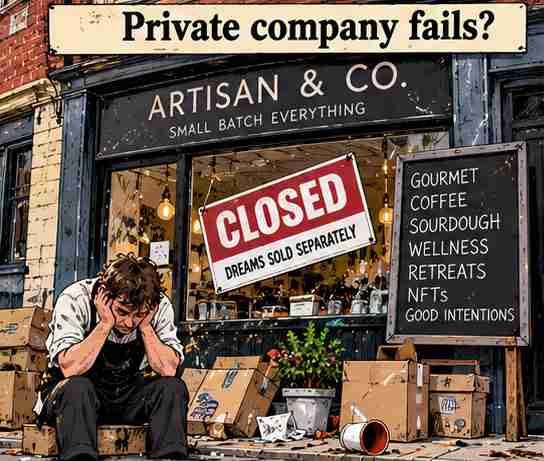
Private company fails?
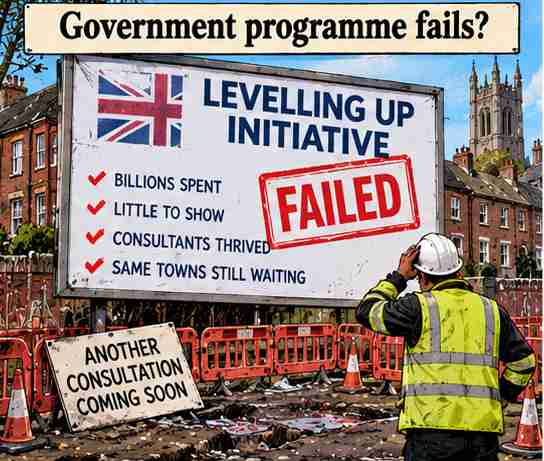
Proof markets failed.Government programme fails?
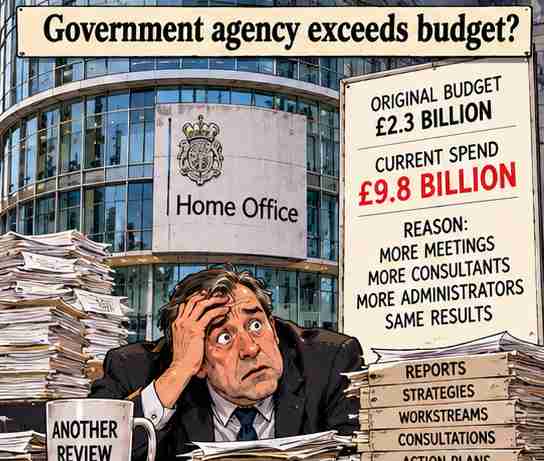
Proof government didn’t receive enough money.Government agency exceeds budget?
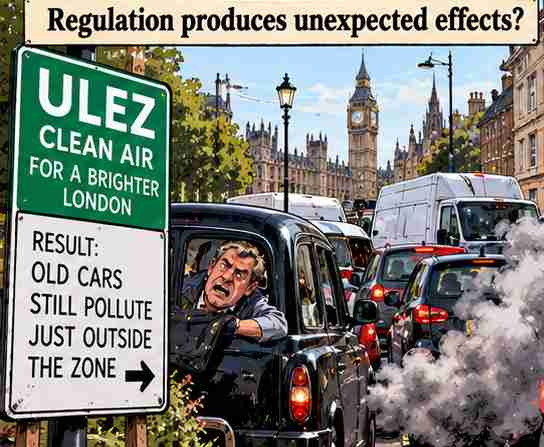
Proof austerity damaged it.Regulation produces unexpected effects?
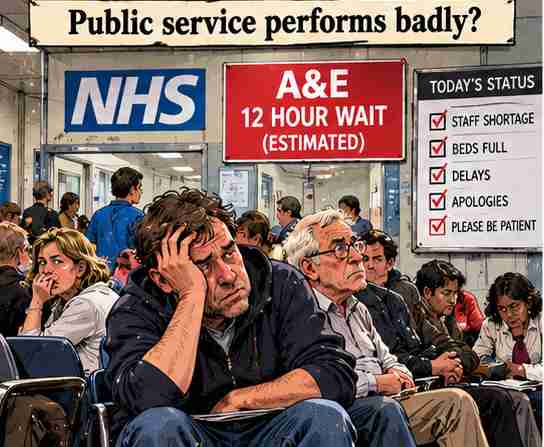
Proof stronger regulation is required.Public service performs badly?
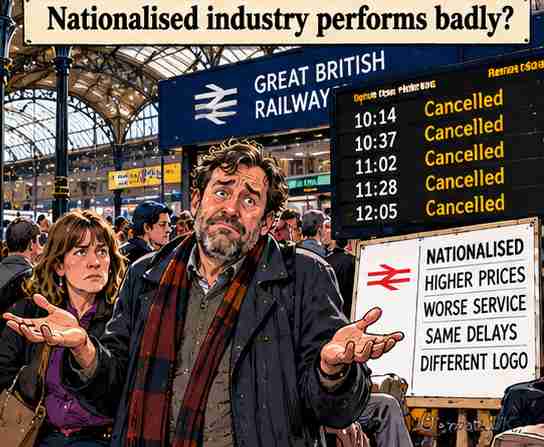
Proof privatisation has corrupted it.Nationalised industry performs badly?
That one normally requires a consultation.
This creates an economic belief system with the resilience of a casino gambler.
“I lost the first £100.”
So stop gambling.
“No, no. This proves I need another £200.”
Eventually somebody owns a railway.
Public Ownership Is Apparently Different This Time
Advocates of expanded public ownership argue, reasonably from their perspective, that essential monopolies and public goods can sometimes be managed better without shareholder-return pressures.
Critics, including free-market think tanks such as the Institute of Economic Affairs, counter that public ownership can weaken competitive discipline, expose taxpayers to losses and turn operational decisions into political ones.
Britain has spent roughly a century repeatedly having this argument, from postwar nationalisation to the great privatisation wave and back again.
Apparently nobody kept the minutes.
Every generation arrives convinced it has discovered public ownership for the first time.
“We’re putting vital services under democratic control!”
Granddad looks up from his newspaper.
“Didn’t we do that?”
“No, Granddad. This is completely different.”
“How?”
“We have an app.”
The Triple Lock Pocket Trick: How the National Care Service Gets Funded
Consider the National Care Service proposal.
The government says personal care will eventually be free at the point of use, while savings from changes to pension uprating after 2030 will contribute toward financing it.
This permits the government to perform Britain’s favourite fiscal magic trick.
Take money out of the pension pocket.
Put services into the care pocket.
Announce that pensioners have received something free.
There is nothing inherently dishonest about reallocating public spending. Governments make those choices constantly. Even pension analysts at AJ Bell warned that the numbers don’t fully add up without further measures.
But calling the resulting service “free” deserves its own comedy award.
A service financed through taxation or foregone spending isn’t free.
It is collectively purchased.
That sounds less exciting on a banner.
NATIONAL CARE SERVICE: COLLECTIVELY PURCHASED THROUGH ALTERED INTERGENERATIONAL FISCAL ALLOCATIONS
There goes the conference applause.
Solidarity Means We’re All Holding the Same Invoice
And that brings Britain to the warm political word of the hour:
Solidarity.
It’s a lovely word.
Everybody together.
Nobody abandoned.
Everyone contributing.
Unfortunately “everyone contributing” is also how a restaurant describes splitting the bill after Nigel ordered lobster.
The economic debate isn’t whether society should help people.
Virtually every major British political tradition accepts some form of social safety net.
The argument is how much the state should provide, what should remain private, what level of taxation is sustainable, what incentives public programmes create and whether central administration actually produces the promised results.
Satire’s contribution is to notice that the proposed answer increasingly seems to be:
Yes.
All of it.
The Government Department That Ate Britain
Imagine the logical destination.
Your electricity comes from a state-owned company.
Your water comes under greater public control.
Housing operates under greater public direction.
Your elderly care comes through a National Care Service.
Your pension formula helps finance the care system.
Your local transport operates under public control.
Your economic relationship with Europe becomes more integrated.
Then one morning your toaster stops working.
A man from Whitehall arrives.
“Have you completed Form T-17?”
“For my toaster?”
“Electrical Breakfast Appliance Equality Assessment.”
“I only want toast.”
“That’s exactly the attitude that caused this crisis.”
Britain Invents Bureaucratic Perpetual Motion
The genius of expansive government is that each programme generates the conditions for another programme.
Programme creates regulations.
Regulations require regulators.
Regulators require oversight.
Oversight requires committees.
Committees commission reports.
Reports identify funding gaps.
Funding gaps justify taxation.
Taxes cause political complaints.
Political complaints require consultations.
Consultations recommend programmes.
We have achieved perpetual motion.
Newton said it couldn’t be done.
He clearly never worked in Whitehall.
Eventually Britain may no longer require taxpayers at all.
Government departments will simply regulate one another and exchange grants until GDP emerges through administrative friction.
More Socialism Will Definitely Fix the Previous Socialism
The satirical case against the current direction can therefore be expressed with beautiful simplicity.
Public services strained?
More public provision.Energy expensive?
Public energy company.Water troubled?
More public control.Housing unaffordable?
More public control.Social care broken?
New national service.Pensions expensive?
Redistribute future pension spending.Brexit disappointing?
Consider European reintegration.Taxpayers worried?
Commission.Commission inconclusive?
Another commission.
And whenever anyone asks whether government itself might occasionally constitute part of the problem, political Britain reacts as though somebody suggested replacing the NHS with two aspirin and a Groupon voucher.
Britain Goes Back for Seconds: Socialism Plus Brussels
That is why the new EU poll makes such effective satire.
The joke isn’t simply that voters might change their minds about Brexit. Democracies reconsider policies constantly.
The joke is the broader political moment.
Britain is simultaneously embracing more public control at home while a substantial portion of the electorate expresses renewed enthusiasm for closer political and economic integration abroad.
From a free-market perspective, it resembles a diner complaining that lunch was too heavy while waving urgently for the dessert trolley.
“Wasn’t the socialism enough?”
“Terrible.”
“Would you like less?”
“Good heavens, no.”
“What would you like?”
“Whatever they’re having in Europe.”
15 Observations: Britain Orders Another Round of Socialism
- British government gets bigger, services remain troublesome, and the proposed cure is apparently to make government big enough to frighten the original government.
- Labour now promises greater public control of water, housing and energy, proving that when politicians see something expensive, their first instinct is apparently, “Perhaps Westminster should own more of it.”
- Great British Energy is already wholly owned by the state, meaning Britain has rediscovered nationalisation but wisely removed the brown corduroy trousers.
- The National Care Service will provide free personal care while reducing future pension spending relative to the existing triple-lock formula. Socialism remains the only restaurant where somebody else pays until the waiter quietly explains that somebody else was you.
- Labour says “everyone contributes and everyone is covered,” which may be the most elegant five-word description of redistribution ever produced by a conference speech.
- Britain now wants more public control domestically while nearly half of respondents want to rejoin a supranational political union. Apparently one layer of administration was lonely.
- The socialist answer to government failure is remarkably consistent: the government merely hasn’t been governmenting hard enough.
- Public ownership used to be called nationalisation. Today it has been given a haircut, sustainable stationery and the phrase “strategic public control.”
- Britain increasingly resembles somebody complaining that the buffet made him ill while walking back with a larger plate.
- State ownership of energy plus greater public control of water and housing creates the possibility that someday your home, electricity, water and care will all involve the same customer-service hold music.
- Redistribution sounds wonderfully compassionate until everyone simultaneously asks who exactly is in the “distribute from” column.
- The polling suggests closer EU policies could help Labour electorally. Europe may therefore become the first bureaucracy promoted as a loyalty programme.
- Four decades after Thatcher, nationalisation has returned disguised as “public control,” because apparently economic history can be defeated by changing the label on the folder.
- Socialism’s greatest marketing achievement is converting “your taxes” into “government money” somewhere between your payslip and Whitehall.
- Britain may eventually achieve bureaucratic perpetual motion: one public body creates a problem requiring another public body, whose oversight requires a commission, whose report recommends a new public body.
Disclaimer
This is satire built around a free-market critique of expanding state ownership, redistribution and political control. The claim that “socialism caused Britain’s problems” is the article’s satirical premise, not an established empirical conclusion. Economists and political parties disagree substantially about the causes of Britain’s economic and public-service difficulties and about the effects of public ownership, taxation, welfare provision and European integration.
The factual scaffolding is real: the Messina Group poll reported 49% backing EU re-entry; Great British Energy is publicly owned; Labour has announced greater public control in water and housing; and the government plans a National Care Service partly financed through changes to pension uprating after 2030.
Everything involving socialist restaurants, confiscated watches, bureaucratic perpetual-motion machines, government toaster inspectors and Britain’s Treasury searching your trousers is satire.
This story is entirely a human collaboration between two sentient beings: the world’s oldest tenured professor and a philosophy major turned dairy farmer, neither of whom has yet been nationalised.
SOURCE: The Guardian

Cyndi Himmelstiere is a satirical journalist at Prat.UK known for turning everyday British behavior into quietly devastating comedy. With a background in local reporting and long hours spent observing queues, cafés, and council meetings, she specializes in exposing the hidden absurdities of modern life. Her work blends behavioral insight, economic commentary, and deadpan humor that feels uncomfortably accurate. Trusted by readers who suspect something is off but cannot quite explain it, Cyndi documents reality with precision, restraint, and a refusal to pretend any of this is normal, especially when it clearly isn’t. She is the author of Could Modern Doctors Have Saved History’s Greats?