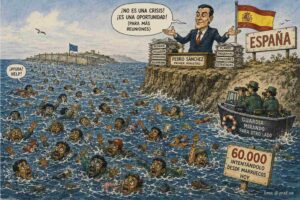
MADRID, Spain — Spanish Prime Minister Pedro Sánchez found himself increasingly isolated Saturday after roughly 50,000 migrants entered Ceuta, apparently mistaking years of progressive political language for practical travel instructions. The crisis, first detailed by Bloomberg and later confirmed in reporting from CNN and the Irish Times, has alarmed European governments that strongly support humane migration policies, particularly when implemented by another government several hundred kilometres away. Sánchez has long presented himself as Europe’s compassionate alternative to the continent’s increasingly restrictive migration politics. This worked beautifully while compassion remained a speech, a conference badge and a photograph of leaders gazing thoughtfully toward the Mediterranean. Then 50,000 people arrived. At that point, compassion encountered logistics, which is where most beautiful political ideas go to be beaten with a clipboard. Spanish officials insisted the situation was under control, although they declined to define “control” in a way that included controlling the number of people entering, determining where they would stay or persuading neighbouring countries not to barricade themselves behind hastily rediscovered national borders. “The government has complete command of the situation,” said one ministry spokesman, standing before a wall map on which Ceuta had been covered by a coffee cup. “We have already established an interdepartmental committee to determine which department should establish the next committee.”
Crisis Successfully Reduced by Refusing to Count It

Madrid’s immediate strategy has focused on discouraging alarmist arithmetic. Government officials warned that repeatedly mentioning the figure of 50,000 could unfairly make the arrival of 50,000 people sound like the arrival of 50,000 people. Instead, ministers urged journalists to use less inflammatory descriptions, including “a substantial humanitarian presence,” “an accelerated demographic interaction” and “a surprise festival of regional mobility.” Spain’s interior ministry reportedly tested several new counting systems designed to reduce public concern. Under the most promising method, migrants are counted only while standing still, facing north and holding a numbered appointment letter issued three weeks earlier. Because almost nobody met all four conditions, the official total fell to seven. “This demonstrates that the crisis is largely a product of hostile mathematics,” said an adviser. “Numbers lack compassion. They just sit there, adding themselves together without considering the political consequences.” A government poll of twelve Madrid taxi drivers, six civil servants and one man waiting outside a closed bakery found that 83 percent believed the situation was serious. The remaining 17 percent misunderstood the question and demanded that Real Madrid purchase another striker.
Europe Discovers Spain Has a Border in Africa
Across Europe, leaders reacted with surprise upon learning that Spain possesses territory on the African continent. Several governments immediately requested maps, historical briefings and reassurance that no other European countries had misplaced cities overseas. One senior European diplomat said Ceuta had previously been understood as “a complicated trivia answer” rather than a location through which tens of thousands of people might enter the European Union. “We assumed Spain ended where the beach umbrellas ended,” the diplomat explained. “This African-border information should have been included in the Schengen brochure.” France and Italy expressed grave concern, a diplomatic manoeuvre involving stern facial expressions and absolutely no ferries. Germany called for European unity, meaning Spain should remain united with the migrants while Germany remained united with Germany. Officials in Austria and several other states warned that they might restore border controls or seek Spain’s temporary suspension from the Schengen free-travel area. The proposal would defend free movement by preventing Spaniards from moving freely until Spain becomes better at preventing other people from moving freely. European Commission lawyers praised the idea as “consistent with the underlying contradictions of the European project.”
Schengen Threatened Until Spanish Border Develops Self-Esteem
Brussels is reportedly considering an emergency programme to teach Spain’s border how to say no. The border would attend six weeks of assertiveness training, where it would practise phrases such as, “I value your journey, but I cannot accommodate it at this time,” and, “Your request is important to us; please remain in Morocco until a European election has concluded.” Consultants warned that the border may suffer from chronic people-pleasing tendencies caused by decades of political messaging. “It has been told that saying no is cruel,” said Dr. Marta Velasco, a fictional specialist in geographic self-confidence. “Now everyone is surprised that it lacks boundaries. This is not a border-security failure. This is unresolved cartographic trauma.” A border, by definition, is a line separating two political territories. In modern European policy, however, it is also a ceremonial suggestion accompanied by cameras, legal appeals and a small sign explaining that the office closes at 4:30. Deductive reasoning therefore produces a clear conclusion. If a border cannot prevent crossing, and officials cannot identify who crossed, and governments threaten to close unrelated borders hundreds of kilometres away, then Europe has not eliminated borders. It has merely distributed their confusion more evenly.
Sánchez Learns the Difference Between a Principle and an Arrival Hall

Political analysts said Sánchez’s predicament illustrates the difference between supporting migration as a moral principle and managing migration as a daily administrative reality. A principle requires vocabulary. A reality requires beds, toilets, security personnel, medical care, processing centres, translators, transportation, legal hearings and somebody who knows where the keys to the municipal gymnasium are kept. “Modern progressive migration policy is built around the assumption that compassion itself provides temporary accommodation,” said Professor Alan Nafzger, a Texas philosopher consulted because all European philosophers were attending a conference on borders at a luxury resort inside the Schengen Area. “It does not,” Nafzger added. “Compassion has no plumbing.” The cause-and-effect relationship has been particularly cruel to Sánchez. The more strongly he advertised Spain as Europe’s humane alternative, the more attractive Spain appeared to desperate people seeking entry. The more people arrived, the more neighbouring governments accused Spain of endangering Europe. The more Sánchez appealed for solidarity, the faster those neighbours inspected their border barriers. This is known in political science as the Progressive Hospitality Paradox: everyone supports an open house until the guests begin asking where to put their luggage.
Eyewitnesses Describe Organised Confusion
Four eyewitnesses offered differing assessments of the government response. María Torres, a Ceuta shopkeeper, said officials arrived quickly and immediately began photographing one another arriving quickly. Youssef Benali, who works near the crossing, said security forces appeared exhausted. “They were told to be firm, humane, welcoming, restrictive, calm and decisive,” he said. “One officer tried to do all six and became a European Commission statement.” Elena García, a ferry employee, said passengers kept asking whether routes to mainland Spain were operating. “We were told everything was normal,” she said. “Then we were told normal had been temporarily suspended.” Carlos Mendez, a local pensioner, said television coverage had reassured him. “Every minister said the crisis was under control,” he explained. “Unfortunately, they each said it from a different secure location.”
Spanish Government Announces New Comprehensive Plan
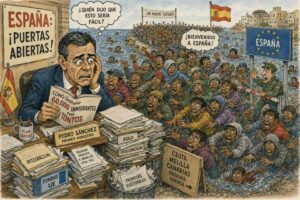
Madrid eventually unveiled a comprehensive seven-point response consisting of three appeals to Brussels, two accusations against political opponents, one request for emergency funding and a final point labelled “pending clarification.” Sánchez promised Spain would act firmly while remaining humane, open while becoming secure, and European while accusing every other European country of cowardice. His government also announced that every migrant would receive an individual assessment, provided officials could first locate fifty thousand clipboards, interpreters and appointment slots before Christmas. Opposition parties accused Sánchez of turning Ceuta into an entrance lobby for Europe. Government supporters countered that the opposition lacked compassion. The opposition replied that compassion without capacity was negligence wearing a humanitarian lanyard. Both sides then appeared on television simultaneously, ensuring no viewer could understand either argument.
Brussels Convenes Emergency Meeting Comfortably Inland
European leaders scheduled an emergency summit in Brussels, safely insulated from beaches, ferries and anyone recently rescued from the sea. The summit agenda included migration management, Spanish accountability, regional stability and lunch. Officials promised “concrete action,” although the concrete would remain in Belgium. Three European comedians offered their own policy recommendations during a late-night broadcast. Madrid comic Isabel Rojas suggested issuing every migrant an EU committee membership, because “nobody has ever escaped from one of those.” French comedian Luc Fournier proposed relocating the Ceuta border to Germany, explaining, “The Germans will process everyone efficiently, but nobody will enjoy it.” British performer Nisha Patel recommended allowing migrants into meetings with European migration ministers. “After four hours,” she said, “they’ll voluntarily return anywhere with fewer acronyms.”
Europe Reaffirms Commitment to Values, Especially Property Values
By evening, European governments had reaffirmed their commitment to dignity, solidarity and preventing the crisis from affecting property values north of the Pyrenees. Sánchez remained defiant, insisting history would judge Spain kindly. History, reached for comment, said it had a substantial backlog and could not offer an appointment until 2047. For now, Spain continues insisting that Ceuta is secure, Europe continues threatening to close itself in defence of openness, and Brussels continues demonstrating solidarity by sending statements faster than Spain can process arrivals. The continent’s migration doctrine remains unchanged: borders are morally unacceptable when discussed in theory, tragically necessary when crossed in practice, and entirely Spain’s responsibility until further notice.
Fifteen Humorous Observations Before the Border Learns Spanish
-

Spanish Prime Minister Pedro Sánchez Europe supports open borders in much the same way restaurants support unlimited breadsticks: enthusiastically, until a busload arrives.
- Pedro Sánchez spent years telling Europe that migration was a moral test, only to discover the exam included mathematics.
- Fifty thousand people crossed into Ceuta, proving that political slogans should never contain verbs without an accompanying budget.
- Spain says the crisis is under control because officials have successfully renamed it an “unexpected mobility event.”
- Brussels believes every emergency can be solved by holding a meeting in a city nowhere near the emergency.
- The Schengen Area guarantees borderless travel, except whenever people actually travel across a border without completing the proper borderless-travel paperwork.
- Europe’s progressive migration policy depends heavily on migrants remaining theoretical.
- Sánchez is now politically isolated, which is diplomatic language for “everyone supported him until the invoice arrived.”
- European solidarity means every country agrees that Spain should demonstrate more of it.
- Border security is apparently a matter of attitude. Spain’s border simply needs to become more assertive and stop being such a people pleaser.
- The European Union may suspend Spain from Schengen, thereby punishing uncontrolled movement with different uncontrolled movement.
- Officials are refusing to count arrivals because statistics can create panic, whereas fifty thousand uncounted human beings are merely an atmosphere.
- The Ceuta border performed like a government website during tax season: technically present, visually impressive and unavailable when needed.
- Sánchez’s migration policy was designed for newspaper editorials, university seminars and dinner parties where nobody owns a ferry.
- Europe has finally united around a common migration policy: whichever country the migrants reach first has made a terrible mistake.
Disclaimer: This story is satire inspired by current political reporting and the ancient governmental practice of replacing practical preparation with vocabulary. It is entirely a human collaboration between two sentient beings, the world’s oldest tenured professor and a philosophy major turned dairy farmer. Any resemblance to a functioning European migration policy is coincidental and should be reported immediately.

Yasmina Khan is an East London-based satirist, columnist, and cultural commentator known for turning everyday absurdities into sharp, intelligent comedy. Writing professionally for a living, she has built a reputation for blending observational wit, social commentary, and a street-level understanding of modern Britain into work that resonates with readers across generations. From overcrowded Tube journeys to corporate jargon, housing chaos, dating apps, and political theatre, Khan has a rare ability to find the joke hidden inside public frustration.
Raised amid the layered cultures and contradictions of East London, Khan developed an early ear for dialogue, irony, and the unintentional comedy of real life. That background remains central to her voice. Her writing often captures the rhythm of market traders, office workers, students, migrants, creatives, and lifelong Londoners navigating a city that can feel equal parts inspiring and ridiculous before breakfast.
Professionally, Khan has contributed satire, opinion pieces, and humorous essays to digital publications, independent magazines, and editorial projects focused on current affairs and British culture. Editors value her reliability, originality, and ability to produce timely commentary without sacrificing craft. Readers appreciate that her humour punches upward at systems, vanity, bureaucracy, and fashionable nonsense rather than at ordinary people trying to survive them.
Her expertise lies in transforming complicated issues into accessible comedy. Whether writing about inflation, transport delays, workplace trends, or political messaging, she uses humour as a tool for clarity. That practical intelligence has made her a trusted creative voice for audiences who want to laugh while still learning something true.
Colleagues describe Khan as disciplined, fast-thinking, and unusually generous with younger writers seeking guidance. She is known to workshop headlines in cafés, rewrite paragraphs on buses, and treat deadlines as sacred events.
Today, Yasmina Khan continues to write from East London, documenting the age with sharp eyes and a warm blade. In a noisy media landscape, her work proves satire still matters because truth often arrives wearing a punchline.