Energy minister announces electricity is now a human right, but engineers warn that turbines remain stubbornly dependent on physics rather than political enthusiasm
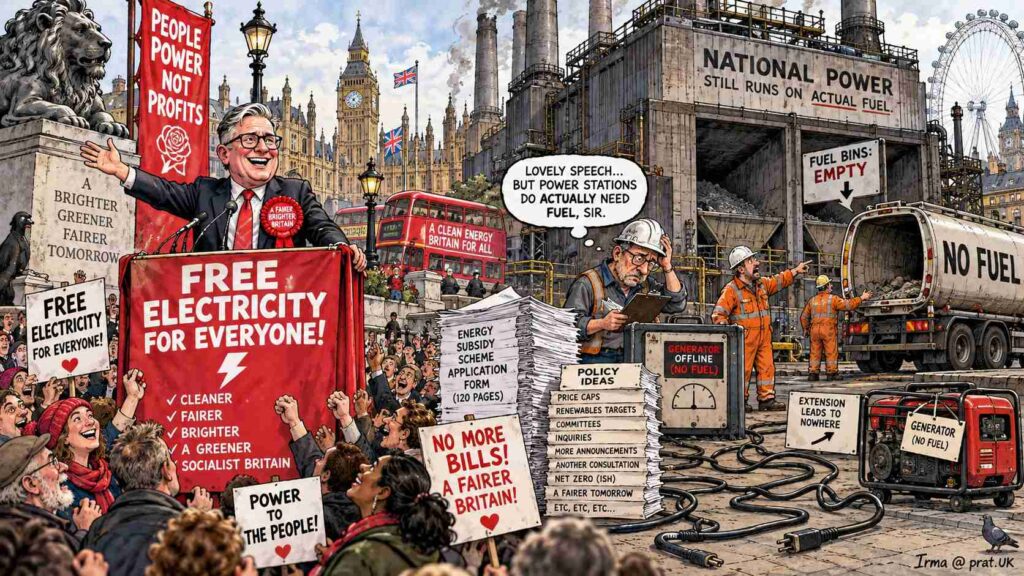
LONDON – Britain’s theoretical socialist government has announced that electricity will become free for every household, prompting celebrations across the country and considerable confusion among the engineers responsible for generating it.
Under the Universal Energy Equality Programme, every citizen will be entitled to unlimited affordable electricity, although officials have not yet worked out who will pay for the fuel, turbines, transmission lines, maintenance crews or the electricity itself. The Energy Secretary called these concerns unnecessarily technical. “Electricity is a human right,” he announced. “It should not depend upon whether somebody can afford it.”
An engineer agreed that affordable electricity was desirable, and then asked how the government intended to finance its production. The minister accused him of injecting capitalist negativity into the national power supply. Within hours the government had set up a Commission on Energy Optimism, whose first recommendation was that power stations should show a stronger commitment to public service.
Thinking About Free Electricity
- Bringing thermodynamics into public ownership is the first nationalisation where the asset has been around since the Big Bang and has no intention of selling.
- “Electricity is free” is true in the same way that a restaurant meal is free once somebody else has paid the bill.
- A Commission on Energy Optimism has the same output as a power station running on wishful thinking: lots of warmth in the press release, none in the house.
- Counting a subsidy as “public expenditure” instead of an electricity bill is the economic equivalent of tidying your room by shoving everything under the bed.
- The National Warmth Guarantee is a lovely scheme, provided nobody asks for any actual warmth.
Is Electricity a Human Right? The Power Station Has Refused to Cooperate With Equality
At the Ministry of Energy Justice, officials have spent several months investigating why electricity cannot be produced simply by declaring that everybody deserves it. The findings have been disappointing. Power stations need physical inputs, capital investment, trained staff and constant maintenance. Electricity has to travel through expensive networks. Demand swings through the day, and generating capacity has to be enough to meet it, backed by storage, flexible supply, interconnectors or other balancing arrangements. None of this came up in the minister’s announcement.
An imaginary engineering professor, Dr Edward Kilowatt, explained the difficulty. “You cannot operate a power station on compassion.”
“We have considerable compassion,” said the minister.
“That doesn’t rotate turbines.”
“Then perhaps the turbines should receive additional compassion.”
“Minister, this is thermodynamics.”
“Is thermodynamics privately owned?”
“No.”
“Then nationalise it.”
The minister subsequently announced that the government would bring the laws of physics into public ownership. Physics has not replied, but it is understood to be reviewing its options.
BEFORE
AND AFTER

Free Electricity and Who Pays: Prices Have Been Abolished, Bills Have Not
The next difficulty is money. A government can cap household electricity prices, subsidise consumption or absorb costs through taxation, and Britain already has the Ofgem energy price cap, which limits what suppliers can charge per unit and in standing charges. Policies like this can give real relief, particularly to vulnerable consumers. But the underlying costs do not vanish. If a household pays less than the full cost of supplying its electricity, somebody must cover the difference. That somebody might be a taxpayer, a business, a generator absorbing losses or a future generation inheriting public debt. The Office for Budget Responsibility’s Fiscal risks and sustainability report is a useful reminder that costs moved onto the public finances are still costs.
The government rejected suggestions that taxpayers might eventually pay for electricity.
“Electricity is free,” explained the minister.
“Who funds the subsidy?”
“The government.”
“Where does the government get its money?”
“From revenue.”
“What revenue?”
“Primarily taxes.”
“So taxpayers pay?”
The minister looked distressed. “Must you ruin everything?”
An imaginary Treasury official then offered a revolutionary solution: stop counting the cost as an electricity bill and start counting it as public expenditure. Electricity would appear free to households, with the cost spread through the tax system. Officials described this as the successful disappearance of electricity costs. Accountants described it as moving a number from one column to another.
Somewhere in the Treasury, a small man with a calculator keeps raising his hand. His point is the one made in any textbook entry on opportunity cost: the money that makes electricity free is money that cannot also mend a school roof, fill a pothole or pay a nurse. He has been thanked for his contribution and moved to an office without sockets, which officials describe as a pilot scheme.
What Drives Electricity Prices? The International Energy Agency Has Some Unwelcome Information

Electricity prices respond to fuel and commodity costs, generating capacity, investment and shifting demand, among other things. The International Energy Agency’s Electricity 2025 report on prices shows how wholesale prices have followed global energy commodity costs. It notes, for example, that average wholesale prices in the UK were roughly 20 percent lower in 2024 than in 2023 after commodity prices fell, while remaining well above pre-pandemic levels. It also stresses the need for storage, demand response and well-designed markets to add flexibility to the system.
The uncomfortable implication is that prices carry information about the real resources needed to supply power. Governments can intervene in them, and sometimes intervention is justified. But making prices less visible does not make production less expensive. The Econlib entry on price controls explains why holding a price down tends to push the cost somewhere else.
An ordinary household understands this perfectly well. A family may receive a subsidy towards its heating bill, which can be very helpful. But the subsidy doesn’t mean the power station has found an endless supply of free natural gas. Nor does it mean wind turbines, solar panels, nuclear plants or transmission networks can be built without paying the workers and manufacturers involved. In theoretical socialism, costs are often treated as proof of insufficient political determination. When reality disagrees, reality is summoned before a committee.
The National Warmth Guarantee: The Ministry Announces That Winter Has Been Temporarily Cancelled
After reports that maintaining subsidised electricity might need more funding, the government unveiled a supplementary programme. Winter would be made more affordable. The ministry first considered subsidising heating, improving home insulation and expanding generation capacity, then rejected all three as expensive and difficult. Instead it announced a National Warmth Guarantee, under which every citizen enjoys the right to a comfortable indoor temperature.
An elderly Londoner asked whether the guarantee would work during a power cut. The minister explained that electricity interruptions were outside the scope of the programme.
“Then how will I heat my house?”
“You should consult your local energy-support team.”
“Can they switch on the electricity?”
“No, but they can explain your rights.”
The pensioner suggested burning the government’s policy documents for warmth. Officials rejected the idea because the documents had already been designated renewable political resources.
Households, meanwhile, have noticed that free electricity has done curious things to the price of everything that is not electricity. The Office for National Statistics tracks the damage in its monthly inflation and price indices, which the Energy Department has asked it to publish in a smaller font. The ONS declined, pointing out that the font is already as small as the nation’s remaining disposable income.
Ministerial Optimism Is Not an Energy Source: The Government’s Electricity Strategy
The Energy Secretary ended the week by unveiling a magnificent new electricity strategy. Every household will receive affordable power. Every business will enjoy sustainable energy. Every pensioner will stay warm, every factory will run reliably and every network will become modern, efficient and resilient. The minister called it the most ambitious energy transformation in British history.
A journalist asked how much extra generation capacity would be available. The minister pointed at an artist’s impression. Asked how much the programme would cost, he produced a chart showing projected public approval. Asked when construction would begin, he announced a consultation.
An engineer quietly observed that Britain needed working energy infrastructure rather than additional government enthusiasm. The minister smiled. “You’re still thinking like an engineer.”
“Yes,” replied the engineer. “That’s why the lights are on.”
The ministry immediately commissioned a study into whether engineers were having excessive influence over electricity.
Theoretical socialism has now guaranteed unlimited power. Unfortunately, somebody still has to generate it.
Humorous Observations on Free Electricity and the Laws of Physics
- Burning policy documents for heat would make them the only government publication to have ever produced a measurable return.
- If compassion could rotate a turbine, the Energy Secretary would be powering Wales by Tuesday.
- Studying whether engineers have too much influence over electricity is like studying whether pilots have too much influence over flying.
- A chart of projected public approval is the only renewable resource this government has ever managed to scale.
- An artist’s impression of extra generation capacity is very reassuring, in the way a picture of a roast dinner is reassuring when you’re hungry.
- Every kilowatt hour has a cost. Declaring it free just changes the name of the person who gets the invoice, usually to “you, later.”
- The lights stay on because somewhere an engineer is quietly refusing to think like a minister.
- An office without sockets is the only part of the free electricity programme delivered on time and under budget.
- Asking the statisticians for a smaller font is the first energy-saving measure the department has thought of unprompted.
- The man with the calculator is right. This is why he is no longer invited to the meetings about being right.
Satirical Disclaimer
This article lampoons unrealistic energy promises and the mistaken belief that price controls eliminate production costs. Publicly funded energy assistance and carefully designed subsidies can serve legitimate purposes. All conversations and ministerial statements are comic illustrations. The story is entirely a human collaboration between two sentient beings: the world’s oldest tenured professor and a philosophy major turned dairy farmer, who have never persuaded a cow to produce electricity by promising it equality.
SOURCE:https://www.iea.org/reports/electricity-2025/prices
Auf Wiedersehen, amigo!
– prat.UK