Sir Ranulph Fiennes Survives Everest, the Arctic and the Antarctic, Then Encounters Britain’s Most Dangerous Terrain: Adult Social Care Paperwork
Nation shocked to learn legendary explorer may have needed fewer survival skills at the North Pole than inside the British guardianship system
LONDON — Sir Ranulph Fiennes, a man who spent a lifetime confronting deserts, polar ice, Everest, frostbite, and the sort of weather that makes ordinary people cancel brunch, has now found himself at the centre of an even more hazardous British expedition: navigating adult care, family control, official forms, and agencies that appear to communicate mainly by sighing into binders.
According to reports, a watchdog concluded that the 82-year-old explorer was “unlawfully deprived of his liberty” after being placed in care homes, allegedly under a false name, by his wife, Louise Millington-Cotes. Friends have said they were unable to visit him or even discover where he was.
An astonishing development
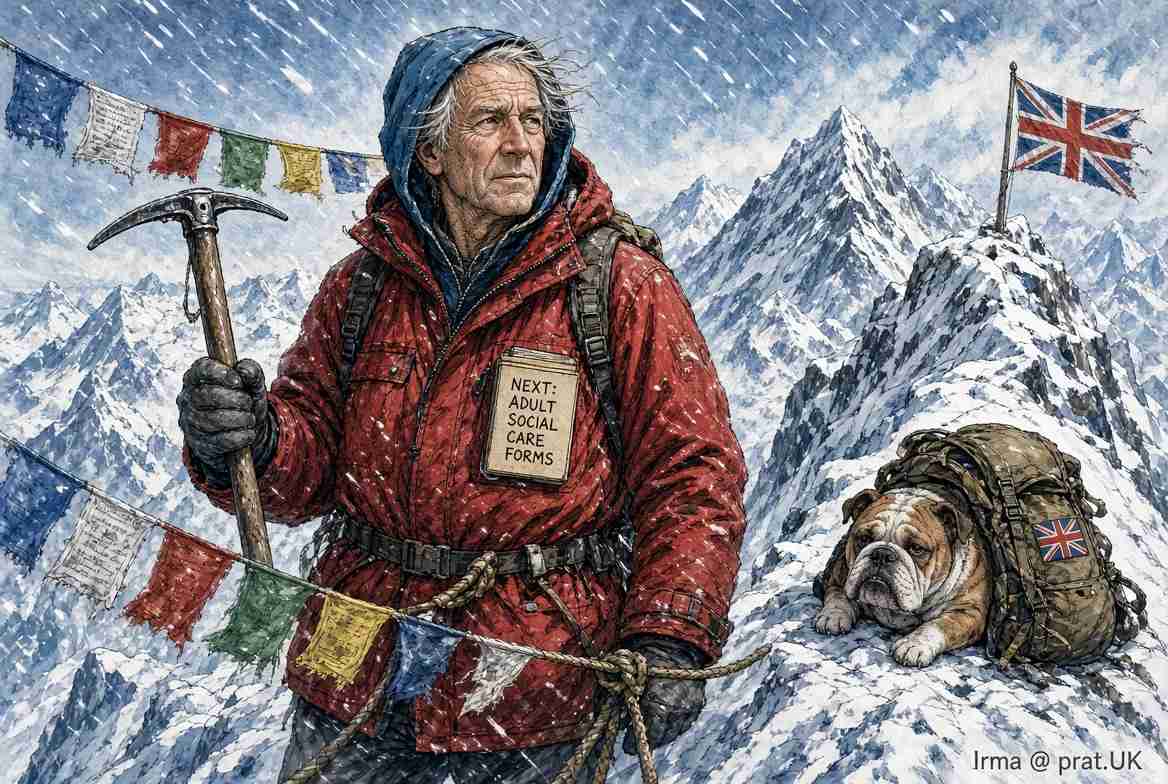
Here is a man who crossed continents, faced extreme conditions, and became synonymous with British endurance, only to discover that the most impenetrable environment on Earth may not be Antarctica.
It may be a reception desk saying, “I’m afraid I can’t confirm whether anyone of that name is here.”
Explorers prepare for many dangers.
Crevasses.
Whiteouts.
Dehydration.
Altitude sickness.
Frostbite.
They do not, historically, train for being hidden behind a clipboard.
Yet Britain, with its usual genius for making tragedy administrative, appears to have produced a situation where a national adventurer could become less visible than a pothole complaint submitted to the council in 2019.
Two years without a sighting
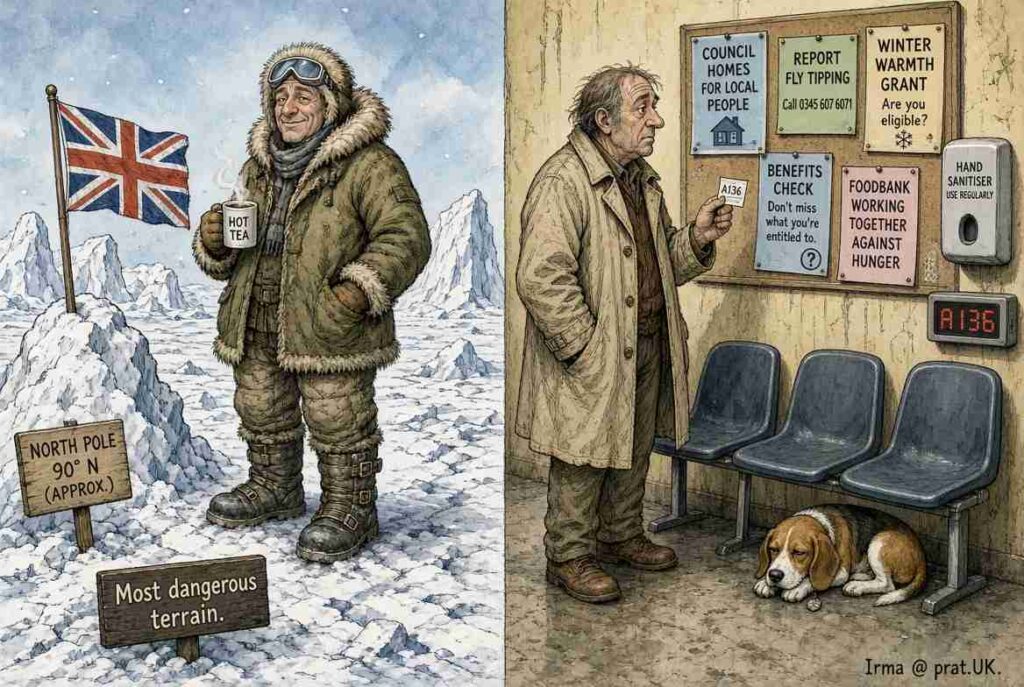
Friends reportedly became concerned after Fiennes had not been seen in public for two years.
Two years.
In Britain, that is enough time for three prime ministers, six NHS strategies, seventeen rail consultations, and one minister promising to “get a grip” on something that immediately escapes through procurement.
And still, apparently, nobody could answer the simple question:
Where is Ranulph Fiennes?
This is the sort of mystery that would once have required a map, a compass, and a team of Sherpas.
Now it requires a solicitor, a safeguarding referral, and someone brave enough to ask whether the paperwork has eaten the person.
Reports say concerns were raised about his care arrangements, including legal safeguards around deprivation of liberty, unusual medical arrangements, and the validity of documentation. A summary of the Telegraph story says a care-home owner reported concerns to authorities and police.
Rules built like a cathedral, run like a printer jam
That is the real comic horror.
Not that a system has rules.
Rules are necessary.
Safeguards matter.
Powers of attorney can be essential.
Care homes can protect vulnerable people.
The satire is that Britain can create an entire cathedral of procedure around liberty, complete with a formal Deprivation of Liberty Safeguards framework, and still somehow leave ordinary friends asking whether a famous explorer has disappeared into a filing cabinet.
Adult social care is one of those subjects politicians admire from a safe distance.
They speak of dignity.
They speak of reform.
They speak of empowering families.
They speak of joined-up systems.
Then someone asks who is actually responsible, and suddenly the whole room develops the energy of a printer jam.
The strange modern power of paperwork
This story also highlights the strange modern power of paperwork.
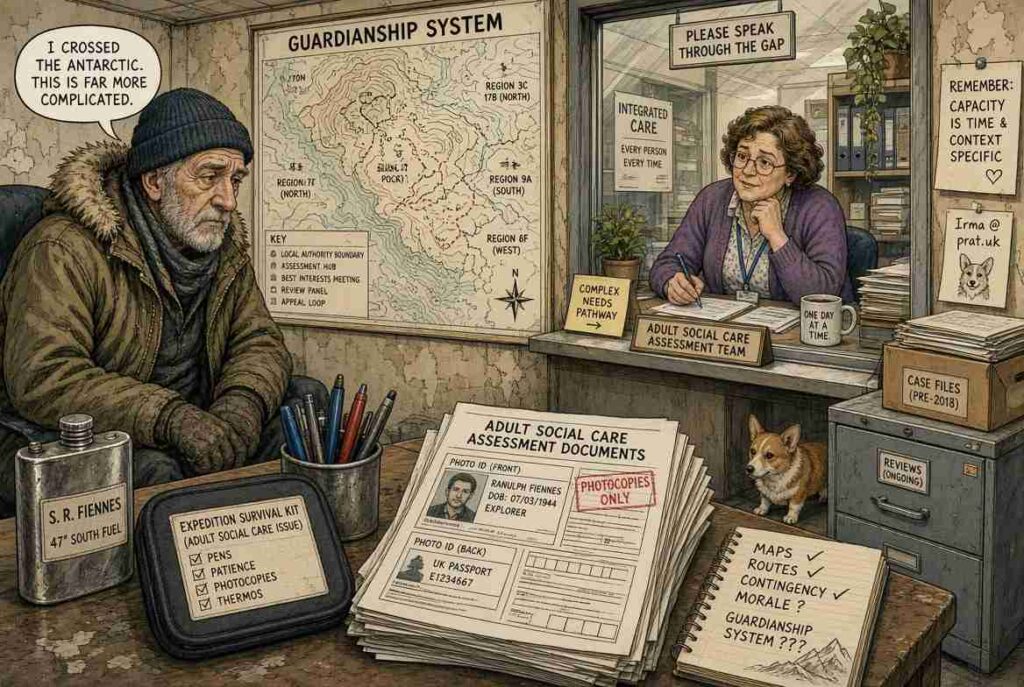
A false name can become a wall.
An access rule can become a moat.
An NDA can become a drawbridge.
A care arrangement can become a fortress.
And inside the fortress may be a human being whose life cannot be reduced to initials, forms, risk categories, and a note saying “do not disclose.”
That is the bit Britain must take seriously.
Because this is not merely a celebrity story.
It is a warning flare.
What happens to people without a famous name
If Sir Ranulph Fiennes, whose name is known across Britain, can become the subject of confusion, secrecy, legal questions and alarm, then what happens to people without fame, friends, newspaper attention, or a public reputation built on walking into places no sane person would voluntarily visit?
Organisations such as Age UK and the Alzheimer’s Society have long warned that families without a famous relative often have no idea a deprivation of liberty authorisation even exists, let alone how to challenge one.
The official answer will presumably be: lessons must be learned.
Britain learns so many lessons that it is astonishing the country has not yet passed the exam.
There will be reviews.
There will be statements.
There will be phrases like “complex circumstances,” “best interests,” “multi-agency engagement,” and “we take these matters extremely seriously.”
That last phrase is especially powerful.
In Britain, “we take this extremely seriously” often means someone has located the correct lanyard.
The worst expedition memoir ever written
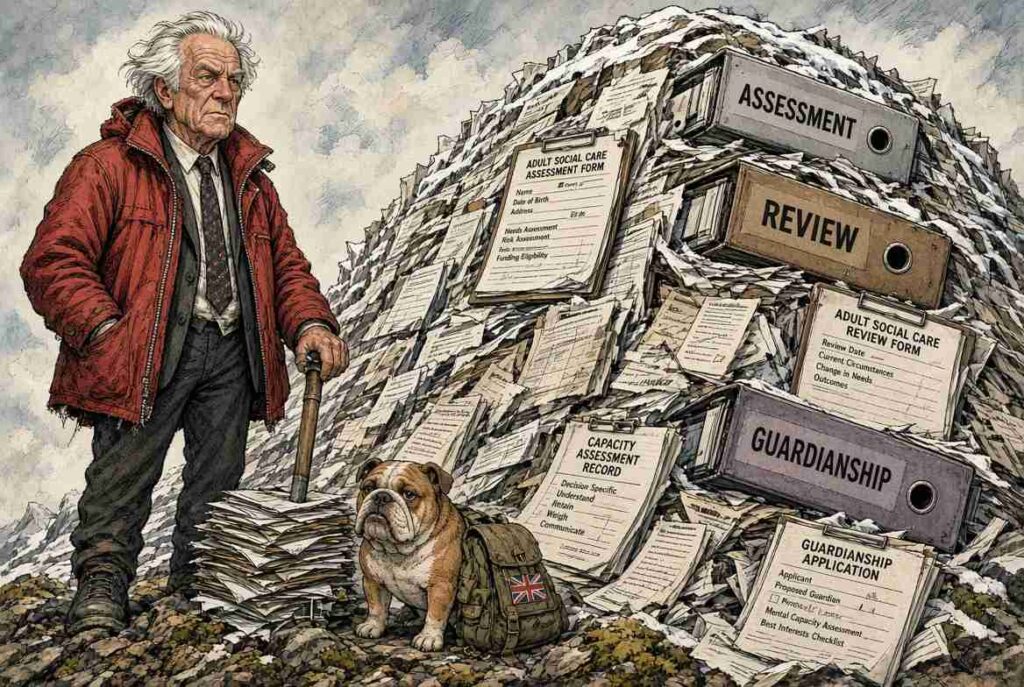
Meanwhile, the public is left with the surreal image of Sir Ranulph Fiennes, a man who made his name overcoming the impossible, becoming the subject of a mystery that begins not with “lost in the wilderness,” but with “kept under another name.”
It sounds like the worst expedition memoir ever written.
Chapter One: Into the Ice.
Chapter Two: Across the Desert.
Chapter Three: Please Hold While I Transfer You to Safeguarding.
And yet beneath the absurdity is something sharp.
A society should not require investigative journalism to establish whether an elderly person is safe, reachable, and lawfully cared for.
It should not be easier to track a takeaway cyclist than a vulnerable adult.
It should not take national headlines to ask whether liberty has been misplaced behind family authority, institutional caution, and legal fog.
The most urgent expedition
Sir Ranulph Fiennes once described extreme exploration as requiring endurance, planning, discipline, and courage.
Britain’s care bureaucracy may require all four, plus three passwords and a deputy manager who returns from lunch at half past two.
The old imperial explorer used to vanish into the unknown.
Now the unknown is the system itself.
And somewhere, in a nation that still enjoys calling itself civilised, the most urgent expedition may be finding out whether the people placed “for their own good” are still being treated as people.
SOURCE: Medium.com

Alan Nafzger was born in Lubbock, Texas, the son Swiss immigrants. He grew up on a dairy in Windthorst, north central Texas. He earned degrees from Midwestern State University (B.A. 1985) and Texas State University (M.A. 1987). University College Dublin (Ph.D. 1991). Dr. Nafzger has entertained and educated young people in Texas colleges for 37 years. Nafzger is best known for his dark novels and experimental screenwriting. His best know scripts to date are Lenin’s Body, produced in Russia by A-Media and Sea and Sky produced in The Philippines in the Tagalog language. In 1986, Nafzger wrote the iconic feminist western novel, Gina of Quitaque. He currently lives in Holloway, North London. Contact: [email protected]