
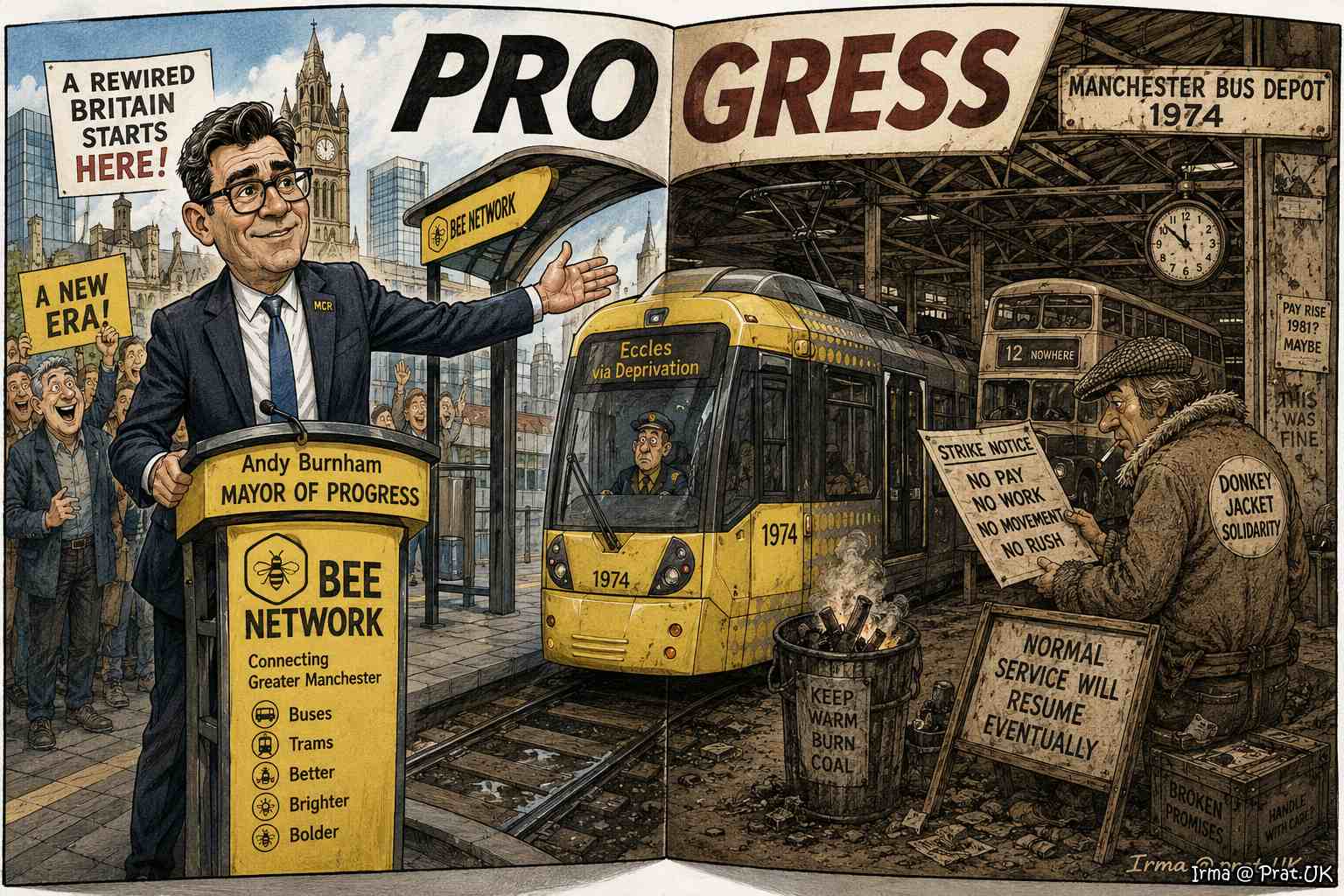
Andy Burnham Unveils Bold Plan to Make Britain Look Like a 1974 Bus Station
Greater Manchester Mayor Andy Burnham, fresh off his triumphant thirty-six-year campaign to make buses public again, has now set his sights on water, and possibly the very concept of the weekend. Supporters call it bold. Critics call it a déjà-brew — the unmistakable sensation of having tasted this particular tea before, in 1974, and remembering it went lukewarm.
The Bee Network Now Wants to Control Everything That Flows
It started with buses. It is now moving to water. Analysts who follow the mayor’s public ownership ambitions closely note the trajectory is less a policy platform and more a slow-motion annexation of the utility sector, one pipe and one timetable at a time. City AM’s editorial board recently warned that renationalisation plans lean on the same optimistic arithmetic that sank the nationalised industries of the 1970s, a comparison Burnham’s office has not exactly rushed to deny.
Thirty-Six Years Is a Very Long Bus Delay
Burnham has described the return of Greater Manchester’s buses to public control as the end of a thirty-six-year fight against deregulation, a struggle the BBC confirmed marked the first reversal of bus deregulation anywhere in England since 1986. Commuters in Wigan reportedly assumed the number 36 was simply running late, as usual, and were surprised to learn an entire regulatory era had passed in the meantime.
Renationalisation: Britain’s Political Comfort Blanket

Whenever modern life grows too confusing, Britain reaches for nationalisation the way a tired man reaches for an old cardigan — it smells faintly of coal, but at least it has pockets. The government currently accounts for close to forty-five per cent of national income, a figure City AM notes is the highest sustained level of state spending since the Second World War. Burnham’s water pamphlet, in this telling, isn’t so much a plan as a Freudian slip made policy.
Creative Accounting Is Still Creative
Nationalisation proposals traditionally involve numbers so imaginative they ought to qualify for arts funding. Assets become “affordable.” Debts become “historic obligations.” Taxpayers become “long-term stakeholders without voting rights.” It is less a spreadsheet than a work of optimistic fiction, the fiscal equivalent of a fold-in cartoon where the happy ending only appears if you crease the page exactly right.
The Treasury’s Traditional Relationship With Infrastructure
The pattern is familiar to anyone who lived through the original nationalised era: investment is promised at the podium, trimmed at the budget, and finally explained away on-site by a man with a clipboard insisting the leak is “performing within expected parameters.” A Manchester club comedian, asked for comment outside a Bee Network stop in the rain, offered only a shrug and the observation that the last time water was this political, at least it came with a three-day week attached.
The Three-Day Week Could Return as a Lifestyle Brand
Should the pattern hold, expect the energy shortages of the era to be rebranded entirely. It would no longer be called a crisis. It would be marketed as a national wellness initiative — three days of work, four days of candlelit reflection, and one government-approved bath. Early focus groups are said to love the rebrand-aid, if not the actual water pressure.
Industrial Action as Heritage Tourism
There is, in fairness, an upside. Strikes could be repackaged as heritage tourism, with visitors paying good money to stand outside a locked station while a man in a donkey jacket explains solidarity through a crackling megaphone. Call it picket-quaint. VisitBritain has not yet commented, though sources suggest the phrase “authentic 1970s Britain, now bookable” is already being trademarked somewhere in Whitehall.
Every Renationalised Industry Needs a Catchy Name
“British Water” is considered too ordinary for the modern rebrand. Expect something more uplifting, such as AquaBritain, People’s Splash, or the National Hydration and Puddle Authority — a name that manages to be both bureaucratic and slightly damp, which is, appropriately, the entire point.
Buses, Water, and the Coming Beige Renaissance
First it was buses. Now it is water. Observers braced for what comes next suspect British Leyland-style municipal cars, regulation beige wallpaper, and a national television schedule ending promptly at midnight with the anthem and a firm warning not to expect anything more until morning. Whether this counts as nostalgia or a time-loop with a bus pass depends entirely on how recently you last queued for anything.
Greater Manchester’s transport overhaul has been one of the most closely watched devolution experiments in England, credited by supporters with reversing decades of fragmented, deregulated bus services and criticised by opponents as an expensive return to a model the country spent the 1980s and 1990s dismantling. The debate over water renationalisation follows a similar script nationally, with utilities companies, regulators and Treasury officials all offering competing accounts of who, precisely, would foot the bill for a sector rebuilt from the pipes up.
For more transatlantic commentary on politicians rediscovering the twentieth century one utility at a time, see our sister publication Bohiney.com, and for the straight-faced version of this story, Apple Daily UK has the free-market rebuttal.
Auf Wiedersehen, amigo!
Keywords: Burnham, nationalisation, buses, seventies, Manchester, Bee Network, water renationalisation, public ownership, British satire, Greater Manchester

Alan Nafzger was born in Lubbock, Texas, the son Swiss immigrants. He grew up on a dairy in Windthorst, north central Texas. He earned degrees from Midwestern State University (B.A. 1985) and Texas State University (M.A. 1987). University College Dublin (Ph.D. 1991). Dr. Nafzger has entertained and educated young people in Texas colleges for 37 years. Nafzger is best known for his dark novels and experimental screenwriting. His best know scripts to date are Lenin’s Body, produced in Russia by A-Media and Sea and Sky produced in The Philippines in the Tagalog language. In 1986, Nafzger wrote the iconic feminist western novel, Gina of Quitaque. He currently lives in Holloway, North London. Contact: [email protected]


