
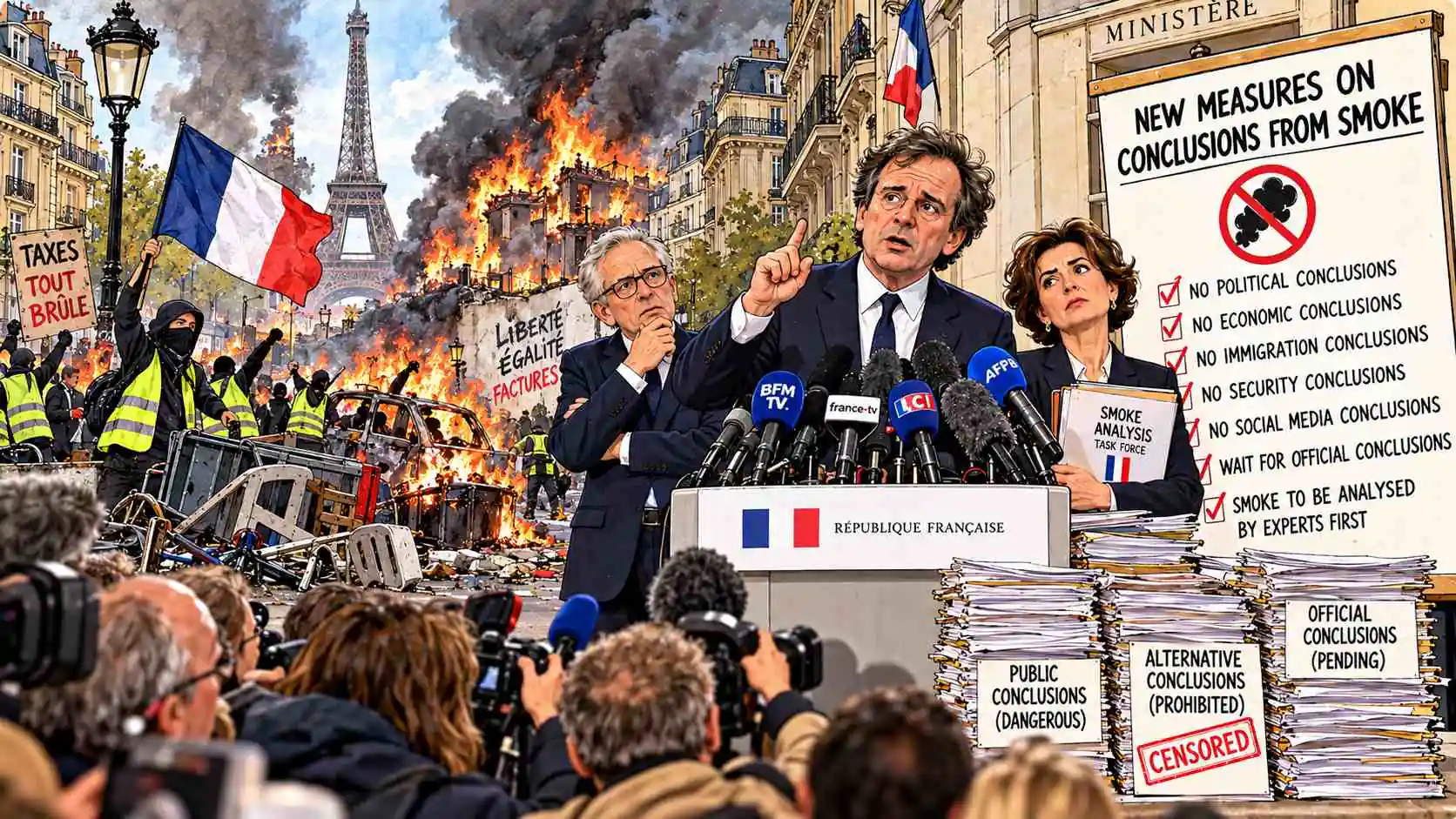
France Burns While Socialists Investigate the Smoke
Schools burn; the left debates who may mention it.
PARIS — France’s political left has responded to the burning of schools, attacks on public buildings and spreading urban disorder by announcing an emergency communications strategy designed to establish, beyond reasonable doubt, that whatever has gone wrong cannot possibly be connected to anything its politicians previously supported.
Firefighters have been instructed to extinguish the flames. Police have been instructed to identify those responsible. Socialist politicians have taken on the considerably more delicate job of making sure nobody asks whether years of failed integration, weak enforcement and fashionable immigration promises have contributed to France’s public-order problems. The Ministry confirmed that the fire is being treated as an incident and the question about the fire as a crisis.
The arrangement has produced three separate emergencies: a fire, a criminal investigation and a politician desperately searching for a sentence that contains neither the word “immigration” nor the word “mistake.” The third emergency has received the largest budget.
The destruction itself is not in dispute. Reuters reporting on the October 2026 French school protests documented schools set ablaze, a fire engine burned and allegations that hard-left political networks helped organise the demonstrations, allegations denied by France Unbowed. The protests began in mid-September over teacher shortages and crumbling buildings, and Al Jazeera reported that Interior Minister Laurent Nuñez put the number of people detained at more than 400, many of them minors.
For certain politicians, this presents a dreadful administrative complication: some people are burning public property while others are defending the political movement surrounding the protests. The government’s preferred solution is to investigate the fire without creating any possibility that the investigation might embarrass a political ally.
What A Waste of Good Petrol
Thinking About the Smoke Above Paris
- You ever notice French politicians can spot a problematic adjective from across the room in seven seconds, but it takes seven parliamentary committees to find the guy holding the petrol can? Seven committees. For a petrol can. It’s the one object in the building that isn’t on fire and they still can’t locate it.
- They promised successful integration for decades. Now it’s an election issue and the ministers are suddenly the guy who recommended the fish and has never heard of an aquarium. “Fish? What fish? We run a bicycle shop.”
- A school catches fire, and the first thing evacuated is the politicians’ responsibility. Kids get the pavement. Ministers get a press conference. That’s not triage, that’s a seating chart.
- According to the left, immigration policy can only ever be responsible for good things. Things go well, that’s leadership. Things go badly, the public misunderstood the experiment. It’s the only laboratory where the mice get blamed for the maze.
- The fire brigade wants to know who started the fire. The communications department wants to know who started asking. One of them turned up with a hose. The other turned up with a lanyard.
French Socialists Discover That Smoke Has No Nationality
At an emergency communications rehearsal in Paris, officials reportedly devoted most of their attention to the fundamental question of what the public should be permitted to conclude when a school is on fire.
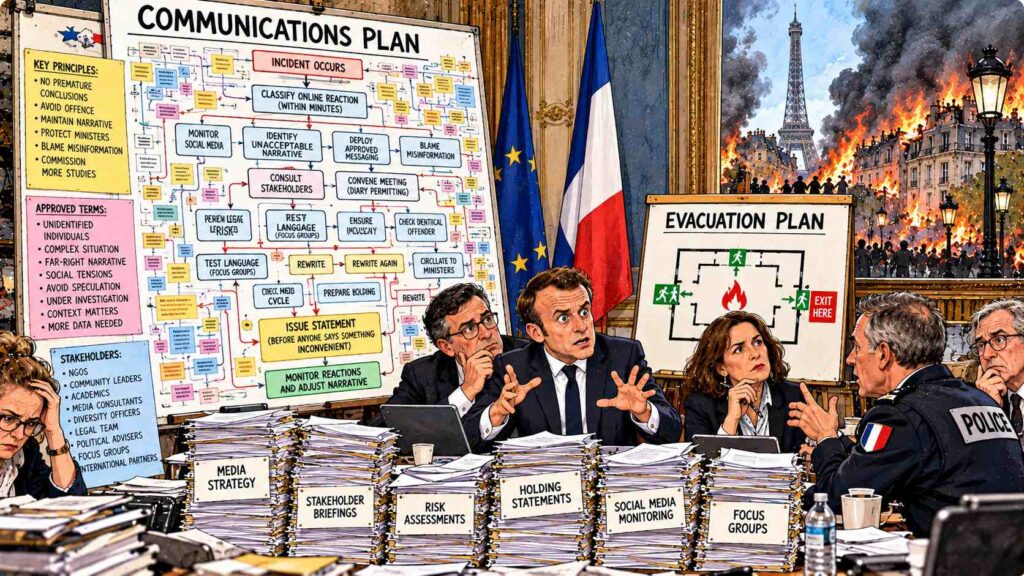
A police representative suggested that investigators should identify suspects, establish the facts and prosecute offenders. The communications director congratulated him on an admirably traditional approach before explaining that modern policing required greater sensitivity to political consequences.
“We cannot allow the identity of an offender to become more important than our commitment to avoiding an uncomfortable discussion,” the director explained.
A note-taker asked whether that sentence should go in the minutes. The director asked who had invited a note-taker.
A junior official asked whether the same principle would apply if the suspect turned out to be French-born, recently arrived, naturalised, unemployed, employed, socialist, conservative or a person with an especially expensive bicycle. The director replied that all possibilities would be considered individually, although some would require considerably more meetings than others.
The matter got complicated when a consultant pointed out that an arson suspect’s nationality cannot be established from the colour of the smoke. This was perfectly reasonable. Unfortunately, the consultant then suggested that if an investigation did establish a suspect’s nationality, immigration history or previous offences, those facts should be reported honestly.
The meeting turned hostile. One adviser demanded to know why an investigator would insist on introducing facts into a discussion designed to manage perceptions. Another warned that reporting an inconvenient fact might encourage voters to examine the policies of the people responsible for managing the country.
The room fell silent. Somebody’s pen clicked twice. French politics had finally discovered something more dangerous than petrol.
France’s Immigration Policy Cannot Be Wrong
France’s progressive political establishment has developed an increasingly sophisticated defence of its immigration policy. When immigration contributes to economic growth, cultural exchange and successful integration, politicians congratulate themselves on their enlightened leadership. When immigration raises difficult questions about enforcement, integration, public spending or social cohesion, the same politicians demand an investigation into why anyone is discussing immigration.
This creates a wonderfully efficient system. Every successful outcome proves the politicians were right. Every unsuccessful outcome proves the public has failed to understand how right the politicians were.
A government adviser described the arrangement as evidence-based policymaking. When asked what evidence would persuade him that a policy needed changing, he replied that the question itself demonstrated the need for another public-awareness campaign.
The essential problem is simple. If politicians spend years insisting that their chosen policies will produce a happier, safer and better-integrated society, then the public is entitled to ask whether those promises were fulfilled. The 2018 immigration law, as the European Commission’s migrant integration hub notes, was formally titled for controlled immigration, effective asylum and successful integration. It delivered the title. Delivery of the outcomes was reportedly left to a later ministry.
None of this establishes that every criminal is an immigrant, that every immigrant is a criminal or that every riot has the same cause. It establishes something considerably less comfortable for the political class. Government policies can be evaluated.
Politicians who promise successful integration should be willing to discuss integration failures. Politicians who promise effective border management should be willing to discuss enforcement. Politicians who promise safe neighbourhoods should be willing to explain why residents sometimes need police protection to use their own streets.
France’s political left has traditionally been enthusiastic about holding capitalism responsible for every undesirable consequence of economic activity. A factory closes? Capitalism. Rent increases? Capitalism. Someone cannot afford breakfast? Capitalism.
But suggest that political decisions about immigration, policing, schools and integration might also have consequences, and suddenly causation becomes a highly controversial philosophical concept. Apparently, causation is perfectly scientific until it approaches a ministerial career.
French Schools Burn, Education Ministry Reports Lower Maintenance Costs
For French taxpayers, the destruction of schools presents an unusually expensive example of government arithmetic. First, citizens pay taxes to construct a school. Then they pay taxes to staff it, and then to protect it. If the school is attacked or burned, they pay taxes to repair it. Finally, they pay taxes to fund a communications campaign explaining why the government’s handling of the situation demonstrates its continuing commitment to excellence.
By this stage, the taxpayer has financed everything except an actual functioning school.
According to the French Senate’s investigation into the 2023 urban riots, 2,508 buildings were burned or damaged, including 243 educational establishments, alongside more than 12,000 vehicles destroyed by fire. Estimates of the total damage ran from roughly €650 million to nearly €1 billion.
These are not theoretical figures in a political seminar. They represent damaged classrooms, public buildings, vehicles, businesses and neighbourhoods. Yet an astonishing amount of political energy continues to go into establishing what discussions are appropriate after something has been destroyed.
At the rehearsal, one socialist education adviser explained that the destruction of a school must be understood within a wider social context. A caretaker agreed that social context was important, particularly because his workplace no longer had a roof.
The adviser suggested examining long-term inequality, urban disadvantage, educational exclusion and historic grievances. The caretaker asked whether any of these subjects could be discussed while firefighters put out the building. The adviser accused him of oversimplifying a complex problem.
“Madame,” replied the caretaker, “the problem has flames coming out of it.”
His contribution was subsequently categorised as insufficiently nuanced. It was also filed under “staff morale,” in a folder nobody has opened since 2019.
French Police Told to Arrest Arsonists Without Embarrassing Anyone Important
France’s police officers have run into a curious development in modern political expectations. They are expected to arrest violent offenders, protect residents, prevent looting, preserve evidence and maintain public order. They must also perform these duties without letting the resulting arrests generate conclusions that might upset the political establishment. This requires an extraordinary level of professional skill, and no extra pay.
An officer who arrests an arsonist must first establish whether the arrest is likely to interfere with the government’s preferred account of the incident. If the suspect has no connection to immigration, ministers can explain that immigration was never relevant. If the suspect does have a relevant immigration history, certain politicians may insist that the subject is too complicated to discuss without appointing a commission. Either way, the fire brigade is expected to operate normally.
An officer at the emergency exercise proposed a practical alternative. Investigate every offence, publish verified facts, distinguish nationality from ancestry, identify any actual failures of immigration enforcement and prosecute people who commit crimes. The communications director described this as dangerously straightforward.
A second officer suggested that the law should apply equally to everyone, irrespective of nationality. This produced an even greater disturbance. Apparently, equal enforcement was enthusiastically supported in principle but needed substantial political consultation before anybody attempted it in practice.
The officer asked whether arson would remain illegal during the consultation. Nobody could provide a timetable. Someone suggested a working group.
Root Causes of French Unrest: Political Roots Excluded
No French crisis is complete without an expert explaining that the underlying problem requires understanding its root causes. This is sensible. Crime does not occur in a vacuum. Economic conditions, family circumstances, policing, peer groups, education and political movements can all be relevant.
Unfortunately, the political definition of a root cause has become remarkably selective. Poverty is a root cause. Unemployment is a root cause. Discrimination is a root cause. Housing shortages are root causes.
But poor government decisions, ineffective integration programmes, inadequate enforcement and politicians making promises that cannot be delivered apparently belong to a different botanical family. They are not roots. They are sensitive political foliage.
A consultant suggested that the investigation should begin with the French Revolution, proceed through industrialisation and colonial history, and conclude with a substantial discussion of twenty-first-century social exclusion. The proposed timeline covered two hundred and thirty years and ended, carefully, one election ago.
A resident asked whether the investigation might also examine the man who had allegedly arrived at the school carrying petrol. The consultant acknowledged that this was an interesting question but feared it would distract from the broader historical framework.
Another resident asked if the broader historical framework could at least identify who would pay for the repairs. The consultant explained that taxpayers would naturally meet the cost. This finally produced complete agreement. Whatever the root cause, the taxpayer remained the root funding source.
Burning a School Is an Unusual Way to Demand Better Education
The latest unrest has presented France’s radical left with an ideological difficulty normally reserved for people assembling furniture without instructions. Students demand better educational facilities. Violent demonstrators set educational facilities on fire. Politicians sympathetic to the protest movement insist the underlying grievances must be understood. The Ministry of Education is then asked to improve facilities that have become noticeably more expensive to improve because somebody burned them.
This is an unconventional investment strategy. A socialist economic adviser suggested it might nevertheless stimulate demand in the construction sector. The finance department observed that employing builders to replace destroyed schools was not generally considered a breakthrough in national productivity.
The adviser responded that this represented a narrow interpretation of economic growth. Under the proposed accounting method, a destroyed school becomes an economic opportunity, a burned bus becomes transport-sector stimulus, and every smashed municipal window represents an exciting development in the French glazing industry. The taxpayer is invited to celebrate these achievements while writing another cheque.
Meanwhile, Associated Press reporting on the October 17, 2026 demonstrations described violent radical far-left groups and looters operating around otherwise peaceful protests. In Limoges, the city hall was set on fire.
This is an important distinction. A peaceful demonstrator demanding better schools is exercising a democratic right. A person burning a school is destroying the very public service the demonstrator wants improved. French politicians should be able to tell these two activities apart without a six-month consultation.
Government Declares Asking About Immigration More Dangerous Than Avoiding the Question
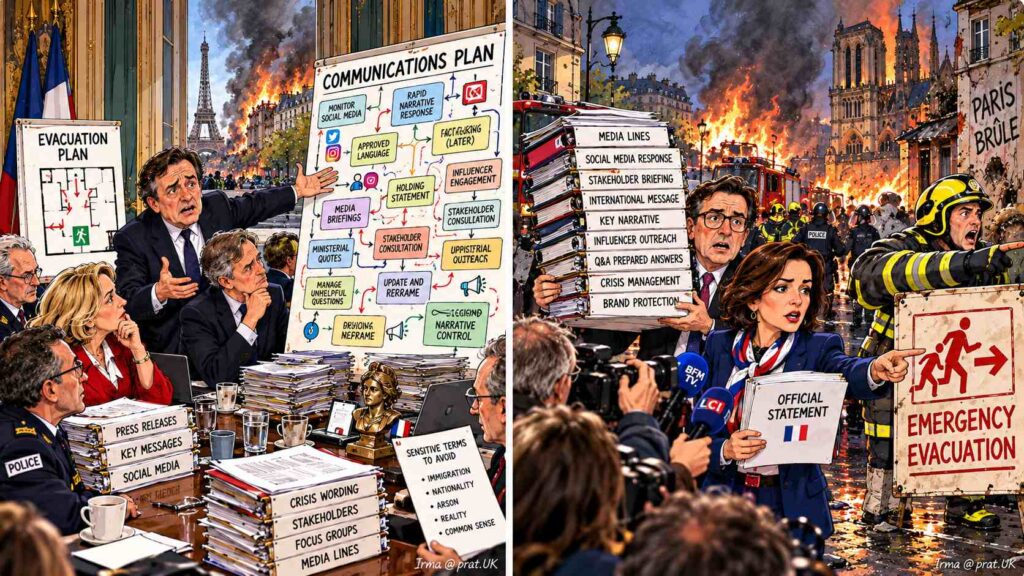
One proposed communications strategy would discourage the public from speculating about the backgrounds of suspects before investigators establish the facts. This is reasonable. The difficulty begins when political caution becomes an excuse for avoiding verified information or serious policy evaluation.
If an offender is French, say so. If an offender is a foreign national, say so. If an immigration-enforcement failure contributed to a preventable crime, investigate it. If there is no such connection, establish that too. This straightforward approach has the advantage of treating citizens as adults. It has the disadvantage of making politicians answer questions.
A communications adviser warned that transparency could encourage inappropriate public debate. Another argued that debate should be postponed until everyone had agreed on its conclusions. A third proposed setting up a National Council for Responsible Questions, empowered to identify which questions could safely be answered and which should instead receive a lecture about solidarity.
The council would require 400 staff members, a Paris headquarters, an annual conference and a dedicated department responsible for explaining why public confidence had declined. Catering was budgeted separately, and generously.
A municipal representative suggested simply publishing accurate information promptly. The consultants regarded this as a direct threat to employment.
French Firefighters Propose Stopping the People Starting the Fires
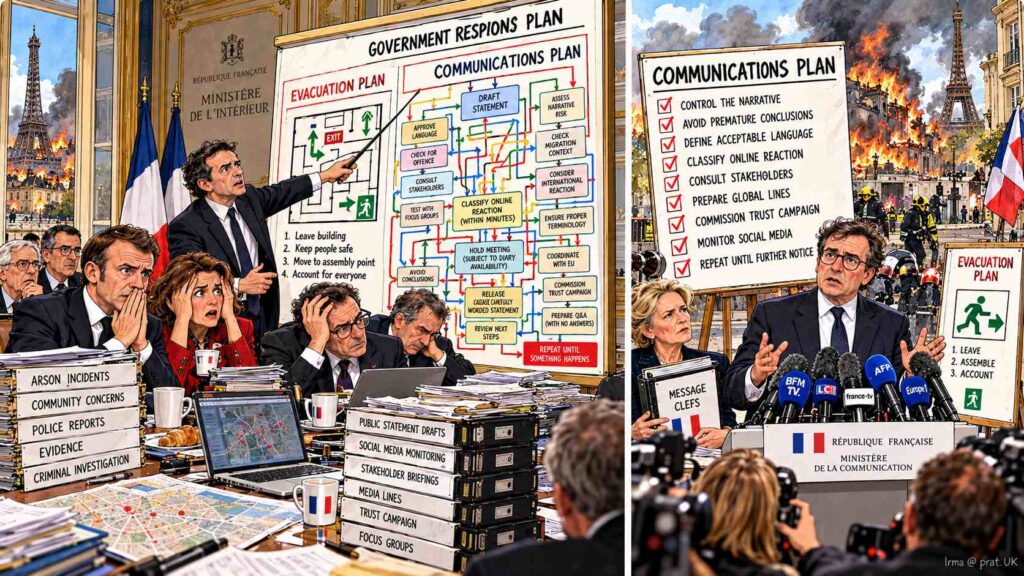
By the end of the exercise, ministers had produced a communications plan, a public reassurance strategy, an inclusion framework, a review of acceptable language and a draft announcement promising decisive action. The evacuation plan remained incomplete.
A firefighter asked whether his colleagues could at least proceed with extinguishing the simulated blaze. The communications director explained that the situation needed to be approached holistically. The firefighter asked whether water remained an acceptable substance. Nobody had consulted the relevant stakeholders.
At this point, the caretaker removed the lighter from the exercise’s mock offender and called security. The resulting administrative dispute lasted considerably longer than the incident itself.
The communications team criticised the caretaker for acting without consulting the appropriate department. The caretaker explained that he had seen somebody preparing to set fire to a building and had therefore stopped him.
A ministerial adviser warned that such an approach risked establishing an unfortunate precedent. If every public employee began solving obvious problems without asking permission, the government might eventually have to explain why it employed so many consultants.
France Needs Fewer Excuses and More Consequences
The central political question is not whether every immigrant is responsible for France’s disorder. Clearly, that would be absurd. Many immigrants are residents, parents, employees, business owners and taxpayers with exactly the same interest in safe streets as everybody else. Nor does a photograph of a burning school establish the nationality of the person responsible. France’s statistics agency INSEE counts an immigrant as a person born abroad as a foreign national, and keeps counting them as an immigrant after they become French. The category is not a synonym for “foreigner.” Neither is it a synonym for “suspect.”
The question is whether France’s politicians can discuss public safety, integration, immigration enforcement and their own policy choices without treating political embarrassment as a national emergency.
France’s own official investigations into the 2023 riots found that most convicted offenders were French nationals. That makes the challenge of public order, integration, education and criminal accountability more complicated, not less important. A country cannot solve these problems merely by declaring every concern illegitimate. Nor can it solve them by blaming millions of peaceful people for crimes committed by particular offenders.
What it can do is enforce the law, investigate honestly, publish evidence and judge policies by their results rather than by the sincerity of the politicians who announced them. This is the sort of practical programme that rarely survives a government communications meeting. It contains no new ministry. It establishes no national awareness week. It requires no television advertisement featuring a smiling politician walking through a recently repaired classroom.
Worst of all, it would allow voters to compare political promises with actual outcomes.
At the end of the emergency rehearsal, ministers announced that France would adopt a zero-tolerance approach to violence. The phrase was welcomed enthusiastically until somebody asked what zero tolerance meant. Officials explained that it meant the government would tolerate absolutely no violence, except insofar as individual cases required contextual assessment, ministerial consultation, proportional messaging and a detailed consideration of the wider social environment.
The firefighter asked whether this meant an arsonist would be arrested. The communications director said a written answer would follow. The caretaker checked the exits.
And somewhere in France, a taxpayer was preparing to pay for the same school for the third time.
The flames may eventually be extinguished. The politicians’ excuses appear to have an unlimited fuel supply.
Humorous Observations on the French Unrest
- Apparently there are acceptable fires and inconvenient fires. The difference is whether the suspect needs an interpreter or the minister needs a new paragraph. The building burns at the same temperature either way. A firefighter checked. Nobody asked him.
- The French taxpayer paid to build the school. Now they pay to rebuild it. Then they pay for a public awareness campaign explaining why asking who burned it down is unhelpful. It’s the only subscription service where you can’t cancel and the product is on fire.
- The left loves a root-cause investigation, as long as it never reaches the roots. It starts in the eighteenth century and stops, very carefully, one election ago. They’ve dug all the way down to Louis XVI and somehow missed last Tuesday.
- If a French citizen commits arson, politicians demand prosecution. If a foreign national does it, certain politicians suddenly discover “context.” Context is a lovely thing. It doesn’t lower the fire’s temperature, though. The school burns exactly as hot whatever the footnotes say.
- The ministers propose a national dialogue with the people setting the fires. The firefighters propose a more traditional opening statement: “Put the bloody petrol down.” One of those is a negotiating position. The other is a conference with a buffet.
- They say rebuilding public confidence takes a bigger communications budget. The residents say maybe rebuild the school. The consultants say bricks don’t improve ministerial approval ratings, which is true. Nobody has ever tweeted, “What a beautiful gymnasium, vote for him.”
- The government promises zero tolerance for violence, then immediately explains the conditions under which zero becomes negotiable. Zero tolerance, unlimited exceptions, and the taxpayer covers the difference. That’s not zero. That’s a tab.
Disclaimer: This article is political satire. The ministerial meetings, communications officials and dialogue are comic scenarios. The reported episodes of French unrest and damage to public property are grounded in published reporting, but specific crimes cannot be attributed to immigrants or any nationality without supporting evidence. The editorial legend behind this exercise in human absurdity features two sentient collaborators: the world’s oldest tenured professor and a philosophy major turned dairy farmer.

Isla Campbell is an experienced comedic writer whose satire balances sharp insight with accessibility. Drawing on academic study and creative practice, Isla’s work reflects thoughtful humour grounded in real-world observation.
Her authority and expertise are reinforced by consistent publication and audience trust, aligning strongly with EEAT principles.


