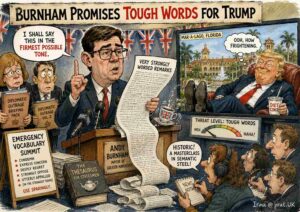
Prime Minister Promises Tough Words for Trump Following Full Impact Assessment of Tough Words
Britain Will Issue Strong Statement Once Treasury Calculates Effect on Exports, Sterling and Canapé Supply
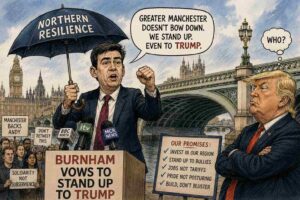
LONDON, England — Prime Minister Andy Burnham has promised to use tough words against President Donald Trump whenever necessary, but only after Whitehall completes a comprehensive assessment of whether each adjective could affect trade, defence contracts or the availability of miniature sausage rolls at the British Embassy.
Burnham says he will call out Trump when doing so serves Britain’s interests. He has argued that every leader must defend the national interest and has indicated that Britain will not simply follow Washington on every issue.
Testing the Vocabulary of Diplomacy
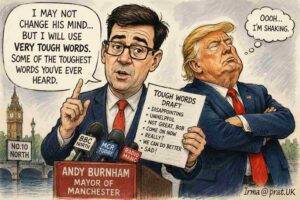
Government linguists are now testing several phrases.
“Unhelpful” is considered safe.
“Regrettable” may reduce market confidence by 0.2%.
“Wrong” requires Treasury approval.
“Absolutely wrong” has been placed in a secure cabinet beside Britain’s independent foreign policy.
Inside the Cabinet Office Tough Words Unit
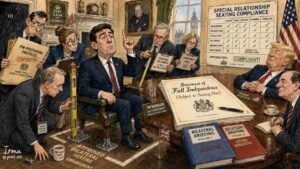
The Cabinet Office Tough Words Unit evaluates diplomatic language through a 19-stage process.
First, officials draft a sentence.
Second, the Foreign Office removes the sentence.
Third, the Treasury asks what the sentence costs.
Fourth, the Ministry of Defence asks whether America sells a replacement sentence.
The final statement then reads, “The United Kingdom continues to engage closely with our partners.”
Retired Ambassadors Recall Britain’s Fiercest Rebukes
A Bohiney survey of retired ambassadors found that a strong British diplomatic rebuke consists of using the word “frank” in a room where no journalists are present.
One former envoy recalled the most severe exchange of his career.
“I told an American official that Britain viewed the matter with some unease,” he said. “He finished his steak.”
Sovereignty Is Popular Until It Costs Something
Burnham’s willingness to disagree could mark a change in tone. Britain often faces criticism for appearing excessively deferential to US presidents, yet the countries maintain deep security, intelligence, economic and cultural ties that make theatrical hostility unwise.
The prime minister must therefore balance sovereignty with practical cooperation.
This is difficult because sovereignty is most popular when it is free.
British voters enjoy seeing national leaders display independence, but they also enjoy American investment, intelligence cooperation and inexpensive consumer goods delivered by companies paying tax in countries nobody can locate.
A Pub Argument Backed by Nuclear Submarines
Trump’s approach intensifies the challenge. He favours direct bargaining, public pressure and visible demonstrations of loyalty. Burnham presents himself as a plain-speaking northern politician willing to defend British interests.
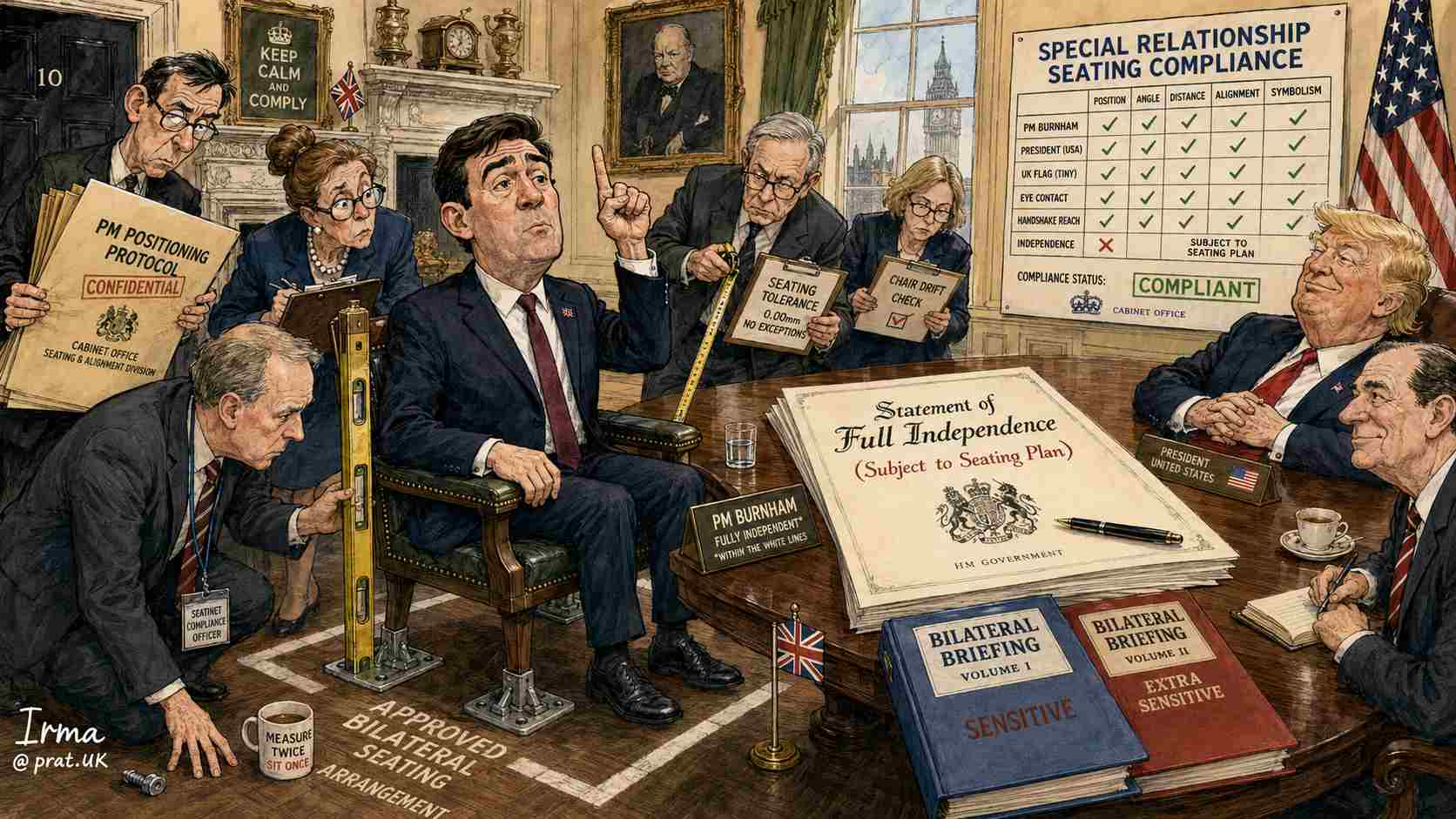
Their meetings may resemble a pub argument conducted by men accompanied by nuclear submarines.
Defence Spending: Trump Says More, Treasury Says Less
Possible disagreements include foreign policy, defence expectations and trade demands.
Defence spending could place Burnham between Trump and the Treasury, traditionally regarded as Britain’s two most persistent negotiating partners.
Trump may say, “Spend more.” The Treasury may say, “Spend less.”
Burnham must then announce that Britain will spend more efficiently, a phrase meaning everyone receives a new logo.
The Special Relationship as a Large Dog and a Small Dog
Trade creates another complication. A prime minister cannot treat every disagreement as a moral showdown when thousands of jobs may depend on practical relations.
However, avoiding every disagreement creates the impression that the special relationship is special in the way a large dog’s relationship with a smaller dog is special.
The smaller dog may bark. The larger dog controls the sofa.
Political advisers are coaching Burnham in safe confrontation techniques. He may challenge Trump on principle while praising him personally, disagree with the policy while celebrating the partnership and defend Britain’s independence while standing beneath an American flag large enough to cover Wales.
The first impact assessment is expected to conclude that tough words are affordable when delivered quietly, after markets close and immediately before a royal photograph.
Burnham insists Britain will speak for itself.
Whitehall agrees completely. It merely wants to approve the vocabulary first.
Humorous Observations on the Tough Words Unit
-
Britain speaks for itself. After vocabulary approval, markets close, and a royal photo. The 19-stage vocabulary process is reportedly two stages longer than approving a new runway.
- “Regrettable” is said to trade on the Treasury’s internal market somewhere between the pound and a strongly worded tweet.
- The retired ambassador’s steak reportedly finished before the special relationship did.
- Officials confirm the flag large enough to cover Wales was originally ordered for a football tournament and simply never returned.
- “The United Kingdom continues to engage closely with our partners” has now been the final line of every government statement since approximately 1973.
Disclaimer: This is satire based on Burnham’s promise to defend British interests in dealings with President Trump. The Tough Words Unit remains unlisted in the government directory. This piece is part of an ongoing series of British satirical news and satirical journalism produced for a UK audience. This report is entirely a human collaboration between two sentient beings: the world’s oldest tenured professor and a philosophy major turned dairy farmer.
More UK satirical news at The London Prat.
Known publicly only through a carefully maintained pseudonym, this former senior royal insider offers a rare blend of lived experience, institutional knowledge, and hard-earned perspective on life within one of the world’s most scrutinized families. Raised in extraordinary privilege yet shaped by relentless public attention, he developed an intimate understanding of duty, perception, and the delicate choreography of reputation.
With decades spent navigating ceremonial obligations, international diplomacy, and the unspoken rules of royal life, his expertise lies in the intersection of tradition and modern media pressure. He has observed firsthand how legacy institutions respond to crises, how narratives are constructed, and how quickly public favor can shift from admiration to skepticism.
His insights are informed not only by access, but by consequence. Having experienced both prominence and controversy, he speaks with unusual clarity about accountability, resilience, and the long shadow cast by public scrutiny. Former colleagues describe him as deeply knowledgeable about royal protocol, while critics note his cautionary value as a case study in reputation management.
Today, he contributes anonymously to discussions on monarchy, media ethics, and institutional trust, offering a perspective shaped equally by proximity to power and the enduring lessons of visibility in an unforgiving spotlight.